Table of contents
- How to Date Old Watch Fobs
- What Exactly Is a Vintage Pocket Watch Fob?
- Anatomy of a Fob Chain, T-Bar, and Ornament
- Reading Hallmarks to Date Vintage Pocket Watch Fobs
- What the Hallmark Numbers Actually Tell You
- Beyond the Stamp
- Spotting Georgian, Victorian, Edwardian, and Art Deco Fobs
- Dating Advertising, Fraternal, and Commemorative Fobs
- Brass, Celluloid, Gold, and the Honey-Gold Era
- How to Spot a Modern Reproduction Before You Overpay
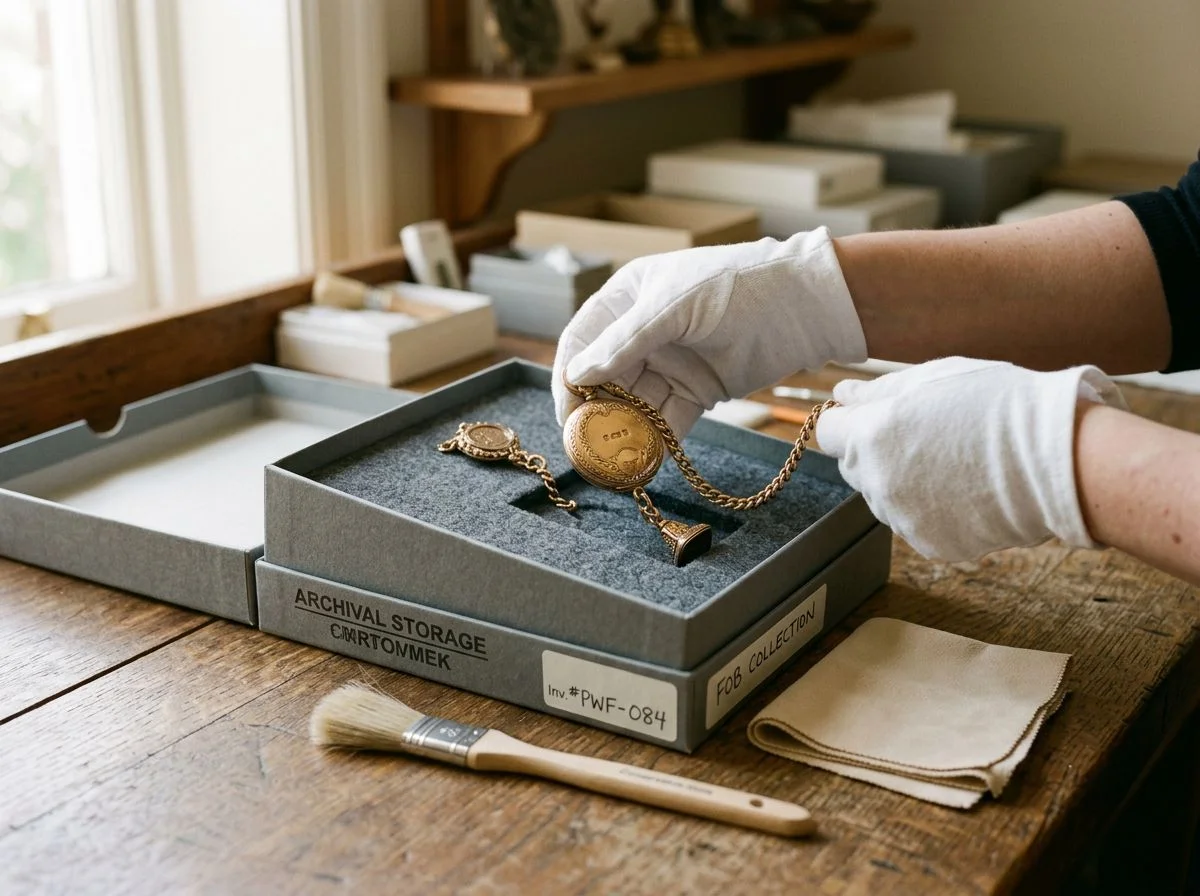
- Cleaning, Preserving, and Storing Your Fob
- Vintage Pocket Watch Fob Questions Answered
How to Date Old Watch Fobs
Dating a vintage fob comes down to three things: hallmarks, materials, and design era. Read the marks first. They’ll narrow your window to a decade or less. Then let the metal and the decorative style confirm what the stamps are telling you.
The single most useful dating trick I’ve learned is the 15ct gold mark. If you find “15ct” or “15k” stamped on a fob, you’re holding something made between 1854 and 1932 — no exceptions. That purity was only used during that specific window, which makes it a gift for authentication. After 1932, it disappeared entirely.
For the rest, material tells you a lot. Victorian-era fobs were commonly brass or nickel-plated brass. Celluloid inserts were genuinely rare. Gold came in 9ct, 15ct, and 18ct purities. 9ct was the workhorse of the Victorian and Edwardian periods. 18ct examples are scarce enough to command real money.
One caution: if you see an advertising fob stamped “sterling silver,” be suspicious. Most are modern reproductions, not period pieces. The originals were usually brass. The sterling stamp is a red flag, not a selling point.
Beyond marks, think about when the design language fits. Georgian fobs were ornate status symbols with seals and intaglios. By the early 1800s, that elaborate masculine jewelry had largely given way to simpler, utilitarian chains. Art Nouveau brought flowing organic lines. Art Deco went geometric. If a fob’s decoration doesn’t match its claimed era, walk away.
I’ll admit — I’ve been burned by a “sterling” advertising fob myself. Looked great in the case, felt wrong in the hand. The marks didn’t lie. I just didn’t read them carefully enough.
What Exactly Is a Vintage Pocket Watch Fob?
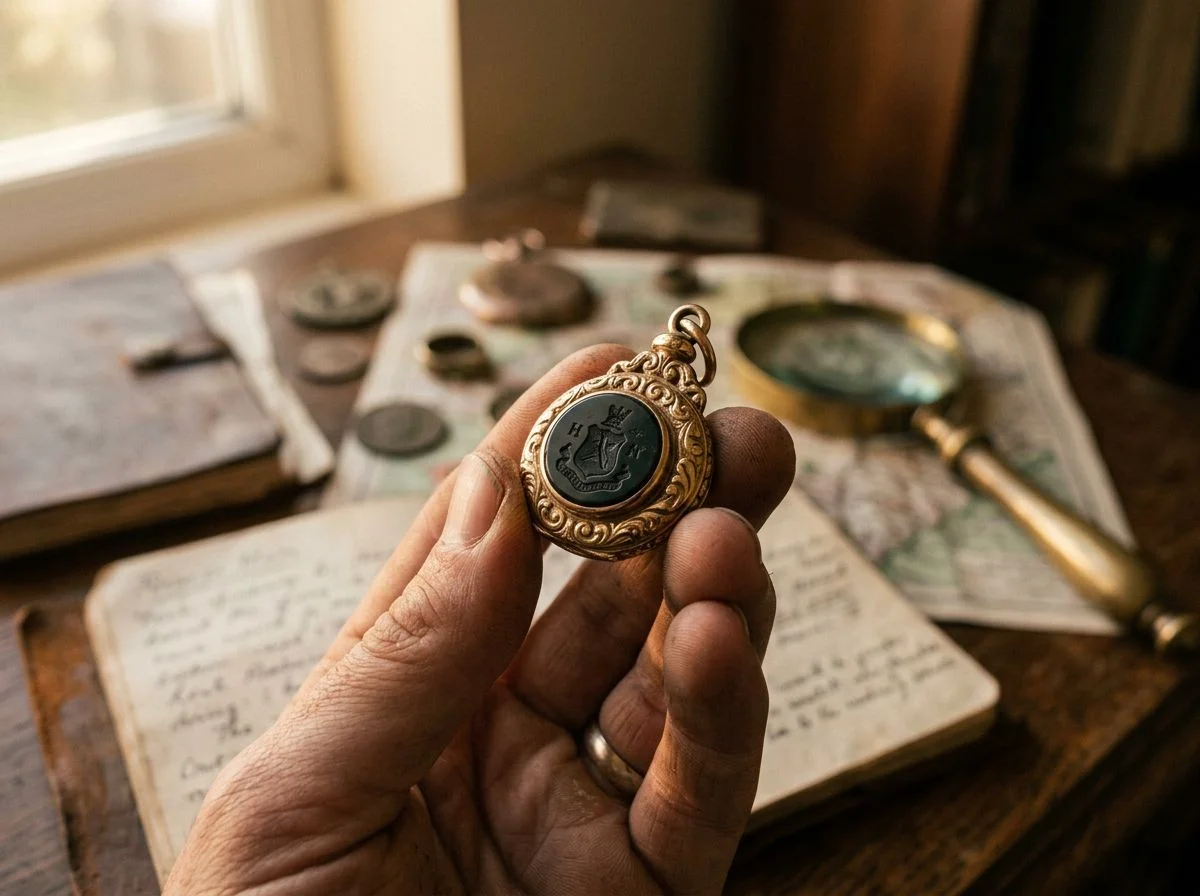
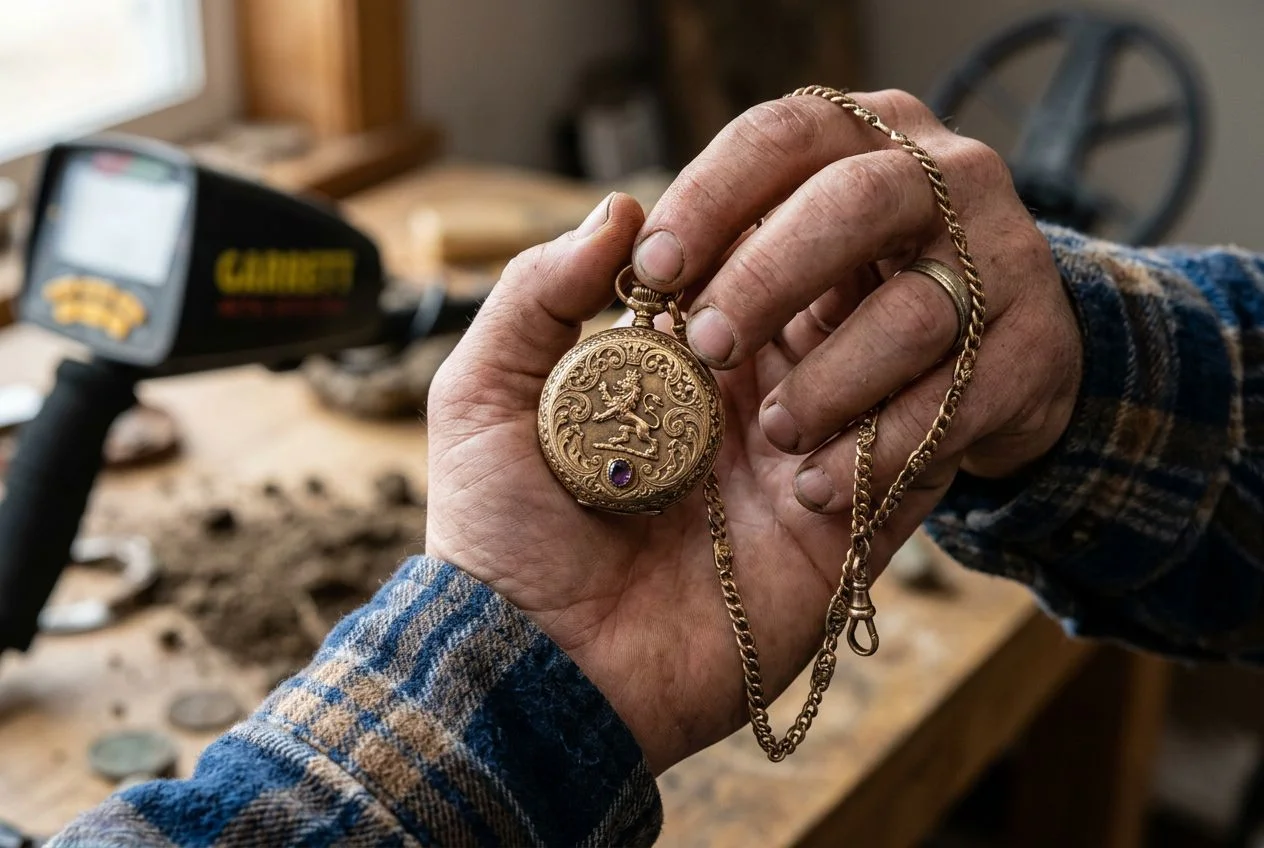
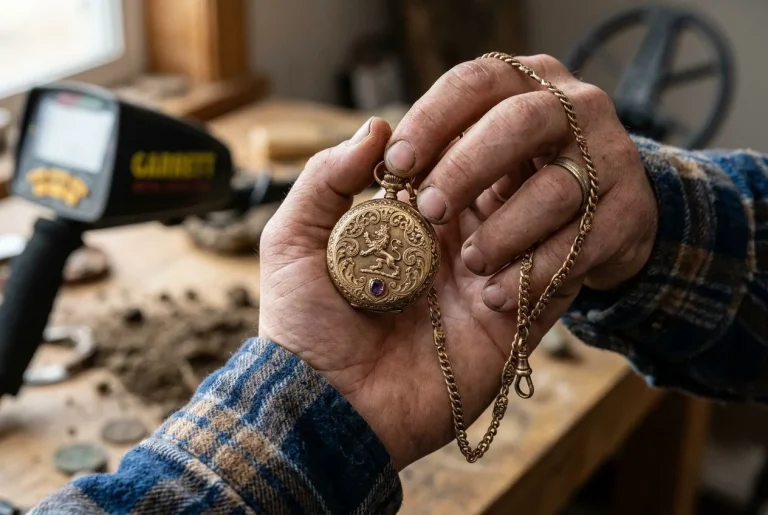
A watch fob is the small pocket in a waistcoat where a pocket watch lived. Later, it came to mean the chain, ribbon, or ornament attached to that watch. The word comes from the German fuppe, meaning “small pocket”. The term as we use it today only dates to about 1888.
Here’s the problem: most sellers use “fob” to mean whatever they’re holding. What’s the difference between a fob, a chain, and an Albert? If you can’t answer that in one sentence, you’re about to overpay for something mislabeled on eBay. Trust me — I’ve watched it happen at club meetings more times than I can count.
The confusion started in 1675. That’s when Charles II introduced waistcoats to English fashion. Gentlemen suddenly had a secure pocket for their new rounded, flat timepieces. That pocket was the original “fob.” Over time, the word drifted. By the late 1800s, “fob” meant three different things depending on who was talking. It could be the pocket itself, the chain or ribbon attached to the watch, or the decorative medallion hanging from that chain.
So when you’re holding a vintage piece and trying to date it, the first question isn’t “how old is this?” It’s “which part am I actually holding?” Get that wrong and you’ll date the chain as a fob. Or the fob as a watch. Or you’ll pay Albert-chain money for a repurposed guard chain. The terminology isn’t pedantry — it’s the difference between a bargain and a mistake.
Anatomy of a Fob Chain, T-Bar, and Ornament
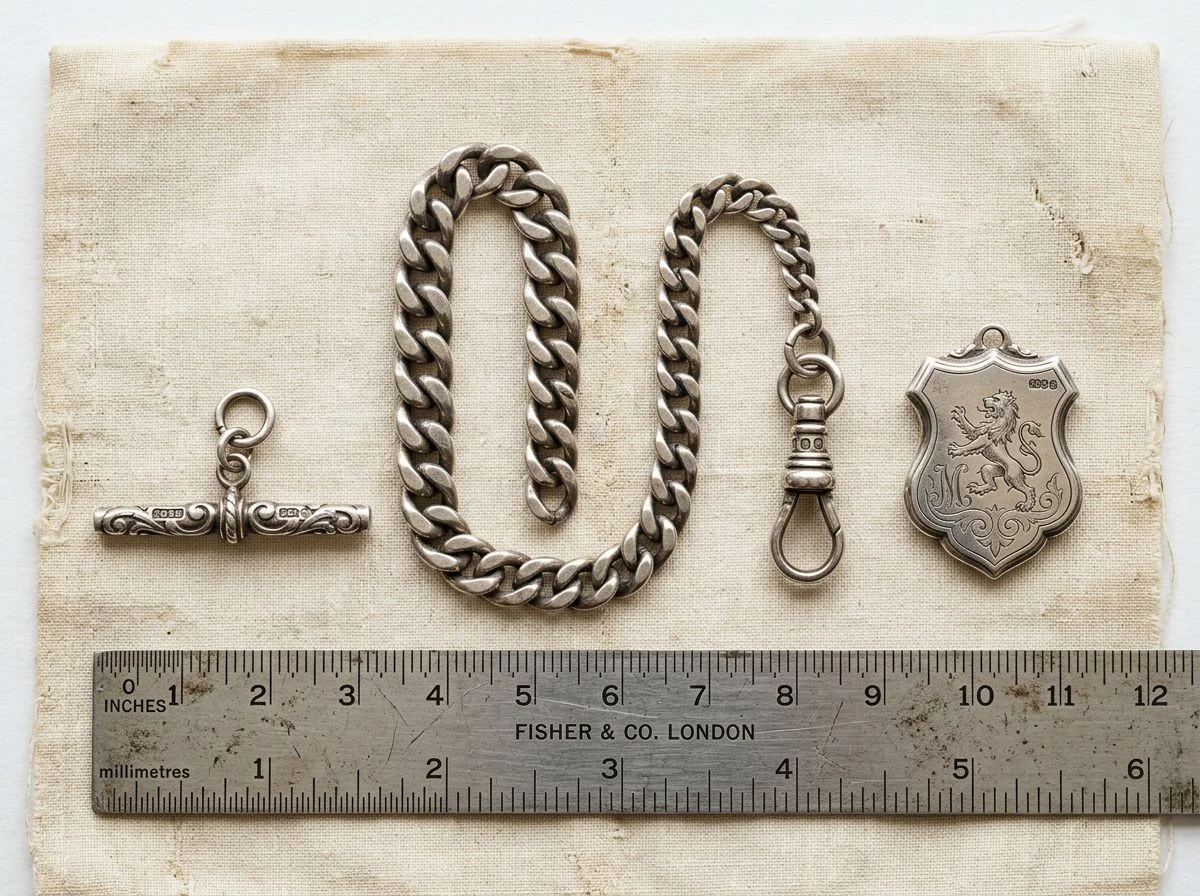
A vintage fob isn’t one object. It’s a system of connected parts, and each part has its own dating story. The chain, the T-bar, and the hanging ornament all evolved separately. That means you can often date a piece by identifying which components are original and which were added later.
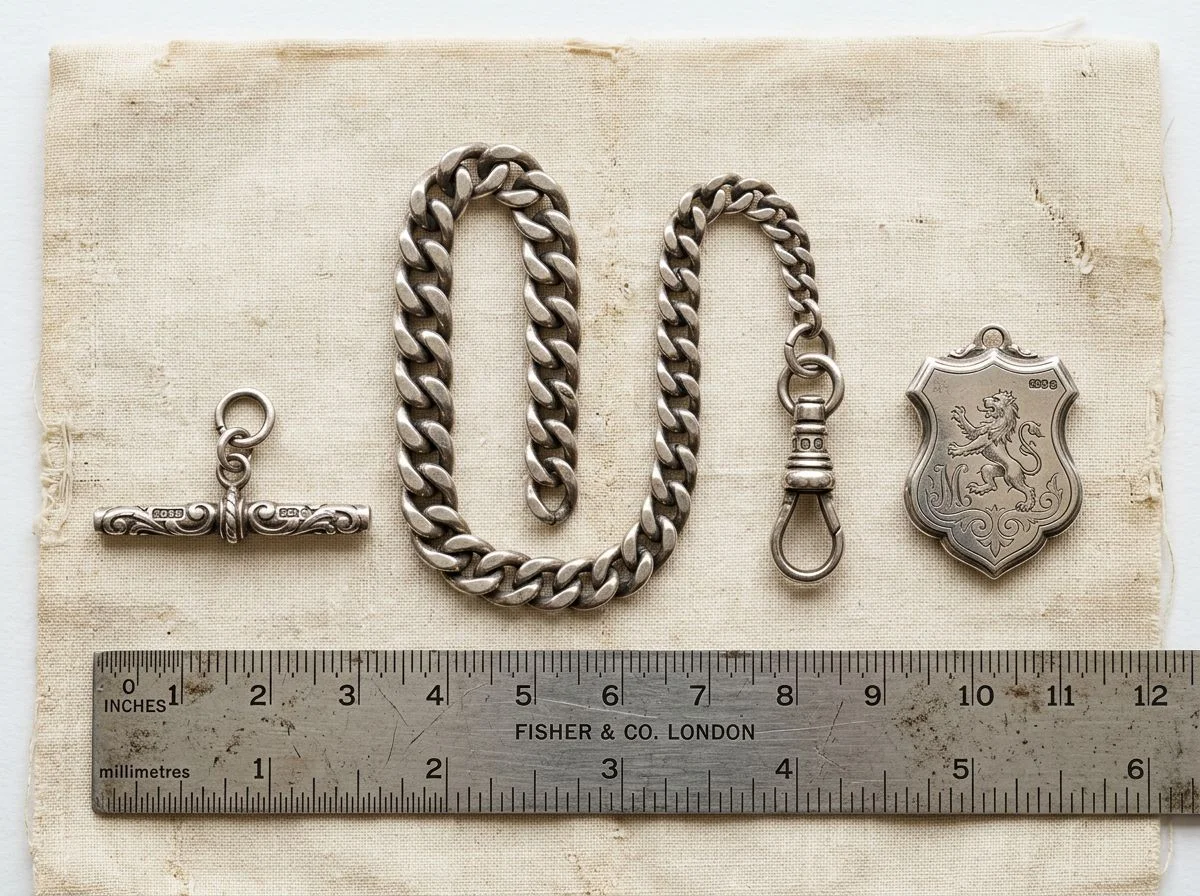
The most famous chain style is the Albert chain, named after Prince Albert, Queen Victoria’s consort. It featured a T-bar designed to secure the chain to a waistcoat buttonhole. That bar wasn’t decorative. Its whole job was preventing the heavy timepiece from falling out of the pocket. When you’re looking at a chain with a T-bar, you’re looking at an Albert. When the T-bar is missing, things get murkier.
I learned that lesson the hard way. My first “Albert chain” came from a flea market outside Sacramento for what I thought was a steal. Beautiful links, nice patina, felt substantial in the hand. I showed it off at the next club meeting like I’d pulled a seated Liberty dime. Mike took one look and said, “Where’s the T-bar?” Turned out I’d bought a repurposed Victorian guard chain. Lighter, designed for a lady’s watch, and missing the very part that would have made it an Albert at all. The seller hadn’t lied exactly. He just let me believe what I wanted to believe.
Chain materials varied wildly. Gold, silver, ribbon, leather, or braided human hair were all used. During the Victorian era, hair chains from a spouse were genuinely popular. Romantic, sure — but try finding one of those intact after a century in the ground.
Reading Hallmarks to Date Vintage Pocket Watch Fobs
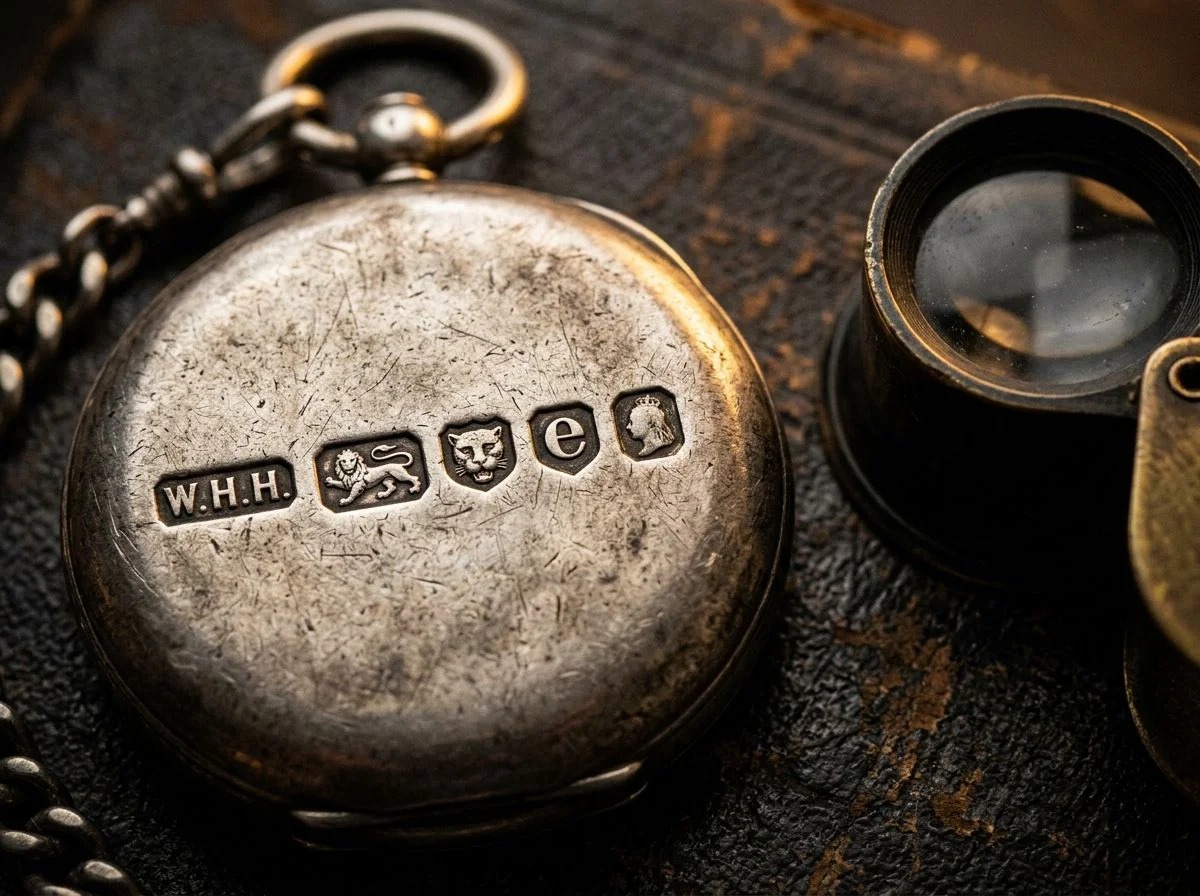
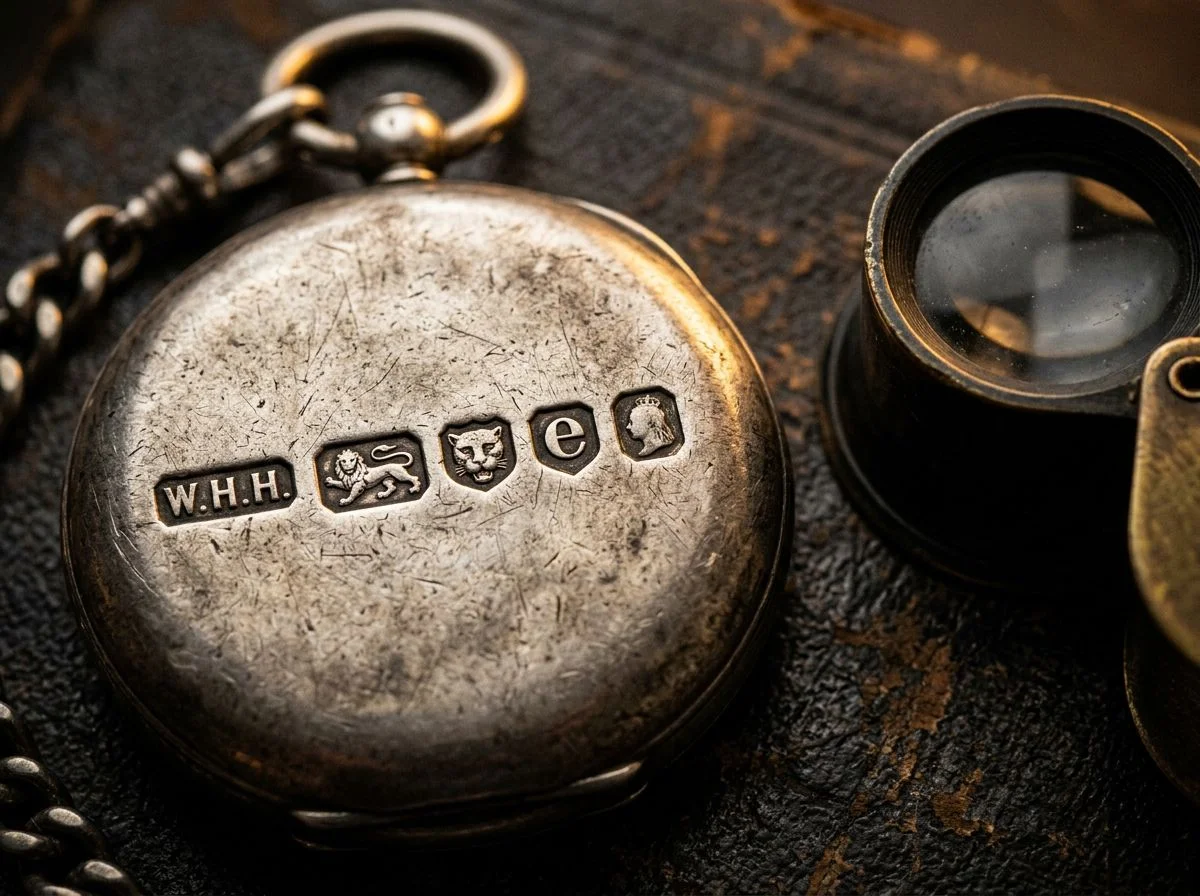
The fastest way to date a gold fob is to read its hallmarks. Specifically, the carat stamp. If your fob is stamped 15ct, it was made between 1854 and 1932. That’s a 78-year window that instantly rules out Georgian and modern pieces.
Here’s why this works. Gold purity marks weren’t standardized overnight. They shifted as British law changed. The 15ct standard existed only during that specific period. That makes it one of the most reliable dating indicators you’ll find on a chain or fob. TheNorthC’s guide on antique pocket watch chains notes that gold chains are most commonly found in 9ct, 15ct, and 18ct purities. That 15ct mark is your shortcut to “definitely antique.”
What the Hallmark Numbers Actually Tell You
9ct gold was the workhorse of the Victorian and Edwardian eras. It’s the most common purity you’ll encounter. That means it’s also the most commonly misrepresented. Sellers love calling 9ct “Victorian gold” without mentioning that 9ct remained legal long after Victoria died. The stamp alone gets you to “probably 1854–1920s.” You’ll need other clues — chain style, clasp design, wear patterns — to narrow it further.
18ct gold is a different story. Far rarer in fob chains, and far more valuable when you find it. If you’re holding an 18ct fob, the odds are good it was a commission piece or something made for someone with money. That changes how you approach the purchase — and how carefully you should check for reproductions.
Silver marks follow their own logic. British sterling carries a lion passant, date letters, and assay office marks. Those can pin a piece to a specific year. American silver is messier. “Sterling” or “coin silver” stamps lack the same rigor. I’ve pulled enough silver fobs from antique store cases to know that “sterling” on a fob means less than the full set of British marks would.
Beyond the Stamp
Hallmarks get you started, but they’re not the whole story. Reputable dealers authenticate these pieces using gold testing, hallmark identification, and historical context clues about materials and craftsmanship. That third piece — context — matters more than most beginners realize. A 15ct stamp on a chain with a modern lobster clasp? Something’s been altered. A 9ct stamp on a fob with Victorian-era link construction and period wear? That’s a coherent piece.
The mark tells you when the metal was legal. The construction tells you whether the piece you’re holding is actually from that era — or a Frankenstein assembled from old parts and new findings.
Spotting Georgian, Victorian, Edwardian, and Art Deco Fobs
Would you be able to tell a Georgian fob from an Edwardian one at a glance? The difference comes down to one word: restraint. Georgian fobs are heavy, ornate, and unapologetically decorative. Edwardian pieces are lighter, finer, and built around elegance rather than ornament. Once you know what to look for, the era reveals itself almost immediately.
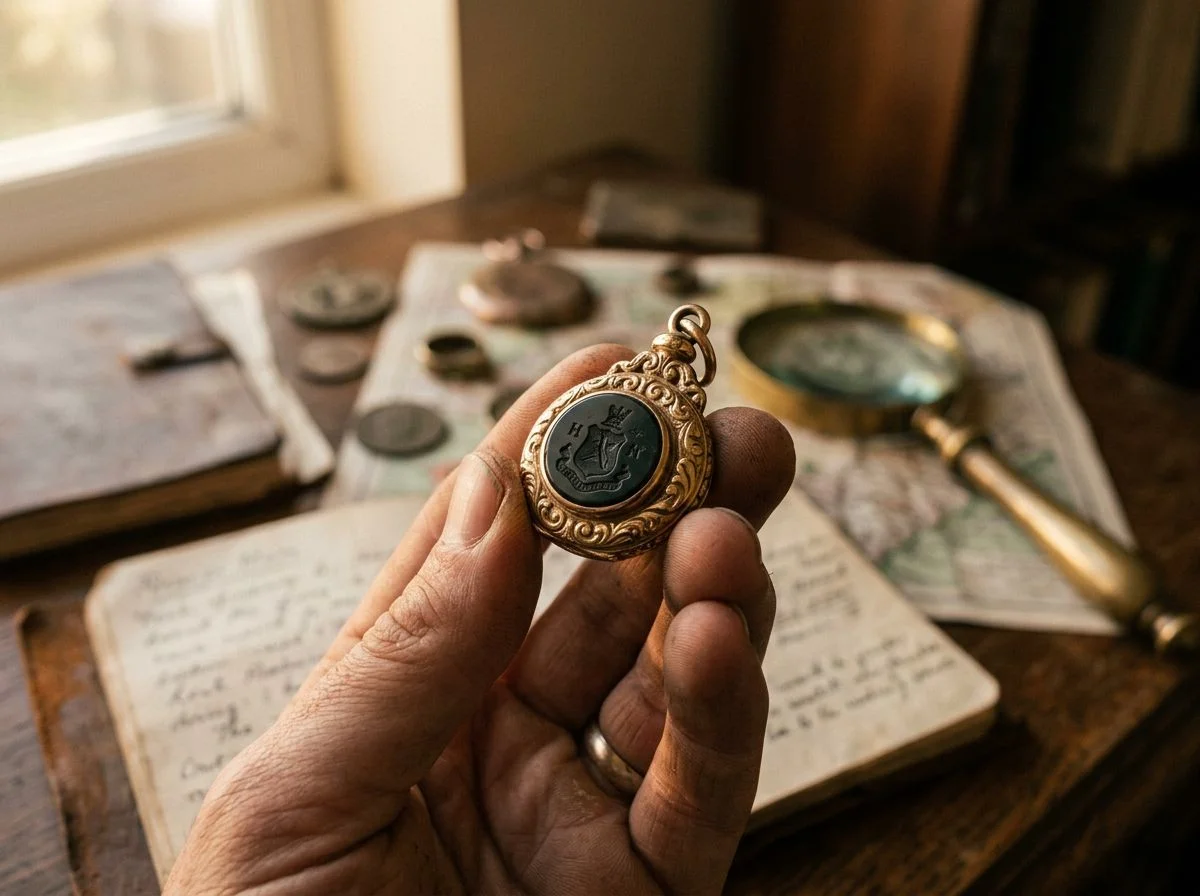
Georgian (1714–1837) fobs are the show-offs of the bunch. Think chains supporting decorative seals, chunky links, and a general sense of “look at me.” Around 1772, men started carrying two watches in their waistcoat fob pockets. One was often a non-functioning false timepiece, purely for display (Encyclopædia Britannica). That tells you everything about the Georgian mindset. The fob wasn’t just functional. It was masculine jewelry at its most elaborate. But by the early 19th century, that fashion had largely passed. It was replaced by simpler, utilitarian chains that did their job without demanding attention.
Victorian (1837–1901) fobs split the difference. Early Victorian pieces carried some Georgian weight. But the era’s real signature was sentimentality. Hair chains from a spouse, mourning fobs, lockets holding photographs. The Albert chain dominated. Practical, but still decorative enough to feel personal. Victorian fobs tell stories. Georgian ones just flexed.
Edwardian (1901–1910) is where restraint really arrives. Designs shifted toward lighter, more refined aesthetics. Finer links, delicate engraving. An Edwardian fob in your hand feels almost fragile compared to its Georgian ancestor. That’s not a flaw — it’s the point.
Art Deco (1920s–1930s) brings geometry. Clean lines, bold symmetry, platinum and white metals. Fob chains span Georgian, Victorian, Art Nouveau, Edwardian, Art Deco, and Retro periods. But Deco is the easiest to spot from across a room. If it looks like it belongs on a skyscraper, it’s Deco.
The progression is a straight line from excess to efficiency. That line is your best dating tool.
Dating Advertising, Fraternal, and Commemorative Fobs
A Jimmy Carter campaign fob can’t be from 1904. Sounds obvious, but collectors routinely misdate advertising fobs by decades because they never check the content. If the fob advertises a product, candidate, or event, the content itself gives you a hard “no earlier than” date. Often a tight window.
Most fobs fell into three categories: simple (initials or state seals), fraternal (military or labor unions), and advertising (Collectors Weekly). Each category carries its own dating logic.
Political fobs are the easiest to date because the timeline is well documented. They became popular campaign items starting with William Henry Harrison’s campaign in 1888. They peaked during the 1904 and 1908 elections, when over 100 styles were produced for William Jennings Bryan and William Howard Taft (Farm Collector). That’s a narrow 20-year window for the golden age of political fobs. The final presidential watch fob was made for Jimmy Carter’s 1976 campaign (Farm Collector). So any political fob in your hand dates between 1888 and 1976. A dealer calling a McKinley fob “Victorian” is technically right — barely.
Advertising fobs work the same way. A Heinz Ketchup fob or Coca-Cola fob can’t predate the company’s founding. The design language of the logo often narrows it further. Industrial fobs depicting tractors or oil-field equipment are almost always early 20th century. That’s when those industries were booming enough to commission promotional pieces.
Fraternal fobs — military units, labor unions, fraternal orders — require a bit more research. But the content still anchors you. A fob marked with a specific infantry division or union local was made after that unit or local existed. Local fobs produced in limited numbers for events like the State Fair of Texas or the Wichita Commercial Club (Collectors Weekly) often carry the event year right on the piece.
The lesson: read the fob before you read the hallmarks. The content tells you when it could have been made. The hallmarks tell you when it was.
Brass, Celluloid, Gold, and the Honey-Gold Era
Materials are your fastest dating shortcut. Brass and nickel-plated brass dominate the market. Celluloid is genuinely rare. That distinctive honey-gold color only appears after 1900. Learn to read the metal, and you’ll catch most mislabeled fobs before you ever reach for a loupe.
Brass or nickel-plated brass fobs are the most common. That’s not a knock on quality. It reflects how these pieces were actually used. Most fobs were promotional, fraternal, or commemorative items produced in quantity, not heirloom jewelry. They were made from brass, nickel-plated metal, gold, platinum, leather, or fiberboard with celluloid inserts. The cheaper materials appear far more often because more of them were made.
Celluloid fobs are the exception that proves the rule. They’re rare. Partly because celluloid was fragile, and partly because fewer were produced to begin with. If you find one intact, you’ve got something worth a second look — and worth handling carefully.
Then there’s the honey-gold era. In the 1900s, a distinct honey-colored gold was created by mixing copper with yellow gold. It’s warmer than standard yellow gold, softer than rose, and immediately recognizable once you’ve seen it. If a fob has that specific tone, you know it’s early 20th century at the oldest. Nobody was alloying honey gold in 1880.
I learned the materials lesson the hard way at an estate sale a few years back. I found what I was sure was a gold fob. Rich color, convincing patina, the works. The price was fair, so I bought it. Got home, ran a magnet over it, and damn if it didn’t stick in one spot. The plating had worn through just enough to expose the brass underneath. The giveaway was invisible until you tested for it. A magnet costs nothing and saves you from paying gold prices for brass.
How to Spot a Modern Reproduction Before You Overpay
The short version: if an advertising fob is stamped “sterling silver,” it’s almost certainly a modern reproduction. Period advertising fobs were brass, not silver. Learn that one rule and you’ll dodge 90% of the fakes flooding eBay and flea markets.
Here’s why that rule works. Advertising fobs were promotional items. Mass-produced giveaways meant to put a company’s name in front of customers for pennies apiece. Collectors Weekly is blunt about it: advertising fobs stamped “sterling silver” are usually modern reproductions rather than authentic period pieces. No company in 1910 was handing out solid silver fobs with a ketchup logo on them. The economics didn’t work then, and they don’t work now. That’s exactly why the fakes stand out.
The second red flag is quantity. Authentic watch fobs are rare, one-of-a-kind items due to their age. If a seller has five identical “1908 Coca-Cola” fobs listed, or you see the same design pop up week after week at different booths, you’re looking at modern production. Real period fobs survived in small numbers. No two survived identically.
Then there’s the stamped brass category. Reproduction fobs in stamped brass are a known category of modern fantasy pieces. Old West themes, railroad motifs, saloon imagery — all manufactured to look aged. They’re not even good counterfeits of specific historical fobs. They’re invented designs meant to trigger nostalgia. They fool beginners constantly.
My rule of thumb: if the fob depicts something romantic — a cowboy, a steam locomotive, a saloon girl — and it’s stamped brass, assume it’s fantasy until proven otherwise. The real advertising fobs were for boring things like tractors, oil-field equipment, and state fairs. The fakes sell the myth, not the history.
Cleaning, Preserving, and Storing Your Fob
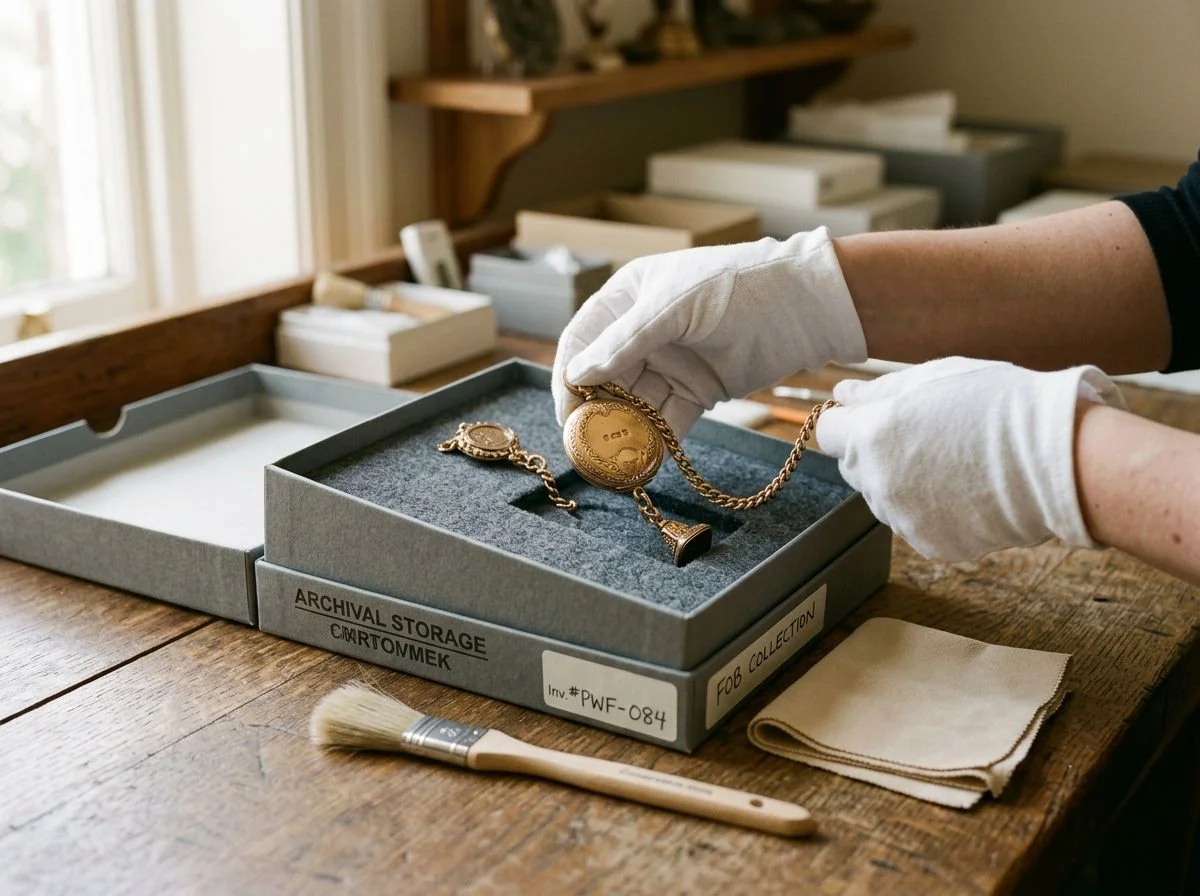
Should you polish a vintage fob? The answer depends on whether you’re preserving history or maximizing resale value. Those goals sometimes conflict. Collectors split hard on this. I’ve heard the argument at club meetings more times than I can count.
The short version: if you’re keeping the fob, do minimal cleaning. If you’re selling, leave it entirely alone and let the buyer decide.
For brass fobs, a soft toothbrush and mild dish soap in warm water removes surface grime without stripping the patina that took a century to build. I found a 1910s tractor advertising fob at an estate sale that looked nearly black. A gentle wash revealed the manufacturer’s name still crisp underneath. I stopped there. No polish, no buffing wheel. That dark background actually makes the raised lettering pop. Serious collectors want it that way.
Celluloid and fiberboard fobs are a different animal entirely. Fobs were made from materials including leather and fiberboard with celluloid inserts. These degrade in ways metal never will. Celluloid crazes, warps, and can even combust in extreme heat. Never soak these. Dry brush only. Store them away from direct sunlight and heat sources. I keep my celluloid pieces in individual acid-free sleeves inside a wooden box that lives in a closet — nowhere near a window.
One more thing that catches beginners off guard: braided human hair was a highly popular chain material during the Victorian era. It requires entirely different preservation than metal chains. Hair absorbs moisture, attracts pests, and frays if handled roughly. If you find a hair-work chain attached to a fob, store the assembly flat, padded, and dry. Don’t hang it. Gravity will eventually pull the weave apart.
For storage, silica gel packets are your friend. Toss one in whatever container you use and swap it out every few months. Humidity is the quiet killer of old metal.
Vintage Pocket Watch Fob Questions Answered
The short version: a fob is the ornament, and an Albert chain is what holds it. The fob is the medallion, seal, or advertising piece dangling at the end. The Albert chain is the actual chain with a T-bar that anchors to your waistcoat. Most eBay listings get this wrong. Learn the difference before you bid.
That question — “What’s the difference between a fob and an Albert chain?” — shows up constantly in r/pocketwatch threads. Honestly, it’s a fair confusion. The term “fob” dates back as far as 1888. It’s been used loosely ever since to mean the chain, the ribbon, or the ornamental piece attached to a pocket watch. Three different objects, one word. No wonder people mix them up.
Here’s the cleanest way I can break it down. The Albert chain is named after Prince Albert and has a T-bar at one end. That T cross bar was designed to prevent the heavy timepiece from falling out of a waistcoat pocket. You thread it through a buttonhole, and the watch stays put. The fob is what hangs from the opposite end of that chain: the decorative seal, medallion, or advertising piece.
Another question I get at club meetings: “Why are some fobs so plain?” Simple economics. Advertising fobs were giveaways. Companies ordered them by the thousands for a few cents each. A Heinz ketchup fob wasn’t jewelry. It was a walking billboard. The fancy stuff — gold seals, engraved monograms, hair-work chains — that was personal jewelry. It cost real money.
The last question worth addressing: “When did people stop wearing these?” Pocket watch and fob popularity declined during World War I with the rise of wristwatches. Trench warfare made a wrist-mounted watch far more practical than fishing around in a waistcoat pocket. By the 1920s, the fob was already becoming a collector’s item rather than an everyday accessory.

My name is Paul and I am the founder of Detector For Metal, a dedicated resource for metal detecting enthusiasts seeking to uncover historical treasures and connect with the past using the latest technology. As a stay-at-home dad and family man, I’ve found metal detecting to be the perfect hobby that combines family adventure with historical learnings for the whole family.
As a father, I’m deeply committed to passing on this hobby to the next generation of detectorists, starting with my own children. I share advice on everything from metal detecting with kids to exploring the top 10 metal detecting sites you never thought about. My methodical approach to the hobby goes beyond the thrill of discovery—it’s about creating family traditions while preserving history and sharing the stories of those who came before us.