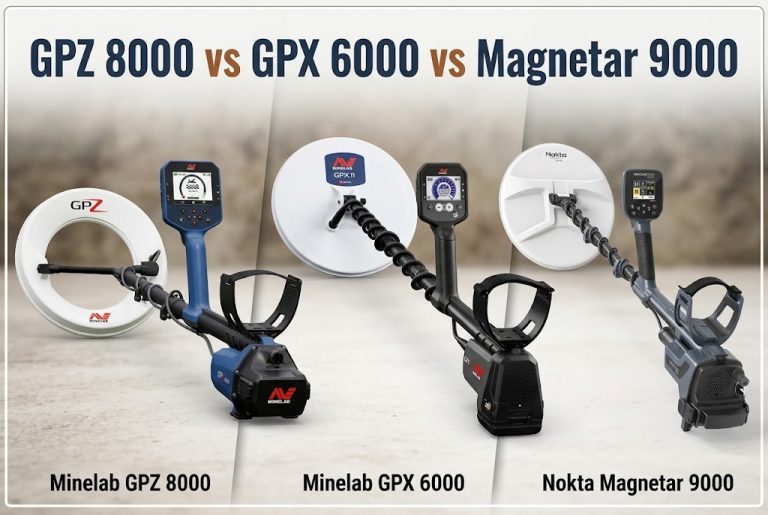
Three high-end gold metal detectors, one big question: should you buy the Minelab GPZ 8000, the GPX 6000 or the Nokta Magnetar 9000? This review comes from maker specs and field reports by experienced prospectors, not from my own time swinging these machines. I’ll flag what’s solid and what’s just one person’s story. (PI means pulse induction, and a pulse induction detector can handle ground that makes ordinary detectors scream. New to the hobby? Start with the basics of how metal detectors work.)
Here’s how the best high-end gold metal detectors of 2026 stack up:
- Nokta Magnetar 9000: the best value, at $4,999 with two coils in the box, though Nokta calls that price temporary.
- Minelab GPX 6000: the lightest, and the best PI detector for small gold nuggets thanks to its long track record. It lists at $6,999 with two coils.
- Minelab GPZ 8000: the deepest on medium-to-large gold, but at $9,999 it only earns its price once the 13″ and 17″ coils ship.
Prices and availability last checked October 13, 2026.
- GPZ 8000 Price and Weight Compared to GPX 6000 and Magnetar 9000
- Depth: Which Gold Prospecting Detector Finds Small and Large Gold Best?
- Weight, Waterproofing and Ease of Use: Which PI Metal Detector Is Easiest to Carry?
- Is the GPZ 8000 Worth the Money? Price, Coils and Value vs Magnetar 9000
- Which Gold Metal Detector Suits You? Picks by Budget, Ground and California
- FAQ: GPZ 8000, GPX 6000 and Magnetar 9000 Questions Answered
- Bottom Line: Which Gold Detector Should You Buy in 2026?
- Get Yours Now
GPZ 8000 Price and Weight Compared to GPX 6000 and Magnetar 9000
| GPZ 8000 | GPX 6000 | Magnetar 9000 | |
|---|---|---|---|
| US price | $9,999 (one coil); $11,999 three-coil pack, not confirmed shipping | $6,999 | $4,999 “limited time” (launched at $8,499) |
| Weight | 2.78 kg / 6.1 lb | 2.1 kg / 4.6 lb | 2.4–2.8 kg / 5.3–6.2 lb |
| Waterproofing | 1 m, under 30 min | Coils to 1 m; box rain-proof only | IP68, 3 m |
| Coils in box | 18″ Z18 | 11″ mono + 14″ DD | 11″×8″ + 14.5″×13″ DRC |
| Coil availability | 13″ and 17″ delayed | Mature ecosystem | Extra coils announced, not shipping |
| Small gold | Weaker with the 18″ | Best proven | Strong early reports |
| Large gold | Strongest in open ground | Good | GPZ 7000-class in early reports |
Depth: Which Gold Prospecting Detector Finds Small and Large Gold Best?
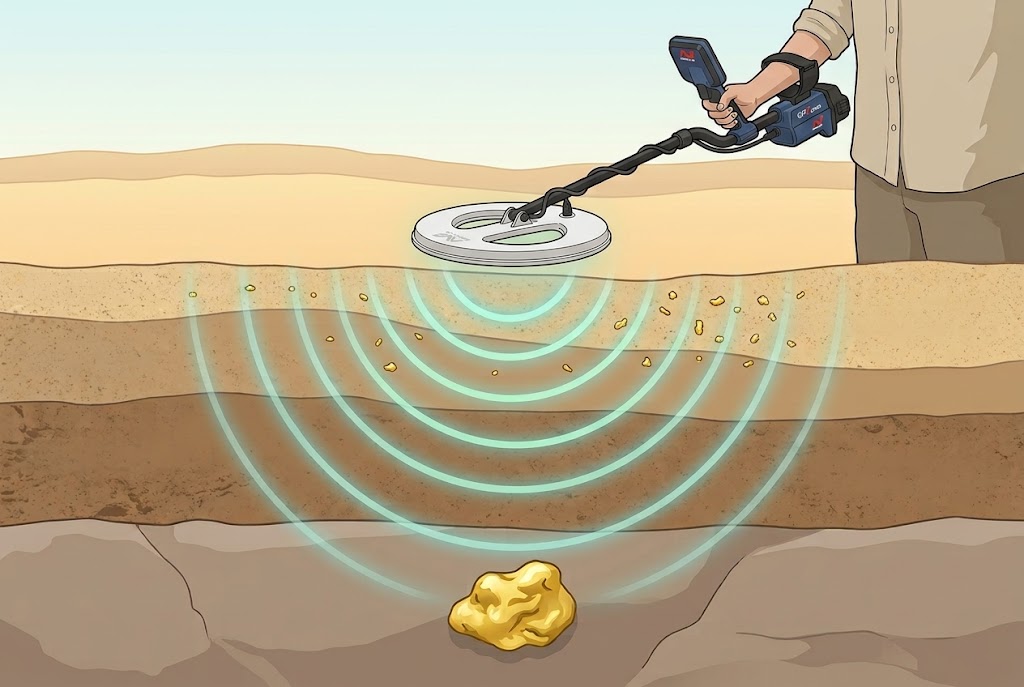
None of these makers publishes depth numbers, and any site that promises “2–3 meters” is selling something. Everything below is anecdotal, so the best pulse induction metal detector for gold in 2026 depends on the size of your nugget, not on one clear winner.
Here’s the tech in one line each:
- GeoZVT (GPZ 8000): Minelab’s zero-voltage-transmission system, made for deep, mineralized ground.
- GeoSense-PI (GPX 6000): Minelab’s self-tuning pulse induction, which is quick on tiny targets.
- DRC (Magnetar): a dual-receiver coil that reads two signals in one sweep, so it can chase small and deep gold at once.
Here’s the coil-size catch. Steve Herschbach, probably the best-known independent tester, ran the GPZ 8000 for about 30 hours in Nevada and the California High Sierra. He called it more evolutionary than revolutionary. He also pointed out that the 18″ coil has over twice the receive area of the stock GPZ 7000 coil, which flatters the new machine in launch comparisons. On tiny stuff, he says it “can’t hit small gold like a 6000 can”.
The GPX 6000 has owner reports of a 0.15 g nugget at about 13″ deep with the stock 11″ coil. The catch is noise, like more hot rocks and more EMI (electromagnetic interference, such as power lines).
In this Nokta Magnetar 9000 review for gold prospecting, the early reports are eye-opening. Herschbach rated it neck and neck with the GPZ 7000, and dealer Rob Allison called its depth “very close, if not equal.” One claim team reported 18″ on a 9 g nugget. Still, Nokta itself cites that thread, some users doubt how fast its auto ground balance tracks out hot rocks, and the machine has only about five months in the field. In a Nokta Magnetar 9000 vs Minelab GPX 6000 comparison, the Magnetar’s edge is reported depth, while the 6000’s edge is proof on small gold.
Weight, Waterproofing and Ease of Use: Which PI Metal Detector Is Easiest to Carry?
Over a 10-hour day, weight matters. And if you want a waterproof pulse induction gold detector, only one of these three is fully submersible.
- GPX 6000: It’s the only one that’s comfortable all day without a harness. The coils survive 1 m of water, but the control box is only rain-proof.
- GPZ 8000: It’s lighter than the GPZ 7000 but still needs a harness. Herschbach says a full day on rough ground without one would hurt. It’s waterproof to 1 m for under 30 minutes, and it dropped the GPZ 7000’s built-in GPS mapping.
- Magnetar 9000: It’s middle weight and rated IP68 to 3 m, with a built-in speaker and standard Bluetooth. Herschbach still took off a star for the bigger coil’s weight.
Is the GPZ 8000 Worth the Money? Price, Coils and Value vs Magnetar 9000

The Minelab GPZ 8000 costs $9,999 for a single 18″ coil. The $11,999 three-coil pack adds the 13″ and 17″ coils, which are meant to help with small gold, tight brush and noisy ground. The trouble is that Minelab’s April dealer notice said the three-coil pack would arrive in the “4th quarter 2026 at the earliest” and might slip into 2027. As of mid-October, US dealers still list it as backordered. Single-coil buyers get gap pricing on the other coils, but there’s no ship date.
Minelab GPZ 8000 vs Nokta Magnetar 9000 on value isn’t close. The Magnetar costs half as much and $2,000 less than the GPX 6000, and it comes with two coils, two batteries, Bluetooth headphones and a backpack. That price is officially “limited time,” and the extra coils Nokta announced haven’t shipped.
So, when is a $9,000 metal detector worth it? Only if all three of these are true:
- You have ground that likely holds gold your current gear can’t reach.
- You’ll put in the hours, because the detector doesn’t find gold, you do.
- The coil set you need actually exists. Right now, that’s the GPZ 8000’s weak spot.
Which Gold Metal Detector Suits You? Picks by Budget, Ground and California

- First PI, around $5,000: Magnetar 9000.
- Small gold and long walking days: GPX 6000, or a VLF like the Minelab Gold Monster 1000 on a budget.
- Best metal detector for deep gold in mineralized ground: the GPZ 8000 in open ground, with the Magnetar as the value pick. Herschbach’s nugget detector guide sums up the PI question well: “use a VLF when you can, and use a PI when you have to”.
- GPX 6000 owner: Don’t trade it in. Add a depth machine.
- Creeks and wet ground: Magnetar.
Looking for the best gold detector for prospecting in California? Expect brush, steep slopes, creeks and worked-out ground. The Magnetar’s 11″×8″ coil or the GPX 6000’s 11″ mono fit best, and the GPZ 8000’s 18″ coil is the least suited until the 13″ arrives. Check claim ownership and park rules before you swing, then see the best places for metal detecting in California Gold Rush towns.
FAQ: GPZ 8000, GPX 6000 and Magnetar 9000 Questions Answered
GPZ 8000 vs GPX 6000: Which Is Better for Gold?
It depends on the gold. The GPX 6000 wins on tiny nuggets, weight and simplicity, while the GPZ 8000 wins on medium-to-large gold at depth in open, mineralized ground.
How Much Does the Minelab GPZ 8000 Cost?
$9,999 buys the single-coil pack with the 18-inch Z18. The three-coil pack is priced at $11,999, but it isn’t confirmed shipping in the US as of October 13, 2026.
What Is the GPZ 8000 Three Coil Package Release Date?
Nobody knows yet. Minelab told dealers in April it wouldn’t arrive before the fourth quarter of 2026 and might slip into 2027. US dealers still list it as backordered.
Should I Upgrade From GPX 6000 to GPZ 8000?
Not as a swap. The 6000 beats the 8000’s only shipping coil on small gold, so add a deeper machine. Try the cheaper Magnetar before paying GPZ 8000 money.
Is the Nokta Magnetar 9000 as Good as the GPX 6000?
On medium and larger gold, early reports suggest so, landing closer to a GPZ 7000. On tiny gold it looks promising, but it lacks the 6000’s five-year record.
Is the Nokta Magnetar 9000 Nokta’s First Pulse Induction Detector?
Yes. The Magnetar 9000 is Nokta’s first PI metal detector, arriving after two decades of VLF and multi-frequency machines. US deliveries began May 15, 2026.
What Are the Minelab GPZ 8000 vs GPZ 7000 Differences?
GeoZVT replaces ZVT, and the weight drops from 3.32 kg to 2.78 kg. A harness is included, new Z-Set coils don’t fit the GPZ 7000, and GPS mapping is gone.
Bottom Line: Which Gold Detector Should You Buy in 2026?
Pick the Magnetar for value, the GPX 6000 for light weight and tiny gold, and the GPZ 8000 only if you hunt big gold and can wait on the coils. Check land and claim status, browse more metal detector reviews, then go find some gold! 🪙
Get Yours Now
Disclosure: This article may contain affiliate links; they never influence our picks.

My name is Paul and I am the founder of Detector For Metal, a dedicated resource for metal detecting enthusiasts seeking to uncover historical treasures and connect with the past using the latest technology. As a stay-at-home dad and family man, I’ve found metal detecting to be the perfect hobby that combines family adventure with historical learnings for the whole family.
As a father, I’m deeply committed to passing on this hobby to the next generation of detectorists, starting with my own children. I share advice on everything from metal detecting with kids to exploring the top 10 metal detecting sites you never thought about. My methodical approach to the hobby goes beyond the thrill of discovery—it’s about creating family traditions while preserving history and sharing the stories of those who came before us.