Table of contents
- What Your Buckle Hardware Reveals About Its Age
- Patent Dates Are Your Buckle Birth Certificate
- How the Clasp Mechanism Helps You Date a Buckle
- Button Loops or Clip-Ons? 1894 Changed Everything
- Named Makers and Trademarks Like Boston Garter
- Antique Suspender Buckle Identification in the Field
- Dating Corset, Stocking, and Workwear Clasps Too
- Common Antique Suspender Buckle Identification Mistakes
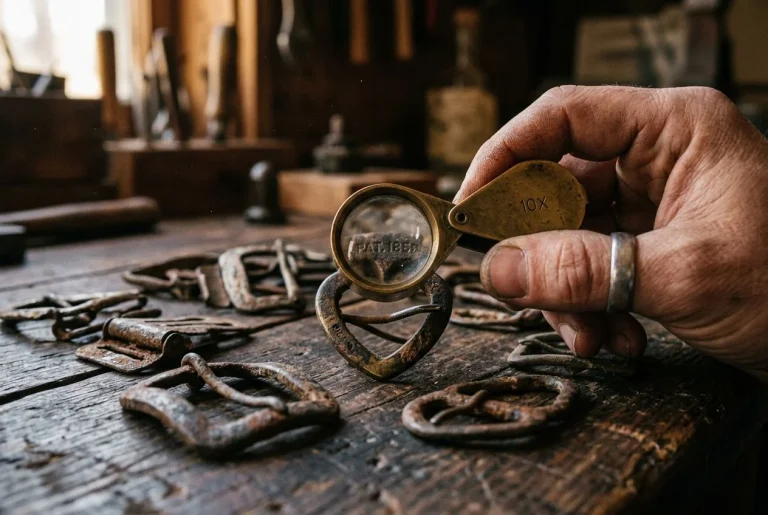
Dating vintage suspender buckles and clothing clasps comes down to reading the hardware, not the style. The mechanism—how a clasp grips, pivots, and locks—changed on specific, patentable dates. Learn those dates and you can place almost any buckle within a decade, sometimes to the exact year.
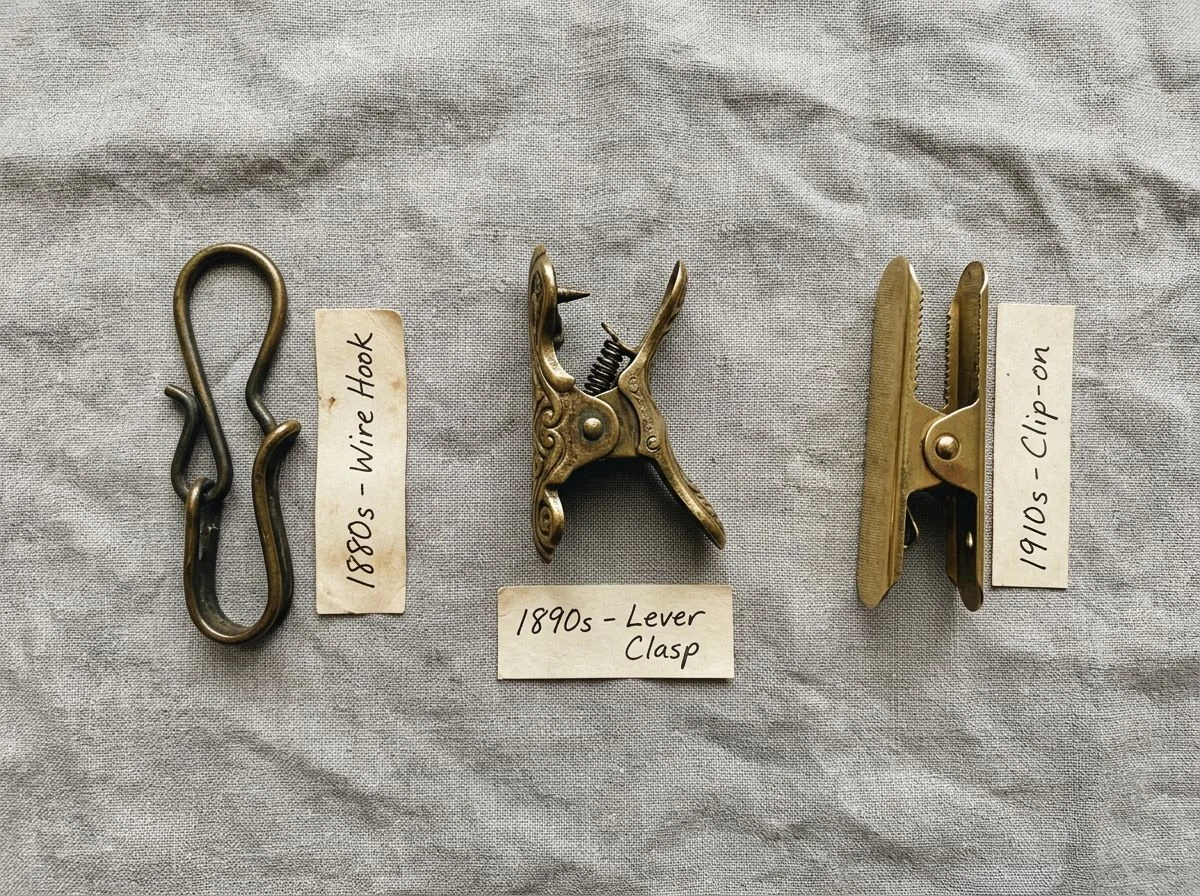
Start with the clasp mechanism itself. Before 1894, suspenders attached with leather loops that buttoned inside the trouser waistband. The metal clip-on clasp was invented in 1894, so any clip-style hardware is automatically post-1894. That single fact eliminates half the guessing.
For earlier pieces, look for patent stamps. Charles Benedict’s 1850 patent (No. 7,726) describes a two-piece buckle with a bent wire tongue and lateral spring—one of the first standardized American designs. Find that heart-shaped frame and you’re in the 1850s–1860s. Sheldon Hartshorn’s 1855 patent (No. 13,218) marks another early benchmark.
Jewelry-style clasps on clothing follow their own timeline. The C-clasp with tube hinge dominated 1850–1900, while the barrel clasp ran from roughly 1850 to 1920. The lever safety catch didn’t appear until 1901.
For workwear, Edward Pavek’s 1944 overall buckle patent (No. 2,362,024) introduced the notched spring-plate mechanism—a dead giveaway for WWII-era denim. And Isaac Kleinert’s 1900 duplex stocking-supporter (No. 655,154) with its right-angle loop marks post-1900 women’s undergarments.
What Your Buckle Hardware Reveals About Its Age
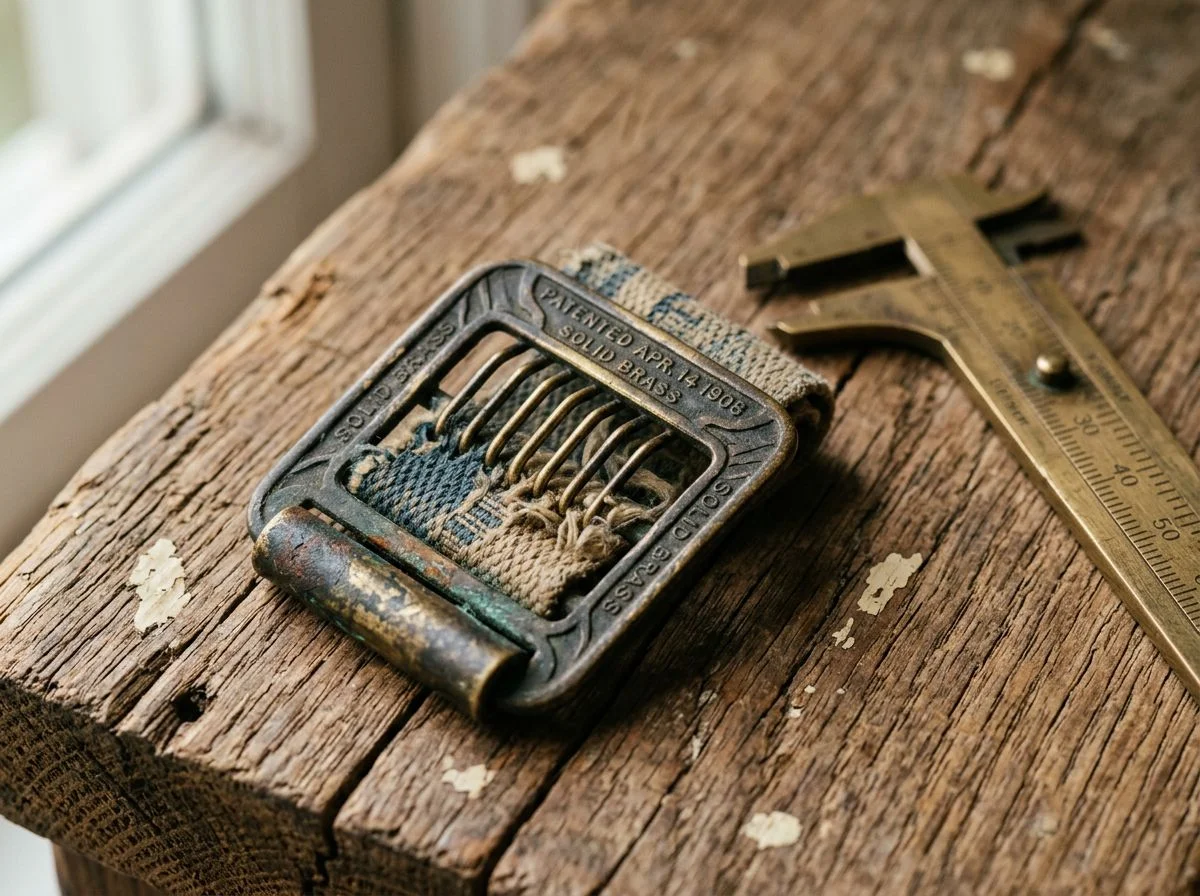
The hardware tells the real story because mechanisms change on patentable dates, not fashion cycles. A clasp’s grip, pivot, and lock design can date a piece to within a decade — sometimes the exact year.
I learned this the hard way in a farm field outside Dixon. I’d dug what I assumed was just another random brass buckle — corroded, bent, heading straight for the junk pouch. But something about the frame shape nagged at me. That night I compared it against patent drawings and realized it matched Sheldon Hartshorn’s 1855 design — Patent No. 13,218, granted July 10, 1855. Suddenly that “random” buckle had a birth certificate, and the field I’d been hunting wasn’t just some farm. It had been worked by people wearing suspenders before the Civil War.
That changed everything about how I hunt and how I research. Style lies — Victorian scrollwork shows up on 1970s reproductions all the time. But mechanisms don’t. Charles Benedict’s 1850 patent (No. 7,726) describes a specific two-piece frame with a bent wire tongue. The metal clip-on clasp arrived in 1894, and Boston Garter launched in 1878 with its own patented clasp. Learn these dates, and you’ll never guess again.
Patent Dates Are Your Buckle Birth Certificate
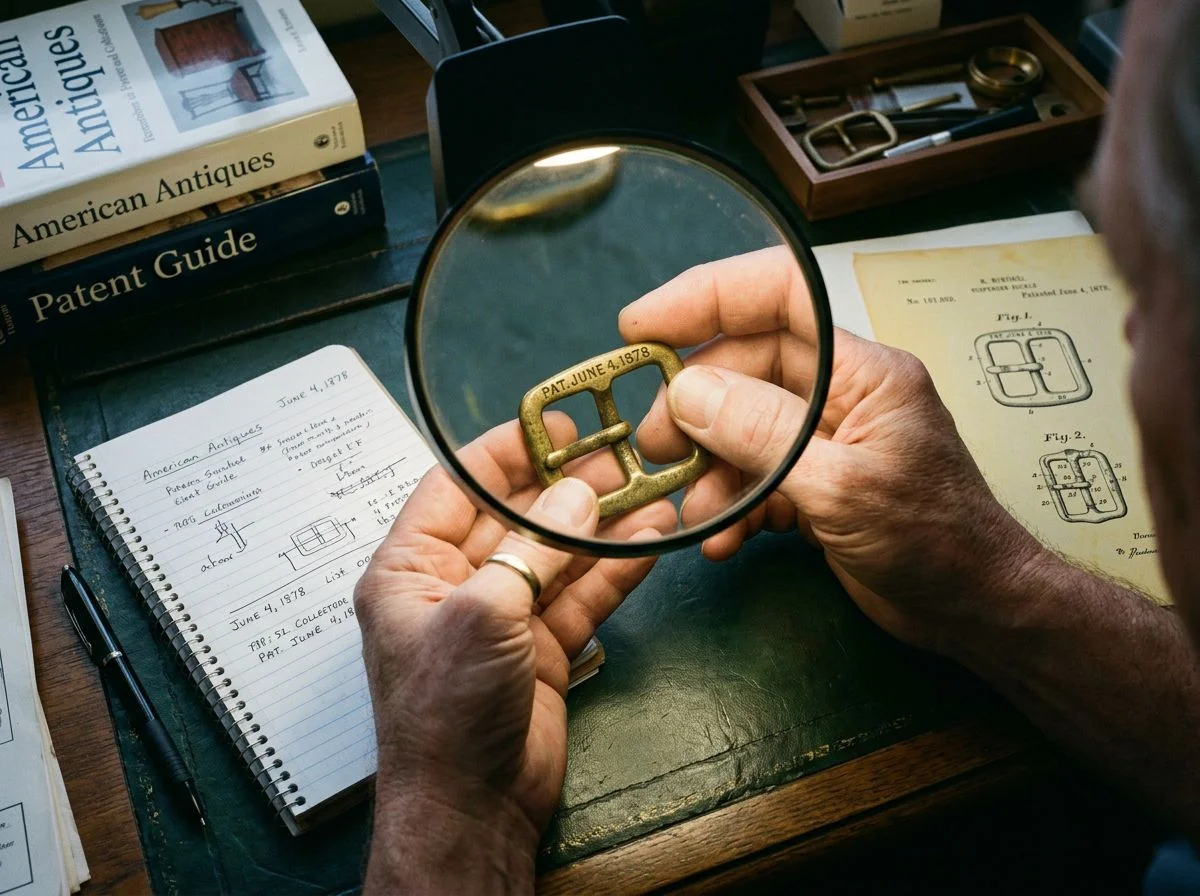
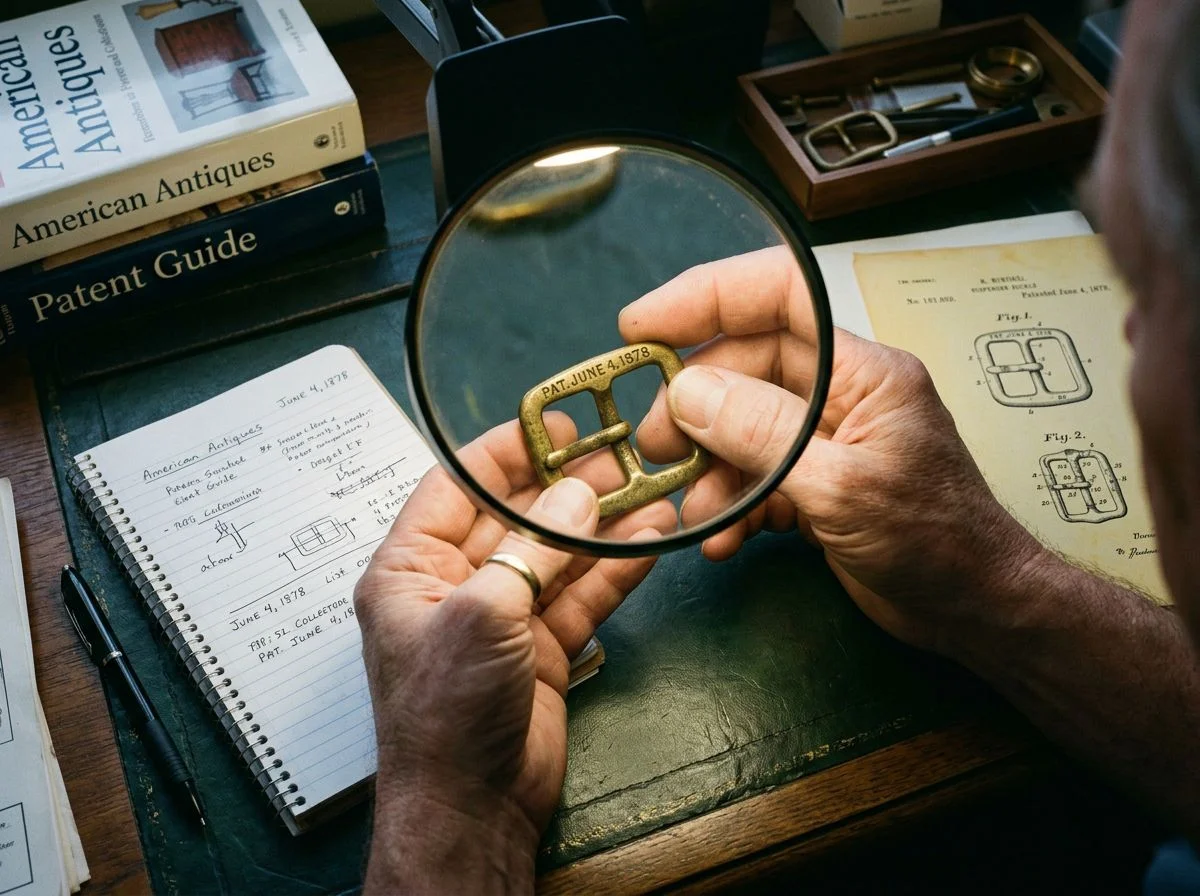
Patent dates are the single most reliable dating tool you have — because they’re legal documents with exact dates, not style guesses. Once you learn the key patents, you can place almost any suspender buckle or clothing clasp within a decade, sometimes to the exact year. Here’s the timeline that matters.
1850 — Charles Benedict’s simplified two-piece buckle. Patent No. 7,726, granted October 22, 1850, describes a cut metal plate with a bent wire tongue and a lateral spring mechanism. It’s one of the earliest standardized American suspender buckle designs. Find that specific heart-shaped or die-struck frame construction, and you’re holding something from the 1850s–1860s — civilian or military era.
1855 — Sheldon S. Hartshorn’s design. Patent No. 13,218, granted July 10, 1855, was later reissued to the West Haven Buckle Company in 1874 under George R. Kelsey. This one shows up on archaeological sites alongside other mid-century hardware, and it’s the exact patent that turned my “random” Dixon field find into a pre-Civil War artifact.
1871 — John E. Smith’s ornamental buckle. Design Patent D4698, granted March 7, 1871, came out of Waterbury, Connecticut — the brass capital of 19th-century America. Design patents cover appearance rather than function, so this one marks the point where buckles started getting decorative stamping along with their mechanical improvements.
1900 — Isaac B. Kleinert’s duplex stocking-supporter. Patent No. 655,154, granted July 31, 1900, introduced a central loop oriented at a right angle to the main frame. That specific right-angle loop hardware is a definitive post-1900 marker for women’s undergarments.
1944 — Edward F. Pavek’s overall buckle. Patent No. 2,362,024, granted November 7, 1944, features a notched spring-plate mechanism designed to grip thick, hemmed overall straps. Find that notched plate, and you’ve got WWII-era workwear.
How the Clasp Mechanism Helps You Date a Buckle
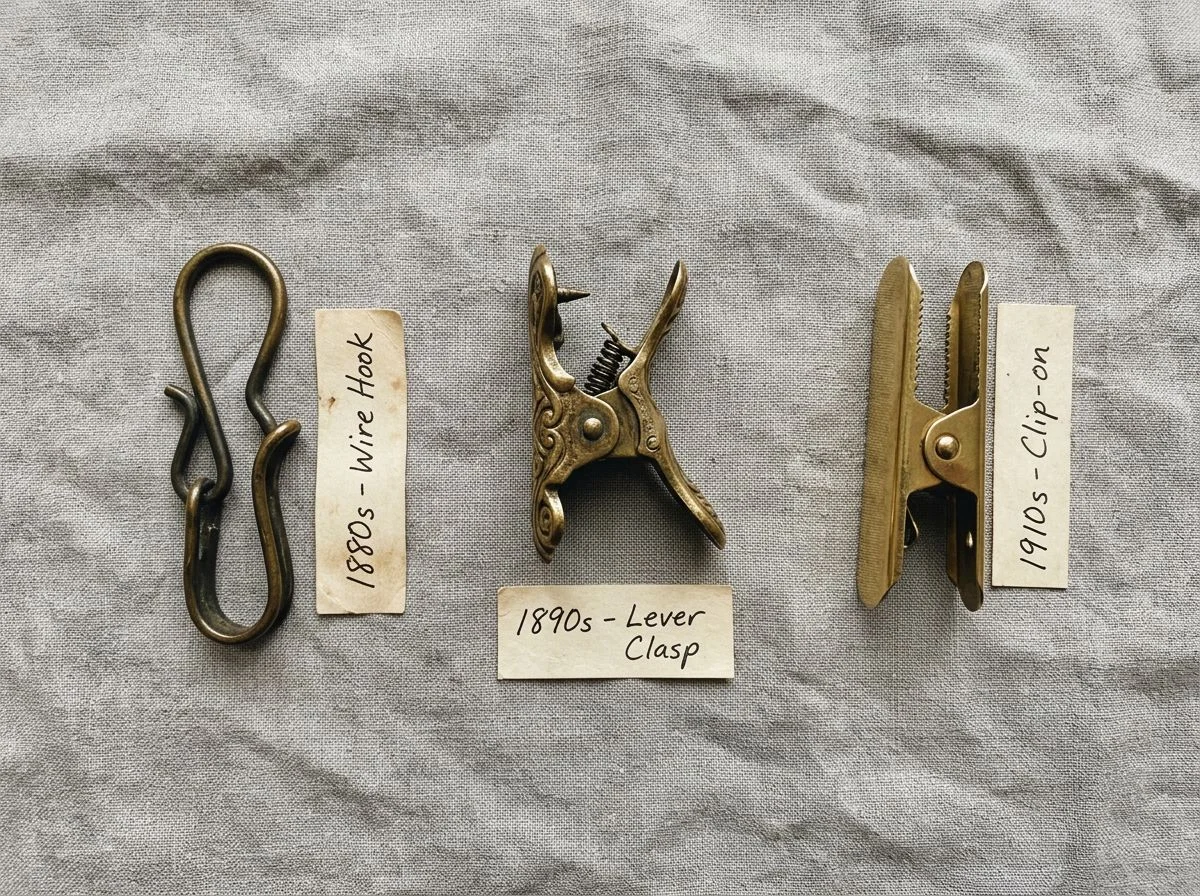
The clasp mechanism is your fastest dating shortcut — because it’s pure engineering, not decoration. A C-clasp with a tube hinge means 1850–1900. A lever safety catch means 1901 or later. The metal doesn’t lie, and it doesn’t follow fashion revivals.
Does your buckle clip, button, or slide? The answer narrows your date range instantly.
Here’s the thing most detectorists miss: manufacturers bought their clasp findings from specialized suppliers, not from the same shop that stamped the decorative face. That means the mechanism on your find is often more consistent — and more datable — than the pretty scrollwork on the front. Arthur Sterling’s visual guide to dating vintage jewelry by clasp type makes exactly this point: hardware follows patent timelines, while styles get revived constantly.
So let’s break down the five mechanisms you’ll actually encounter in the field.
The C-clasp with a tube hinge is your oldest common marker. A simple C-shaped hook that catches a pin, with the hinge formed by rolling the metal into a tube. Dominant from 1850 to 1900. If you dig one of these, you’re holding something from the Victorian era — possibly Civil War period.
The C-clasp with a round hinge is the transitional form. Same basic C-hook, but the hinge is a separate round barrel rather than a rolled tube. Popular from 1890 to 1910, so it overlaps the Victorian-to-Edwardian shift. When I find one of these, I know the site was active right around the turn of the century.
The trombone clasp is the one that throws people off. It’s a sliding tube mechanism — pull the barrel back, insert the pin, release. Widely used in Europe from 1850 to 1940, so it has a huge range. Don’t use it as a precise dating tool on its own; pair it with other hardware clues. Faustas Svencionis at Mozeris Fine Antiques notes that these mechanical details are the most reliable way to avoid modern reproductions.
The lever safety catch is your modern marker. Patented in 1901, it’s the little lever that snaps down over the pin to lock it in place. Still in use today, so finding one means 1901 or later — but not necessarily old.
The barrel clasp is the screw-together cylinder you see on bead strands and chains. Dominant from 1850 to 1920, spanning the Victorian through Edwardian eras. If it unscrews, it’s probably pre-1920.
Learn these five mechanisms, and you’ll date most clothing hardware before you even clean off the dirt.
Button Loops or Clip-Ons? 1894 Changed Everything

If your suspender buckle has a leather loop or buttonhole instead of a metal clip, it predates 1894. If it has a spring-loaded metal clasp that grips the waistband directly, it’s post-1894. That single year split suspender history in two.
Before 1894, suspenders attached to trousers the old-fashioned way: leather loops slipped over buttons sewn inside the waistband. Albert Thurston had introduced the modern design back in 1822 with his H-back configuration — straps made of tightly woven boxcloth, anchored by those leather button loops. For over seventy years, that was the standard. If you dig a buckle with remnants of leather still attached, or a frame clearly designed to hold a stitched loop rather than a metal jaw, you’re holding pre-1894 hardware.
Then came the summer of 1893. A brutal heatwave swept through, and men started ditching their suspenders entirely — you couldn’t remove your suit jacket without exposing your braces, and nobody wanted that in that kind of heat. Belts surged in popularity almost overnight. The suspender industry panicked.
The solution arrived in 1894: the metal clasp. Instead of buttoning onto interior waistband buttons, these new clips gripped the trouser fabric directly. No buttons needed. You could wear them with any pair of pants, jacket or no jacket. The invention saved the industry — and created the single most useful dating marker for detectorists. That spring-loaded clip mechanism? Nothing like it existed before 1894. Find one, and your site dates to the turn of the century at the earliest.
The clasp also changed how suspenders were built. The original H-back design — two parallel straps connected by a horizontal crosspiece — gave way to Y-back and X-back configurations that worked better with clip attachments. So if you’re dating a complete suspender assembly rather than just a buckle, the back configuration is your secondary clue: H-back leans pre-1894, Y-back and X-back are almost certainly post-1894.
Named Makers and Trademarks Like Boston Garter
A trademarked name stamped on your find is a factory birth certificate. The George Frost Company of Boston launched the “Gentlemen’s Boston Garter” in 1878, and any clasp bearing that name dates to 1878 or later — no guesswork required. The story behind it is a perfect example of how tragedy reshaped an industry.
In 1876, the George Frost Company’s Devonshire Street facility in Boston burned to the ground. Most businesses would have folded. Instead, the founder’s son, George A. Frost — born 1857, barely twenty years old — rebuilt the operation from scratch. By 1878, the company was manufacturing the Boston Garter, a sock supporter that solved a problem every man in America understood: socks that wouldn’t stay up.
The hardware that made it work came from F. Barton Brown, who received four garment clasp patents in 1878. Four patents in a single year tells you how fast this technology was moving. The company incorporated in 1891 and expanded to factories in Connecticut and New Jersey, eventually trademarking the “Velvet Grip” hose supporter alongside the Boston Garter name.
What does this mean when you’re holding a corroded clasp in your hand? If it’s stamped BOSTON GARTER or VELVET GRIP, you’ve narrowed your date range to 1878 through the early 1900s. That’s precision most relics never give you.
The broader lesson: named manufacturers cluster around specific hardware innovations. Samuel Williston had already established his gum elastic webbing factory in Easthampton, Massachusetts back in 1841, proving the elastic-webbing infrastructure existed decades before the Boston Garter arrived. And the West Haven Buckle Company’s 1874 reissue of Sheldon Hartshorn’s 1855 patent shows how established buckle makers kept older designs alive.
So when you find a trademarked clasp, you’re not just dating a piece of metal. You’re dating a company’s response to a fire, a market gap, or a patent race.
Antique Suspender Buckle Identification in the Field
You’re holding a corroded brass frame with a tongue, maybe a spring, maybe some stamping. Start with the mechanism — how it grips and pivots — then check for patent dates or maker’s marks. That order alone will date most buckles to within twenty years before you even clean it.
I learned this the hard way on a farm field outside Dixon. The signal was scratchy, the kind I’d normally walk past, but the ground was soft after rain and I was feeling optimistic. Eight inches down: a small brass buckle, no leather attached, no obvious markings. I almost tossed it in the junk pouch. Instead, I took it home and worked through what I now call the field identification sequence.
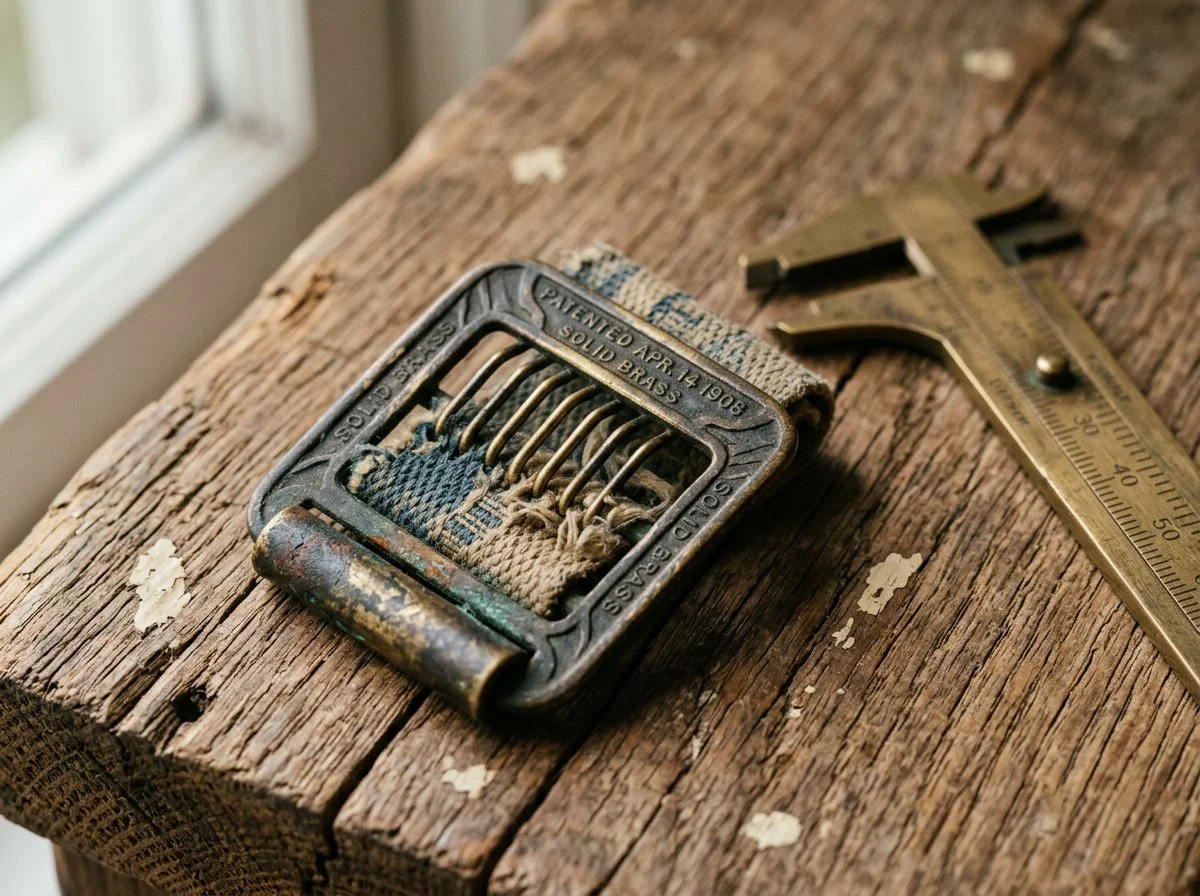
Step one: Examine the attachment mechanism. Is there a leather loop or buttonhole slot, or is there a metal jaw with spring tension? Pre-1894 buckles used leather loops that buttoned onto the waistband. Post-1894 hardware grips fabric directly with a spring-loaded clasp. That single observation splits your find into two centuries.
Step two: Look for patent dates or numbers. The Warner Site in Livingston County, Michigan produced multiple suspender buckles, each tied to a specific patent: Sheldon Hartshorn’s 1855 design, John E. Smith’s 1871 design patent D4698, Joseph Smith and Thomas Peckham’s 1870 patent, and Abraham Shenfield’s 1871 patent. Four buckles from one site, four distinct dates — because the patent stamps were still legible after a century in the ground. If yours has any numbers, even partial, you’re in business.
Step three: Check for maker’s marks. A stamped name like Boston Garter or Velvet Grip narrows things dramatically. A friend of mine pulled a suspender buckle from a cellar hole in upstate New York that he shared on Reddit — 143 years old, dated precisely because the manufacturer’s stamp survived. No stamp? Move on.
Step four: Assess the frame shape and construction. Heart-shaped or die-struck frames suggest 1850s-1860s manufacture, per Charles Benedict’s 1850 patent. A central loop oriented at a right angle to the main frame points to post-1900 stocking supporters, like Isaac Kleinert’s 1900 design. Notched spring plates on overall buckles? That’s Edward Pavek’s 1944 patent — World War II era or later.
That Dixon buckle? No patent stamp, no maker’s mark. But the frame was die-struck with a lateral spring tongue — Benedict’s 1850 configuration. A farm field find, probably lost between 1860 and 1880. Not worth much. But knowing it came from the same era as the Warner Site buckles? That’s the part I actually dig for.
Dating Corset, Stocking, and Workwear Clasps Too
Not every clasp you dig was holding up a man’s trousers. Corsets, stockings, and workwear all used their own patented hardware — and two specific designs bookend nearly half a century of undergarment evolution: Kleinert’s 1900 stocking-supporter and Pavek’s 1944 overall buckle. Learn to spot these mechanisms and you can date women’s undergarments and workwear with the same precision as suspender hardware.
Let’s start with the corset and stocking connection, because it’s the one most detectorists misidentify. Isaac B. Kleinert filed his duplex stocking-supporter patent in November 1899, and it was granted on July 31, 1900. The tell-tale feature is a central loop oriented at a right angle to the main frame. That loop was designed to slip over the lower eye of a corset clasp before the eye snapped onto its stud — the whole point being that the stocking supporter would lie flat against the front of a corset instead of bunching up. If you find a clasp with that right-angle loop, you’re holding something from 1900 or later, and it’s almost certainly women’s undergarment hardware, not suspender hardware.
The George Frost Company’s “Velvet Grip” hose supporters, which we covered earlier, operated on a different principle — a rubber button and metal loop clasp, trademarked from 1878 onward. Same function, different mechanism. That’s the key: function stays constant, mechanism evolves on a patent timeline.
Now jump forward to workwear. Edward F. Pavek’s overall buckle patent, granted November 7, 1944, solved a very specific problem: thick, hemmed overall straps that kept slipping through standard buckles. His fix was a spring plate with notches adjacent to its ends — those notches accommodated the thickened strap edges without reducing clamping force on the center. If you dig a workwear buckle with that notched spring-plate mechanism, you’re looking at post-1944 denim overalls or utility clothing, likely World War II era or later.
Between Kleinert’s 1900 and Pavek’s 1944, you’ve got a working date range for an entire category of non-suspender clasps. The Warner Site in Michigan shows how these pieces turn up alongside suspender buckles in the same archaeological contexts — the trick is knowing which garment each mechanism actually served.
Common Antique Suspender Buckle Identification Mistakes
The biggest mistake is dating by decoration instead of mechanism. Ornate scrollwork, stamped stars, and Victorian-looking flourishes mean almost nothing — those design elements got revived constantly. The mechanism, the patent stamp, and the attachment method are what actually pin down a date.
How many times have you seen a “Victorian” buckle that’s actually a 1970s reproduction? I’ve done it myself. The brass had that nice dark patina, the frame had a floral stamp, and I was ready to call it 1880s. Then I flipped it over and found a modern spring clip that wouldn’t have existed before 1894. Design styles get revived constantly. A Victorian scroll pattern can show up on a reproduction made last year. But the hardware — the way the clasp grips, pivots, and locks — follows strict patent timelines that don’t lie.
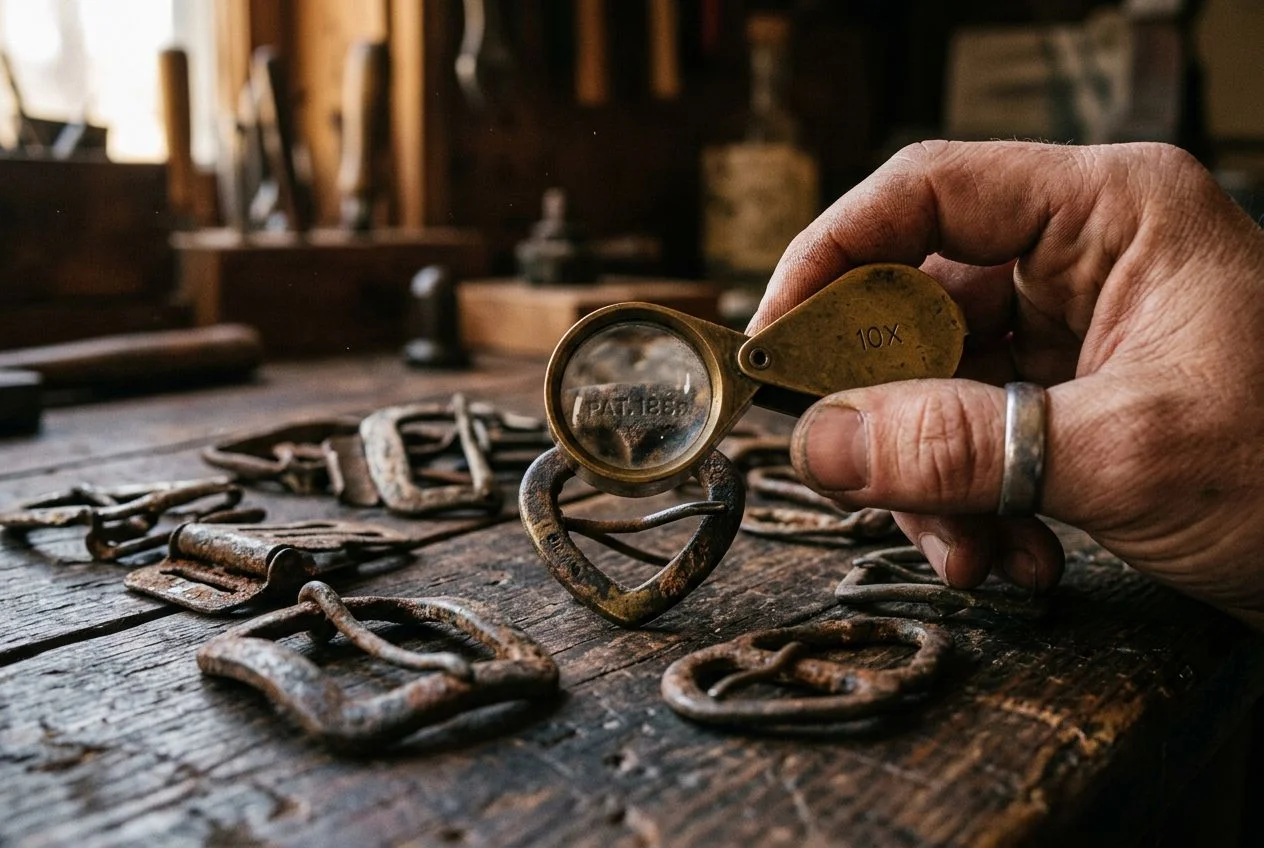
The second mistake is ignoring partial stamps. You dig a buckle with just a fragment of a number or a few letters of a maker’s mark, and it’s tempting to shrug it off. Don’t. Even a partial patent date narrows things dramatically. The Warner Site report from Livingston County, Michigan identified four distinct suspender buckles from one location — each tied to a specific patent: Sheldon Hartshorn’s 1855 design, John E. Smith’s 1871 design patent D4698, a Joseph Smith and Thomas Peckham 1870 patent, and Abraham Shenfield’s 1871 patent. Four buckles, four dates, all because the stamps were still legible after a century underground.
The third mistake is assuming every clasp you find held up a man’s trousers. Corset supporters, stocking clasps, and overall buckles all used different mechanisms — and misidentifying one throws your date off by decades. Kleinert’s 1900 stocking-supporter patent has that right-angle loop, while Pavek’s 1944 overall buckle uses a notched spring plate. Same function, different timeline.

My name is Paul and I am the founder of Detector For Metal, a dedicated resource for metal detecting enthusiasts seeking to uncover historical treasures and connect with the past using the latest technology. As a stay-at-home dad and family man, I’ve found metal detecting to be the perfect hobby that combines family adventure with historical learnings for the whole family.
As a father, I’m deeply committed to passing on this hobby to the next generation of detectorists, starting with my own children. I share advice on everything from metal detecting with kids to exploring the top 10 metal detecting sites you never thought about. My methodical approach to the hobby goes beyond the thrill of discovery—it’s about creating family traditions while preserving history and sharing the stories of those who came before us.