Table of contents
- Why Toddlers and Metal Detectors Actually Work Together
- What Works for Toddlers and What Is a Waste of Money
- Planning a Hunt with a 45-Minute Time Limit
- Toddler Safety Tips Nobody Mentions
- Pre-Burying Finds for Guaranteed Toddler Wins
- Metal Detecting with Kids
- Toddler-Approved Hunting Spots Beyond Playgrounds
- Games and Rituals That Keep Toddlers Engaged
- Why Metal Detecting with Kids Matters for Stay-at-Home Dads
- Metal Detecting with Kids
- You Can Keep Your Hobby and Bring Your Toddler
The short version: you don’t need a smaller detector — you need a smaller job for your kid. Toddlers can’t swing a 2.5–3.5 pound detector, and they won’t stay engaged for a two-hour hunt. But give them a pinpointer, a plastic trowel, and a “treasure pouch,” and you’ve got a genuinely useful hunting partner for 20–40 minutes at a stretch.
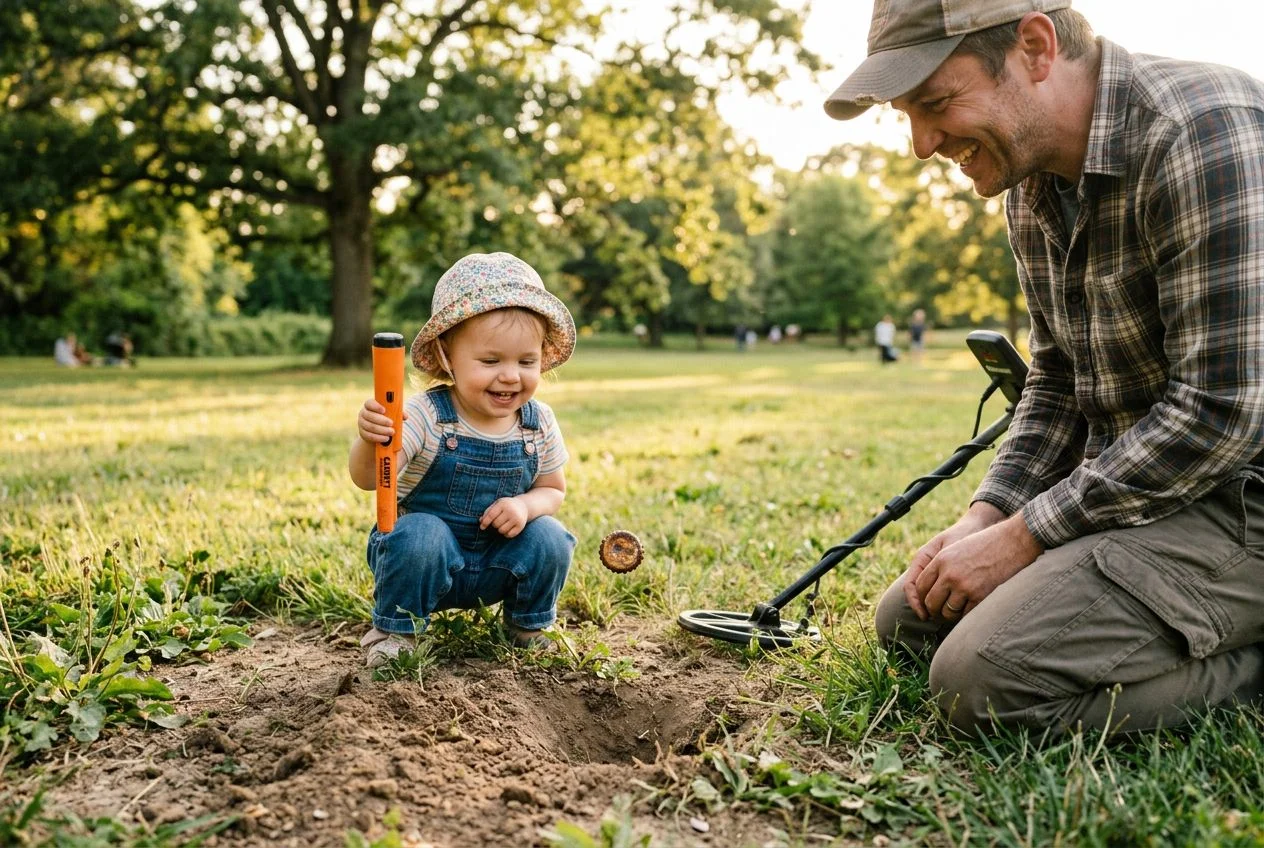
The first time I handed my daughter a pinpointer, she held it like a magic wand. She announced that every bottle cap was “pirate treasure.” She wasn’t wrong, honestly. To a three-year-old, a corroded pull-tab buried three inches down is buried treasure. The trick is leaning into that instead of fighting it.
Here’s what actually works, based on trial and error with my own kids:
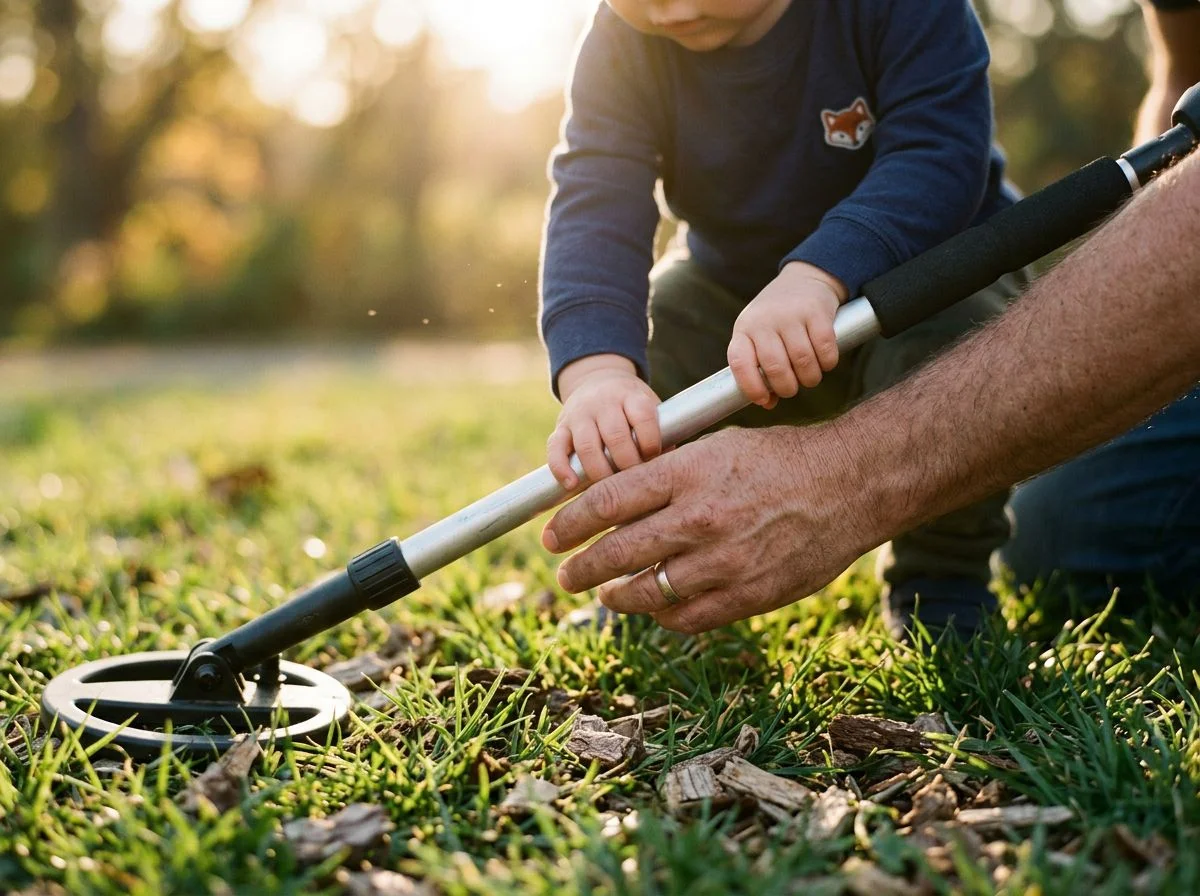
You swing, they pinpoint. A standard adult detector weighs 2.5–3.5 pounds. That’s a pendulum in toddler hands. But a pinpointer weighs under a pound. It has a simple trigger and beeps with instant feedback. When your detector hits a target, hand them the pinpointer and let them “find” it in the hole. They get the dopamine hit of discovery without the frustration of gear they can’t manage.
Keep hunts short and structured. Toddlers sustain focused outdoor activity for 20–40 minutes before needing a reset. Plan your hunt around that window — not the other way around. I’ve learned to pick sites within a 10-minute drive. We hunt for half an hour, then I call it before the meltdown starts. A short successful hunt beats a long miserable one every time.
Make it a game, not a lesson. Hannah Martin’s advice about creating a backyard treasure map is spot-on. Draw an “X” marking buried metallic items. Bury a few coins and cheap metal toys in the sandbox. Let them “discover” the treasure. It builds the link between detecting and fun before you ever leave the yard.
Safety is on you, not them. Toddlers put everything in their mouths — dirt included, apparently. Sharp finds, small choking hazards, and rusty nails are your job to spot and remove. Discovery Daisy’s classroom approach applies here: set up the environment so the kid can’t fail.
Why Toddlers and Metal Detectors Actually Work Together
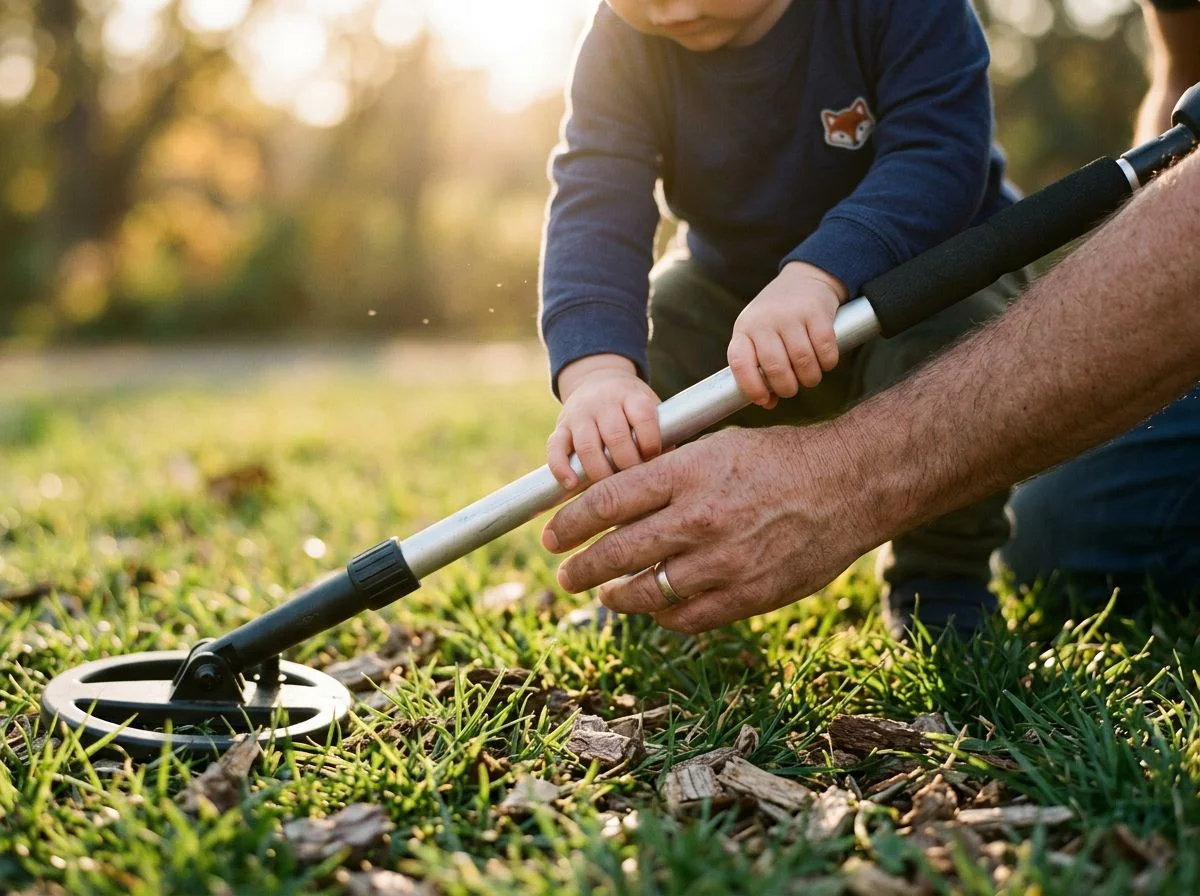
Toddlers and metal detectors work because you’re not teaching a skill. You’re handing a kid a job they can actually do. A pinpointer weighs under a pound and gives instant beeps. It makes a three-year-old feel like the one making the discovery. You swing the big detector. They do the pinpointing. That division of labor is the whole game.
The first time I handed my daughter a pinpointer, she held it like a magic wand. She announced that every bottle cap was “pirate treasure.” She wasn’t wrong, honestly. To a three-year-old, a corroded pull-tab buried three inches down is buried treasure. The trick is leaning into that instead of fighting it.
Here’s the thing most “detecting with kids” articles miss: toddlers can’t physically operate the gear. A standard adult detector weighs 2.5 to 3.5 pounds. That’s a pendulum in toddler hands. They can’t swing it or hold it steady. They definitely can’t interpret the tones. But a pinpointer? That’s a different story. It weighs under a pound and has one button. It beeps the second it gets near metal. Instant feedback, zero learning curve.
The other piece is attention span. Toddlers sustain focused outdoor activity for 20 to 40 minutes before needing a reset. That reset might be a snack, a water break, or a totally different activity. It’s not a limitation to work around. It’s the structure of your hunt. You plan for half an hour of real engagement. Then you call it before the meltdown starts. A short successful hunt beats a long miserable one every time.
What makes the pairing work isn’t the detector at all. It’s the fact that toddlers are natural treasure hunters. They already believe the world is full of hidden, magical things. Your job is just to hand them the tool that makes that belief pay off.
What Works for Toddlers and What Is a Waste of Money
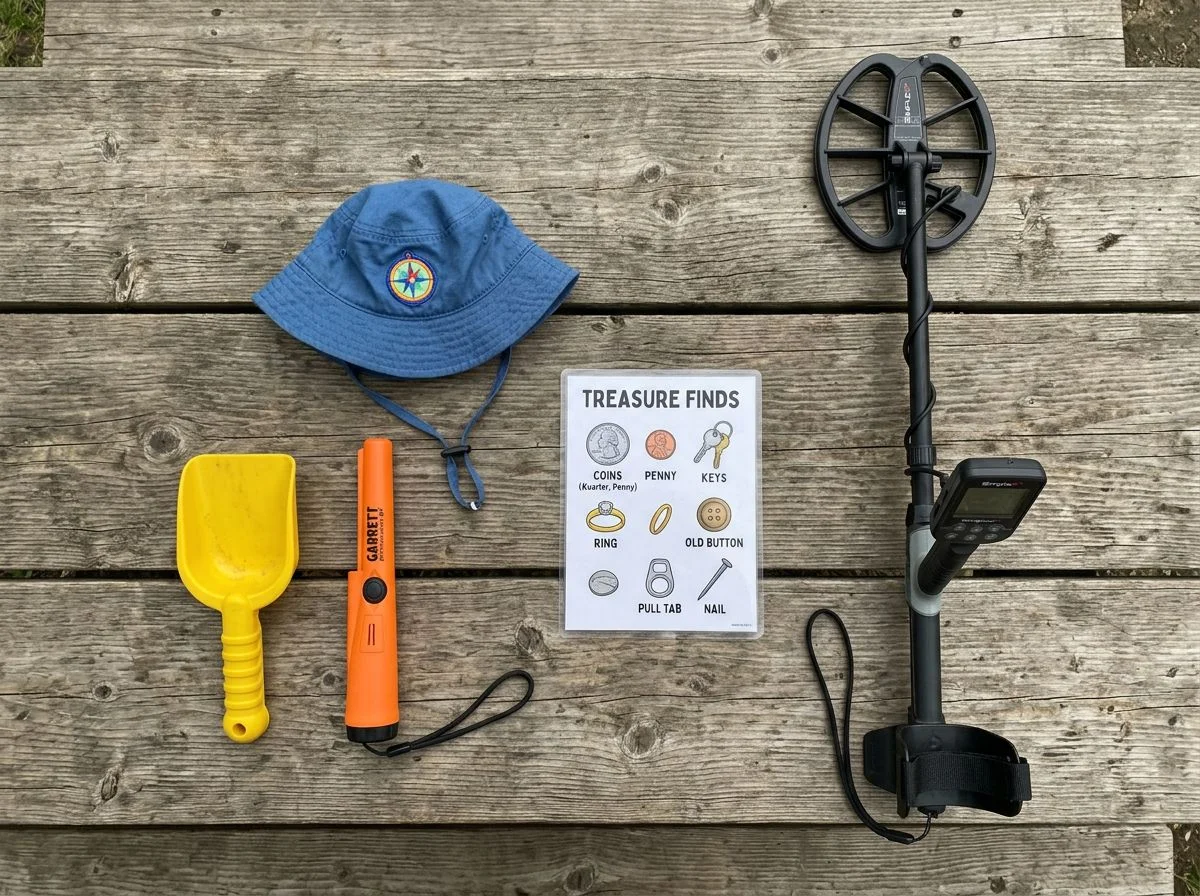
Here’s the short version: skip the “kids metal detector” aisle entirely. Your toddler needs a pinpointer, not a detector. Anything marketed as a toddler-specific detector is still just a supervised novelty.
Have you ever watched a toddler try to hold a 3-pound detector steady? It’s like watching someone parallel park a canoe. The thing swings, dips, and drags through the dirt. Eventually it becomes a walking stick or a weapon against a sibling. A standard adult detector weighs 2.5–3.5 pounds. That doesn’t sound like much until you hand it to a three-year-old. Their arm gives out after fifteen seconds. Even most “kids” detectors are sized for six-to-ten-year-olds, not toddlers. They’re lighter, sure. But they’re still two-handed tools with controls a preschooler can’t operate.
The average toddler attention span for one activity runs about 3–5 minutes. That’s not a flaw in your kid. It’s just how their brains work. Even if you found a detector light enough for them to hold, they’d lose interest before you finished ground balancing. This is why the pinpointer is the answer. It weighs 0.5–1 pound and fits in one hand. It gives instant feedback with a beep and a buzz. My daughter treats hers like a magic wand that finds hidden treasure. Honestly, that’s exactly what it is to her.
Now, about those toddler-specific detectors like the Nokta Mini Hoard. They weigh under 1.5 pounds and look like toys. That’s both the appeal and the problem. They work fine for what they are, but they still need constant supervision. They don’t give your kid a real job in the hunt. You’ll end up running both detectors while your toddler wanders off to collect sticks. Save the money. A decent pinpointer costs less and fits in the diaper bag. It makes your kid an actual participant instead of a spectator holding a prop.
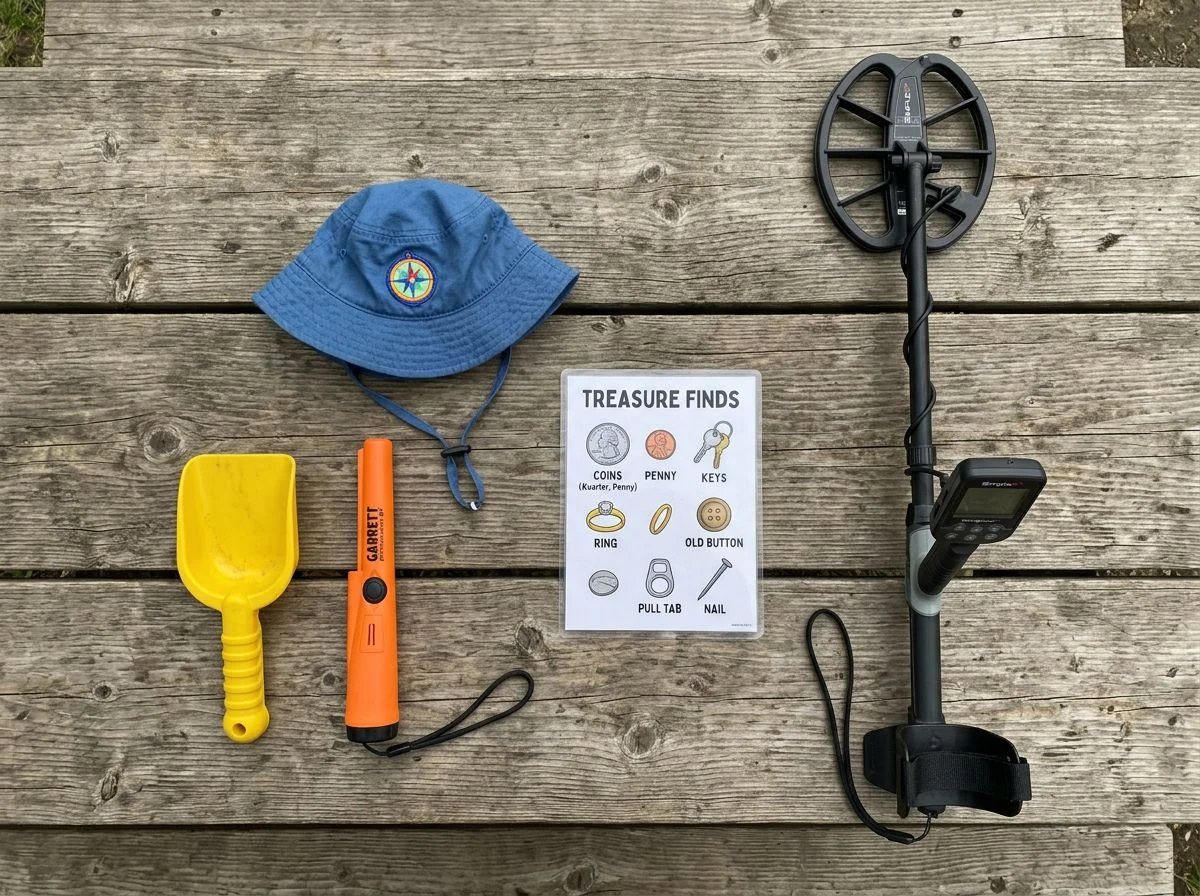
The waste-of-money list is long. Cheap toy detectors that can’t find a quarter on the surface. “Junior” detectors with flashing lights and no discrimination. Any gear that needs your toddler to hold something steady for more than thirty seconds. The keep list is short: a pinpointer, a plastic trowel, and something to put “treasure” in. That’s it. That’s the whole kit.
Planning a Hunt with a 45-Minute Time Limit

Here’s the rule: plan your hunt in 45-minute blocks. Assume 20–40 minutes of actual engagement. Have an exit strategy ready before you even park the car. Toddlers don’t do open-ended adventures. They do short, successful missions with a clear finish line.
My first “real” hunt with my daughter lasted 22 minutes. She pinpointed two bottle caps and announced she was “all done.” Then she sat down in the grass to collect sticks. I stood there with my detector and a half-dug plug. I hadn’t planned for the ending — only the beginning. She was perfectly happy. I was the one who needed to adjust.
That 22-minute hunt taught me more than any forum post. Toddlers can sustain focused outdoor activity for 20–40 minutes before needing a reset. That window is your entire hunt. Not the warm-up to the hunt. The hunt.
So here’s how I structure it now. We arrive and I spend five minutes getting gear out. She holds the pinpointer. Then we hunt for 20–30 minutes. That’s it. Then we do something completely different. Snack break, stick collecting, a walk to look at bugs. If she’s still engaged after the reset, we do another short round. If not, we leave. No guilt, no pushing it.
The built-in exit strategy matters more than the hunt itself. When your toddler says “all done,” you’re done. Fighting it turns a good outing into a parking lot meltdown. I keep the car packed so leaving takes two minutes, not fifteen.
Food is your secret weapon. Pack 2 snacks per hour of field time — more than you think you need. A hungry toddler is not a detecting partner. They’re a tiny union negotiator with unreasonable demands and no interest in compromise. Goldfish crackers have salvaged more hunts than my Equinox ever has.
One more thing: pick a site within 15 minutes of home. The drive is part of the 45-minute block. A 40-minute drive each way to a “better” site means you’ve burned the whole attention span before the coil hits the ground. Save the far-flung research sites for solo hunts. With a toddler, the best site is the closest one.
Toddler Safety Tips Nobody Mentions
Here’s the uncomfortable truth: the biggest danger to your toddler on a detecting hunt isn’t the detector. It’s the stuff you’re digging up. Small finds like coins, buttons, and pull tabs are perfect choking hazards for kids under 3. The ground itself is full of sharp surprises.
The CDC reports that choking is a leading cause of injury in children under 4. Now imagine handing that child a pile of bottle caps and pull tabs. Every single target you unearth is a potential mouth-sized object. Toddlers put objects in their mouths an average of 10 times per hour during outdoor play. That’s not a kid being difficult. It’s developmentally normal behavior that will absolutely ruin your hunt if you’re not ready for it.
So here’s my system. First, I carry a dedicated “keeper pouch” that clips to my belt and stays closed. When I dig a target, it goes straight into the pouch before my daughter even sees it. She gets to see the find after I’ve assessed it — and only if it’s too big to swallow. A seated dime? That’s a “Daddy will show you later” item. A rusted harmonica reed? Still a no. A large brass buckle? That she can hold.
Second, scout your site before letting a toddler loose on it. Older parks are loaded with rusty nails and broken glass just below the surface. That’s exactly where little hands dig. I do a slow sweep of the area first and remove anything sharp I can see. It’s not perfect, but it catches the obvious hazards.
The real rule: your toddler never touches a find until you’ve decided it’s safe. No exceptions, no “just this once.” A choking incident happens in seconds. The closest hospital is always too far away.
Pre-Burying Finds for Guaranteed Toddler Wins

Here’s the method in one sentence: before your toddler ever swings a pinpointer at “real” ground, bury three to five modern coins in a small, contained area. Their first fifteen minutes will produce a 100% success rate. A skunked hunt — zero finds, just bottle caps and foil — will demoralize a toddler within ten minutes flat. They don’t understand odds or patience. They understand found it. So you manufacture the finding.
Before a “real” hunt, I bury three or four modern coins in the sand at the edge of the search area. My toddler finds them with the pinpointer. Suddenly she’s hooked for the next 20 minutes. That’s the whole trick. It feels like cheating, and it is. But it’s cheating in service of a kid who doesn’t know the difference between a 2021 penny and a Roman denarius anyway. What she knows is that the magic wand beeped, she dug, and treasure appeared. That’s the hook.
The mechanics are simple. Pick a spot just outside where you plan to hunt. The edge of a sandbox works. So does a soft dirt patch near the playground or the loose sand at the beach. Push each coin about two inches down. Don’t go deeper than a toddler can dig with a plastic trowel or their hands. Space them a foot or two apart. Each find should feel like a fresh discovery, not a cluster of coins that fell out of someone’s pocket. Then hand over the pinpointer and let her work the area. You’re not detecting during this phase. You’re coaching, celebrating, and watching for the moment she starts scanning on her own.
The genius of this method is that it front-loads success. A toddler’s first ten minutes determine whether the next thirty happen at all. If she’s found three “treasures” before you’ve even turned on your detector, she’s invested. She’ll follow you to the next spot because the pattern is set: this activity produces treasure for me. Without that pattern, she’s just watching you swing a noisy stick at dirt. That gets old in about the time it takes to dig one pull tab.
One warning: don’t overdo it. If every hunt is a guaranteed jackpot, the real finds lose their shine. Use the pre-buried coins as a warm-up. Then transition to genuine detecting. When she pulls a real target — even a bottle cap — celebrate it the same way. The goal isn’t to trick her forever. It’s to build enough early wins that she’ll stick around for the occasional skunked afternoon.
Metal Detecting with Kids
Here’s the short version: skip the toy detectors entirely. A quality pinpointer and a plastic sand scoop are the only two pieces of gear your toddler actually needs. Together they’ll cost about the same as a “kids detector” that will never leave your garage. A $200 “kids detector” will sit in your garage. A $100 pinpointer will get used every single hunt. That’s not an exaggeration. It’s the exact pattern I’ve watched with my own kids and half a dozen other dads in my detecting club.
The problem is physics, not interest. A “kids detector” like the Bounty Hunter Junior costs $60-100. That sounds reasonable until you realize it weighs 2+ pounds and needs your toddler to swing it in a controlled arc. My three-year-old lasted maybe ninety seconds before she started using it as a walking stick. Then a weapon. Then she dropped it in the sand and wandered off to collect sticks. The pinpointer, by contrast, weighs under a pound. It fits in her hand like a flashlight. She can hold it steady and press the trigger. It beeps instantly over a target. That’s a tool she can actually operate. Which means she’s a participant instead of a spectator.
For a pinpointer, I’d recommend the Garrett Pro-Pointer AT, the Minelab Pro-Find 35, or the Nokta PulseDive. All are in the $100-150 range. They’re waterproof and durable enough to survive toddler handling. They’re sensitive enough to find coins buried two inches deep in sand. My daughter treats hers like a magic wand. Honestly, that’s the right metaphor. It beeps, she digs, treasure appears.
For digging, get a plastic sand scoop for $10-15. It’s the right size for toddler hands. It won’t hurt anyone when swung enthusiastically. It teaches the basic motion of scooping sand away from a target. Steel trowels are too sharp and too heavy for little kids. I learned that the hard way when my daughter tried to “help” and nearly took a chunk out of my shin. The plastic scoop is forgiving. That’s exactly what you want when your toddler is learning that treasure is buried under the surface.
Skip the “toddler-specific” detectors too. The Nokta Mini Hoard and similar models weigh under 1.5 pounds. That’s better, but they still need a level of motor control and patience most toddlers simply don’t have yet. Save that purchase for age five or six. Right now, the pinpointer-and-scoop combo is all you need. It’s what will actually get used every single time you head out.
Toddler-Approved Hunting Spots Beyond Playgrounds
Here’s the short version: dry sand is your best friend. Grassy park edges are your reliable backup. Woodchip playgrounds should be avoided entirely. The goal is easy digging, low hazard density, and enough real signals to keep a toddler engaged without constant junk frustration.
When was the last time you detected a playground and didn’t find 40 pull tabs and a rusty nail? Woodchip playgrounds are high-signal, low-reward environments. Every beep is a bottle cap, a zipper pull, or a screw from the jungle gym. Worse, those woodchips hide the exact choking hazards you’re trying to keep away from a toddler who still puts everything in her mouth. The signal density sounds exciting until you realize you’re digging garbage while your kid wanders toward the swing set.
Dry sand is the easiest digging medium for toddlers, full stop. A plastic scoop cuts through it like butter. A two-inch hole stays open without collapsing. Small finds shake clean with one pass. Beaches, sand volleyball courts, and the sandy edges of lakes and riverbanks all work. My daughter can dig a target in dry sand faster than I can get my own trowel out of my pouch. That keeps her engaged instead of waiting for me to finish the hard part.
Athletic fields and grassy park edges offer lower hazard density than playgrounds. The grass is usually short. The soil is often soft from irrigation. The targets tend to be real coins dropped from pockets — not playground hardware. Fair warning: grass digging requires more finesse. This is where you dig the plug and let your toddler “help” by pulling the find out of the hole. The edges of soccer fields, baseball diamonds, and picnic areas are prime territory.
Games and Rituals That Keep Toddlers Engaged
Here’s the short version: assign your toddler a specific job with a title. Celebrate every single find with a consistent, over-the-top ritual. Role-based play keeps them focused. A repeatable celebration gives them something to look forward to that isn’t just the next beep.
The fastest way to lose a toddler on a hunt is to let them drift without a defined purpose. “Helping daddy” is too vague. “You’re the Official Digger” is a job. I’ve watched this work with my own daughter and with the kids at a metal detecting educational day. An elementary school teacher divided 22 students into rotating stations. The kids with assigned roles stayed engaged dramatically longer than the ones just milling around.
My daughter’s official title is “Pinpointer Operator, First Class.” She holds the pinpointer and presses the trigger. She announces the verdict on every target. When I hand her the scoop, she becomes “Head of Excavation.” The titles are ridiculous. The focus is real. Role-based play works because it gives a toddler a defined job with clear boundaries. They know exactly what they’re supposed to be doing. That’s developmentally comforting for a brain that gets overwhelmed by open-ended instructions.
Then comes the ritual. Every time we find something, my daughter does a “treasure dance.” It’s ridiculous and I love it. It also buys me five more minutes of cooperation. That’s not a coincidence. A consistent celebration ritual reinforces positive behavior and extends cooperation windows. The dance, the high five, the “TREASURE!” announcement — whatever yours is, make it identical every time. Predictability is the toddler engagement cheat code.
One warning: don’t let the ritual become a negotiation. If the treasure dance only happens for “good” finds, you’ll spend half your hunt explaining why a pull tab doesn’t count. Celebrate everything. A rusty washer gets the same dance as a quarter. Your toddler doesn’t care about value. They care about the moment.
Why Metal Detecting with Kids Matters for Stay-at-Home Dads
Here’s the short version: stay-at-home dads are a growing demographic. But they report higher rates of social isolation than stay-at-home moms. A hobby that gets you outside, gives you a structured activity, and connects you with a community is not a luxury. It’s a survival tool.
I learned this the hard way. When I first stepped away from full-time work to stay home with my kids, I figured the hardest part would be the logistics. The meals, the nap schedules, the never-ending laundry. What I didn’t anticipate was the quiet. The days were loud with toddler chaos. But the silence between adult conversations stretched for weeks. That’s not just my experience. Shannon Carpenter’s manual for stay-at-home dads tackles this head-on. He devotes serious attention to male loneliness and mental health. The isolation is real, and it sneaks up on you.
Structured outdoor activities are one of the most effective counters. Research consistently shows they reduce parental stress and improve mood. Metal detecting delivers both. And it does it in a package that’s actually compatible with toddler supervision. You’re outside. You’re moving. You have a clear objective — swing, listen, dig, repeat. That structure matters more than I can explain when your whole day otherwise revolves around someone else’s needs.
The community piece is what surprised me most. Metal detecting clubs offer adult social connection that stay-at-home dads often lack. These are conversations that aren’t about nap schedules or snack preferences. Scott Bevan, a stay-at-home dad in the UK, built relationships with local farmers and museum staff through his detecting. He registered finds and preserved local history in the process. That’s adult connection built through shared purpose, not forced small talk.
For me, the hobby became the thing I talk about at dinner that isn’t about the kids. My wife says I collect obscure facts like some people collect stamps. But those facts come from conversations with other detectorists. Real adults who know my name and ask about my last hunt. That’s not a hobby perk. That’s the whole point.
Metal Detecting with Kids
What’s the absolute minimum gear I need to start detecting with my toddler?
One working metal detector (any model you already own is fine), one pinpointer ($100–150), one plastic sand scoop ($10–15), one zippered finds pouch, two snacks, and one water bottle. That’s the whole kit. The toddler doesn’t swing the detector — you do. They operate the pinpointer and the scoop. That’s where the engagement happens. Skip the “kids detector” for now. A kid-friendly detector is a purchase for later. Wait until they’re school-age and can actually hold one steady for more than thirty seconds.
How long can I realistically expect a toddler to last on a hunt?
Twenty to forty minutes of focused outdoor activity before they need a reset. Plan your hunt around that window, not the other way around. When you see the focus slipping, call it. A good twenty-minute hunt beats a miserable hour-long one.
What if my toddler eats dirt or puts finds in their mouth?
Assume everything goes in the mouth, because it will. Keep small finds in your zippered pouch, not theirs. Let them handle only objects too large to swallow. Supervise every dig. A plastic sand scoop keeps their hands out of the hole while you retrieve the target.
Do I need a special detector for detecting with a toddler?
No. Any working detector you already own is the right detector. The toddler isn’t swinging it — you are. If you’re buying something, spend the money on a pinpointer instead. That’s the tool your toddler will actually use. It’s the single best engagement purchase you’ll make.
Is it worth joining a detecting club if I have a toddler?
Yes, eventually. Not for the toddler — for you. The stay-at-home dad isolation problem is real. A club gives you adult conversation that isn’t about nap schedules. Bring the toddler when you can. Go solo when you can’t.
You Can Keep Your Hobby and Bring Your Toddler
You can keep detecting with a toddler in tow. It just requires a different division of labor, shorter hunt windows, and a willingness to let your kid run the pinpointer while you run the detector. The hobby doesn’t pause because your kids are little. It adapts.
I’ve spent enough mornings wrestling a three-year-old into a car seat with a detector in the trunk to know this isn’t theoretical. The twenty-minute hunts, the dirt-eating incidents, the “pirate treasure” declarations over every bottle cap — it all adds up to something better than solo detecting ever was. My daughter now asks to go “treasure hunting” the way other kids ask for the playground. That’s the win, not the finds themselves.
The isolation stay-at-home dads face is real. It doesn’t fix itself. Shannon Carpenter’s manual doesn’t pull punches on male loneliness, and neither will I. You need something that’s yours. Something that gets you outside. Something that gives you adult conversations at club meetings and shared purpose with your kid. Metal detecting delivers all three. The toddler years are chaos. But they’re also the window where your kid thinks you’re the most interesting person alive. Hand them a pinpointer and watch what happens.

My name is Paul and I am the founder of Detector For Metal, a dedicated resource for metal detecting enthusiasts seeking to uncover historical treasures and connect with the past using the latest technology. As a stay-at-home dad and family man, I’ve found metal detecting to be the perfect hobby that combines family adventure with historical learnings for the whole family.
As a father, I’m deeply committed to passing on this hobby to the next generation of detectorists, starting with my own children. I share advice on everything from metal detecting with kids to exploring the top 10 metal detecting sites you never thought about. My methodical approach to the hobby goes beyond the thrill of discovery—it’s about creating family traditions while preserving history and sharing the stories of those who came before us.