Table of contents
- Why Boots Matter More Than Your Detector
- What the Best Boots for Metal Detecting Need
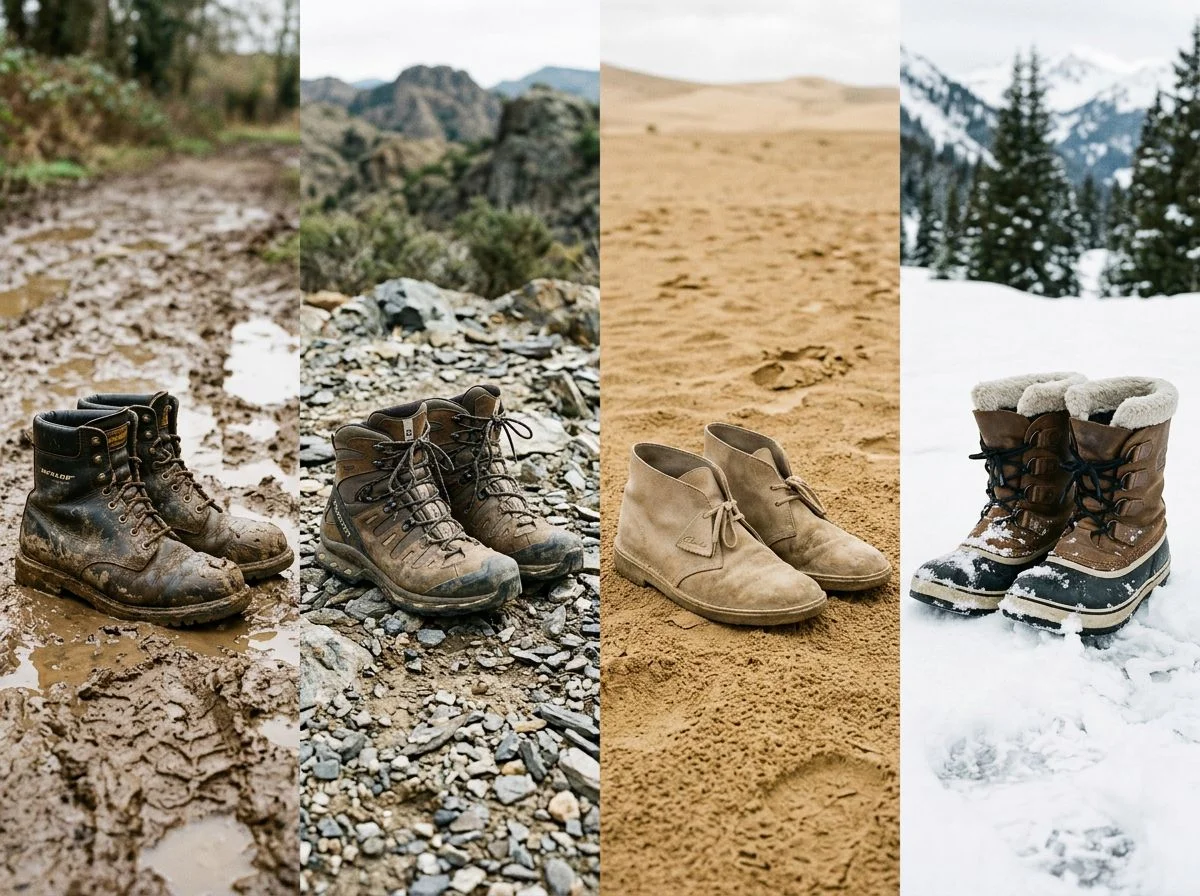
- Matching Boots to Mud, Rocks, Sand, and Snow
- Budget Boots That Don’t Suck
- Premium Boots Worth the Investment
- Can Your Boots Sabotage Your Hunt?
- Socks, Insoles, and the Comfort Layer
- Care and Maintenance for Longer-Lasting Boots
- Frequently Asked Questions
- Buy for Your Terrain, Not for the Hype
The short answer: a fully metal-free, waterproof boot with aggressive multi-directional tread and high ankle support. Spend $100-200 and you’ll cover most terrain. Spend more and you’re paying for premium materials, not better detecting.
Let me break that down, because “best” depends entirely on where you swing.
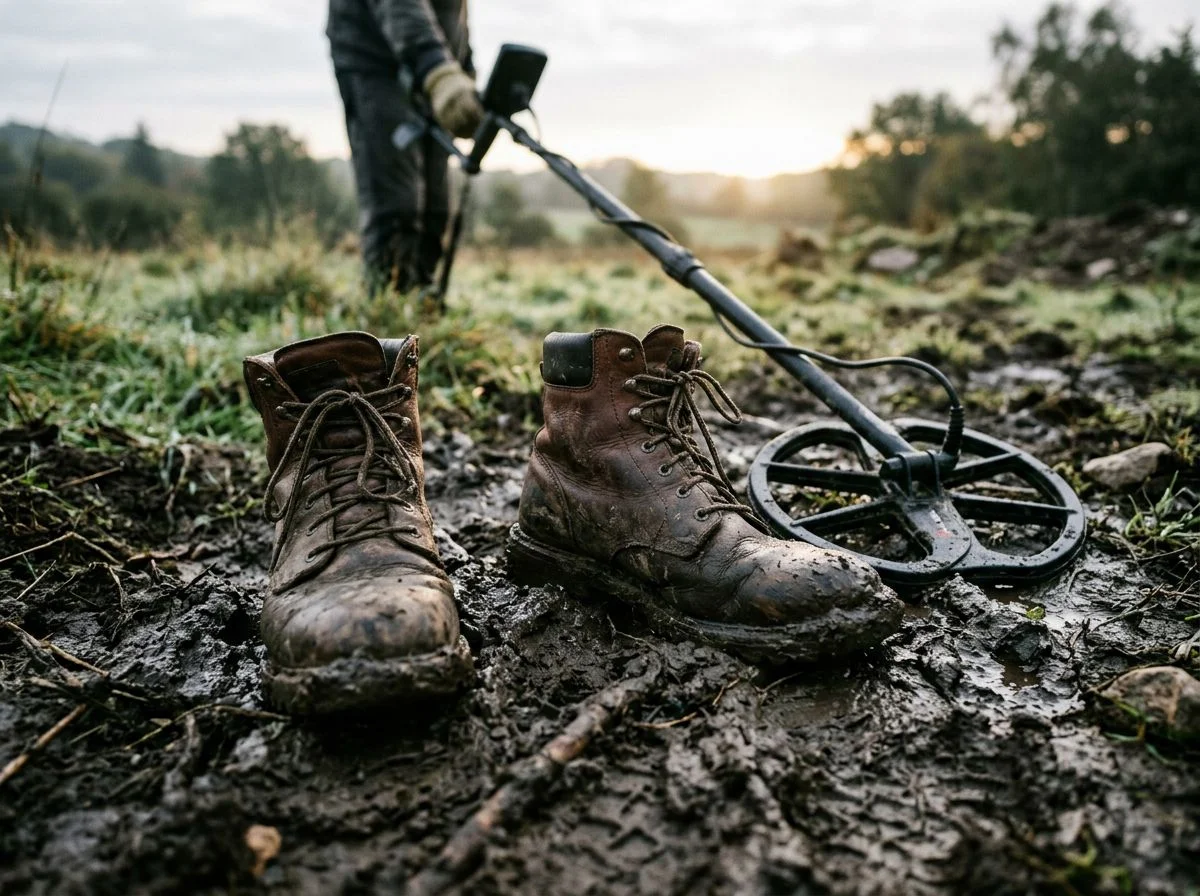
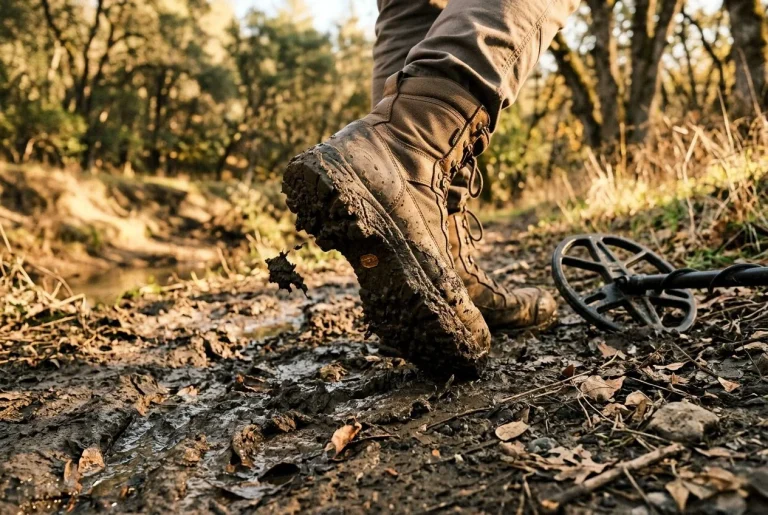
For muddy farm fields and creek beds, I reach for a tall rubber or neoprene boot every time. My buddy Mike swears by his knee-high Muck Boots. They’re lightweight, completely waterproof, and the mud sheds off the soles instead of caking up. The tradeoff? Minimal ankle support. I rolled my ankle three miles from the truck once in a similar pair. That limp back was a long, humbling walk.
For rocky terrain and all-day comfort, a proper hiking-style boot wins. The HAIX Black Eagle line keeps coming up in detecting circles because it’s genuinely metal-free. No brass eyelets, no steel shank. And the Gore-Tex membrane actually breathes. I’ve watched detectorists chase phantom signals for twenty minutes before realizing their own boot hardware was the target. Don’t be that person.
Here’s what I’ve learned after a decade of wet socks and sore arches: match the boot to the ground, not the forecast. Deep, multi-directional treads handle mud and slippery rocks, but they’re miserable on hard-packed dirt. And budget picks can surprise you. A detectorist I know tested $48 snow boots through a California downpour and a Canadian snowstorm. They outperformed boots triple the price.
Comfort matters more than specs. You’ll cover five-plus miles and kneel a hundred times in a single hunt. If your feet hate you by hour two, that expensive detector stays in the truck.
Why Boots Matter More Than Your Detector
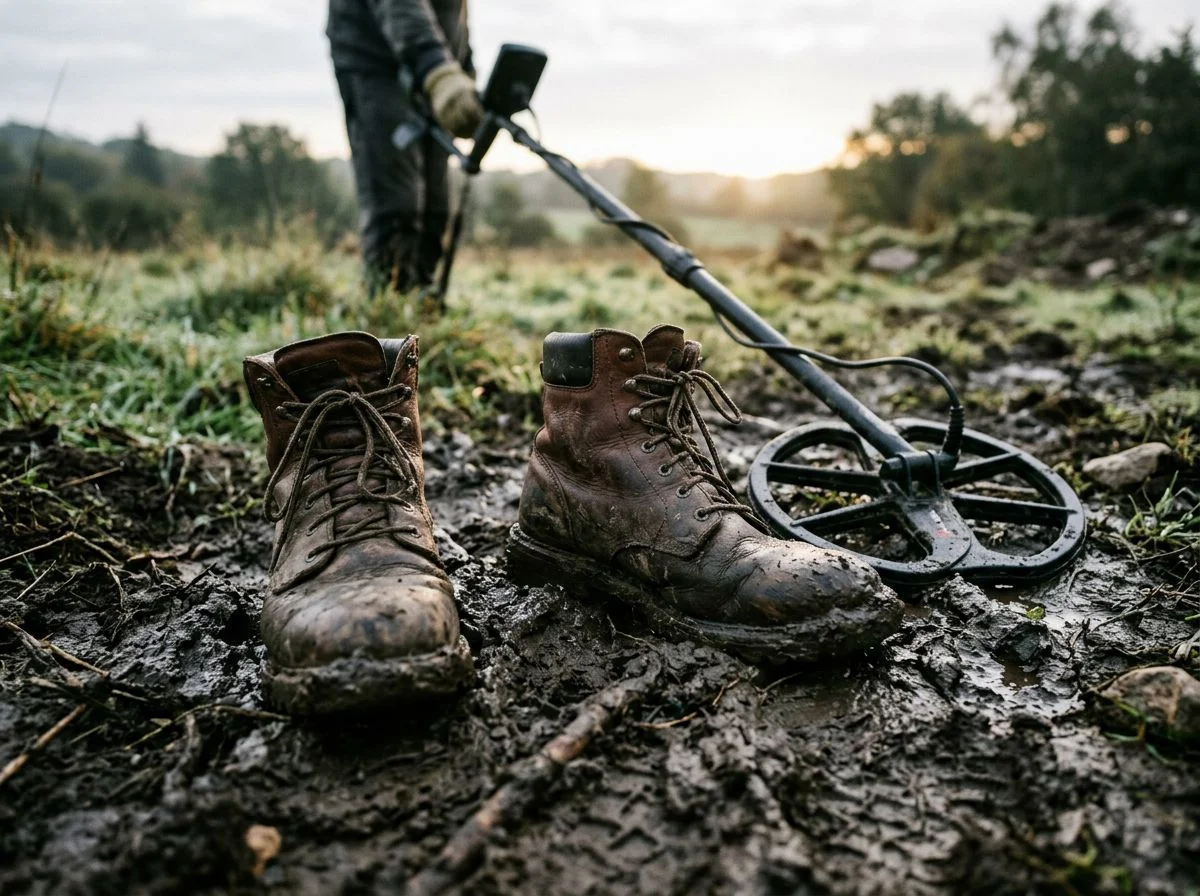
Here’s a counterintuitive claim: the most important piece of detecting gear you own isn’t your detector. It’s whatever’s on your feet. You can swing a $200 entry-level machine at a researched site and pull incredible finds. But try doing that in boots that leak, slip, or leave your feet screaming after hour three. Suddenly that $1,500 detector is useless because you’re limping back to the truck early.
Think about what a real hunt actually looks like. The average detecting session involves five to eight miles of walking over uneven terrain — pasture, plowed fields, creek banks, rocky slopes. And you’re not just walking. You’re bending and kneeling fifty to a hundred times per hunt. Digging targets. Standing back up. Swinging again. That’s not a stroll. That’s a workout with a metal detector attached.
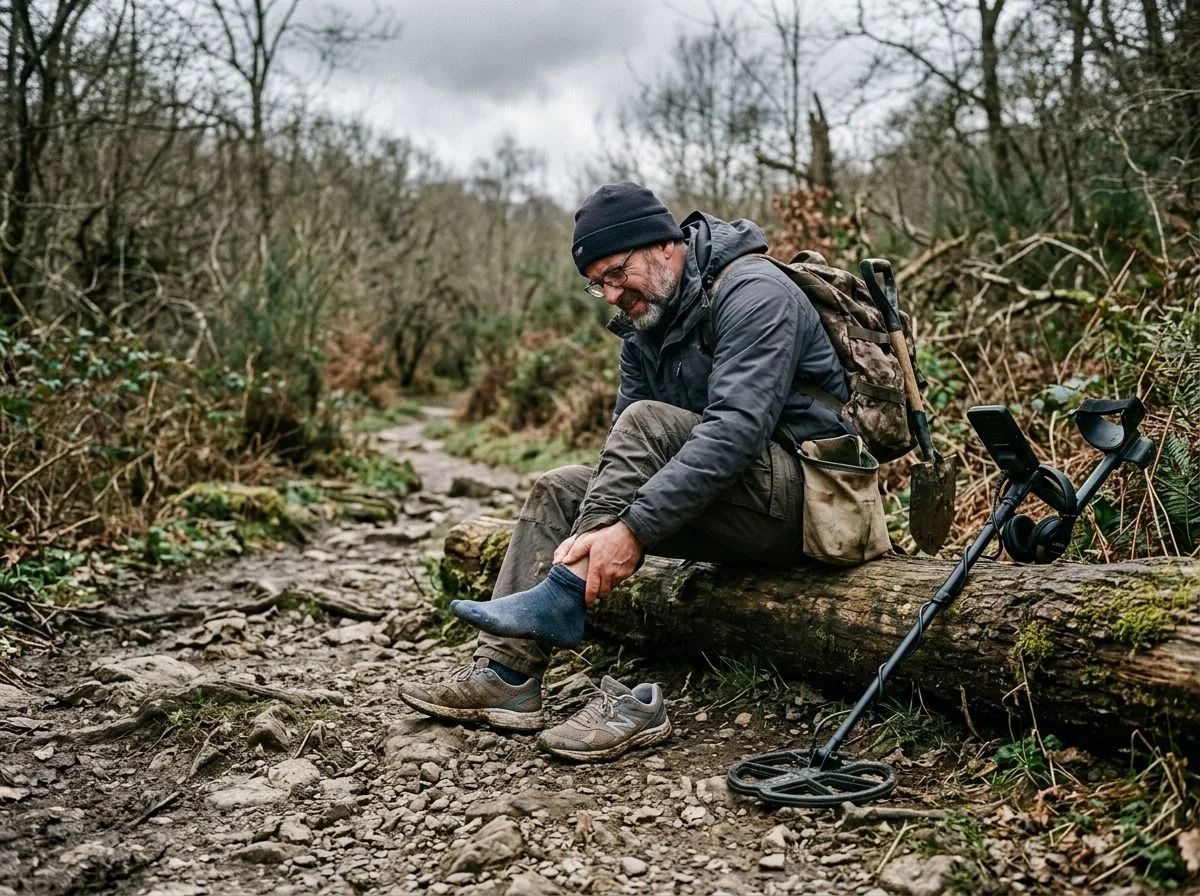
I learned this the hard way. My first serious hunt, I wore worn-out running shoes to a creek-side site outside Sacramento. The ground looked solid. It wasn’t. I hit a patch of slick clay, my foot went sideways, and I spent the next three weeks on the couch with a sprained ankle. Meanwhile, my detecting buddy Tom texted me photos of the Barber dimes he was pulling from the exact spot I’d scouted.
The research was right. The footwear was wrong.
That ankle roll changed everything about how I approach this hobby. I’d spent hours poring over old maps to find that site. The thing that took me out wasn’t a lack of knowledge or a bad detector. It was a $20 pair of sneakers with zero tread and zero ankle support. Since then, I’ve treated boots as seriously as I treat my coil choice. Here’s the thing: your detector finds targets. Your boots determine whether you’re still out there to dig them.
The good news is you don’t need to spend a fortune to get it right. But you do need to understand what actually matters. Metal-free construction. Ankle support. Tread pattern. Waterproofing. And what’s just marketing noise. That’s exactly what the rest of this guide covers.
What the Best Boots for Metal Detecting Need
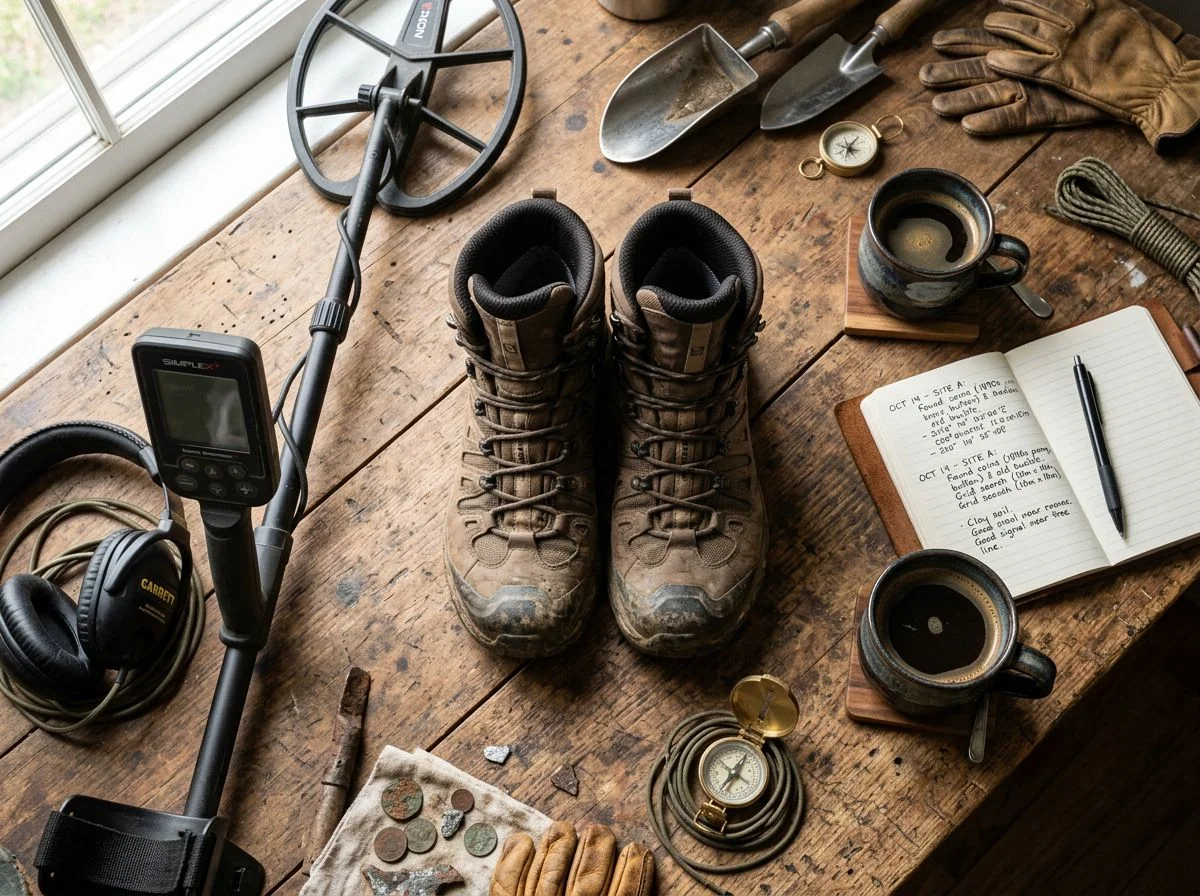
If I had to boil it down to four things: metal-free construction, waterproofing that actually holds, ankle support you can trust, and tread that grips the ground you’re actually standing on. Everything else is marketing.
Let’s start with the metal-free part. It’s the one thing that separates detecting boots from every other category. Your detector’s coil picks up metal within 12 to 18 inches of the ground. That includes the hardware on your own feet. A standard work boot has 8 to 12 metal components: brass eyelets, a steel shank, speed hooks, sometimes a safety toe. Swing your coil too close to your boot and you’ll chase phantom signals all afternoon.
I learned this the embarrassing way. My first “serious” detecting boots were a pair of work boots I already owned. They were comfortable, waterproof, and completely wrong for the hobby. Every few swings, my detector would chirp. I’d dig. Nothing. It took me an embarrassing twenty minutes to realize the signal was my own boot eyelets.
That’s why I now do what I call the kitchen table test. When a new pair of boots arrives, I don’t put them on. I lay them on the kitchen table, grab my pinpointer, and run it over every inch. Eyelets, hooks, sole, shank area, toe. If that pinpointer so much as twitches, the boots go back. My wife thinks I look ridiculous hunched over a boot with a handheld detector. But it’s saved me from buying at least two pairs that claimed “metal-free” and weren’t.
Waterproofing matters too, but “waterproof” on a product page means less than you’d hope. Swing Beep Dig Repeat’s guide emphasizes that a Gore-Tex membrane is the gold standard. It actually breathes while keeping water out. Cheaper “waterproof” boots just trap sweat. That leaves you with wet feet anyway — just from the inside.
And ankle support? That’s non-negotiable after my creek-side ankle roll. High-top construction isn’t a style choice. It’s the difference between finishing your hunt and limping back to the truck.
Matching Boots to Mud, Rocks, Sand, and Snow
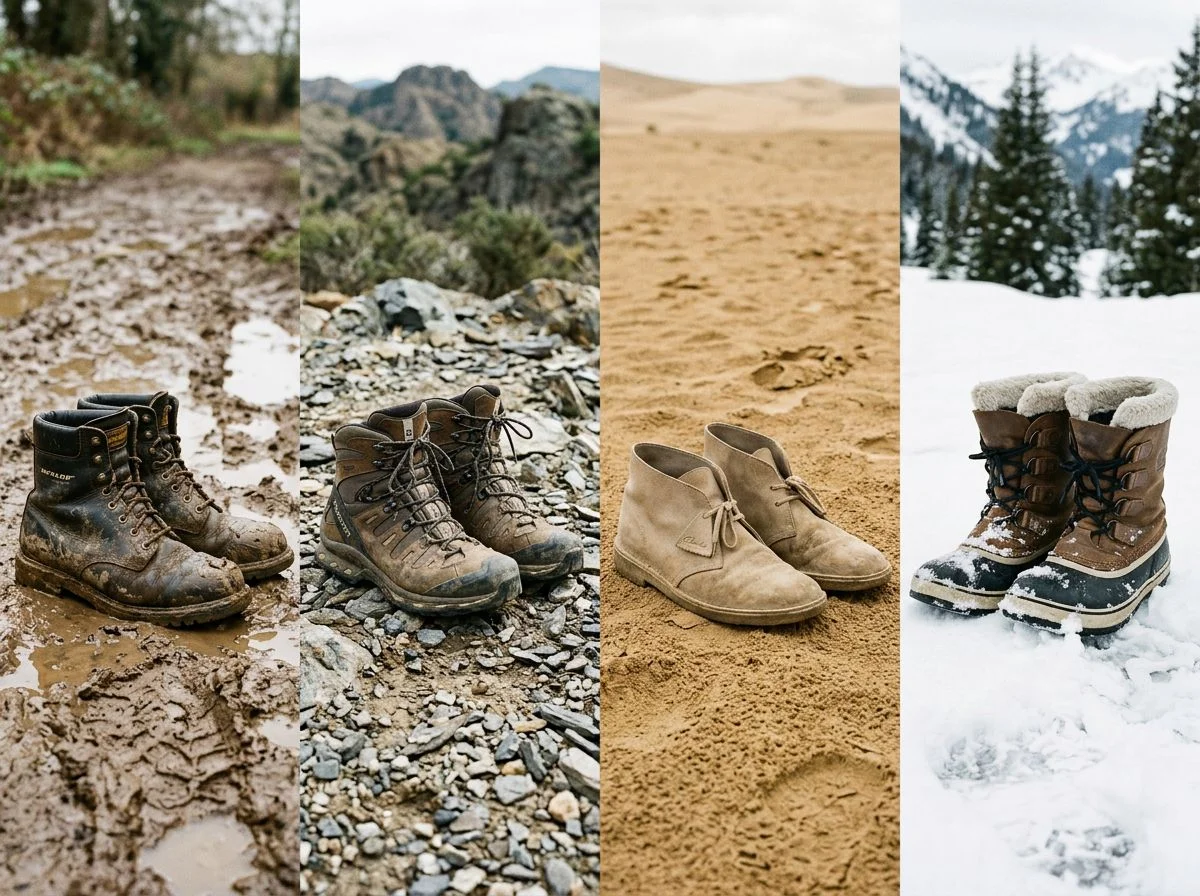
Here’s the short version: no single boot does everything well. Sticky clay demands deep, self-cleaning lugs. Loose sand needs a sole that floats instead of sinking. Rocky creek beds want grip and stiffness. Snow requires insulation and waterproofing. Match the boot to the ground, not the other way around.
I learned this the hard way at a forgotten train stop near Auburn. An 87-year-old former conductor tipped me off about it during a historical society meeting. I’d spent two weeks cross-referencing old railroad maps before I ever set foot there. The site sits on decomposed granite — that crumbly, pebbly stuff that looks solid until you put weight on it. I showed up wearing what I called my “all-terrain” boots. They were hiking boots with a decent lug pattern that had served me fine in pastures and plowed fields.
They were useless. Completely, embarrassingly useless.
Every step on that decomposed granite felt like walking on ball bearings. The lugs were too shallow and too widely spaced to bite into the loose surface. I’d take two steps forward, slide one step back. Digging a target meant bracing myself against a manzanita bush just to stay upright. After an hour, my ankles were shot and I’d nearly gone down three separate times. The boots weren’t bad boots. They were just wrong for that terrain. I eventually found a seated Liberty dime out there. But only after I switched to a pair of old work boots with deeper, tighter tread. The lesson stuck: terrain dictates tread.
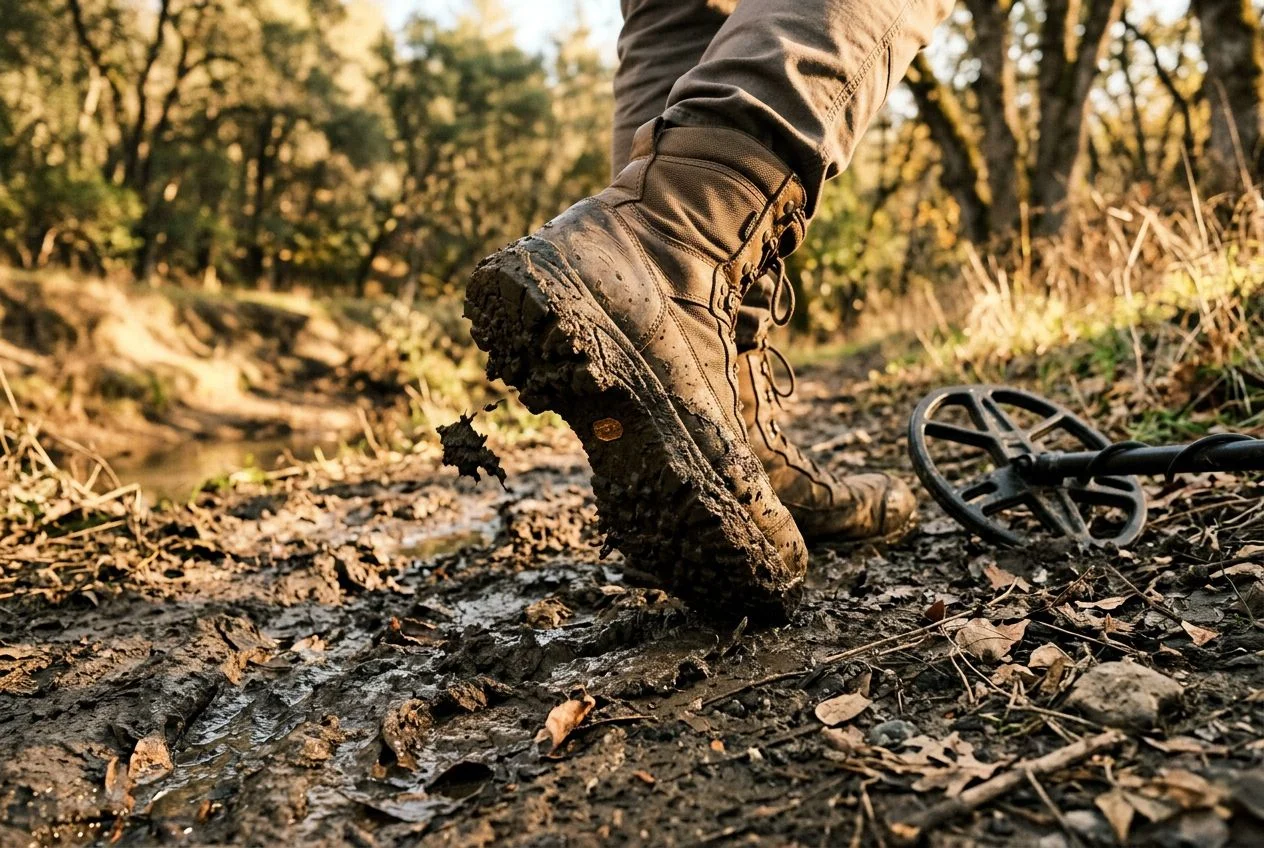
Sticky clay is its own special hell. The best boots for mud use deep, multi-directional lugs that self-clean as you walk. You need lugs at least 5mm deep. Anything shallower just cakes up into a smooth, slippery sole within ten steps. I’ve watched my buddy Tom turn his boots into clay bricks on a wet farm field while I walked away clean. All because his tread was too shallow. The difference isn’t subtle.
Loose sand requires a completely different sole pattern than rocky creek beds. On sand, you want wider, flatter lugs that spread your weight and keep you from sinking. On rocks, you want aggressive, multi-directional tread that grips wet stone from every angle. Muck Boots designs their detecting line specifically for muddy, uneven terrain. But even they’d tell you a pure mud boot isn’t ideal for scrambling over granite boulders.
Snow adds insulation to the equation. Detectorists hunting winter beaches and frozen fields report that waterproofing alone isn’t enough. You need a thermal lining that keeps blood flowing to your toes. Cold feet end hunts faster than frozen ground does.
The takeaway isn’t that you need five pairs of boots. It’s that you need to know your primary terrain and buy for that first. My Auburn mistake cost me an hour of frustration. But it taught me to read the ground before I read the product page.
Budget Boots That Don’t Suck
You can get a fully metal-free, waterproof, comfortable detecting boot for under $60 if you know what to look for. You just have to ignore the marketing and focus on three things: no metal anywhere, waterproofing that holds, and a sole that grips. Everything else at this price point is bonus.
My favorite budget pick right now is the Wondamo Men’s Snow Boot. Joanna Jana Laznicka at Focus Speed reviewed these after testing them in a California downpour and then during one of the worst Canadian snowstorms in 50 years. Three months of beach and relic hunting later, her feet stayed warm and dry. The boots cost $48. Forty-eight dollars.
Here’s the part that still makes me laugh. I bought a pair after reading her review, mostly out of curiosity. When they showed up, I ran them through my kitchen table test with the pinpointer. Completely clean. No metal anywhere. Then I wore them on a muddy creek hunt outside Sacramento. Dry feet all morning. Good grip on slick clay. I came home and told my wife, “These $48 boots just outperformed my $200 pair.”
She looked at me for a long second and said, “So you’re telling me you could have been buying $48 boots this whole time?”
Fair point. I had no good answer.
For warmer weather, the same logic applies. The Detecting Hub forums are full of recommendations for Dunlop wellies as a three-season budget option. One user with over 1,400 posts calls them “incredible for daily walks” and swears by them for winter detecting. They’re not fancy. But they’re completely metal-free, waterproof, and cheap enough that you won’t cry when the mud finally wins.
The one thing budget boots often sacrifice is ankle support. That’s the tradeoff. If you’re hunting flat farm fields or beaches, fine. If you’re scrambling over rocky creek beds, save up for something with real structure. But for most detecting days? A $48 boot that passes the kitchen table test beats a $200 boot that doesn’t.
Premium Boots Worth the Investment
If you’re going to spend real money, spend it on boots that solve a problem your $48 pair can’t. For me, that means serious ankle support, a Vibram sole that grips decomposed granite, and waterproofing that survives more than one season. The Haix Commander GTX checks every box. And here’s the part that still makes me grin. I found a pair on eBay, Grade 1 ex-military, for £60. They retail at £200. Three layers of Gore-Tex, Vibram sole, lightweight enough that my feet don’t feel like cinder blocks after six hours. A forum user on The Detecting Hub turned me onto them. He wasn’t exaggerating about the mud resistance. I’ve worn them through sticky clay that would have swallowed lesser boots whole.
Here’s the thing about Grade 1 ex-military stock: it’s often barely used. Soldiers get issued gear. Some of it sits in a locker. Eventually it gets surplused. That means you can find boots with 90% of their life left at 60-70% off retail. You just have to be patient and check listings regularly. My £60 Haix pair looked like someone had worn them twice.
The tradeoff is sizing and availability. You don’t get to try them on first, and popular sizes disappear fast. But if you’re going to spend premium money anyway, this is the smartest way to do it.
Can Your Boots Sabotage Your Hunt?
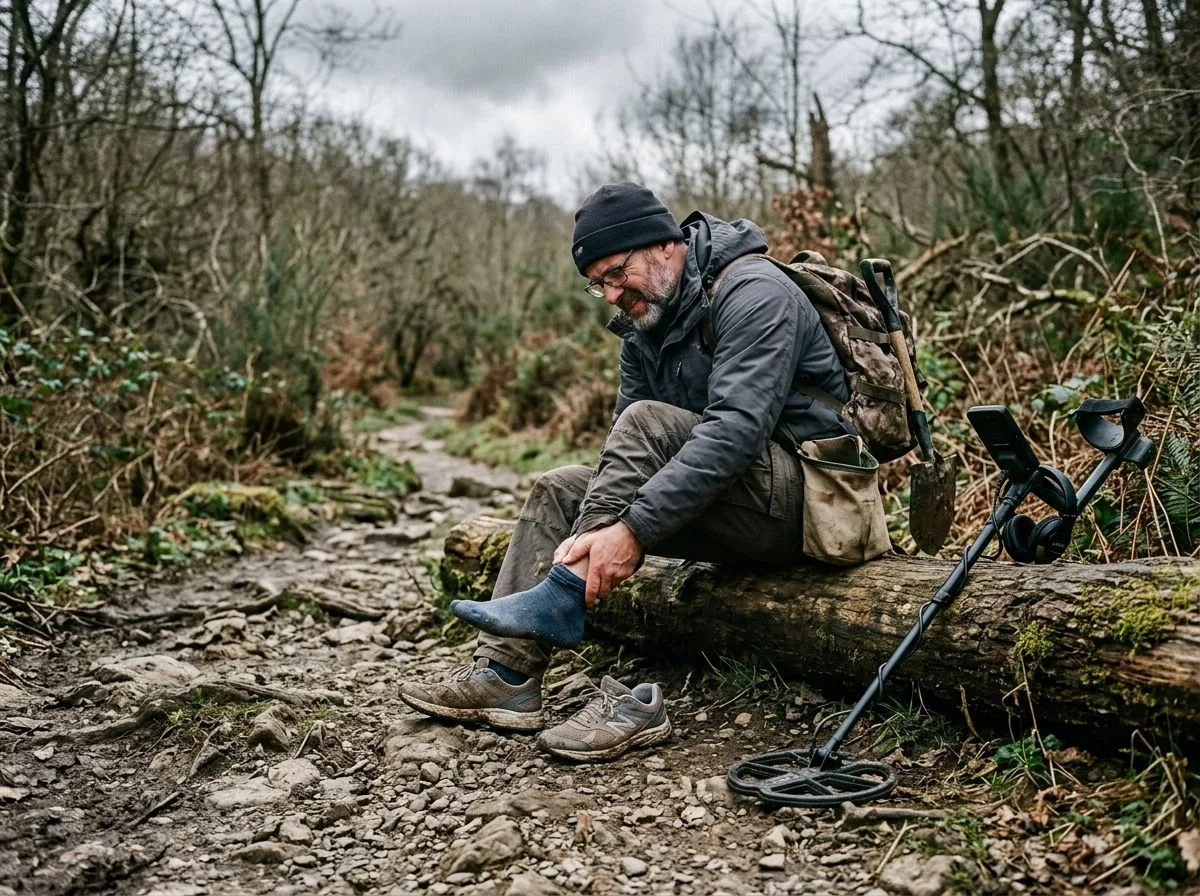
Yes, your boots can absolutely trigger your detector. And they will, if they have brass eyelets, steel shanks, or metal speed hooks. Those components sit 12 to 18 inches from your coil on every swing. That’s well within detection range. The result is a phantom signal that follows you around like a ghost you can’t shake.
I learned this the embarrassing way. My second season detecting, I spent fifteen minutes chasing a solid, repeatable signal in a farm field outside Dixon. Every pass gave me a clean hit. I dug a plug. Nothing. Scanned the hole. Nothing. Scanned the plug. Nothing. Swung again — there it was, same spot, same tone. I’m on my knees, pinpointer out, questioning my own sanity. Then I finally swept the coil past my own foot. BEEP. My brand-new work boots had brass eyelets running all the way up. I’d been detecting my own footwear for a quarter of an hour.
The Swing Beep Dig Repeat guide flags this as the single most overlooked buying factor for detectorists. A standard work boot can carry eight to twelve metal components. Eyelets, shank, toe cap, speed hooks. Every one of them is a false-signal factory. The fix isn’t complicated: look for boots explicitly marketed as metal-free, with composite shanks and non-metallic hardware. Then verify the claim yourself. I run every new pair through what I call the kitchen table test. Hold your pinpointer against the boot, all the way around, and listen. If it chirps anywhere, those boots stay home on detecting days.
Socks, Insoles, and the Comfort Layer
Here’s the short version: your boots are only half the equation. Pair them with moisture-wicking socks instead of cotton, and you’ll cut your blister risk by up to 50%. Add a quality insole for $20–40, and you’ll get measurable all-day comfort without spending a fortune. The comfort layer matters as much as the boot itself.
I learned this the hard way on a beach hunt near Half Moon Bay. Six hours of walking on sand, and I’d worn cotton socks under my brand-new boots. By hour four, I could feel the hot spots forming. By hour five, I was limping. By the time I got back to the truck, I had blisters on both heels the size of quarters. The boots were fine. The socks were the problem.
That’s when I developed what I now call the two-sock system. A thin, moisture-wicking liner sock underneath a heavier wool or synthetic outer sock. The liner pulls sweat away from your skin. The outer sock absorbs the friction that would otherwise go straight to your heel. It sounds like overkill, but I haven’t had a single blister since I started doing it. The Swing Beep Dig Repeat guide specifically recommends pairing detecting boots with moisture-wicking socks. They’re right. Cotton holds moisture against your skin, which softens it and makes it tear. Merino wool or synthetic blends dry fast and keep your feet stable inside the boot.
Then there are insoles. Most boots ship with a thin foam insert that compresses to nothing after a month. For $20–40, you can swap in something with actual arch support and heel cushioning. I use Superfeet in my Haix Commanders. The difference after a six-hour hunt is night and day. My feet used to ache by early afternoon. Now they just feel tired in the normal way. Not the “I want to amputate my own legs” way. It’s the cheapest upgrade you can make to any pair of boots. And it works whether you spent £60 on surplus or £200 on retail.
Care and Maintenance for Longer-Lasting Boots
The short version: clean your boots after every hunt, condition the leather monthly, and you’ll get two to three times more life out of them. Neglect them, and the seams and eyelets will fail long before the soles ever do.
I have a pile in my garage I call the boot graveyard. Six pairs, all dead before their time. Three of them died because I never cleaned the mud off after hunts. The dried clay worked into the stitching and slowly sawed through it. Two died at the eyelets, where rust from repeated soaking ate through the leather. One pair, my old Garrett-branded work boots, simply cracked across the toe. The leather dried out like a desert riverbed.
The frustrating part? Every one of those deaths was preventable.
Proper cleaning and conditioning can extend a leather boot’s life by 2-3x, and I believe it. The routine takes five minutes after a hunt: knock off the loose dirt, rinse with clean water, and let them dry away from direct heat. Never park them next to a heater or fireplace. That’s how leather cracks. Once they’re dry, work in a leather conditioner. I use Obenauf’s, but any quality product works.
The seams and eyelets are where neglected boots fail first. Once those go, no amount of conditioning brings them back. Water gets in through the stitching holes. The leather around the eyelets stretches and tears. Suddenly your “waterproof” boots are sponges.
Five minutes after every hunt. That’s the whole secret. My current pair of Haix Commanders is three years old and still going strong. Which is more than I can say for anything in the graveyard.
Frequently Asked Questions
The short version: most boot questions boil down to three things — metal-free construction, waterproofing, and whether you can actually afford them. Here’s what real detectorists keep asking, compiled from threads I’ve followed for years.
“Do my boots really need to be metal-free?”
This one comes up constantly. On the Friendly Metal Detecting Forum, user vanstheman3 warned that his Wolverine boots’ “brass eyelets and speed laces can sometimes be detected.” That’s not paranoia — it’s physics. Your coil picks up metal within a foot or more. Your own feet are always inside that radius. I’ve watched guys chase phantom signals for twenty minutes before realizing it was their own boot hardware. If you’re kneeling to dig, those eyelets are even closer to the coil.
“Can I just wear running shoes?”
You can, and plenty of people do. In a Reddit thread, user ChainBuzz recommended Hoka Speedgoats for dry hunts because of the cushioning. Fair point — they’re light and comfortable. But the moment you hit mud, creek beds, or uneven ground, you’ll want ankle support. I rolled my ankle in running shoes once. Once was enough.
“What’s the cheapest boot that actually works?”
Dunlop wellies get recommended repeatedly. On The Detecting Hub, Bronze age Dave called them “incredible for daily walks” and an excellent budget three-season option. You can also find ex-military Haix Commanders on eBay for a fraction of retail. Prasutagus on that same forum snagged a Grade 1 pair for £60.
“Won’t waterproof boots make my feet sweat?”
Only if you pair them with cotton socks. Moisture-wicking socks solve that problem. I covered the two-sock system earlier. Trust me on this one.
Buy for Your Terrain, Not for the Hype
Here’s the short version: a $50–150 boot gets you everything you actually need for detecting. Metal-free construction, waterproofing, ankle support, and grip. Spending more buys durability and brand name, not capability. Buy for where you hunt, not for what the marketing tells you.
I rolled my ankle in running shoes once, and that was enough. These days I wear Haix Commanders — ex-military Grade 1s I snagged on eBay, same as Prasutagus on The Detecting Hub who got his for £60. Three years in, they’re still going. The graveyard in my garage is proof that cheap boots die fast. But mid-range boots with proper care? They last.
That’s the thing nobody tells you: the $48 Wondamo boots that Joanna Laznicka tested outperformed brands costing three times as much. The Dunlop wellies that Bronze age Dave swears by cost less than a tank of gas. You’re not paying for performance when you spend $300. You’re paying for a logo and maybe an extra season of hard use.
Match the boot to the terrain. Muddy farm fields? Wellies. Rocky creek beds? Hiking boots with real ankle support. Beach? Something that sheds sand and dries fast. The boot that works everywhere doesn’t exist. But the boot that works where you hunt costs a lot less than you think.

My name is Paul and I am the founder of Detector For Metal, a dedicated resource for metal detecting enthusiasts seeking to uncover historical treasures and connect with the past using the latest technology. As a stay-at-home dad and family man, I’ve found metal detecting to be the perfect hobby that combines family adventure with historical learnings for the whole family.
As a father, I’m deeply committed to passing on this hobby to the next generation of detectorists, starting with my own children. I share advice on everything from metal detecting with kids to exploring the top 10 metal detecting sites you never thought about. My methodical approach to the hobby goes beyond the thrill of discovery—it’s about creating family traditions while preserving history and sharing the stories of those who came before us.