Table of contents
- The Red Clay Problem No One Warned You About
- Why Sierra Foothills Clay Is So Hard to Detect
- What Your Detector Is Actually Doing When It Ground Balances
- Which Ground Balance Mode Works in Red Clay
- Calibrating Your VLF Detector for Red Clay
- Find Clean Ground and Set Your Baseline
- Manual Ground Balance Using the Pump Method
- Back Off Sensitivity
- Open Up Discrimination or Lose Silver
- Sensitivity and Recovery Speed Settings Explained
- What a Ground Balance Number of 85 to 95 Means
- Calibration Mistakes That Kill Your Silver Finds
- Quick Answers for Metal Detecting in Red Clay
You calibrate for Sierra Foothills clay by manually ground balancing to the 85–95 range. Then you drop sensitivity 2–3 notches below your park setting. Finally, widen your discrimination just enough to ignore iron chatter without masking deep silver. Here’s the exact sequence for successful metal detecting in red clay.
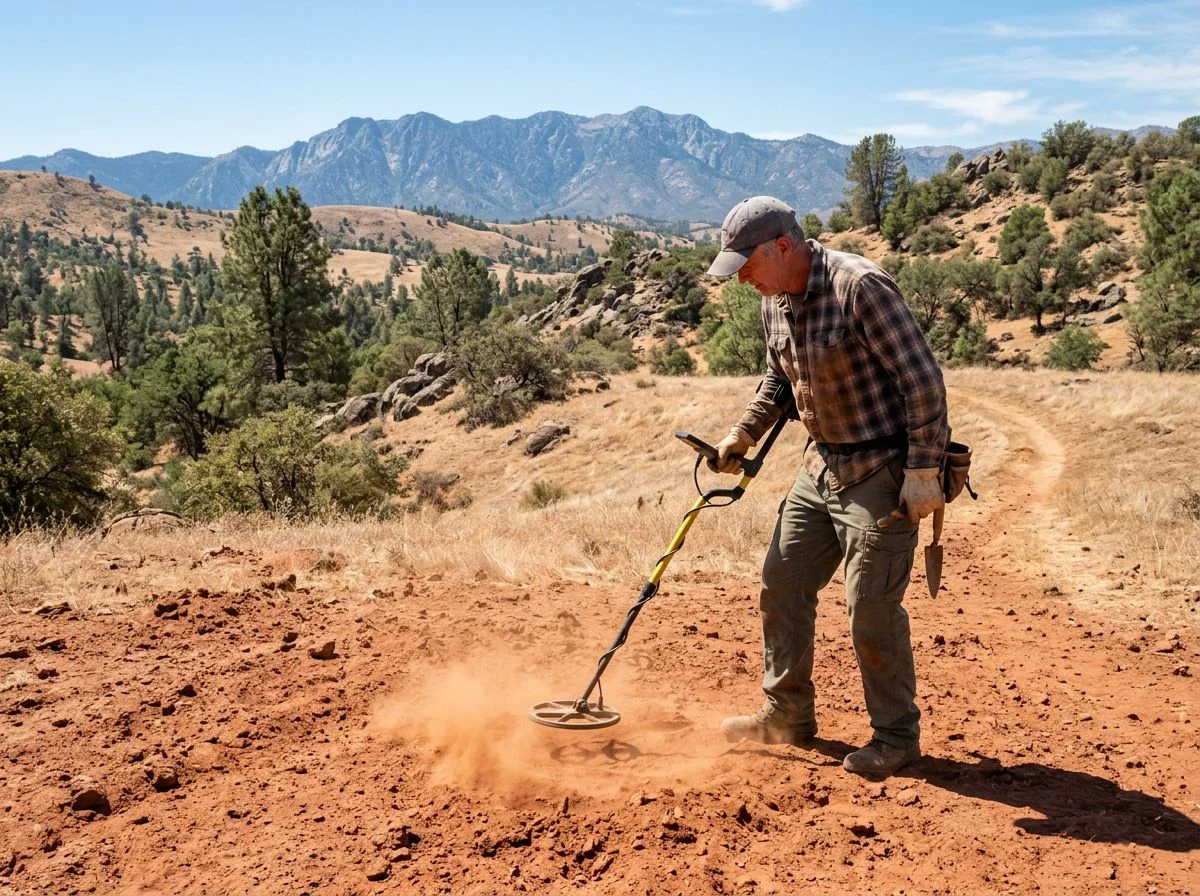
First, find clean ground. No targets, no old nail beds — just bare red dirt. Pump your coil in slow, steady 6-inch lifts while holding the ground balance button. Don’t rush it. Pumping too fast or twisting the coil throws the reading off. On my Equinox 900, the number settles between 85 and 95 out here. That’s your baseline for metal detecting in red clay.
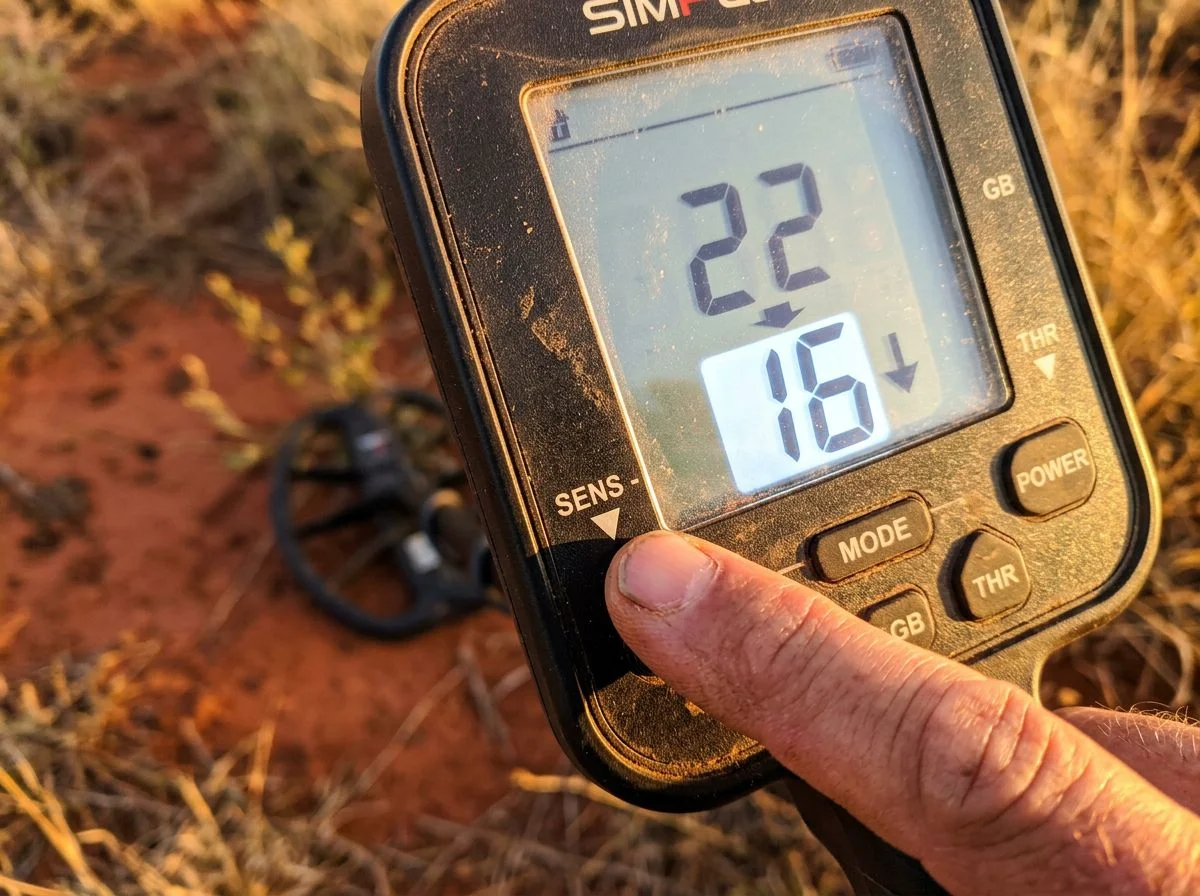
Now drop sensitivity. Red clay mimics metal targets and disrupts your detector’s electromagnetic field. Running hot just amplifies the noise. I start three notches below my normal park setting. Then I nudge up one at a time until the chatter starts. Back off one. Done.
For discrimination, resist the urge to notch out everything below dime. That iron-heavy clay will drag your target IDs down. A Seated Liberty at 8 inches can read jumpy — sometimes a solid 28, sometimes a flirty 19. If you’ve discriminated too aggressively, you’ll never hear it. I run just enough iron rejection to kill the worst square-nail falsing. Then I dig the iffy signals anyway.
Re-balance when conditions shift. Moving from a dry hillside to a damp creek bottom changes everything. Manual ground balance gives you precise control in inconsistent ground. And the Foothills are nothing if not inconsistent.
The Red Clay Problem No One Warned You About
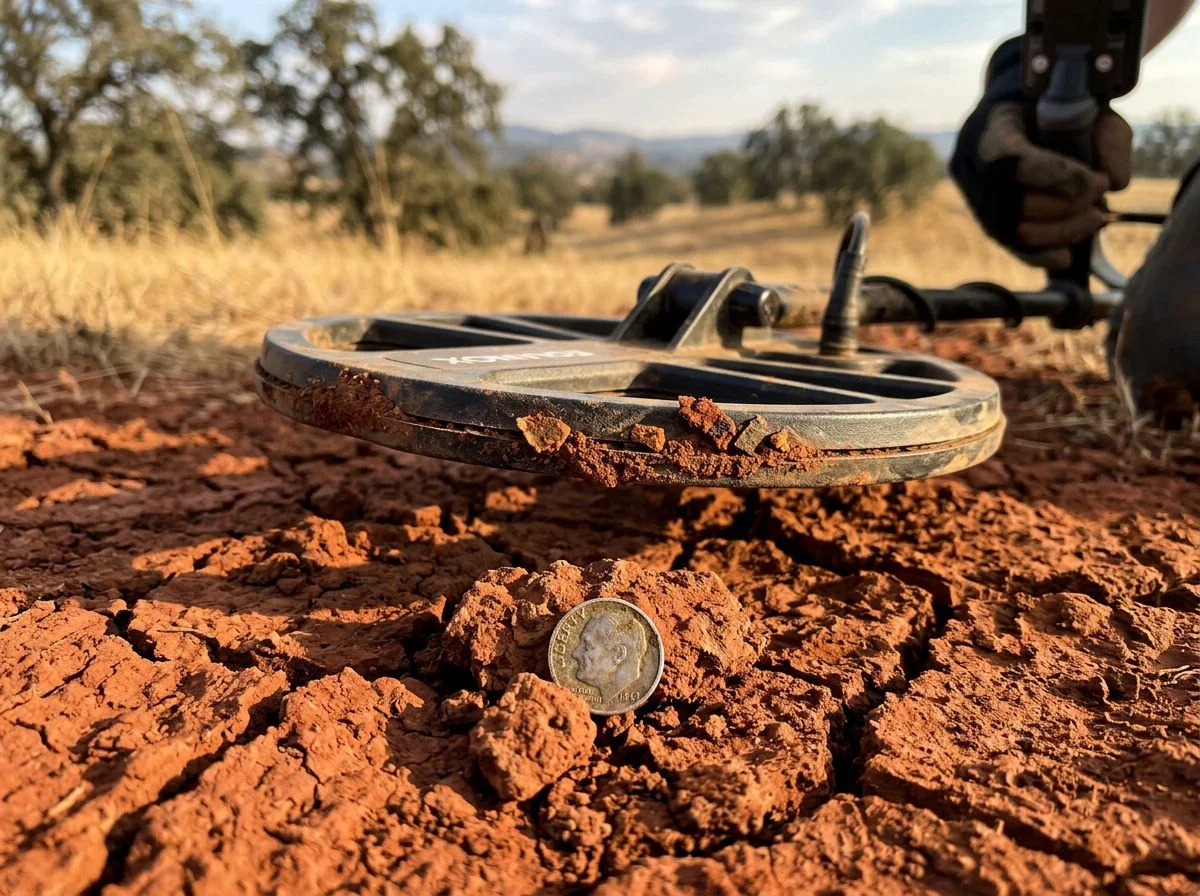
Sierra Foothills red clay isn’t just “mineralized soil.” It’s an iron-oxide-saturated environment that typically ground balances between 85–95 on the 0–99 scale. If you don’t calibrate specifically for metal detecting in red clay, you’ll spend your day digging square nails instead of silver. Here’s what nobody tells you before you drive up into gold country.
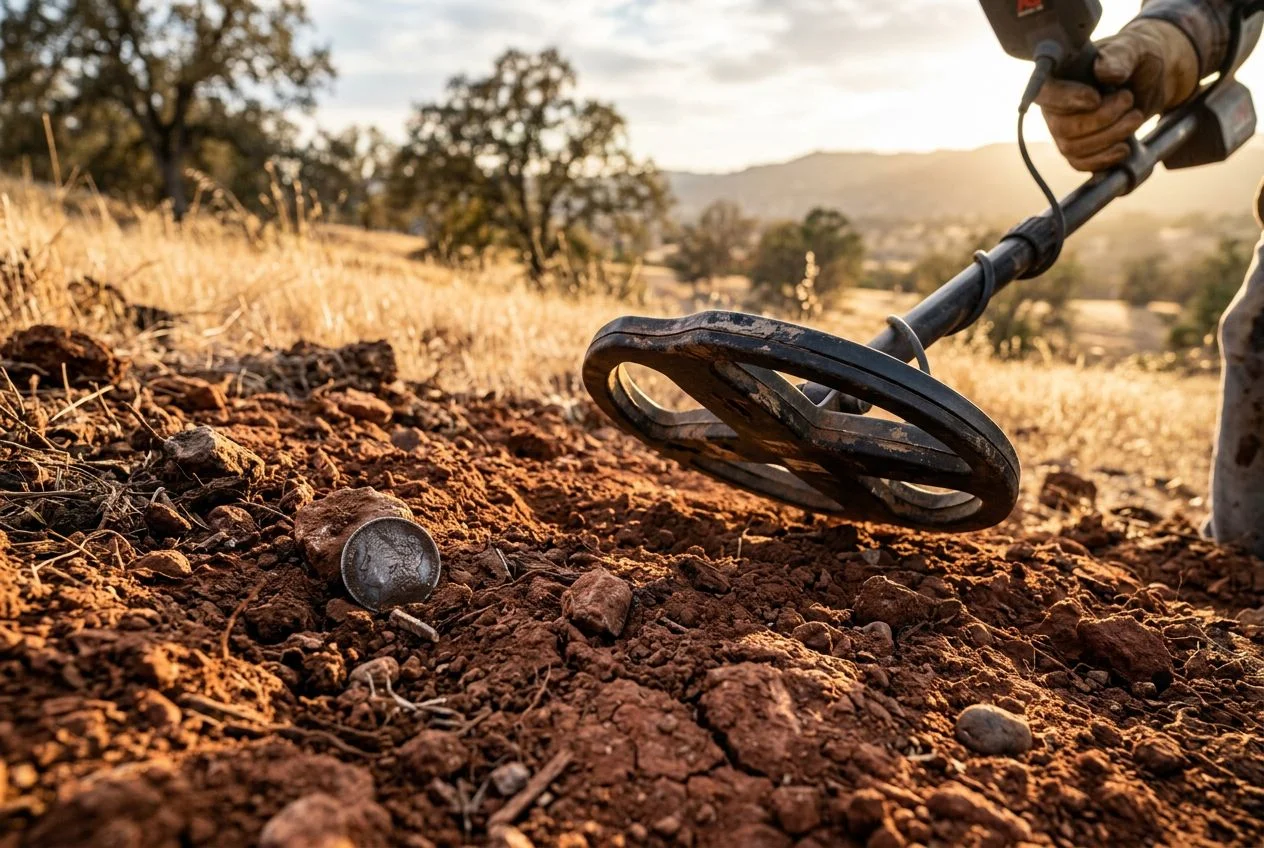
My first hunt near Auburn was a disaster. I’d been detecting for years in Sacramento parks. I figured the Foothills would be the same thing with better scenery. Within five minutes, my Equinox 900 sounded like a Geiger counter at Chernobyl. Every swing: chirp. Grunt. Scream. I dug 47 square nails that afternoon. I know because I counted them, lined up on my tailgate like some kind of sad iron museum exhibit. The problem? My ground balance was still set for park soil. That red clay was mimicking metal targets and disrupting my detector’s electromagnetic field with every pass.
Here’s the thing that generic calibration guides won’t tell you: not all red clay behaves the same. On the 0–99 ground balance scale, clean topsoil sits between 30 and 60. Typical parks run 60 to 85. But Sierra Foothills clay — that rust-colored dirt born from ancient volcanic and metamorphic rock — occupies the 85 to 95 band. That’s right where detection depth drops off a cliff. And it gets weirder. Forum reports show the Equinox 600/800 ground balances between -3 and +9 in Colorado’s iron-rich soils. But it jumps dramatically in Georgia red clay. Different clay, different numbers, different headaches.
This article will teach you exactly how to ground balance a VLF machine for Sierra Foothills soil. You’ll learn how to adjust sensitivity and discrimination without losing deep high-conductor signals. And you’ll learn how to interpret what your detector is telling you when the red dirt starts lying. Because out here, it will.
Why Sierra Foothills Clay Is So Hard to Detect
Sierra Foothills clay isn’t just “highly mineralized.” It’s a specific iron-oxide-saturated environment that typically ground balances between 85 and 95 on the 0–99 scale. That’s right where detection depth significantly drops. The same settings that work in Virginia red clay will fail here. The iron concentration, hydration, and geological origin are completely different.
The Sierra Foothills didn’t earn their red dirt by accident. This is weathered volcanic and metamorphic rock, packed with iron oxides. Those oxides give the soil its rust color. The same geological processes that concentrated gold in these hills also saturated the ground with ferrous minerals. When your VLF coil sends a signal into that soil, those iron particles become energized and create their own response. They essentially shout over the weak signals from deep silver.
Here’s the comparison that matters. On the 0–99 ground balance scale, clean topsoil and dry sand sit between 30 and 60. Typical lawns and parks run 60 to 85. Red clay occupies the 85 to 95 band. But not all red clay is created equal. Forum reports show the Equinox 600/800 ground balances between -3 and +9 in Colorado’s iron-rich soils. Yet it jumps dramatically in Georgia red clay. Different clay, different numbers, different headaches.
What makes the Foothills uniquely hostile is the combination. The iron oxide concentration is high enough to mimic metal targets and disrupt your detector’s electromagnetic field. But the clay’s hydration level also fluctuates wildly. Dry summer hillsides. Damp winter creek bottoms. That’s why re-balancing isn’t optional out here. It’s the difference between hearing a Seated Liberty at 8 inches and digging your 48th square nail.
What Your Detector Is Actually Doing When It Ground Balances
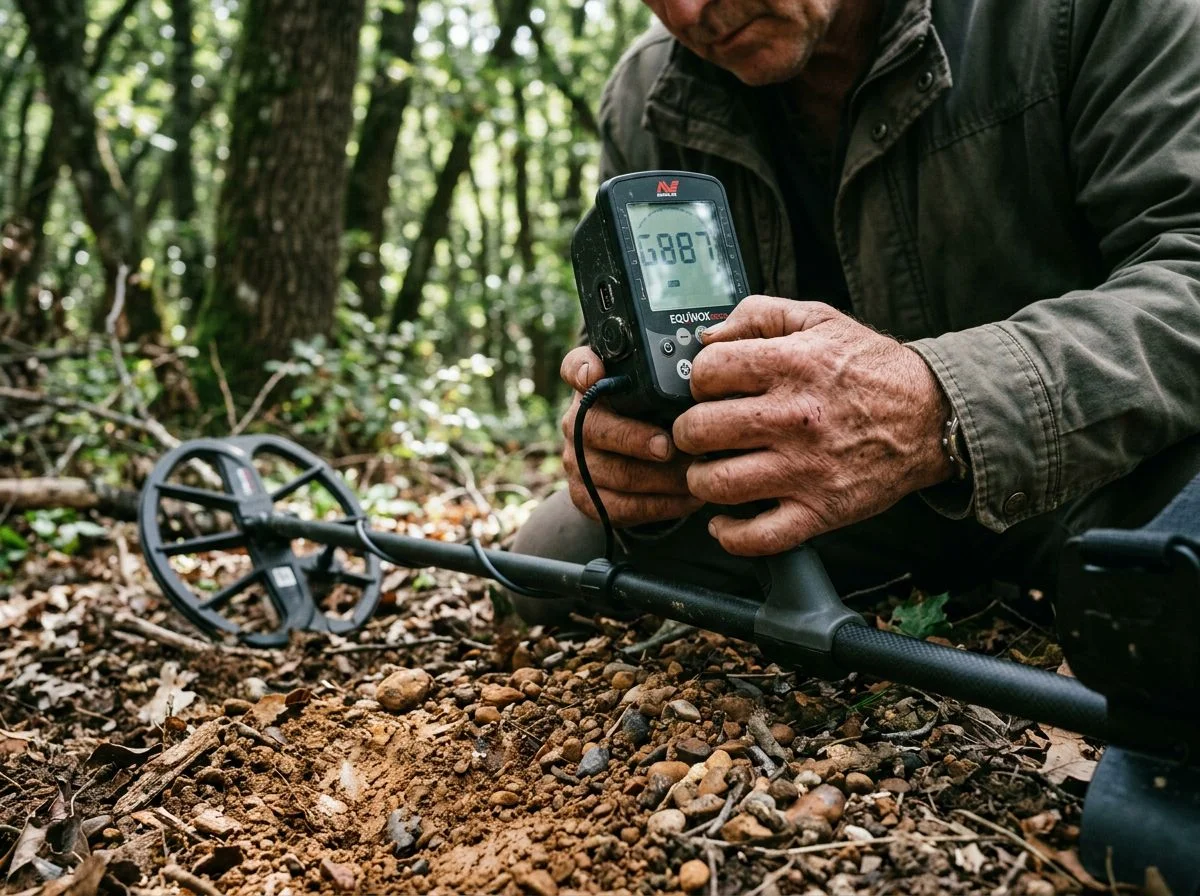
Ground balance is your detector’s way of tuning out the earth itself so it can hear metal underneath. It calibrates the machine to ignore natural soil minerals. Those iron oxides, magnetite, and conductive salts would otherwise trigger constant false signals. Once they’re tuned out, the only thing left screaming at you is an actual target.
Have you ever wondered why your detector goes quiet when you pump the coil over clean ground? But then it screams over a patch of red clay? That’s the ground balance circuit doing its job — or failing to.
Here’s the basic physics. Your VLF detector’s transmitter coil sends an electromagnetic signal into the ground. That signal energizes everything conductive or magnetic it encounters. Including the soil itself. When the soil is packed with iron particles, those minerals become energized and create their own response. They essentially shout over the weak signals from deep silver. Ground balance tells the detector, “Ignore that mineral response. That’s just dirt talking.”
The key distinction matters more than most beginners realize. Minelab’s guide separates mineralization into two categories: ferrous and non-ferrous. Ferrous mineralization — red clay, black sand, iron oxides — is magnetic. It responds strongly to your detector’s field. Non-ferrous mineralization — wet beach sand, alkali soils — is conductive but not magnetic. It messes with your machine in a completely different way. Sierra Foothills clay is ferrous. And aggressive ferrous at that.
When ground balance is set correctly, the mineral signature of the clay gets tuned out. That allows real target signals to come through cleanly. When it’s off, you get what I got that first day near Auburn. A machine that sounds like it’s having a seizure over every square inch of ground. Because it’s reading the dirt itself as one giant target.
Which Ground Balance Mode Works in Red Clay
In Sierra Foothills red clay, manual ground balance wins almost every time. Auto gets you close. Tracking drifts when you need stability most. And manual — once you learn to pump the coil properly — locks in the exact setting that lets deep silver cut through the iron chatter.
I learned this the hard way. Last spring I was hunting an old stagecoach stop near Coloma. I ran my Equinox 900 in auto ground balance like I’d done for months. The machine seemed fine — until it didn’t. Over about thirty minutes, I watched the ground balance number drift from 87 to 92. No warning. No obvious reason. The clay wasn’t changing that fast. The detector was chasing its own tail. And every time it adjusted, deep targets got a little murkier.
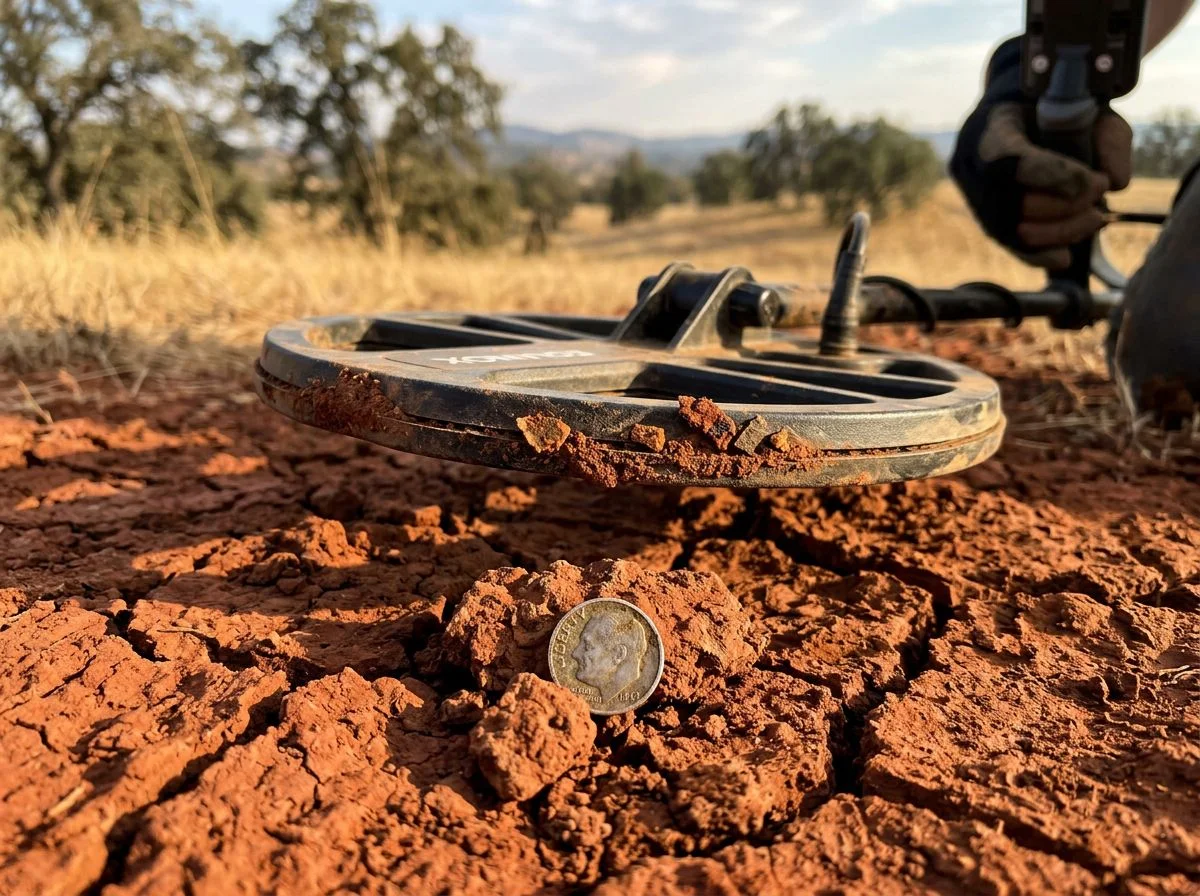
So I stopped. I switched to manual. I pumped the coil over a clean patch of ground while adjusting the controls until the threshold tone steadied. That’s the classic manual ground balance method. It took me maybe forty seconds. First real signal after locking it in? A 1902 Barber dime at seven inches. It was sitting right where I’d already swung a dozen times with auto engaged. The coin hadn’t moved. The detector just finally stopped lying to me.
Here’s the breakdown. Automatic ground balance determines the setting with a single button press. It’s fast, convenient, and good enough for mild soil. But in aggressive red clay, that single press samples one tiny patch of ground at one moment in time. If you’re standing over a hot rock or a pocket of concentrated iron, your “auto” setting is already wrong before you start swinging.
Tracking ground balance continuously adjusts in real-time. That sounds perfect for changing conditions. The problem? In red clay, tracking can’t tell the difference between a deep silver coin and a mineralized pocket. It adjusts toward the noise, not away from it. That drift from 87 to 92 wasn’t the soil changing. It was the tracking algorithm slowly tuning itself into the clay’s iron signature instead of rejecting it.
Manual puts you in control. You pump the coil. You listen to the threshold. You decide when it’s locked. It’s slower, sure. But in Sierra Foothills clay, slow and deliberate beats fast and wrong every single time.
Calibrating Your VLF Detector for Red Clay
What if I told you that most detectorists in the Foothills are running their sensitivity 30% too high? And their discrimination 20% too aggressive? The result is a machine that screams constantly. It masks deep silver. And it leaves you digging iron nails all afternoon. Here’s the calibration sequence that fixes it for metal detecting in red clay.
Find Clean Ground and Set Your Baseline
Before touching any dials, locate a patch of ground with no targets. Sweep a 3-foot square area. If you get any repeatable signal, move. You cannot ground balance over a buried nail or hot rock. The detector will calibrate to the target instead of the soil. Every subsequent reading will be wrong.
Once you have clean ground, note the current ground balance number. In Sierra Foothills clay, that number typically lands between 85 and 95 on the 0–99 scale, according to LuckyFind’s practical guide. If you’re seeing something in the 40s or 50s, you’re either not on red clay or your machine is lying to you.
Manual Ground Balance Using the Pump Method
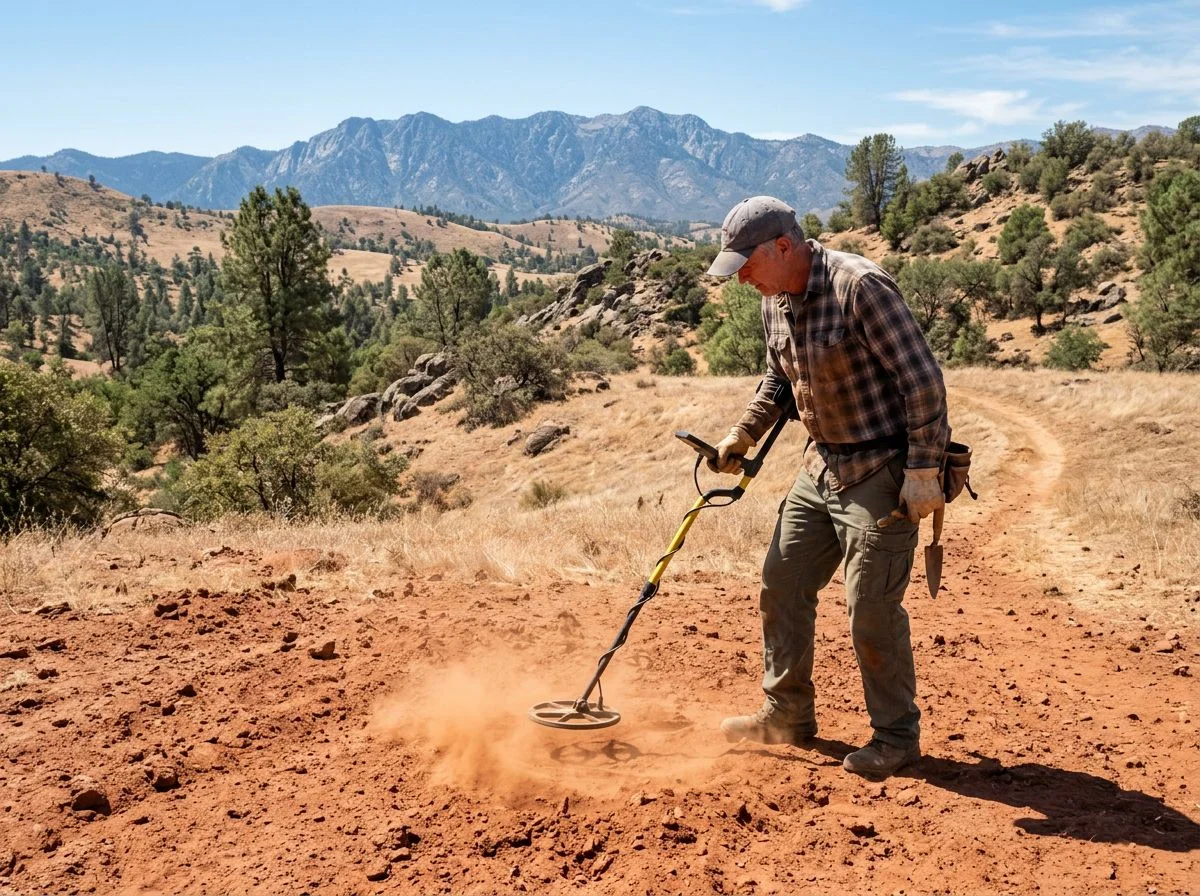
Switch to manual ground balance. Auto and tracking modes have their place. But in aggressive ferrous clay, manual gives you the precise control that keeps deep high-conductor signals audible.
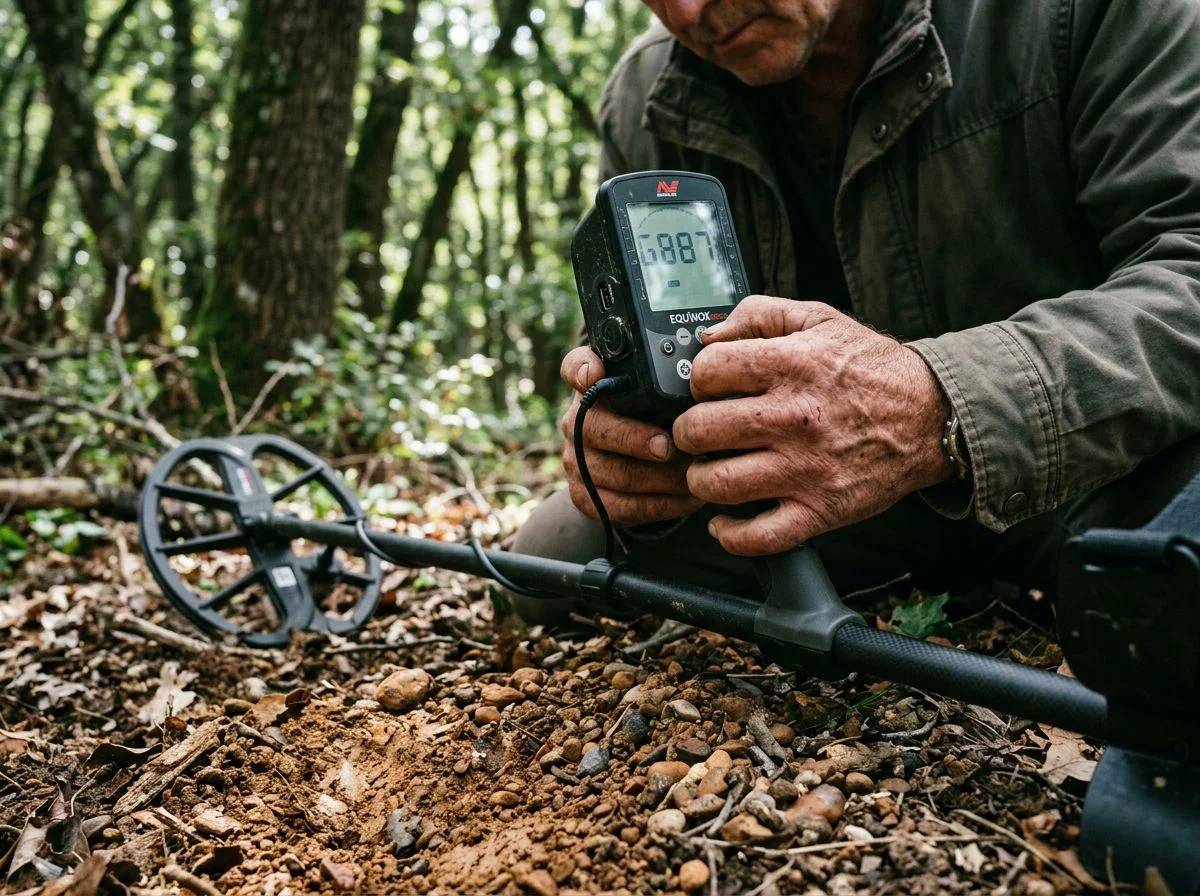
Hold the coil about six inches above the ground. Press and hold the ground balance button. Then pump the coil smoothly down to within an inch of the soil and back up. Don’t twist the coil on the way down. That introduces false readings. Adjust the ground balance setting up or down while pumping. Keep going until the threshold tone remains steady whether the coil is high or low. When the tone stops changing with coil height, you’ve locked it in.
Back Off Sensitivity
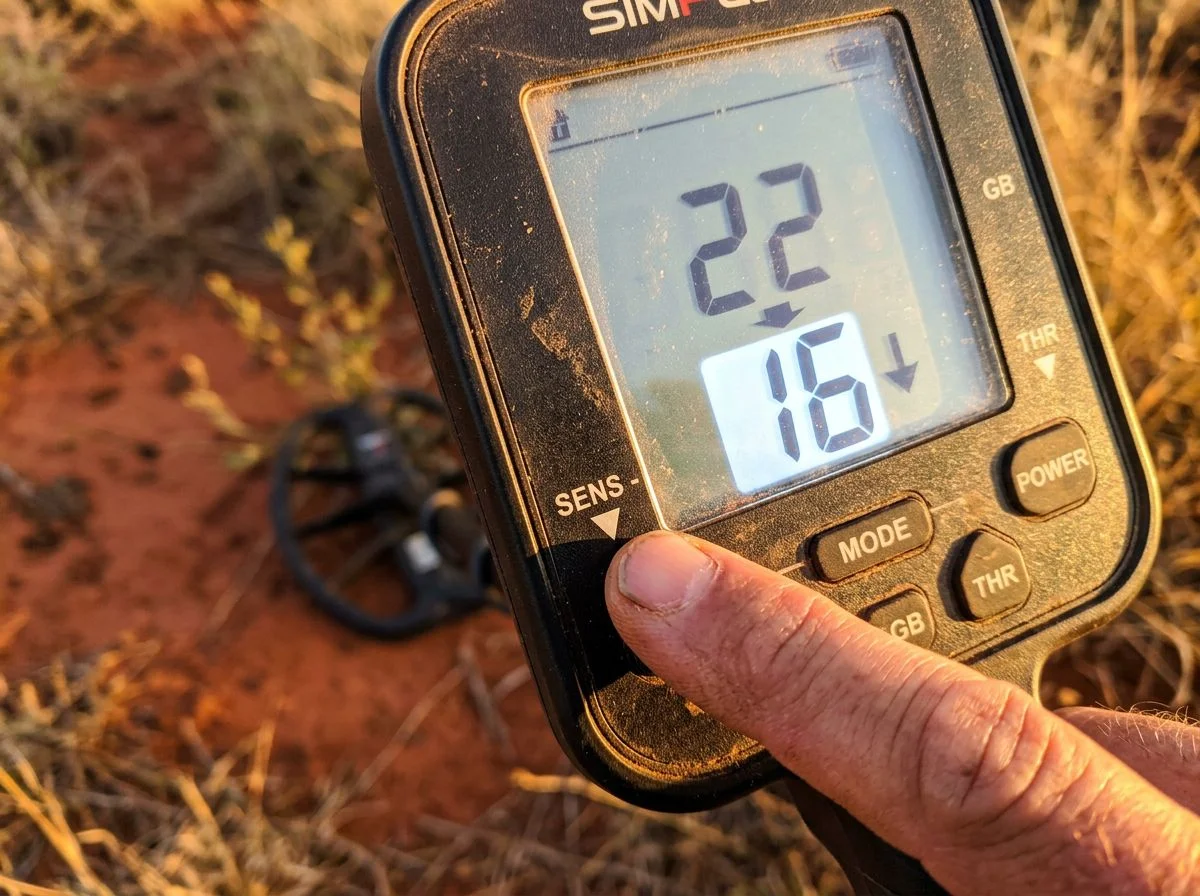
Here’s where most Foothills hunters go wrong. They crank sensitivity to maximum, thinking more power equals more depth. In red clay, the opposite happens. High sensitivity amplifies the mineral response from the iron oxides. That creates excessive ground noise and signal distortion. It buries faint silver signals under a wall of chatter.
Start at 60% of maximum sensitivity. Hunt for ten minutes. If the machine is stable — occasional chirps you can mentally filter, not constant screaming — bump it up 5%. Repeat until you find the threshold where instability begins. Then back off one notch. That’s your setting. In my Equinox 900 on Auburn clay, that’s usually around 18–20 on the 0–25 scale.
Open Up Discrimination or Lose Silver
Discrimination is a double-edged sword in ferrous soil. Red clay already mimics ferrous targets. So aggressive discrimination — anything above iron rejection — will mask high conductors like silver that sit near iron. The clay itself creates enough ferrous interference that your detector can’t reliably separate a deep dime from the surrounding minerals.
Set discrimination to reject only the lowest iron range. If your machine has notches, reject nothing above a small nail. Yes, you’ll dig more trash. But you’ll also hear the silver that everyone else is walking over.
Sensitivity and Recovery Speed Settings Explained
Sensitivity and recovery speed are where most Foothills detectorists sabotage themselves. Crank sensitivity to max and slow recovery to a crawl, and you’ll actually hear less silver — not more. The trick is running both settings lower than your instincts tell you.
Here’s the hard truth. In highly mineralized soils, running sensitivity at maximum can reduce your effective detection depth by 40% or more. Compared to a properly calibrated lower setting. I know that sounds backwards. You’d think more power equals more depth. But in red clay, that extra sensitivity doesn’t punch deeper. It just energizes more iron particles. Those particles flood your detector with ground noise. And that noise masks the weak signals from deep high conductors.
When your ground balance readings land in that 85–95 range, detection depth drops off a cliff if you’re running hot. And that’s exactly where Sierra Foothills clay sits, according to LuckyFind’s scale. I’ve tested this on my Equinox 900 more times than I care to admit. Sensitivity at 22 out of 25? Chatter city. Drop it to 16 or 17? Suddenly the machine settles down. I’m hearing faint, repeatable signals at seven inches that were completely invisible before.
Recovery speed works the same way, just in reverse. Most people slow it way down thinking they’ll catch deeper targets. But in iron-saturated clay, a slow recovery speed means your detector spends too long processing every speck of mineralized dirt. A faster recovery — not max, but quicker than default — lets the machine separate real targets from ground noise. On my Equinox, recovery speed 5 or 6 in Foothills clay beats 3 every single time.
The takeaway? Stop fighting the dirt. Back off sensitivity until the chatter stops. Then back off one more notch. Speed up recovery just enough to keep signals crisp. Your ears will thank you. And so will the silver that’s been hiding under all that noise.
What a Ground Balance Number of 85 to 95 Means
A reading of 85–95 on the 0–99 scale means you’re standing in highly mineralized soil. It’s almost certainly iron-rich red clay. Detection depth drops significantly here. And your machine has to work hardest to separate real targets from ground noise. It’s not a malfunction. It’s a diagnosis.
The first time I ground balanced at a Foothills homestead and saw 93 on the display, I thought my detector was broken. It wasn’t. It was telling me exactly what I was up against.
Here’s the scale, straight from LuckyFind’s practical guide. 0–30 is the salt range — wet beach sand and alkali flats. 30–60 is low-mineral ground. That’s your clean topsoil and dry sand. 60–85 covers typical US lawns and parks. That’s the kind of dirt most detectorists learn on. Then 85–95 is where you are now: high-mineral red clay and iron-stained soil. Above 95, you’re in magnetite-heavy gold country. The ground itself practically sets off your coil.
What that 93 is really telling you is this. The iron oxides in that clay are energizing in response to your detector’s electromagnetic field. And they’re shouting back at it. The clay isn’t just passive dirt. It’s actively competing with every coin and relic down there. That’s why your depth drops. The machine isn’t losing signal strength. It’s losing signal contrast. A silver dime at six inches has to out-shout a whole cubic yard of screaming iron particles.
So when you see 85–95, don’t panic. And don’t crank sensitivity to compensate. That number is your detector being honest with you. The fix isn’t more power. It’s the calibration sequence we covered in Steps 1 and 2. Plus the sensitivity restraint from the previous section. The red dirt isn’t lying to you. It’s just loud.
Calibration Mistakes That Kill Your Silver Finds
The fastest way to lose silver in red clay is to ground balance wrong. Usually by balancing directly over a target. Or pumping the coil too fast. Or twisting it during the sweep. These mistakes don’t just cost you depth. They actively train your detector to ignore the signals you came for.
How many silver dimes have you walked over because your ground balance was set for the parking lot, not the clay? I don’t want to know the answer. Because I’ve probably done the same thing.
Here’s what I see detectorists get wrong most often. And I’ve been guilty of every single one.
Ground balancing directly over a target. This is the big one. You find a quiet-looking patch. You start your balance routine. And — surprise — there’s actually a buried nail or a coin right under your coil. Your machine now thinks that target’s signal is the ground itself. So it tunes it out. Congratulations: you just made silver invisible. Always balance over clean ground. If you’re not sure, sweep the area first. Dig any repeatable signals before you calibrate. LuckyFind’s guide calls this out specifically. It’s the mistake I see cost people the most finds.
Pumping the coil too quickly. Ground balance routines need a steady, deliberate up-and-down motion. Maybe one pump per second. When you pump fast, the detector can’t sample the ground properly. It locks in a wrong value. In Foothills clay, a wrong value means your machine is either chattering constantly or deaf to deep high conductors. Slow down. Breathe. Let the machine do its job.
Twisting the coil during the pump. Your coil needs to stay parallel to the ground throughout the motion. If you twist your wrist at the bottom of each pump, the coil’s angle changes. The detector reads the soil differently on every pass. That inconsistency produces a garbage balance. Keep your arm straight and the coil flat.
The fix is simple. Find clean ground. Pump slowly and steadily. Keep the coil flat. And re-balance whenever the soil changes. Moving from a dry hilltop to a wet creek bottom, for example. Re-balancing takes thirty seconds. Skipping it can cost you the entire hunt.
Quick Answers for Metal Detecting in Red Clay
Here’s the short version if you’re standing in red dirt right now: balance over clean ground, keep sensitivity around 60–70%, slow your sweep, and re-balance every 20–30 minutes as moisture changes. That alone fixes most of the chatter.
Why does my detector go crazy in Sierra Foothills clay?
The iron oxides in that red dirt are electrically conductive enough to mimic metal targets and disrupt your detector’s electromagnetic field. Your machine isn’t broken — it’s hearing the ground itself. A proper ground balance tunes that out.
What ground balance number should I expect?
Between 85 and 95 on the 0–99 scale. That’s the high-mineral red clay band where detection depth drops significantly. If you’re seeing numbers in the 30s or 40s, you balanced over a target. Or your machine didn’t lock in correctly. Start over on clean ground.
How often should I re-balance?
More than you think. Moving from a dry hilltop to a wet creek bottom changes the soil’s mineral signature enough to throw off your calibration. LuckyFind recommends re-balancing whenever conditions shift. In the Foothills, that means every 20–30 minutes as the day heats up and the clay dries out.
Should I use tracking ground balance instead?
Tracking can help on ground that changes constantly. But in heavy clay, it sometimes chases hot rocks and drifts off target. Manual or auto balance with periodic re-checks gives you more control. If your machine has tracking, test it. But don’t trust it blindly in this soil.
Will a pulse induction detector solve this?
PI machines handle extreme mineralization better than VLF. But you lose discrimination. For silver hunting in red clay, a properly calibrated VLF still wins.

My name is Paul and I am the founder of Detector For Metal, a dedicated resource for metal detecting enthusiasts seeking to uncover historical treasures and connect with the past using the latest technology. As a stay-at-home dad and family man, I’ve found metal detecting to be the perfect hobby that combines family adventure with historical learnings for the whole family.
As a father, I’m deeply committed to passing on this hobby to the next generation of detectorists, starting with my own children. I share advice on everything from metal detecting with kids to exploring the top 10 metal detecting sites you never thought about. My methodical approach to the hobby goes beyond the thrill of discovery—it’s about creating family traditions while preserving history and sharing the stories of those who came before us.