Table of contents
- Why Fall Is the Most Underrated Detecting Season
- Harvested Fields Most Detectorists Miss
- The 48-hour window
- Why tilled ground is worth the scramble
- Reading the field before you swing
- Beach Detecting After the Tourists Leave
- The Erosion Effect
- Where to Actually Hunt
- What Actually Comes Out of the Ground
- Wet Soil and Your Detector Settings
- Sports Fields and Fairgrounds in the Fall
- Field Techniques for Stubble and Harvested Ground
- Permission Protocols for Fall Farmland
- Gear Adjustments for Cooler, Wetter Conditions
- Common Fall Metal Detecting Questions
- Can I detect in the rain?
- When should I schedule my fall hunts?
- Get Out Before the Ground Freezes
Fall detecting comes down to three metal detecting strategies: hit harvested fields the moment crops come down, lower your sensitivity and ground balance constantly in wet soil, and slow your swing way down. Do those three things and you’ll pull targets from ground you’ve already walked a dozen times.
The harvested field window is the big one. Corn, wheat, and soybean fields are locked all summer. They’re physically impassable until combines come through. Then, as ckgscoop’s autumn field guide points out, you’ve got a gap that can be as narrow as a single day before the plow churns everything under. That’s not a metaphor. A farmer harvests Monday, tills Tuesday. If you didn’t ask permission in September, you missed it.
My buddy Tom learned that one the hard way. He scouted a soybean field near Dixon all summer, finally got the owner’s number in October, and called two days after the tiller went through. He still found a few wheat pennies in the turned soil, but the deep targets were gone. Redistributed to god knows where.
The moisture shift matters more than people think. When fall rain soaks into that baked summer ground, electromagnetic field transmission actually improves. Your detector sees deeper. But there’s a catch. That same wet dirt gets jumpy. I’ve had my Equinox 900 throw erratic VDI numbers on every other swing in mineralized autumn soil.
The fix is boring but it works: drop sensitivity 15–20% and ground balance every 10 to 15 minutes. Kellyco’s seasonal guide drills this hard, and they’re right. It feels like you’re losing depth, but you’re actually gaining usable signal.
And slow down. I know, everyone says it. But fall is when it actually pays off. The ground is soft enough to hear faint targets. Slower swing, more overlap, lower coil. That’s the whole trick.
Why Fall Is the Most Underrated Detecting Season
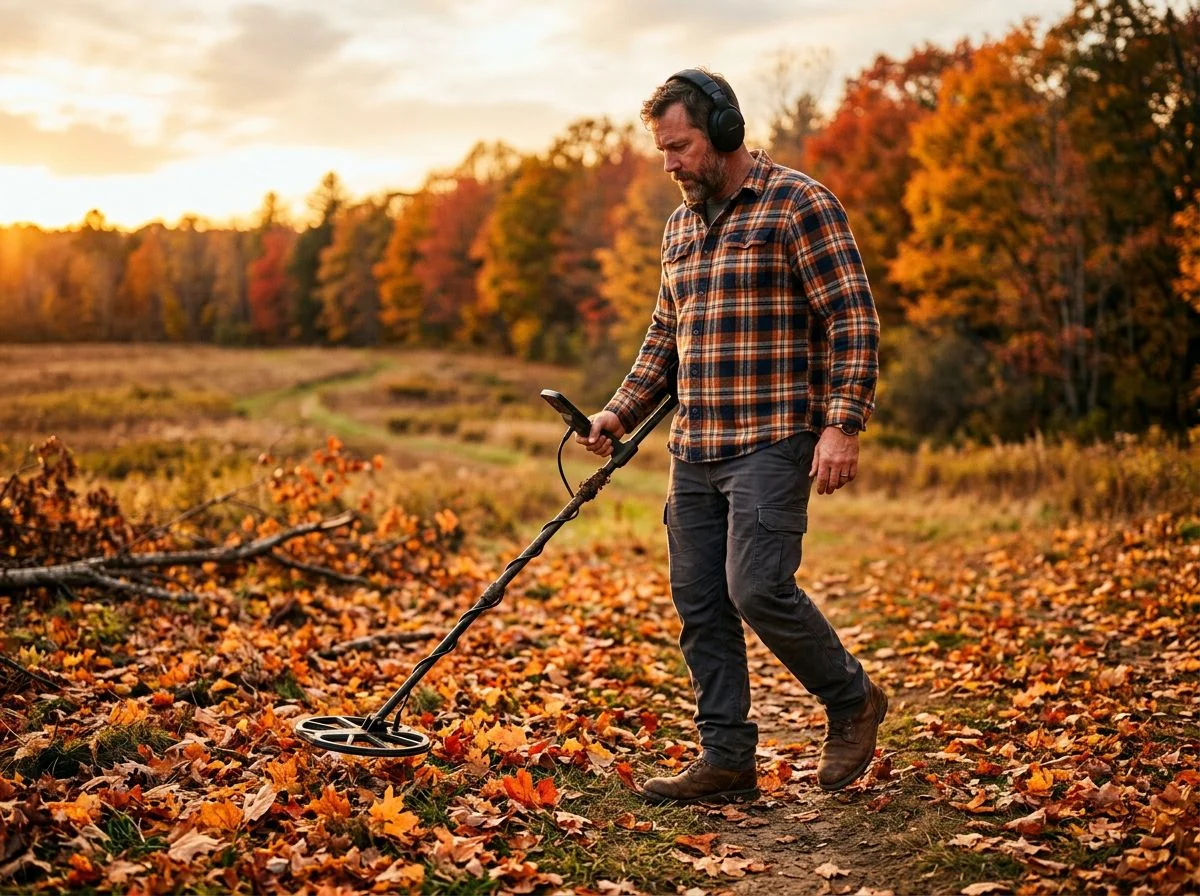
Here’s the short version: fall is when the ground finally gives up what summer was hiding. Rain softens baked soil and improves your detector’s signal penetration. Harvested fields open up for the first time in months. Cooler temperatures mean you can actually hunt past 10 AM without feeling like you’re being slow-roasted. It’s not the consolation prize of the detecting calendar. It’s the main event.
The counterintuitive part is this: the same ground you hunted all summer is hiding targets you couldn’t reach. Fall is when they finally surface. Not because the targets moved. They’ve been sitting there the whole time. Because the conditions changed.
Think about what summer actually does to the ground. Soil temperatures hit 95°F and stay there. The dirt turns to something closer to concrete than earth. Your detector’s electromagnetic field struggles to penetrate that baked crust. Even when you do get a signal, digging a clean plug feels like chiseling through pottery. I’ve bent diggers in August. More than once. (My wife still brings up the “angry trowel incident” of 2023.)
Then fall rain arrives, and everything shifts. Moisture restores soil conductivity, which means electromagnetic field transmission actually improves. Your detector sees deeper, and the signals come back cleaner. Digging becomes easier too. A moist plug cuts clean and lifts out intact. That matters more than most people realize. You’re not just recovering targets faster. You’re leaving the site looking like you were never there.
And then there’s the window. The fall detection window between harvest and tillage can be as narrow as 48 hours. Monday harvest, Tuesday tillage. That’s not an exaggeration. That’s the actual farming schedule in a lot of places. The ground you’ve been driving past all summer, locked behind corn and soybeans, opens up for a blink and then gets churned under again. Miss it and you’ve missed a year.
So yeah, fall is underrated. Criminally. And if you’ve been treating September through November like the off-season, you’ve been doing it backwards.
Harvested Fields Most Detectorists Miss
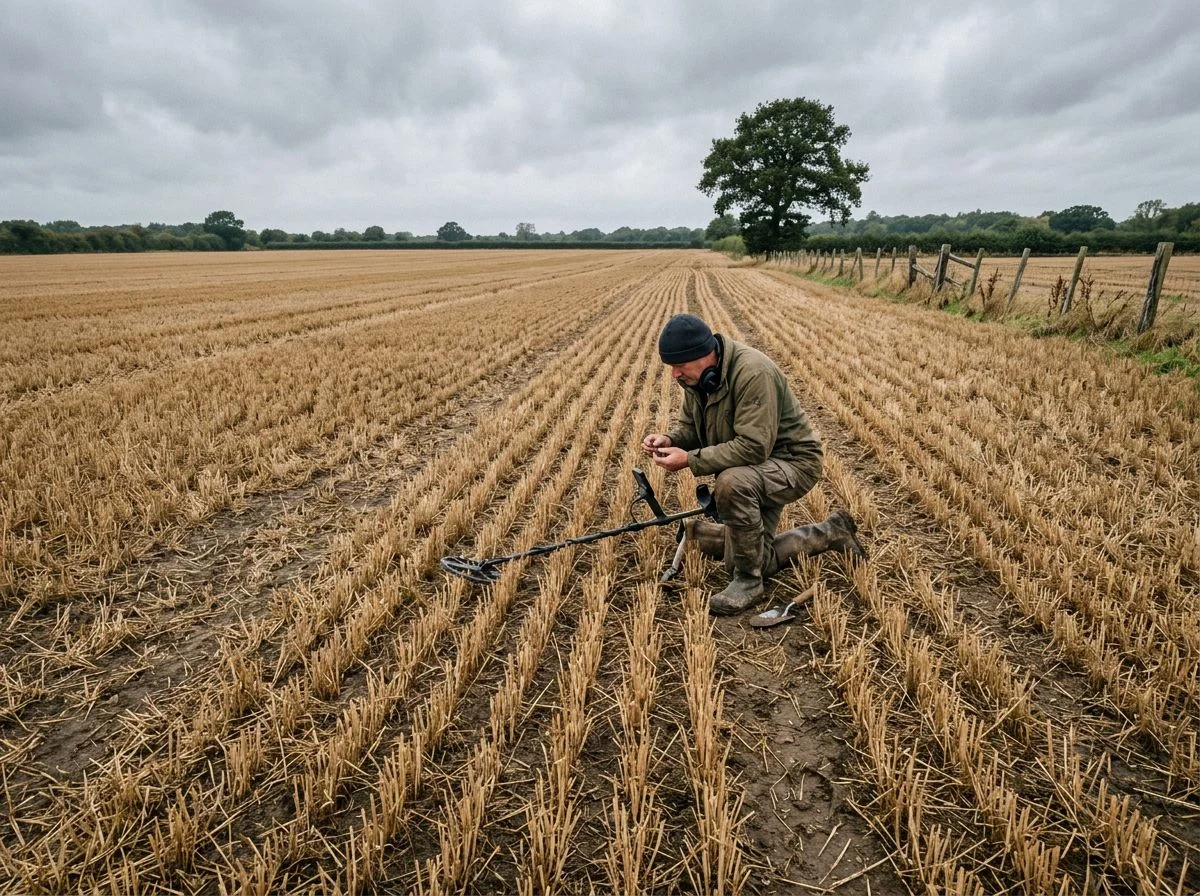
The short version: agricultural fields are locked all summer. Then they open for a brutally brief window between harvest and tillage. Sometimes as narrow as a single day. If you’re not standing there with permission the moment the combine finishes, you’ve missed it. The research and relationship-building has to happen before the crop ever comes down.
Here’s the thing about corn, wheat, and soybean fields: they’re physically impassable from planting through harvest. You’ve been driving past some of the richest detecting ground in your area for months without a second thought. Then the combine comes through, and suddenly that field is open. But not for long.
Crop fields containing corn, wheat, and soybeans are off-limits all summer until combines harvest the crops. That’s not a preference thing. You literally cannot walk through standing corn. No farmer wants you trampling their yield. So the entire summer, those fields might as well be on another planet.
Then harvest happens. And this is where the choreography gets real.
The 48-hour window
A farmer harvests Monday. Tuesday, the tiller goes through. Wednesday morning, that field is seeded for winter wheat or sitting under a fresh layer of turned soil. The deep targets — the seated coins, the colonial buttons, the stuff that’s been down there for a century — just got churned to the surface and then buried again in a different spot. Or worse, chopped into pieces.
UK detectorists report permission windows as narrow as one day between harvest and tillage. One day. That’s not a metaphor. That’s the actual farming schedule in a lot of places.
So the permission conversation has to happen in September, not October. Call the farmer. Ask when they’re cutting. Ask if they plan to till immediately after or let the stubble sit for a week. Ask where to park so you’re not blocking equipment access. Farmers appreciate that kind of specificity. It signals you understand their operation isn’t a hobby.
Why tilled ground is worth the scramble
Here’s the payoff: tilling churns deep targets to the surface. Coins that sat 10 inches down for decades get flipped up to 4 or 5 inches. That’s well within range of a mid-tier detector. Relics that were invisible in packed soil suddenly ring up loud and clear.
I’ve experienced this firsthand. A field near Woodland had given me nothing but shotgun shells and can slaw for two seasons. Then it got tilled. That same weekend, I pulled three Indian Head pennies and a brass harness buckle. Same detector, same settings. Completely different ground.
Reading the field before you swing
Once you’re out there, don’t just grid blindly. Dark soil patches and old cart tracks indicate historical activity. Dark patches often mean decomposed organic matter. An old barn site, a midden, a spot where animals were penned for decades. Old cart tracks show you exactly where people walked and drove for generations. That’s your high-probability zone.
The window is unforgiving. But if you do the homework before harvest, you’ll be standing there when it opens.
Beach Detecting After the Tourists Leave
Here’s the short version: when summer crowds vanish and the first coastal storms roll through, beaches enter their “second phase.” Erosion strips away the top sand layer. That exposes old coins and jewelry that have been buried for decades along towel lines and in the wet sand at low tide. The tourists are gone, but their losses from years past are finally within reach.
Here’s what most people don’t realize about beaches: the sand you’re walking on in July isn’t the same sand that was there in March. Beaches are constantly shifting. By the end of summer, months of accumulated sand has buried the good stuff deep. Sometimes three feet down, sometimes more. Your detector can’t touch it. You could grid that beach for a week straight and find nothing but bottle caps and modern clad.
Then fall arrives, and everything changes.
The Erosion Effect
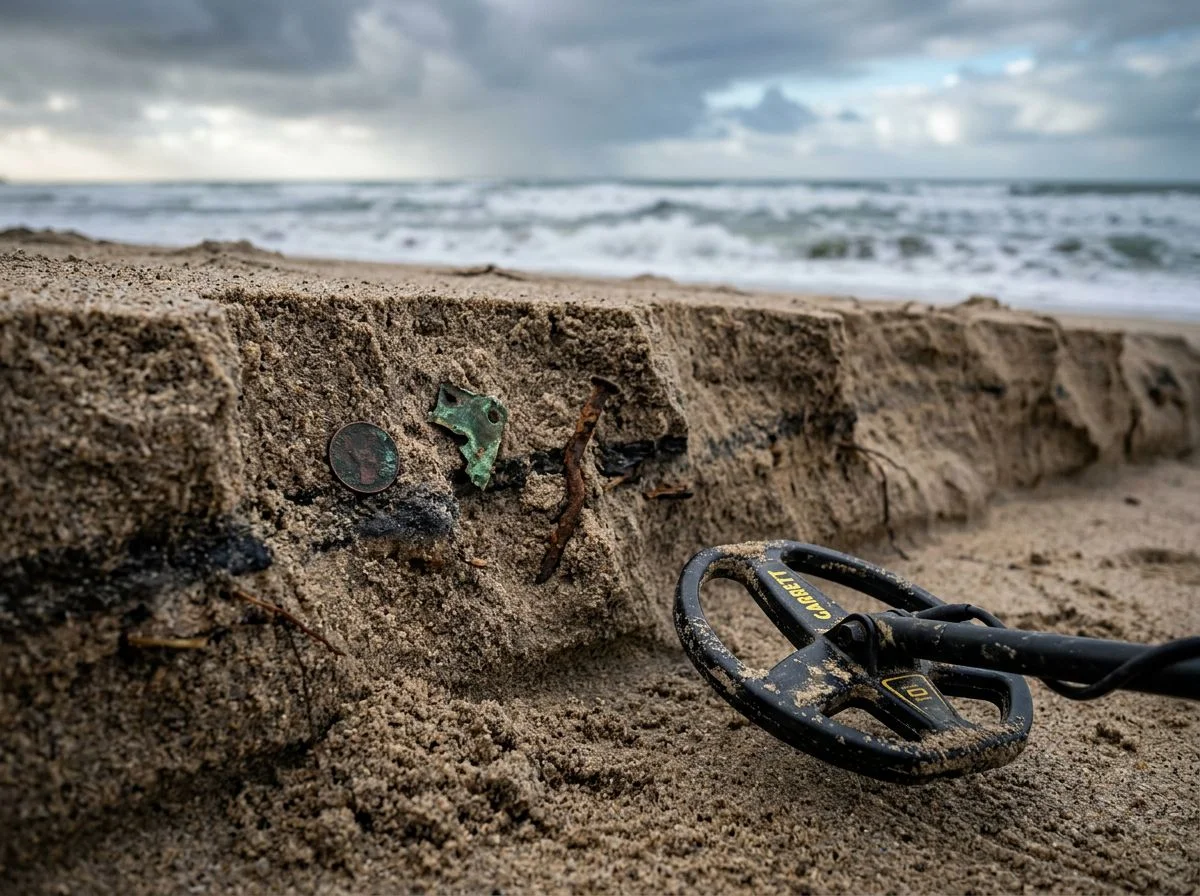
Coastal storms and autumn wave action do something remarkable: they strip away those upper sand layers entirely. Not gradually. Sometimes a single storm will cut a three-foot vertical wall into the beach overnight. That’s the “sand cut” everyone talks about. It’s the single most productive feature you can hunt.
Fall erosion exposes older buried sand layers that have been sitting untouched for decades. Everything that sank out of reach in July is suddenly sitting at detectable depth. Or in some cases, right on the surface.
I’ve walked stretches of beach in November where you could see the strata in the sand cuts like layers in a cake. Each band represents a different era of beachgoers. The targets concentrate along those lines. The trick is getting there before the next storm buries everything again.
Where to Actually Hunt
Beach detecting works best when you think in zones. There are four productive areas: the towel line — that first 10 feet above the high tide mark where people spread their blankets and lose rings, coins, and the occasional earring; the wet sand zone between high and low tide, which gets reworked constantly; shallow water up to neck depth, where swimmers lose chains and watches; and the dry sand further up, which holds the oldest losses.
During fall, the wet sand and towel line zones are where the action is. Low tide is non-negotiable. That’s when you can actually reach the cuts and erosion drop-offs where wave action has sliced away top layers to expose deeply buried targets.
What Actually Comes Out of the Ground
Here’s the part that still gets me excited: the finds from fall beach hunting aren’t just modern losses. Merrill Kazanjian, who’s been detecting New York beaches for years, has pulled gold and platinum rings alongside early American, British Colonial, and Spanish Colonial coins during fall storm season. Think about that for a second. A Spanish Colonial coin, sitting under the sand at a public beach, waiting for the right storm to expose it. That’s not a one-in-a-million fluke either.
Wet Soil and Your Detector Settings
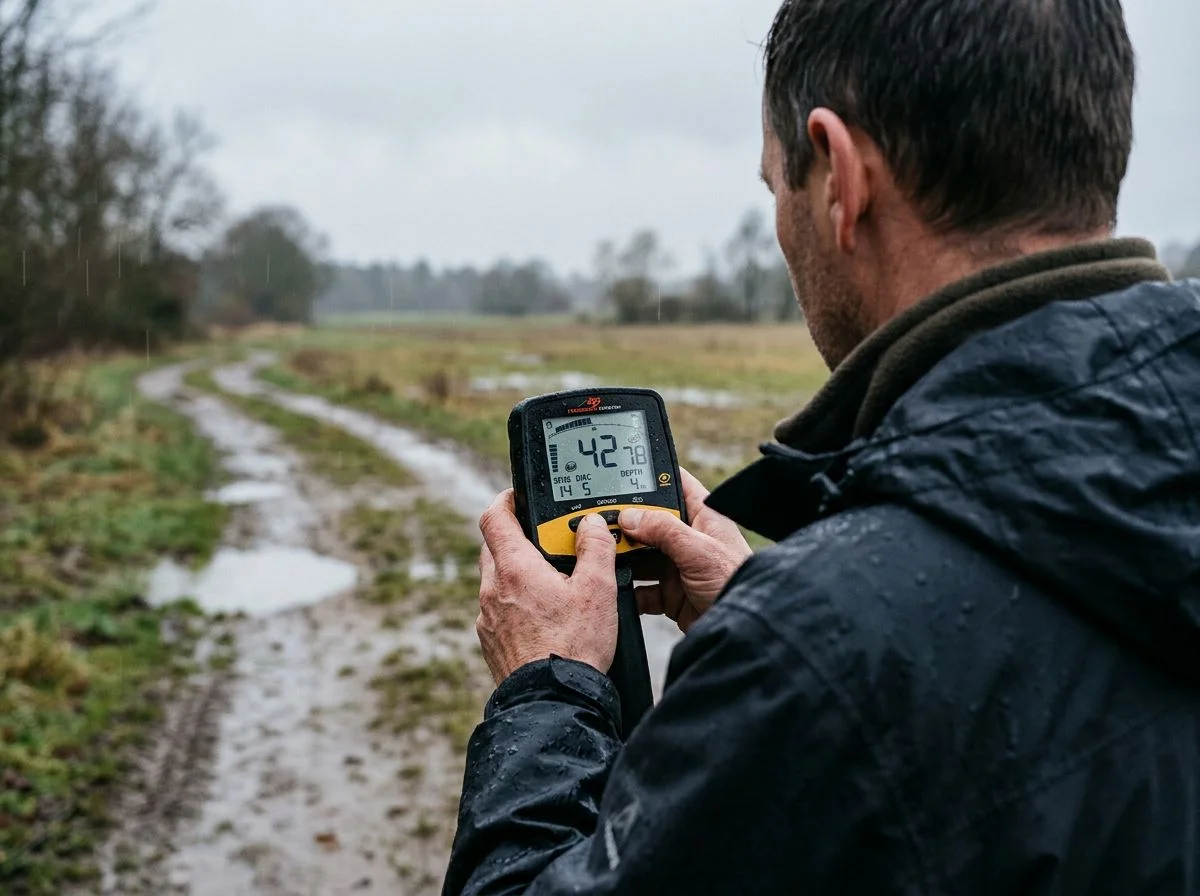
Here’s the short version: wet dirt changes ground conductivity. That can make your detector’s target ID jump around like a pinball. The fix is simple. Lower sensitivity by 15% to 20% and ground balance every 10 to 15 minutes when signals get erratic. That’s the whole playbook, but let me explain why it works.
Fall rain is a double-edged sword. On one hand, moisture improves electromagnetic field transmission. Targets you couldn’t reach in bone-dry August suddenly come alive. On the other hand, that same moisture changes how your machine reads the ground itself. Wet dirt alters ground conductivity, often producing non-repeatable VDI signals. A pull-tab reads like a nickel one second and a zinc penny the next. You’ll chase ghosts all afternoon if you don’t adjust.
My rule of thumb: when the ground gets saturated, I back my sensitivity down 15% to 20% right out of the gate. It feels counterintuitive. Shouldn’t wet soil mean deeper detection? But cranking sensitivity in mineralized, moisture-heavy dirt just amplifies the noise, not the good targets. You want stability, not raw power.
Then there’s ground balancing. In summer, I might balance once when I arrive and call it good. In fall, I’m rebalancing every 10 to 15 minutes. The soil’s mineral content shifts constantly as moisture moves through it. Frequent ground balancing keeps your detector tracking those changes instead of fighting them.
One more thing worth mentioning: a smaller 5 to 6-inch coil handles soft muddy soil better than a big one. Less surface area means less ground noise. It’s also easier to maneuver through sticky mud. I also rub a thin coat of car wax on my coil before fall hunts.
Wet mud slides right off instead of caking on and throwing off the signal. And if you’re hunting into the colder months, lithium batteries hold their charge better in low temperatures than alkalines. Small stuff, but it’s the difference between a productive afternoon and a frustrating one.
Sports Fields and Fairgrounds in the Fall
Here’s the short version: fall brings harvest festivals to fairgrounds and post-season athletic events to sports fields. The real money isn’t on the playing surface. It’s in the spectator areas where people sat, stood, and fumbled through their pockets for decades.
Garrett’s location guide calls it the “gathering principle”: search high-traffic historical locations where people assembled in large numbers over decades. That’s exactly what fairgrounds and sports fields are. Except in summer, they’re either locked up, too crowded, or too baked to dig properly.
Here’s the mistake most people make: they grid the playing field itself. That’s where you find modern clad and the occasional athletic pendant. But think about it. When do people actually lose things? When they’re sitting still, shifting around, pulling keys out of pockets, dropping coins while digging for a hot dog.
Spectator areas near sports fields — sidelines, bleachers, dugouts — historically yield more lost coins and jewelry than playing fields. The grass gets trampled flat there. Your coil sits lower. Decades of dropped change has worked its way down into the soil.
Fairgrounds are even better in fall. Harvest festivals draw crowds to the same patch of ground year after year. Fairgrounds are listed as high-yield autumn targets for good reason. I hit the county fairgrounds outside Sacramento every November after the last event wraps. The vendor areas, the ticket booth lines, the spots where people stood watching the tractor pull. That’s where the old silver hides.
My buddy Tom found a 1920s-era pocket watch at a fairground fence line last fall. Right where spectators used to lean against the rails during horse races. The field itself? Nothing but pull-tabs and modern quarters.
Field Techniques for Stubble and Harvested Ground
Here’s the short version: once the combine comes through, your old permissions are new ground again. But only if you slow down, change your sweep direction, and get your coil lower than you could all summer. Same field, different hunt.
I learned this the hard way on a wheat field outside Dixon. I’d gridded that patch three times over two summers and pulled maybe a dozen wheat pennies and a lot of shotgun shell brass. Figured I’d cleaned it out. Then last October, after harvest, I went back with a completely different approach. I found a 1917 Mercury dime in the first twenty minutes, right in a spot I’d walked over a dozen times.
The difference wasn’t luck. It was technique.
First, I swept the field in a different direction than before. I’d always gridded north-south, following the old furrow lines. This time I went east-west, cutting across them. Sweeping across fields in different directions exposes targets you missed on previous passes. Coins on edge. Targets masked by nearby iron. Signals your coil only catches from one angle.
Second, I slowed way down. My normal swing speed is fine for parks and fairgrounds, but on stubble ground, slowing your swing speed and increasing pass overlap captures faint deep signals that a faster sweep skips right over. I overlapped each pass by about half the coil width instead of the usual third. Felt tedious as hell for the first hour. Then the Merc popped up and I stopped complaining.
Third, I switched to a smaller coil. Not because the field was trashy. Because a smaller search coil separates non-ferrous targets from iron in trashy areas better than increasing sensitivity. Stubble fields hide a lot of iron: old fence staples, broken plow teeth, random nails. Crank sensitivity and you just amplify that junk. Shrink the coil and you hear around it.
The other advantage of fall stubble: grass growth has slowed down. Slower autumn grass growth allows a lower, level coil height. That eliminates the air gaps that reduce target depth. In summer, that field grass was six inches tall and I was swinging over the top of it. In October, I could skim the soil. That alone probably added two inches of effective depth.
My buddy Mike still thinks I’m lucky. I’ll take it.
Permission Protocols for Fall Farmland
Here’s the short version: summer permission doesn’t automatically carry into fall. Harvest changes everything. Access windows, field conditions, and the farmer’s priorities all shift. You need to re-verify before you step foot on stubble ground, even if you had the green light back in July.
Here’s the question that separates the detectorists who keep their permissions from the ones who burn them: do you know when the farmer who gave you access in August is actually harvesting? If not, you don’t have fall permission. You have an old conversation.
UK detectorists report permission windows as narrow as one day between harvest and tillage. One day. If you’re not asking about cutting dates before the combine rolls through, you’re already too late. I learned this from a soybean farmer outside Woodland who gave me summer access to a field that had produced nothing but iron scraps for two seasons.
When I called him in late September to ask if I could get back out there, he laughed and said, “Plowed it under this morning. You’re about eight hours late.” That call taught me the actual protocol.
Farmers need to know three things before you show up: where you’ll park, when you’ll be there, and whether you’ll stay off saturated soil. The parking thing sounds minor until you realize a combine operator doesn’t want to dodge your truck at 5 AM. And saturated ground? Walking on it compacts the soil and damages the structure. That’s a fast way to never get invited back.
So here’s what I do now: call in early September, ask when they’re cutting, and offer a specific window. “I’d like to hunt the north field the weekend after harvest, Saturday morning, parking by the equipment shed.” The farmer says yes or no. Either way, you’ve shown you understand their schedule matters more than yours.
Gear Adjustments for Cooler, Wetter Conditions
Here’s the short version: fall detecting doesn’t require a new detector. It requires a few cheap adjustments to keep your existing gear running through cold mornings, wet grass, and shorter daylight. Most of these fixes cost under twenty bucks.
The battery thing is where most people get caught off guard. Alkaline batteries lose capacity fast once temperatures drop into the 40s. NiMH rechargeables aren’t much better. Lithium batteries hold charge significantly better in low temperatures. They don’t drain as quickly, and they maintain stable voltage when alkalines are already sagging.
I made the switch after a November hunt where my AT Pro went from full bars to dead in under two hours. My buddy Mike was still swinging his Equinox on the same lithium set he’d started the week before. That was enough convincing for me.
Daylight is the other thing you’ll be fighting. By late October, the sun’s gone by 5:30. If you’re hunting after work or after the kids are down, you’re in the dark. A headlamp is a cheap fix that extends your session without calling it quits early. I keep one in my detecting bag year-round now, but fall is when it actually earns its spot.
Moisture is the silent gear killer. Wet grass, light rain, morning dew. All of it finds its way into control units if you’re not careful. Protective covers shield control units from moisture and cost about as much as a fast-food lunch. I learned this one the expensive way, so you don’t have to.
For soft, muddy soil, smaller 5-6 inch coils improve maneuverability and help you work tighter spots without fighting the ground. And here’s a trick that sounds ridiculous but works: car wax on your coil prevents mud from building up in the first place. My wife saw me waxing my search coil in the driveway and just shook her head. But that coil stayed clean through three hours of wet stubble field. So who’s laughing now.
Common Fall Metal Detecting Questions
Yes, you can detect in the rain. Most modern detectors have waterproof coils, and moisture actually improves signal transmission. The real question isn’t whether rain ruins your hunt. It’s whether you’ve adjusted your technique and gear for wet ground before the first drop falls.
Can I detect in the rain?
This is the question I get most, and the answer is more nuanced than most detectorists assume. A light drizzle? Absolutely. In fact, fall rain restores soil moisture and makes electromagnetic field transmission better. Targets you missed in dry August soil suddenly pop.
But a downpour? That’s when wet grass becomes a signal-killer. Your control unit, if unprotected, becomes a liability. Saturated ground turns your clean plugs into mud soup. I’ve hunted through both. The drizzle hunts produced some of my best fall finds. The downpour hunts produced a wet detector and a very annoyed wife. Know the difference before you head out.
When should I schedule my fall hunts?
Search sessions are best scheduled between 10 AM and 2 PM during fall’s warmest hours, according to Serious Detecting’s seasonal guide. That’s not just about comfort. It’s about soil conditions.
Morning frost thaws by mid-morning. South-facing slopes stay soft longer than north-facing ones because they catch more direct sun. I’ve dug targets at 11 AM on a south slope that would’ve been frozen solid at 8 AM on the north side of the same hill. Ground freezing begins in late fall and varies by region. The 10-to-2 window matters more the deeper into November you get.
If you’re in the Sierra foothills like me, that window shrinks fast. If you’re in the Central Valley, you’ve got more flexibility. Either way, plan your hunts around the sun, not your coffee schedule.
Get Out Before the Ground Freezes
Here’s the bottom line: your fall detecting window runs from September through November and slams shut the day the ground freezes solid. Detectorists who plan around harvest schedules, storm cycles, and frost dates consistently outperform those who hunt reactively. The difference shows up in their finds pouches every single season.
Here’s the bold statement I’ll stand behind: the best detecting day of your year is probably in the next six weeks, and you won’t know which day it was until you’re out there.
That’s not motivational fluff. It’s how fall actually works. The moisture’s back in the soil. The crops are coming down. The tourists have gone home from the beaches. The ground is soft enough to dig but not yet frozen into concrete. Every one of those conditions is temporary. Blink and you’re staring at a frozen field with your detector hanging in the garage.
I’ve missed this window before. One year I kept telling myself I’d get out to a harvested cornfield near Dixon “next weekend.” Next weekend became the weekend after, and then a cold snap hit in early December. By the time I showed up, my shovel bounced off the surface like I was digging a parking lot. The farmer told me he’d tilled two weeks prior. That field sat open for ten days, and I spent all of them reorganizing my garage.
Don’t do that. The window is open right now. Check the frost dates for your area. Call the farmers whose fields you’ve been eyeing. Get out there before the ground locks up and takes your season with it.

My name is Paul and I am the founder of Detector For Metal, a dedicated resource for metal detecting enthusiasts seeking to uncover historical treasures and connect with the past using the latest technology. As a stay-at-home dad and family man, I’ve found metal detecting to be the perfect hobby that combines family adventure with historical learnings for the whole family.
As a father, I’m deeply committed to passing on this hobby to the next generation of detectorists, starting with my own children. I share advice on everything from metal detecting with kids to exploring the top 10 metal detecting sites you never thought about. My methodical approach to the hobby goes beyond the thrill of discovery—it’s about creating family traditions while preserving history and sharing the stories of those who came before us.