Table of contents
- Why the Best Coins Hide in the Worst Place
- Why Does Your Detector Go Nuts Near Swing Frames?
- Small Coils Beat Sensitivity Tweaks
- Park Metal Detecting Tips for Settings That Work
- The Swing Zone Method Step by Step
- Working Around Swing Chains
- Realistic Finds in Swing Zones
- Park Metal Detecting Tips: Common Questions Answered
- The Swing Zone Takes Practice to Learn
The coins directly beneath swing frames aren’t lost. They’re hidden. The massive steel structure overwhelms your detector. The fix combines smaller coils, faster recovery speed, and a parallel swing technique. This lets your machine separate a quarter from a 100-pound steel leg. Most detectorists skip this zone entirely. That’s exactly why it’s still loaded. These park metal detecting tips will change how you hunt playgrounds.
Start by swapping to the smallest coil you own. A 5×8″ DD or sniper coil cuts the frame’s electromagnetic footprint dramatically. You can get within inches of the legs without the machine going static-crazy. Focus Speed’s tot lot guide specifically recommends the smallest search coil available for scanning close to metal playground structures. They’re right. That coil is the single biggest lever you can pull for effective park metal detecting.
Then crank your recovery speed (or reactivity) as high as it goes. This setting controls how quickly the detector resets after hitting a large ferrous target. According to Detector Warehouse’s trashy-area guide, a fast recovery speed means the machine “loses sensitivity for an instant” rather than blanking out for a full second. That instant is all you need to catch a coin sitting three inches from the frame. These park metal detecting tips apply to any modern machine.
Finally, change how you swing. Never sweep toward or away from a pole. Always go parallel to it. This technique, recommended in this detecting forum thread, keeps the coil’s field consistent relative to the steel. The detector can lock onto small non-ferrous signals instead of being slammed by the frame’s edge every pass. It’s a core park metal detecting tip that most hunters never learn.
Why the Best Coins Hide in the Worst Place

The coins beneath swing frames aren’t lost to detectorists. They’re lost to the detector itself. That massive steel structure masks everything within a few feet. Most hunters skip it entirely. Which means the single highest-traffic drop zone in any tot lot is also the least-picked-over. These park metal detecting tips target that overlooked zone.
Think about it. When was the last time you watched a detectorist actually work the ground directly under a swing set? Not the perimeter. The actual shadow of the frame. Almost never. And that’s exactly where kids lose an average of 3-5 items per playground visit. Pockets empty at the apex of a swing. Phones, keys, coins, the occasional toy car. Gravity does the rest. Everything lands right in the iron dead zone.
The irony is almost funny. The spot with the highest concentration of lost targets is the spot everyone’s detector tells them to avoid. Walk within three feet of those galvanized steel legs and your machine erupts into a wall of static. So detectorists back off. They swing the open areas. They pull a few modern coins from the wood chips. Meanwhile, a denser layer of targets sits untouched six inches from the frame. Good park metal detecting tips always start with going where others won’t.
Here’s the part that flips the whole thing on its head. Those coins aren’t actually harder to find. They’re just hidden differently. The problem isn’t depth, and it isn’t trash density. It’s electromagnetic overload. That’s a solvable physics problem. With the right coil, the right settings, and a swing technique that works with the frame instead of against it, the worst place in the playground becomes the best.
Why Does Your Detector Go Nuts Near Swing Frames?

Your detector isn’t broken. It’s being overwhelmed. A typical swing frame contains 80-150 pounds of galvanized steel. Your machine’s processor simply can’t separate a quarter from that much metal sitting inches away. The result is the wall of static you hear every time the coil gets close. Understanding this is foundational to park metal detecting tips.
The first time I worked a tot lot, I thought my Equinox had finally died. Clean quarter signal at the edge of the wood chips. Then I took two steps toward the swing frame and the machine erupted like a Geiger counter at Chernobyl. I backed off and swung again. Clean signal. Walked closer. Static. I actually pulled the battery pack out and checked the connections before it clicked.
Here’s what’s actually happening. Your detector transmits an electromagnetic field and listens for distortions caused by metal objects. A coin distorts that field slightly. A 10-foot steel swing frame distorts it massively. When your coil gets close to the frame, the processor gets hit with a signal so strong it can’t process anything else. That condition is called overload. According to Serious Detecting’s guide on iron masking, the detector “loses sensitivity for an instant” after processing a large ferrous signal. That instant is exactly when your quarter disappears.
But the frame isn’t the only problem. Those hanging chains act as vertical antennas. They modulate the return signal every time a kid swings. So even when the set is empty, the chains are still there. Passive steel rods that distort your detector’s field just by existing. And when kids are actively swinging, the interference pattern shifts constantly. That makes the machine’s job even harder.
Small Coils Beat Sensitivity Tweaks
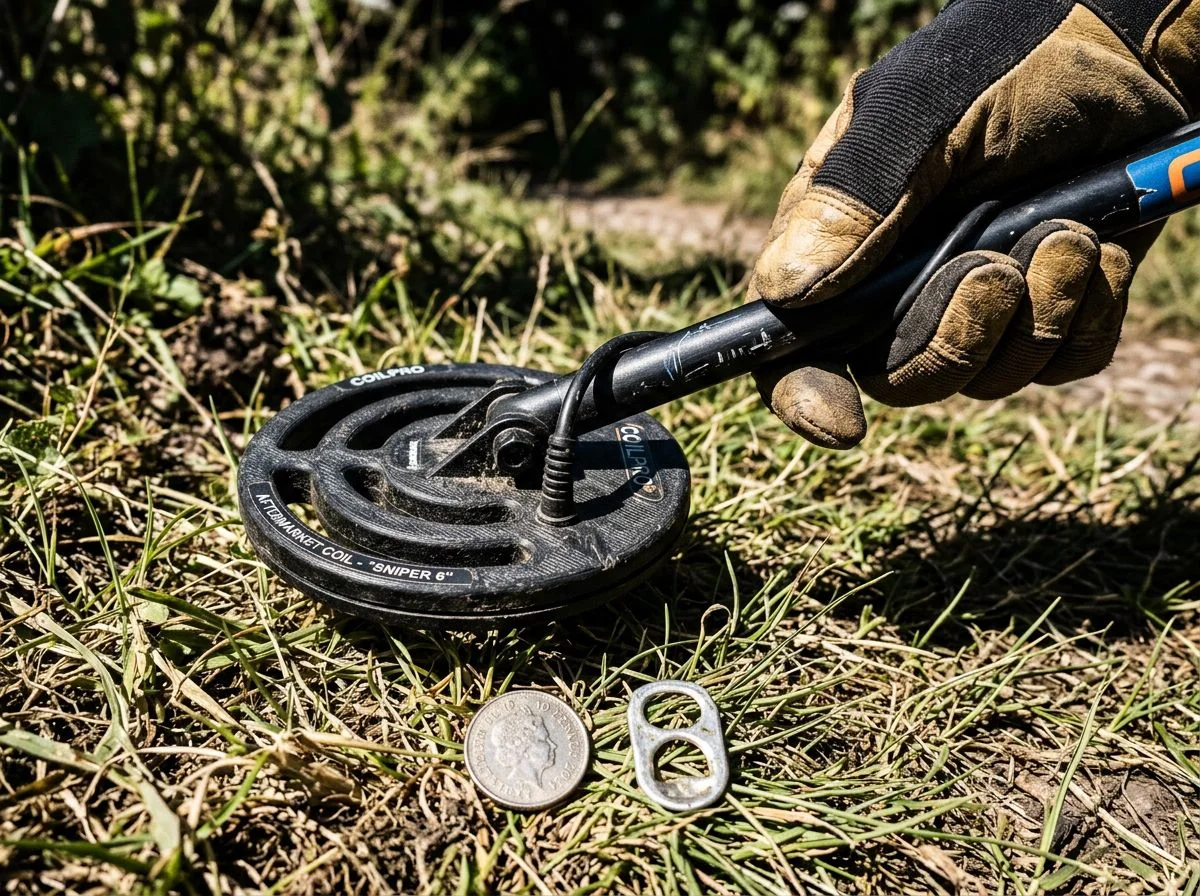
Small coils solve the swing-frame problem at the source. Instead of trying to tune out the overload, you shrink the detector’s field so the frame barely registers. It’s the single most effective upgrade for hunting under playground equipment. And it works better than any sensitivity adjustment you’ll ever make. This is one of the most useful park metal detecting tips I can share.
Here’s the physics in practical terms. A 6-inch sniper coil reduces the detector’s “field footprint” by roughly 60% compared to a standard 11-inch coil. You can get 2-3 feet closer to steel structures before overload occurs. That doesn’t sound like much until you’re actually under the swing frame. Those extra feet mean the difference between static and a clean quarter signal at four inches.
I learned this the hard way. My first season hunting tot lots, I spent hours fiddling with sensitivity. Dropping it from 20 to 12 to 8. Trying to quiet my Equinox near the swing legs. It helped a little, but I was also losing depth on every target in the open areas. Then my buddy Tom showed up at a club hunt with a 6-inch coil on his AT Pro. He walked straight under a swing set I’d written off as undetectable. He pulled three quarters, a house key, and a small silver ring in about twenty minutes. I ordered a sniper coil that night.
The reason sensitivity tweaks fail is that they reduce everything. Including your ability to hear the coin you’re hunting. A smaller coil, by contrast, narrows the transmitted field itself. You’re not turning down the detector’s ears. You’re shrinking the flashlight beam so it doesn’t hit the frame in the first place. According to Focus Speed’s tot lot guide, using the smallest search coil available lets you scan “closer to metal playground structures and concrete containing rebar without experiencing interference.” Exactly what you want under swings.
The tradeoff is depth. But in a tot lot, you don’t need it. Most playground targets sit in the top 4-6 inches of wood chips or sand. A 6-inch coil still hits that depth easily while giving you dramatically better target separation. As Detector Warehouse explains, small DD coils and sniper coils excel in high-trash environments precisely because they see less ground at once. Less masking. Fewer false signals. A clearer read on what’s actually under you.
If you only make one gear change for playground hunting, make it this. Skip the sensitivity games. Get a small coil, slow down, and work the shadow of the frame like you’ve been missing.
Park Metal Detecting Tips for Settings That Work
Recovery speed is your best friend near swing frames. Iron bias is your safety net. And sensitivity is the trap most detectorists fall into. Here’s the honest breakdown of what each setting actually does under a playground. And which ones you should touch first. These park metal detecting tips will save you hours of frustration.
Recovery speed is the big one. This controls how quickly your detector’s processor “resets” after hitting a target. Near a swing frame, that reset time matters more than anything else. According to Detector Warehouse’s trashy-area guide, increasing recovery speed from 3 to 7 on a modern detector can reduce “blind time” after an iron hit by up to 70%. The cost is roughly 1-2 inches of depth. Under a swing set, you’re not hunting deep coins anyway. You’re hunting shallow drops in wood chips. Crank it up. On my Equinox 900, I run recovery speed at 6 or 7 in tot lots and never look back. The machine sounds chattier. But that chatter is your detector actually seeing the space between the frame and the coin.
Iron bias tells your detector how aggressively to call ferrous targets “iron” and move on. Higher iron bias means less falsing on steel. But it also risks masking small non-ferrous targets sitting next to iron. Here’s the question. Do you want your detector to lie to you quietly, or tell you the truth loudly? Near swing frames, I run iron bias low. Around 2 or 3 on the Equinox scale. Yes, you’ll get more iron grunts and occasional falsing from the frame itself. But you’ll also catch the quarter sitting six inches from the steel leg. That’s the entire point of hunting there.
Sensitivity is where people go wrong. Lowering it feels like the obvious fix. Quieter machine, less static. But as Serious Detecting’s beginner guide points out, you’re just reducing the detector’s ability to hear everything. Including the coin you’re after. I keep sensitivity between 16 and 18 near structures. Drop it below 14 and you’re leaving shallow silver in the ground. Your machine can’t hear past its own reduced ears.
The combination that works: high recovery, low iron bias, moderate sensitivity. Let the machine be a little noisy. The noise is information.
The Swing Zone Method Step by Step
The swing zone isn’t the whole playground. It’s a specific, predictable strip where kids lose things. The highest-density coin zone extends 18 inches on either side of the swing seat’s resting position and 6 feet forward. That’s the “sling zone” where kids jump off. Work it methodically and you’ll pull more coins in twenty minutes than most detectorists find in an hour of random wandering. These park metal detecting tips turn random hunts into systematic ones.
Here’s the method I’ve refined over dozens of tot lot hunts. It works whether you’re running a sniper coil or a stock 11-inch.
Step 1: Map the zone before you swing. Stand behind the swing frame and picture three parallel lines running forward from each swing seat. Left edge, center, right edge. Each line is roughly three feet wide and extends six feet out. That’s your grid. The coins aren’t scattered randomly. They’re concentrated where pockets empty mid-jump. According to Focus Speed’s tot lot guide, the ground directly under swings and that six-foot perimeter are the prime target zones. Trust the pattern.
Step 2: Work one line at a time, from the seat outward. Start with your coil touching the ground directly beneath the swing seat. Get as close to the frame as your detector will tolerate without overloading. Swing in short, tight arcs parallel to the frame, not toward it. That parallel swing is the single biggest technique upgrade you can make. It keeps the coil’s field from slamming into the steel leg on every pass. I watched my buddy Tom do this under a swing set I’d written off. He pulled three quarters in the first five minutes while I stood there holding my shovel like an idiot.
Step 3: Overlap each pass by half a coil width. Move forward six inches, swing again. Forward six inches, swing again. It feels slow, but you’re covering the entire sling zone with zero gaps. Most detectorists swing too fast and miss the shallow coins hiding between wood chips. Slow down.
Step 4: When you hit a target, mark it and keep moving. Don’t dig immediately. Finish the line, then come back. This keeps your rhythm and prevents you from trampling the zone you haven’t scanned yet. Trust me. You will find more targets in that six-foot strip than you expect. The last thing you want is to kick wood chips over an unfound quarter.
Step 5: Repeat for each swing seat, then do the landing zones. The area where kids jump off gets hammered with drops. That’s roughly six feet forward and slightly to the sides. Work it the same way. Parallel lines, tight swings, half-coil overlap.
The verification is simple. If you’re not finding at least a few coins per swing set, you’re either moving too fast or your coil isn’t close enough to the frame. The coins are there. The method just has to let you hear them.
Working Around Swing Chains
Swing chains aren’t just steel. They’re steel that never stops moving. A swinging chain changes its electromagnetic signature up to 40 times per second during active use. That creates a flickering interference pattern that mimics small targets. Your detector can’t tell the difference between a chain link and a dime when both are flickering at the same rate. These park metal detecting tips address a problem most hunters never diagnose.
Here’s the thing most detectorists miss. The chains are only a problem when kids are actually swinging. A stationary chain is just another piece of vertical steel. Manageable with the right recovery speed and swing angle. But the moment a kid starts pumping, those chains become antennas broadcasting interference in every direction. I’ve watched my Equinox 900 go from stable to schizophrenic in the time it takes a five-year-old to get airborne.
The fix is simpler than you’d think. Time your hunts around the swings’ active hours. Early morning before the playground fills up, or late evening after the kids clear out. The chains hang dead. That’s when the 40-times-per-second flicker drops to zero. Your detector can actually process what’s underneath. According to Focus Speed’s tot lot guide, the ground directly under swings is prime target territory. But only when you can hear it.
If you’re stuck hunting while kids are swinging, work the outer edges of the sling zone first. The interference falls off fast once you’re six feet out. Save the under-seat grid for when the playground empties.
Realistic Finds in Swing Zones
Let’s be straight. You’ll dig a lot of pull-tabs before you hit a coin. In high-traffic playgrounds, expect a pull-tab-to-coin ratio between 5:1 and 10:1. Sometimes worse if the tot lot hasn’t been hunted in years. That’s not a technique failure. It’s just the reality of where kids drop things. The swing zone concentrates everything that falls out of pockets. Aluminum can tabs are the most common pocket-adjacent trash there is.
The coins you do pull will mostly be modern zinc pennies and clad dimes. That’s the honest math. Focus Speed’s tot lot guide confirms the ground under swings is prime territory. But “prime” doesn’t mean “silver mine.” It means “highest volume of lost items.” Most of those items are worth less than a dollar.
Silver does show up, but it’s rare. In my experience, roughly 1 out of every 100 coin finds in a playground is silver. A Rosie, a Mercury dime, occasionally a war nickel. Last spring I pulled a 1943 Mercury dime from under a baby swing at a park that couldn’t have been older than 2005. That’s the exception that keeps you digging, not the rule.
The real value in swing-zone hunting isn’t the coins. It’s the jewelry. Kids yank off necklaces mid-pump. Parents lose rings pushing toddlers. Chains snap constantly. A single 14k gold chain beats a month of zinc pennies. But you’ll dig five pull-tabs for every coin, and a hundred coins for every piece of real silver. Know that going in, and the pull-tabs won’t drive you crazy.
Park Metal Detecting Tips: Common Questions Answered

The questions below come straight from Reddit threads and detecting forums. Real detectorists wrestling with the same swing-set static you’re dealing with. The short answer to most of them: smaller coil, slower recovery, and time your hunt when the chains aren’t moving. These park metal detecting tips answer the questions I see most often.
“Any tips for detecting tot lots with lots of metal equipment around?”
This one shows up constantly on r/metaldetecting. It’s the right question to ask. The most consistent advice from experienced tot lot hunters: lower your sensitivity before you get near the equipment, not after your detector starts screaming. Drop it to 60–70% of normal and creep back up only if the ground is quiet. Second, slow your sweep speed way down. Like half your normal pace. Your detector needs time to process the overload signal from the frame and recover enough to see a coin sitting six inches away. And if you’ve got a small coil, use it. Six inches or less. A 5×8 DD coil gets you physically closer to the steel legs without the coil’s field overlapping the frame as much.
“Is that found around the swings or something like that?”
Yes. And the “sling zone” is the specific answer. When kids jump off a swing, they land roughly 6 feet out from the set. Whatever was in their pockets lands with them. Focus Speed’s guide calls this out explicitly as prime target territory, along with the ground directly under baby swings. The area right at the base of the frame is also productive. Kids sit there, dig there, and drop things while waiting for a turn. Just remember: the frame’s interference radius extends about 3–4 feet in every direction. So the sling zone actually sits outside the worst of the masking. That’s why it’s easier to hunt than the ground directly under the seat.
“Do I need a special detector for playgrounds?”
No. Any modern detector with adjustable recovery speed and iron bias can handle tot lots. What matters more is the coil size and your settings discipline. A sniper coil on a beginner machine will outperform a 12-inch coil on a flagship detector in this specific environment. The physics don’t care how much you spent.
“Why do I get a good signal, dig, and find nothing?”
That’s the overload recovery lag. Your detector hits the massive frame signal, tries to process it, and briefly goes blind. By the time it recovers, the coin signal has passed. You dig based on a phantom signal that was never really there. The fix is the same park metal detecting tip I keep repeating: smaller coil, faster recovery speed, and a parallel swing that keeps the coil’s field from slamming into the frame on every pass.
The Swing Zone Takes Practice to Learn
Mastering swing-zone iron unmasking isn’t some hidden trick. It’s a trainable skill that pays off everywhere you hunt. Detectorists who put in the hours under playground frames report 30-50% faster target recovery in other trash-heavy environments. Old home sites. Picnic groves. The swing set is your gym. These park metal detecting tips build skills that transfer to every hunt.
I learned this the hard way. Last fall, I spent three weekends at a 1940s farmhouse site that had been hunted to death. Or so everyone said. The ground was riddled with iron. Nails, fence wire, rusted bucket fragments. My buddy Mike lasted an hour before giving up. But those hours I’d logged working the tot lots? They’d rewired my ears. I could hear the difference between a nail’s clipped response and a coin’s round, repeatable hit, even when they overlapped. I pulled a 1917 wheat penny from between two rusted square nails that day. Mike still calls it luck.
That’s the point. The swing zone forces you to master recovery speed, iron bias, and coil control. The frame punishes sloppiness instantly. Once you can separate a dime from a steel leg, a nail next to a silver quarter feels almost easy. The skill transfers. The patience transfers. And the finds start showing up in places other detectorists write off as “too trashy.”

My name is Paul and I am the founder of Detector For Metal, a dedicated resource for metal detecting enthusiasts seeking to uncover historical treasures and connect with the past using the latest technology. As a stay-at-home dad and family man, I’ve found metal detecting to be the perfect hobby that combines family adventure with historical learnings for the whole family.
As a father, I’m deeply committed to passing on this hobby to the next generation of detectorists, starting with my own children. I share advice on everything from metal detecting with kids to exploring the top 10 metal detecting sites you never thought about. My methodical approach to the hobby goes beyond the thrill of discovery—it’s about creating family traditions while preserving history and sharing the stories of those who came before us.