Table of contents
- Why Black Sand Makes Your Detector Lie
- Why Prime Gold Ground Is Also Detector Hell
- Ground Balance Is the Setting That Matters Most
- Manual vs. Tracking Ground Balance
- What the Equinox 800 Guide Gets Right
- The Coil Factor
- What Multi-Frequency Does in Magnetite
- What to Silence and What to Accept
- Sensitivity, Recovery Speed, and Ignorable Chatter
- Why Smaller Coils Work Better in Magnetite
- A Three-Step Setup Checklist for Magnetite Rivers
- Black Sand River Detecting FAQ
- The River Gives Slowly
Your multi-frequency detector can handle heavy magnetite rivers. But only if you stop fighting the ground and start working with it. The fix is a specific sequence: right mode, rolling noise cancel, manual ground balance, reduced sensitivity, and the smallest DD coil you own.
I learned this the hard way on the American River. The black sand runs so thick in places it looks like someone spilled a bucket of iron filings along the waterline. My Equinox 900 screamed at me for two straight hours before I accepted the truth. The problem wasn’t the machine — it was my approach.
The first mistake most people make is skipping mode selection. On Minelab machines, you want Gold Mode 1 or 2. These use a boosted audio system that amplifies faint signals from small gold flakes and pickers. On the XP DEUS II, switch the Magnetic Ground setting from REJECT to ACCEPT. Merrill from XP demonstrated this on a black sand beach. The default REJECT setting actually silences deep targets because their values look too much like the mineralized soil itself. Switching to ACCEPT lets those medium tones through. Suddenly, targets that were invisible start registering.
Then there’s ground balance. QUEST’s gold prospecting guide puts it bluntly: tracking ground balance can mask real gold by reading it as ground noise. In a river, black sand concentrations shift every few feet. I run manual balance and recheck whenever the chatter changes character. It takes thirty seconds. It’s worth it.
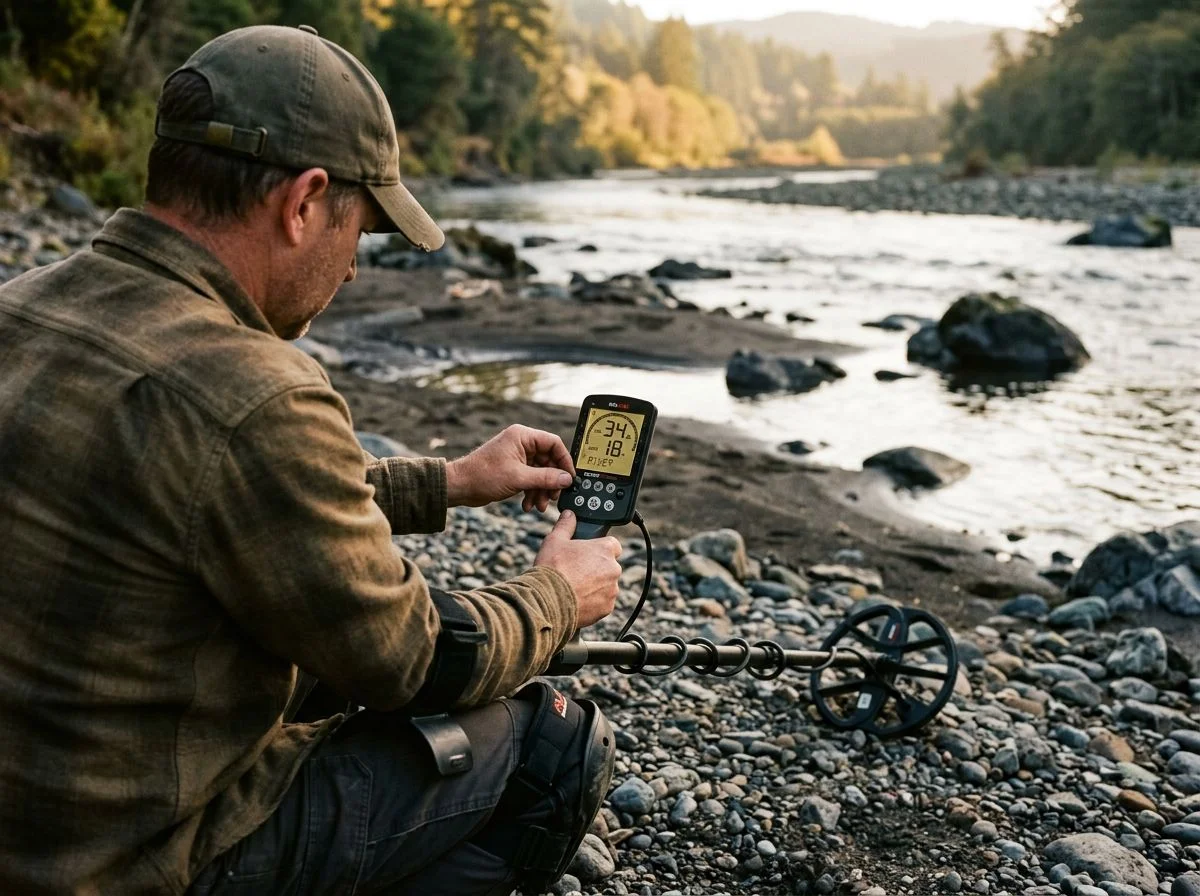
Sensitivity is where pride goes to die. You want it high enough to hear a picker the size of a match head. But low enough that you’re not digging magnetite ghosts all afternoon. Start around 18-19 if the black sand is chattering constantly. Only creep up if the ground settles.
Why Black Sand Makes Your Detector Lie
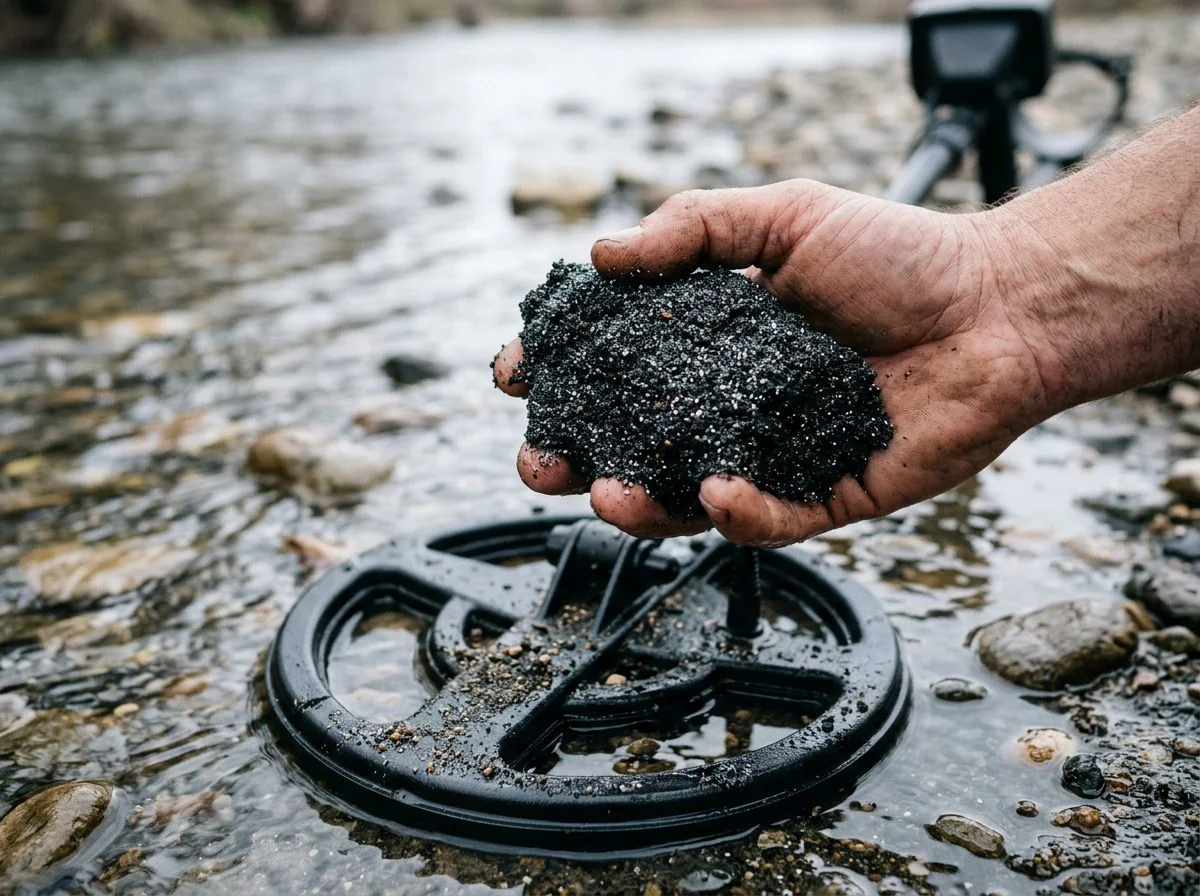
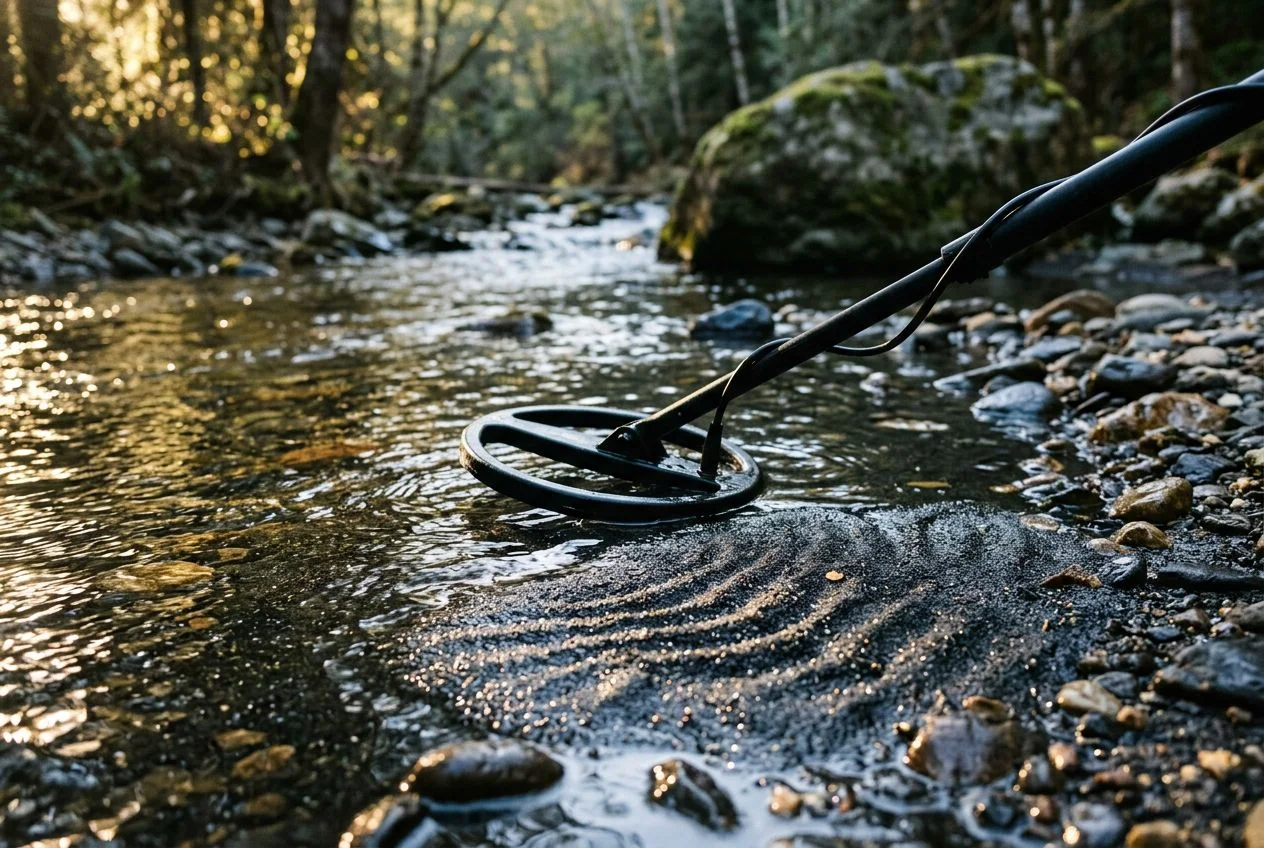
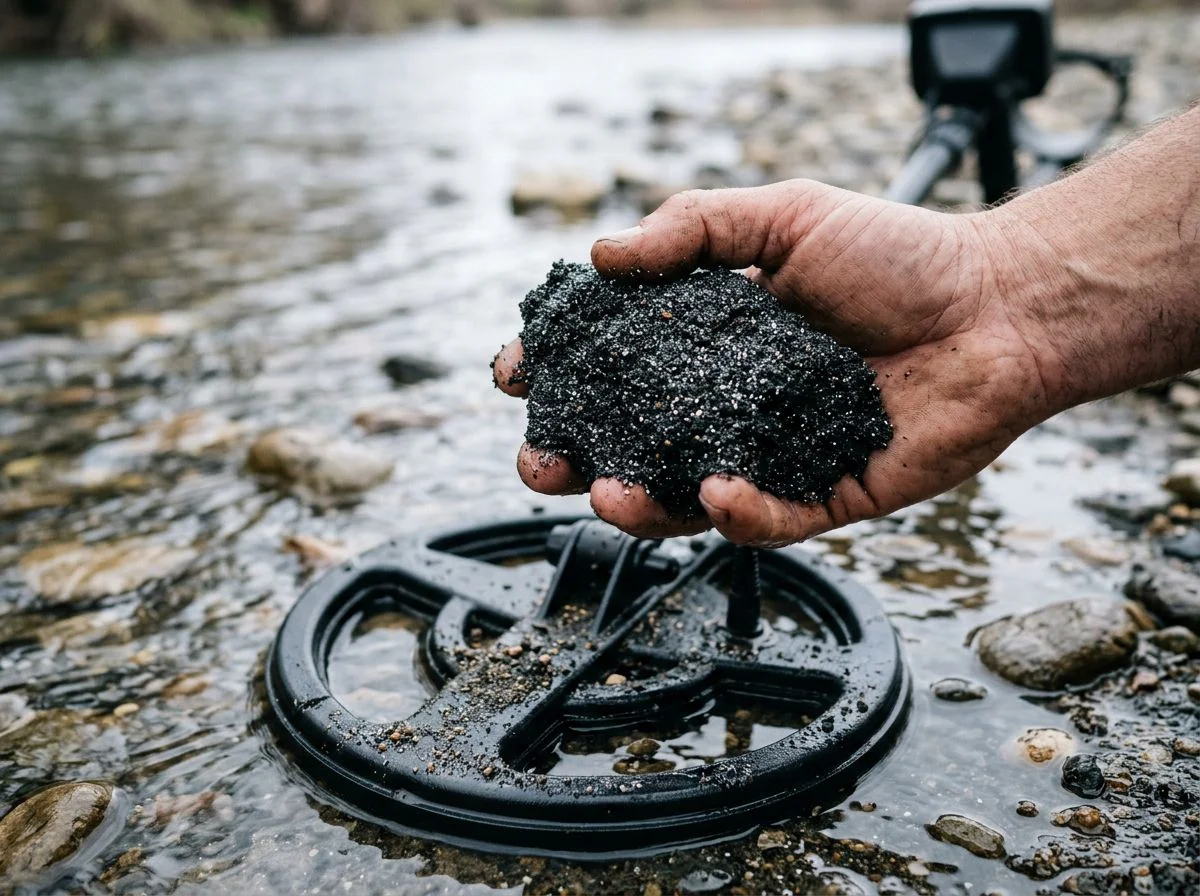
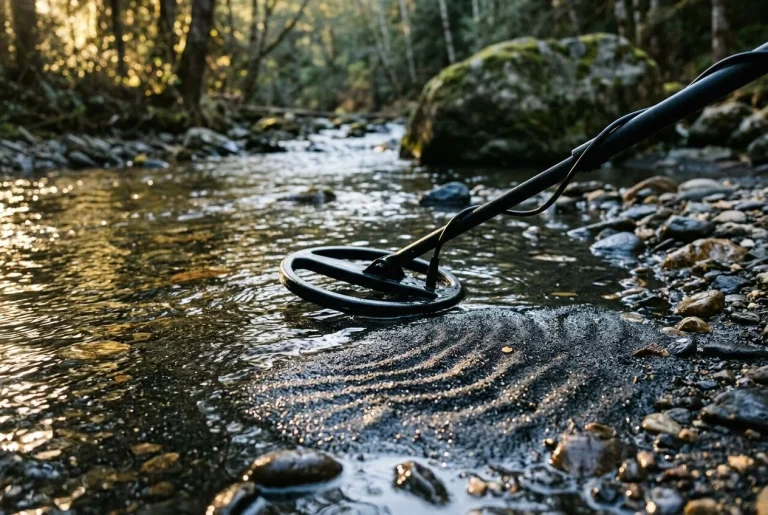
Black sand is concentrated magnetite — an iron oxide (Fe₃O₄) that’s naturally magnetic. Your detector’s coil can’t tell the difference between a patch of it and a buried chunk of iron. That’s the whole story. The machine isn’t malfunctioning. It’s doing exactly what it was built to do, just against a material that mimics metal almost perfectly.
Here’s the frustrating part: the places where gold hides are the exact same places black sand piles up. Gold is 19 times heavier than water, so it drops out of the current wherever the river slows down. Think inside bends, behind boulders, in bedrock cracks. And magnetite, being dense and heavy itself, settles in those same low-pressure zones. Garrett’s river prospecting guide puts it plainly: black sand is one of the strongest indicators that larger gold deposits are nearby or upstream. So the best gold spots are also the worst detecting spots. I’ve stood in river bends where the black sand concentration hit 30-50% magnetite by volume. Basically waving my coil over a layer of powdered iron and hoping to hear a flake of gold underneath it. That’s a losing proposition if you don’t understand what’s happening.
The reason multi-frequency machines help at all is that they transmit across a range simultaneously. The Minelab Manticore runs from 5 kHz to 40 kHz at once. The XP DEUS II spans 4 to 45 kHz through its Fast Multi Frequency technology. That range gives the processor more data to work with. It can compare how a target responds at low versus high frequencies and make a smarter guess about what’s actually down there. But even the best multi-frequency platform gets overwhelmed when the ground itself is more conductive than the target you’re chasing. The signal from a match-head-sized picker gets buried under the collective response of millions of magnetite grains.
So no, your detector isn’t lying to you out of spite. It’s screaming because it’s genuinely confused. And the fix is in the settings, not the machine.
Why Prime Gold Ground Is Also Detector Hell
The best gold spots in any river are also the worst detecting spots. Why? Because gold and black sand settle in exactly the same places — wherever the current slows down. You’re hunting treasure buried under a layer of naturally magnetic iron that scrambles your machine’s brain.
My first river hunt taught me this lesson with embarrassing clarity. I’d found an old swimming hole outside Sacramento. The kind of spot where families had been cooling off since the 1930s. That meant decades of lost coins, jewelry, and who knows what else. I waded in with my AT Pro, full of confidence, and immediately started getting hits. Forty-plus targets in the first two hours. I dug every single one.
Pull-tabs. Foil. A few bottle caps. More pull-tabs.
I was convinced the machine was broken. Hell, I was convinced the swimming hole was cursed. Then I scooped out a handful of the riverbed gravel and noticed what I was actually standing on. A thick layer of black sand, dense as wet concrete, running through every low spot and calm pocket along the shoreline.
That’s when it clicked. Garrett’s river prospecting guide spells out what I’d stumbled into. Black sand, iron-stained rock, and small gold flakes are strong indicators that larger gold deposits may be nearby or upstream. Gold settles where the river current slows — inside bends, bedrock cracks, calm pockets. And here’s the kicker: magnetite is roughly 5.2 times denser than water, so it drops out of the current in those same zones. The result is a perfect storm. High-yield gold ground layered with concentrated black sand that can cause target signals to stray and register as overloads, as documented in Southern California and San Diego beach detecting reports.
So the paradox isn’t a bug. It’s geology. The river concentrates everything heavy in the same places. Your detector has to sort through a layer of iron to find the gold hiding beneath it.
Ground Balance Is the Setting That Matters Most
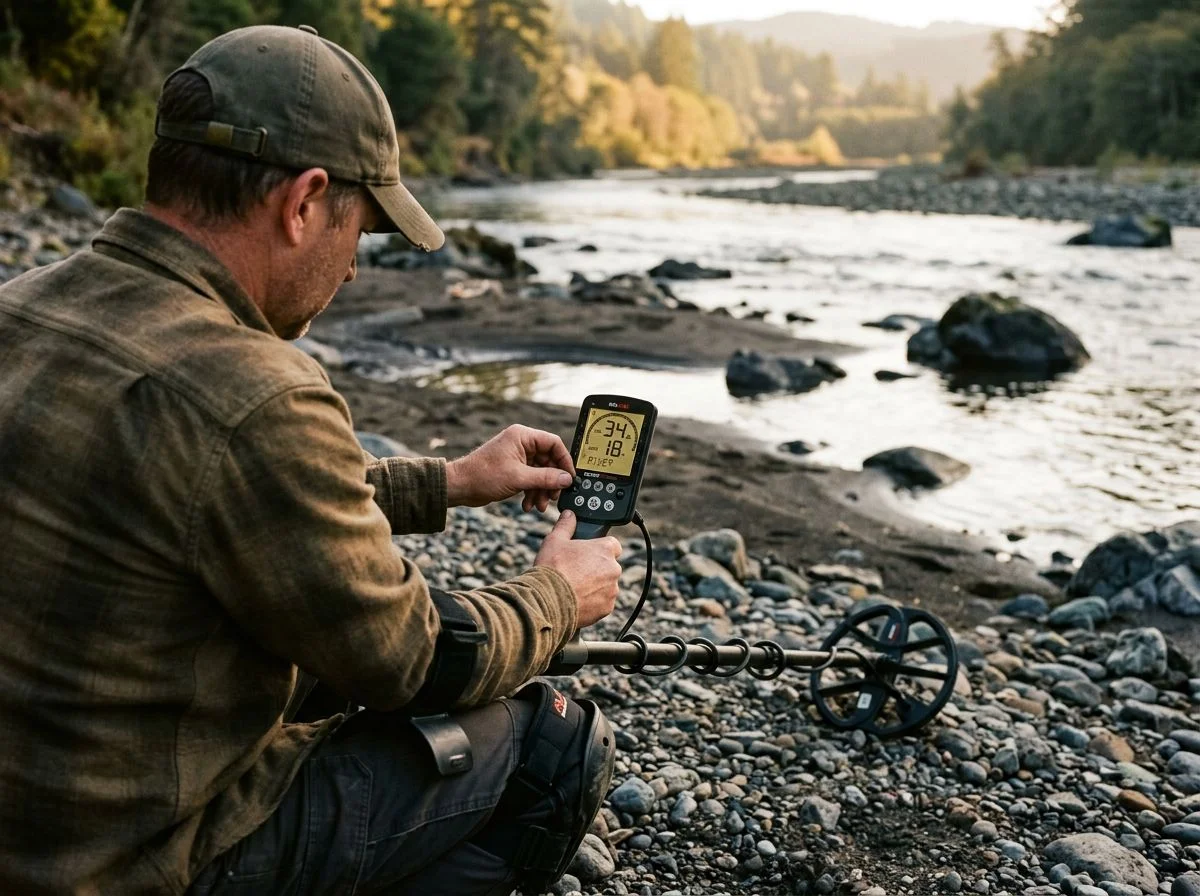
Ground balance tells your detector what the riverbed itself looks like. That way it can ignore the dirt and hear the gold. In black sand, that’s the difference between digging magnetite all day and actually finding something worth keeping. QUEST Metal Detectors puts it bluntly: ground balance is the single most important setting for a successful gold hunt in mineralized terrain. I’ve learned that lesson the hard way more times than I care to admit.
Here’s the core tension: Would you rather hear every grain of magnetite, or risk tuning out a picker the size of a match head? That’s the real tradeoff. There’s no perfect answer — only what works for your specific patch of river.
Manual vs. Tracking Ground Balance
Most detectors offer two approaches. Tracking ground balance automatically adjusts as you walk. It constantly recalibrates to shifting soil conditions. Sounds ideal, right? Except tracking can occasionally mask real gold targets by reading them as ground noise. A small picker sitting in black sand looks an awful lot like mineralization to the processor. It tunes it out, and you walk right over it.
That’s why many experienced prospectors — myself included — prefer manual ground balance. I set it carefully before I start. Then I recheck it every time I move to a different patch of ground. Black sand concentration can change dramatically within thirty feet of riverbank. What was balanced at the water’s edge is useless ten steps upstream where the magnetite runs thicker.
What the Equinox 800 Guide Gets Right
The Minelab Equinox 800 beach settings guide recommends running automatic ground balance continuously. It also suggests executing a noise cancel at every new location. That’s solid advice for beach hunting where the mineralization is relatively uniform. But rivers are different. You’re dealing with pockets and seams of black sand, not broad stretches.
My compromise: I run auto ground balance to get a baseline. Then I switch to manual and fine-tune. It takes an extra thirty seconds. But it’s saved me from more false signals than I can count.
The Coil Factor
One more thing that makes ground balancing dramatically easier: smaller DD coils. A big coil sees a huge volume of mineralized ground. That’s a lot of magnetite screaming at your processor. A smaller DD coil reduces the volume of mineralized ground the detector has to process. Stabilization becomes significantly easier. It’s the difference between trying to hear a whisper in a crowded stadium versus a quiet room.
When I’m working a heavy black sand riverbed, I’ll swap to my smallest coil even though it means less ground coverage. The stability is worth the slower pace.
What Multi-Frequency Does in Magnetite
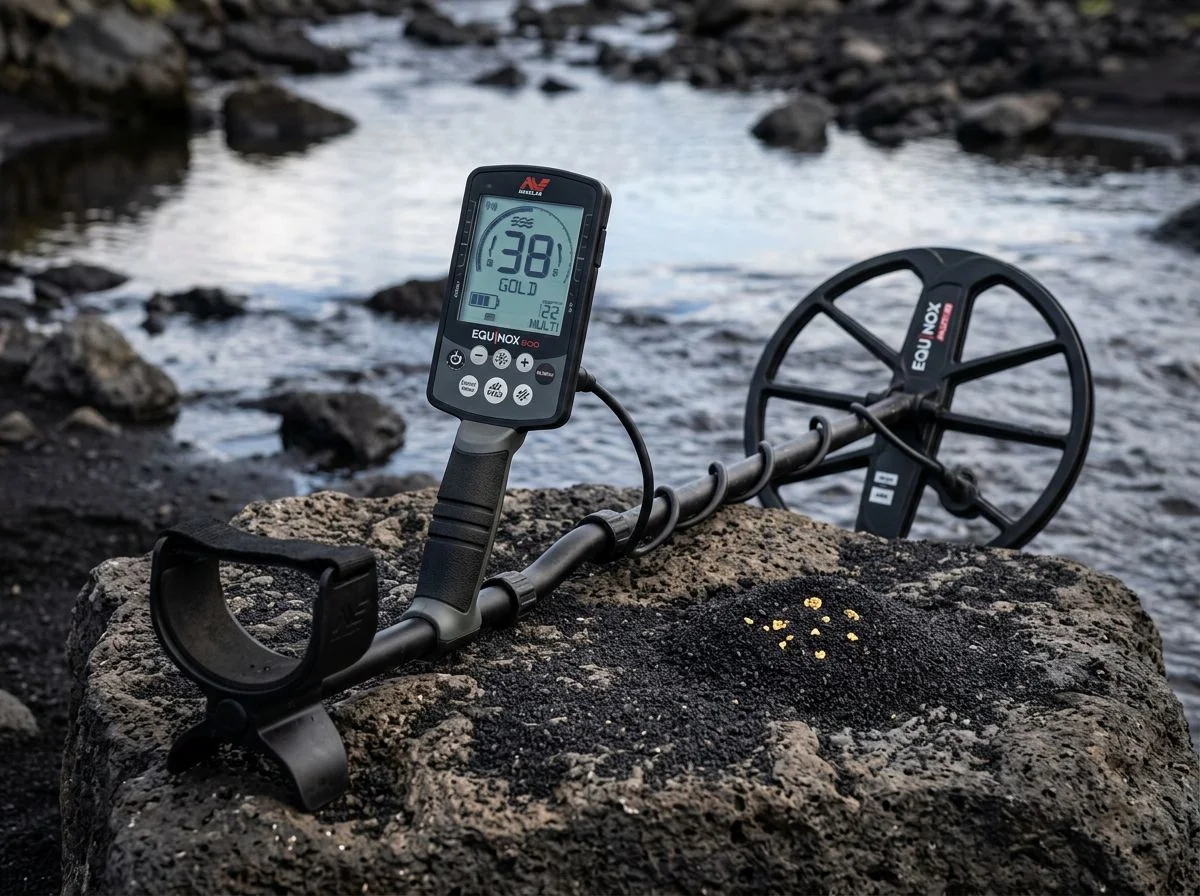
Multi-frequency doesn’t just improve your odds in black sand. It changes the entire game. The detector analyzes multiple frequency responses simultaneously, which lets it distinguish real targets from magnetite noise that would overwhelm any single frequency. That’s the short version. Here’s why it matters in a riverbed.
When your coil sweeps over black sand, a single-frequency machine hears one response. And magnetite responds a lot like a weak, erratic metal target. The processor can’t tell whether it’s seeing ground noise or a gold flake hiding six inches down. But simultaneous multi-frequency technology improves stability by analyzing data across multiple frequencies at once. Magnetite responds differently at 5 kHz than it does at 40 kHz. Gold responds differently too. By comparing those responses in real time, the detector can filter out the ground signature and flag the metal signature.
The hardware matters here. The Minelab Manticore’s Multi-IQ+ platform processes 50% more power than the Equinox series. That matters when you’re punching through magnetite layers. It runs from 5 kHz to 40 kHz simultaneously. The XP DEUS II spans 4 to 45 kHz via Fast Multi Frequency. That wider range gives the processor more data points to work with. More chances to spot the difference between iron oxide and actual gold.
For dedicated gold hunting in black sand, the XP ICONX features a Fast Multi Frequency mode with a 28 kHz gold-optimized setting. It maintains depth on larger nuggets while staying sensitive to small targets. That’s the balance you’re chasing: enough low-frequency punch to reach deep targets, enough high-frequency sensitivity to catch pickers.
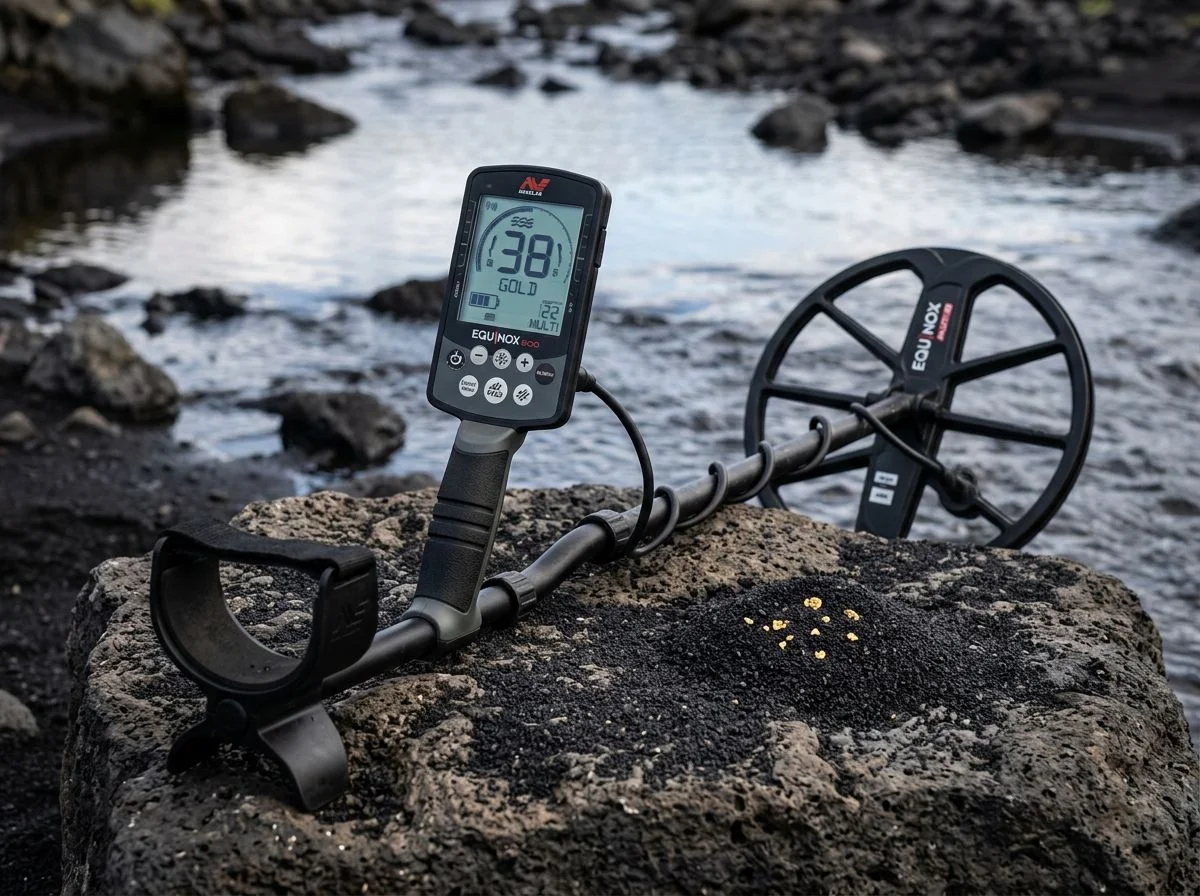
The Equinox 800 handles this differently through its Gold Modes. Gold Mode 1 defaults to Recovery Speed 6, while Gold Mode 2 defaults to Recovery Speed 4. Both use boosted audio that increases volume and pitch to amplify tiny gold signals. That audio boost is what saves you in black sand. The machine might be filtering out magnetite. But the faint whisper of a small nugget still comes through loud and clear.
None of this means you can skip ground balance or sensitivity adjustments. Multi-frequency gives you a massive head start. But the settings still need to match the specific patch of river you’re working.
What to Silence and What to Accept
Here’s the uncomfortable truth: in heavy black sand, your discrimination settings are a gamble. Silence too much and you’ll walk right over deep gold. Accept too much and you’ll dig magnetite until your back gives out. The right call depends on the detector in your hands and how much patience you brought.
The XP Deus II flips conventional wisdom on its head with its “Magnetic Ground” setting. The default is REJECT, which silences black sand, ferrite, and meteorites for maximum stability. Sounds perfect, right? Except that’s exactly the problem. Merrill from XP Metal Detectors demonstrates this in their instructional video. Black sand can mask deep targets because their target values closely resemble mineralized soil. Switch to ACCEPT and the detector starts reporting those medium tones from ground and ferrite. Which also means it can finally hear the deep, valuable targets that were being silenced alongside the junk. It’s counterintuitive, but sometimes you have to let the noise in to hear the signal.
The Minelab Manticore takes a different route. The beach guide from Serious Detecting recommends activating the horseshoe/All Metal Mode function while using ferrous limits. Then adjust discrimination to cancel out tones 1 and 2. That kills the constant magnetite chatter that makes you want to throw the detector in the river. The tradeoff? You might miss a tiny fraction of gold. But detecting those micro-targets in pure black sand is nearly impossible anyway. It’s a trade most detectorists are happy to make.
On the Equinox 800, the beach settings guide suggests keeping Iron Bias between 0 and 2. Set it to 0 when you’re chasing small gold earrings. Low iron bias means the detector is less likely to misclassify a gold target as iron. Crank it to 2 when the iron trash gets overwhelming and you just need the machine to shut up about nails.
My buddy Mike runs his Manticore with tones 1 and 2 cancelled and swears by it. I’ve watched him pull a 14k band from under six inches of black sand that my Equinox was chattering over. Then again, I’ve also watched him dig thirty straight pieces of magnetite while I sat on a log drinking water. There’s no perfect setting. Just the one you can tolerate for six hours.
Sensitivity, Recovery Speed, and Ignorable Chatter
Here’s the short version: in heavy black sand, sensitivity is a volume knob for ground noise. Recovery speed is how fast your detector resets between targets. Crank sensitivity too high and you’ll hear every grain of magnetite. Set recovery speed wrong and deep gold gets lost in the processing lag. The goal is finding the level where the machine whispers instead of screams.
My buddy Tom runs his sensitivity so low on river hunts that Mike teases him about “detecting with a flashlight.” But Tom consistently pulls deeper targets than anyone else in our club. And it’s not luck. His machine isn’t drowning in magnetite noise. So when a real signal breaks through, he actually hears it. The rest of us are too busy filtering out the constant chatter to notice.
The numbers back him up. The Equinox 800 beach guide recommends starting sensitivity at 20 to 22. Bump to 24 in quiet stretches. Drop to 18 or 19 when black sand turns your detector into a screaming liar. That last setting feels wrong when you first try it. Like you’re leaving depth on the table. You’re not. You’re just admitting the ground is too noisy to hear anything useful at higher gain.
Recovery speed works differently. The same guide suggests 4 to 5 for general hunting, 6 to 7 in trashy areas, and 3 for deep targets in clean sand. In a magnetite-packed riverbed, I lean toward 5. Fast enough to separate targets from the constant ground feedback. Slow enough to let deep signals develop.
The Manticore guide pushes the same philosophy: adjust sensitivity to a level where only soft, ignorable background chatter remains. That background murmur is actually your friend. It means the machine is still hearing the ground, just not being overwhelmed by it. Deep targets beneath dense black sand layers come through stronger when you’re not fighting the noise floor.
If your detector still won’t settle down, ckgscoop advises lowering sensitivity further, slowing your sweep speed, and prioritizing repeatable signals. A slow coil over black sand gives the processor time to separate ground response from metal response. Swing fast and everything smears together.
Tom’s “flashlight” settings aren’t a joke. They’re the difference between hearing everything and hearing the one thing that matters.
Why Smaller Coils Work Better in Magnetite
Here’s the short answer: in heavy black sand, a smaller Double-D coil sees less mineralized ground at any given moment. That means your detector spends less processing power fighting magnetite and more actually hearing targets. Big coils cover ground fast. But they also swallow a huge volume of that iron-packed riverbed. And the machine loses the signal in the noise.
Would you rather cover more ground and hear nothing, or cover less ground and actually hear what’s down there?
ckgscoop’s breakdown of false signals in black sand puts it plainly: smaller DD coils reduce the volume of mineralized ground the detector has to process. That makes stabilization dramatically easier. It’s the whole game in a magnetite river. Every square inch of that black sand is screaming at your detector. A big coil is just a bigger microphone for the screaming.
QUEST’s gold prospecting guide recommends smaller search coils for exactly this reason. They’re easier to ground balance and stabilize in difficult mineralized ground. I’ve seen this play out firsthand. My buddy Mike stubbornly ran his stock 11-inch coil on a magnetite-heavy stretch of the American River for a full season. He dug enough hot rocks to build a retaining wall. Swapped to a 6-inch DD the next year and started pulling small pickers from the same stretch.
If you’re running the XP ICONX in gold country, Serious Detecting recommends pairing it with an elliptical or smaller-diameter search coil. Tighter coverage means fewer magnetite grains in the detection field at once. And that’s what lets faint gold signals actually register instead of getting buried in the mineralized roar.
A Three-Step Setup Checklist for Magnetite Rivers
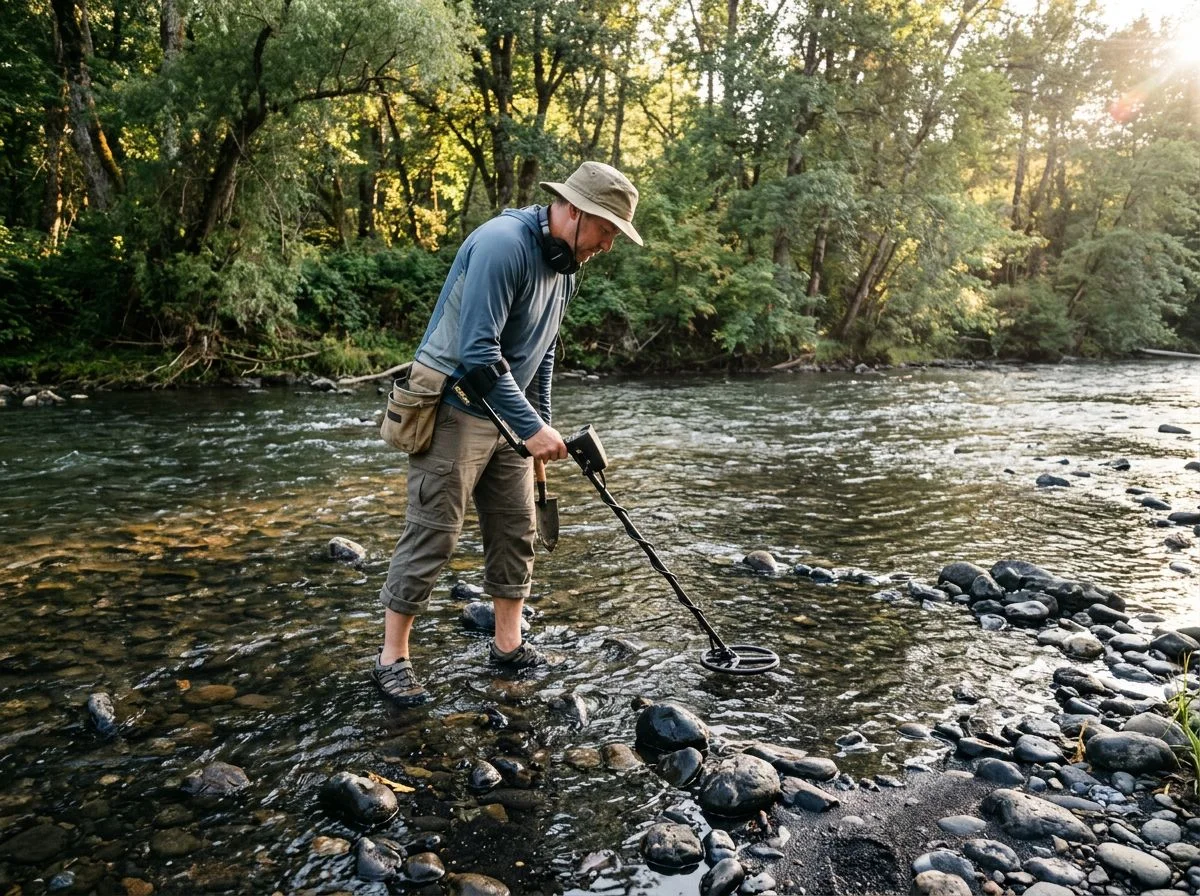
Here’s the short version: mode first, noise cancel second, ground balance third. In that order, every time. Skip a step or shuffle the sequence and you’ll chase phantom signals all afternoon. Follow it and most black sand instability resolves before you ever touch advanced settings.
ckgscoop’s breakdown of false signals in black sand lays out this systematic three-step process. I’ve found it holds up on every magnetite river I’ve worked. The order matters more than most people realize.
Step one: pick the right mode. On the Equinox 800, that means Beach 1 for dry and wet sand, Beach 2 for surf zones or underwater work. Beach modes are tuned to handle conductive ground and salt. Black sand behaves similarly enough that they stabilize the machine dramatically. If you’re running a different detector, look for the equivalent salt/beach program. River gravel with heavy magnetite is closer to a saltwater beach than it is to a farm field, electronically speaking.
Step two: noise cancel. Do this at every new location. Not just every new river, but every time you move a few hundred yards. Electromagnetic interference from power lines, cell towers, even buried cables can mimic ground noise. In black sand, you’ll never tell the difference by ear alone. The Equinox guide is explicit: execute a noise cancel at every new location. On the Manticore, perform a rolling noise cancel. Walk the area while the machine scans, rather than standing still. It takes an extra thirty seconds and saves you an hour of digging ghost signals.
Step three: ground balance. Run automatic ground balance continuously if your machine supports it. The Equinox guide recommends exactly that — automatic ground balance, continuously running. Black sand concentration shifts constantly along a riverbed. What reads as clean gravel in one step might be 40% magnetite three feet later. Let the machine track it. Then, once balanced, adjust sensitivity until only soft background chatter remains. That murmur is your machine working, not failing.
I’ve watched too many detectorists skip straight to sensitivity tweaks and discrimination fiddling before doing these three basics. The order exists for a reason. Follow it.
Black Sand River Detecting FAQ
Short answer: yes, your detector can handle black sand rivers. But “handle” means different things depending on what machine you’re swinging. The Reddit threads tell the real story better than any spec sheet.
The question I see constantly — and I mean constantly — is some variation of “Can my Simplex work on wet sand?” The answer, based on what actual users report, is a qualified yes. Simplex owners on Reddit confirm it functions in wet sand. But the machine chatters noticeably more than on dry ground. That’s not a defect. It’s the VLF single-frequency design fighting conductive, mineralized ground. You’ll get it stable. But you’ll sacrifice depth and sensitivity to do it.
Then there’s the broader question: “Does anybody detect on black sand beaches?” The thread on this exact topic is full of detectorists who do it regularly, with mixed results. The consensus: it’s doable, but you’ll work for every signal.
The gear-upgrade path tells you everything about how serious black sand really is. One user moved from the Equinox 700 to the Manticore. Their one-word review was “wow.” The multi-frequency stability jump in mineralized ground is that dramatic.
For the worst magnetite stretches, some folks skip VLF entirely. The Minelab SDC 2300 is a pulse induction machine waterproof to 10 feet and weighing 5.7 lbs. It’s heavy, but PI ignores mineralization in a way VLF simply can’t. If you want to stay lighter and cheaper, the Nokta Gold Kruzer runs at 61 kHz. It’s waterproof to 16 feet and weighs just 3.0 lbs. A high-frequency single-frequency option that handles black sand better than lower-kHz machines.
The bottom line from the forums: you can detect black sand rivers with almost any machine. Whether you’ll enjoy it depends on your tolerance for chatter and your willingness to tune.
The River Gives Slowly
The short version: multi-frequency machines like the Manticore (5-40 kHz), DEUS II (4-45 kHz), and Equinox 800 with its Gold Modes are purpose-built for magnetite hell. But your settings matter more than your machine. Ground balance, sensitivity, recovery speed, and coil choice decide whether you dig targets or ghosts.
I learned that lesson the hard way at that forgotten train stop near Auburn. Three weekends of fighting black sand, digging pull-tabs and hot rocks, questioning whether I’d wasted my time. Then the settings finally clicked. Ground balance dialed in. Sensitivity backed off just enough. Smaller coil on. And there it was: my first seated Liberty dime, sitting under a layer of magnetite that had been screaming at me for days.
The dime didn’t care that I was running an Equinox 800 instead of a Manticore. It cared that I’d finally set the machine up to hear it.
That’s the deal the river offers. Research the inside bends where gold and black sand accumulate together. Run the three-step sequence — mode, noise cancel, ground balance — every single time. And accept that you’ll dig trash before treasure. Probably lots of it. The river doesn’t hand over its secrets to the impatient. It rewards the persistent, the methodical, and the ones willing to dig forty pull-tabs for one coin that changes everything.

My name is Paul and I am the founder of Detector For Metal, a dedicated resource for metal detecting enthusiasts seeking to uncover historical treasures and connect with the past using the latest technology. As a stay-at-home dad and family man, I’ve found metal detecting to be the perfect hobby that combines family adventure with historical learnings for the whole family.
As a father, I’m deeply committed to passing on this hobby to the next generation of detectorists, starting with my own children. I share advice on everything from metal detecting with kids to exploring the top 10 metal detecting sites you never thought about. My methodical approach to the hobby goes beyond the thrill of discovery—it’s about creating family traditions while preserving history and sharing the stories of those who came before us.