Table of contents
- The 300-Year-Old Coin You Just Dug in a California Park
- Why Chinese Cash Coins Show Up on the West Coast
- Anatomy of a Cash Coin
- The Four Characters on the Obverse
- The Manchu Mint Marks on the Reverse
- Why the Square Hole Matters
- How to Identify a Dug Chinese Cash Coin
- Why the Coin’s Date Isn’t the Site’s Date
- What Your Cash Coin Was Actually Used For
- Where Do Chinese Cash Coins Turn Up?
- Cash Coins vs. Other Asian Coins You Might Dig
- Digging Chinese Cash Coins Responsibly
- Common Chinese Cash Coin Questions Answered
- The Coin Is the Beginning, Not the End
Chinese cash coins metal detecting is one of the most confusing corners of the hobby. Here’s the thing about dating a Chinese cash coin you just dug. The date on the coin tells you when it was minted, not when it was lost. Those two dates can be separated by a couple hundred years. A coin stamped with a 1660s reign title might have been dropped in a California railroad camp in 1885. That’s not a flaw in your dating method. It’s just how these coins actually circulated.
The reign title is your starting point. Flip the coin so the four obverse characters are readable. The square hole should be centered, not diamond-oriented. The top and bottom characters name the emperor who authorized the minting. K’ang Hsi coins, for instance, were struck between 1662 and 1722. But here’s where detectorists get tripped up. Ch’ing Dynasty coins from the four oldest reign periods — 1644 to 1795 — remained in circulation for centuries and show up constantly in late 19th- and early 20th-century contexts.
So what do you actually do with that information? You date the context, not the coin. If you’re digging an 1880s Chinese laundry site and pull a Shun Zhi coin from 1644–1661, the coin doesn’t mean the site is older than you thought. It means someone carried an old coin as a lucky piece, a game marker, or pocket change for decades before losing it. Archaeologists working the Yema-po site in the Bay Area found that the average coin date preceded the site’s occupation by about two centuries. That’s the norm, not the exception.
The honest takeaway? Use the reign title to identify the coin. Then use your site research to date the loss. The coin itself is a clue, not a timestamp.
The 300-Year-Old Coin You Just Dug in a California Park

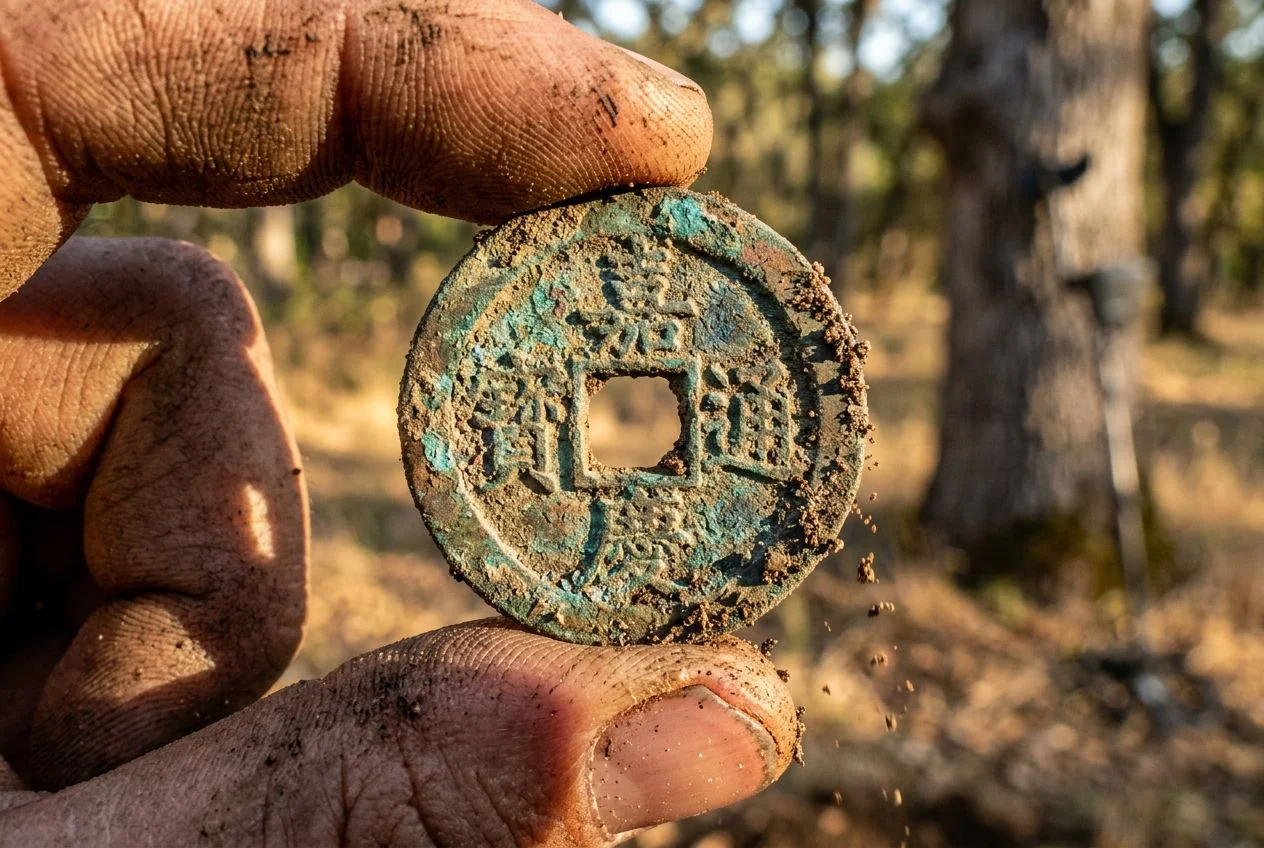
Chinese cash coins metal detecting often starts with confusion. That green disc with the square hole isn’t a washer, and it isn’t junk. It’s a Chinese cash coin, and the date stamped on it could easily be 300 years old. The catch? That date tells you when the coin was minted, not when it was lost. The two events might be separated by two centuries or more.
I still remember my first one. I was working a swimming hole outside Sacramento, digging the usual parade of pull-tabs and bottle caps. My detector hit on a solid mid-tone. I dug down about six inches and pulled out a thin, corroded disc with a square hole punched through the center. My honest first thought: great, another washer. I almost tossed it in the trash pouch without a second look.
Then I rubbed some of the green crust off and saw what looked like Chinese characters. That’s when the confusion set in. A Chinese coin? In a Sacramento swimming hole? It sat on my desk for three weeks before I figured out what I actually had.
Here’s the part that still messes with my head. These coins were minted by the billions and carried a value of roughly 1/10 of an American cent. They were pocket change — the kind of thing you’d string on a cord and forget about. But they circulated for centuries after minting. A coin stamped with a 1667 reign title might have been dropped in a California railroad camp in 1890. Or a Sacramento swimming hole in 1935.
That’s not a flaw in how you date these things. It’s just how they actually moved through the world — slowly, by hand, across oceans and generations. Once you understand that, the coin in your hand stops being a confusing green disc and starts being a story.
Why Chinese Cash Coins Show Up on the West Coast
Chinese cash coins metal detecting on the West Coast connects directly to 19th-century immigration. Here’s the short version. These coins crossed the Pacific in the pockets and pouches of Chinese immigrants during the 19th century. But they weren’t spending money. They were lucky pieces, game markers, and talismans — carried for protection and tradition, not commerce. That’s why a coin minted in 1700 ends up six inches deep in a Seattle neighborhood.
The scale of this migration is easy to underestimate until you see the archaeological record. When construction workers in Seattle started excavating under a bridge near Smith Cove, they uncovered approximately 2,600 historical artifacts from a neighborhood called Finntown. Among them? A Chinese cash coin minted in the 1700s during the Qing Dynasty. Smith Cove was a major landing point for ships carrying Asian immigrants to the American coast. So the coin’s presence makes perfect sense. Someone stepped off a boat with that coin in their pocket, and at some point, it slipped out.
What trips up a lot of detectorists is assuming these coins functioned like regular currency once they arrived. They didn’t. According to Akin, Bard & Akin’s field guide on numismatic archaeology, Chinese cash coins were rarely used as money in the United States. Instead, immigrants used them as lucky tokens and talismans. Sometimes they strung them with red thread into decorative coin swords. They used them as game markers for fan-tan, as medicinal tools for skin rubbing, and as funerary offerings. A coin that looked like pocket change to an American observer was actually doing completely different cultural work.
That’s worth remembering when you dig one. You’re not finding evidence of a transaction. You’re finding evidence of a person carrying their traditions across an ocean — and losing a small piece of them in the dirt along the way.
Anatomy of a Cash Coin

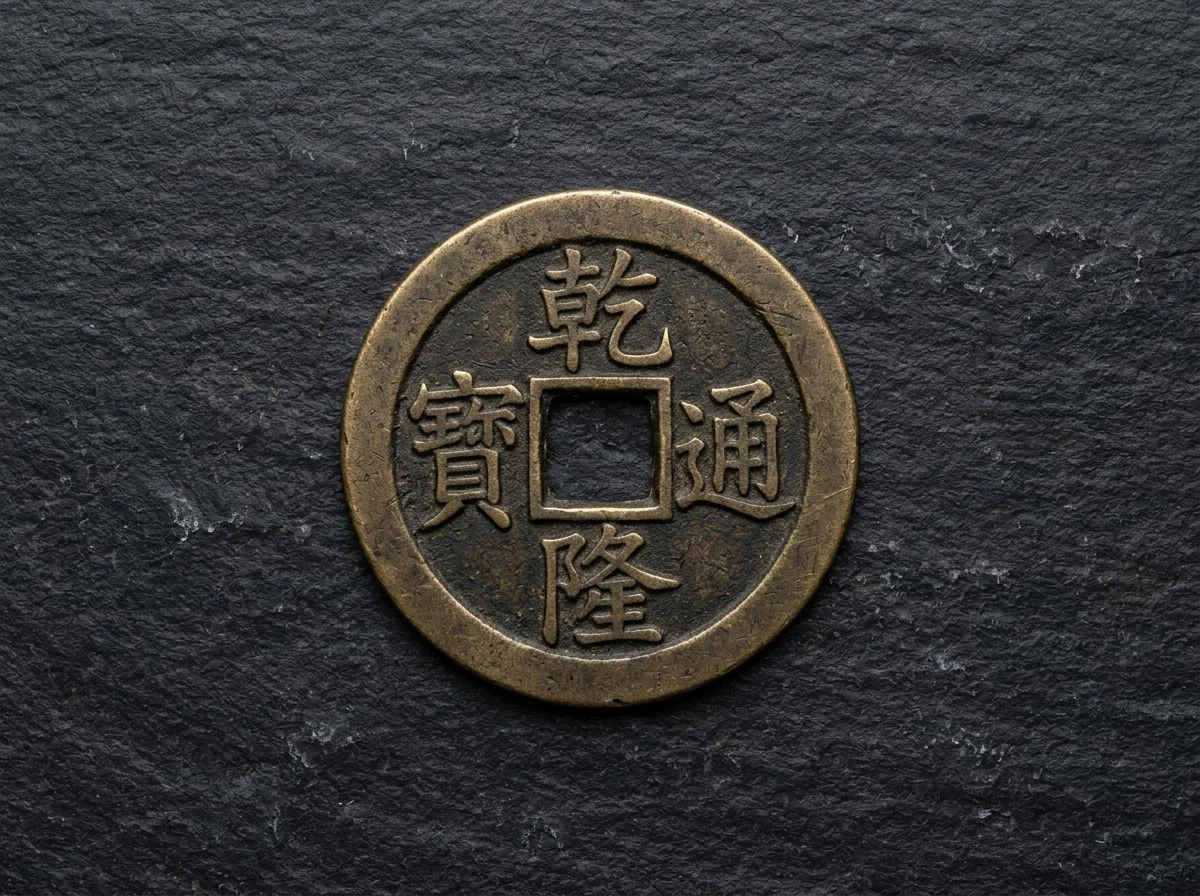
Chinese cash coins metal detecting starts with reading the coin correctly. A Chinese cash coin is a cast brass disc with a square hole punched through the center. Four Chinese characters sit around that hole on the obverse. Two Manchu characters on the reverse identify the mint. That’s the whole anatomy. But reading it correctly is the difference between “old coin” and “K’ang Hsi, minted in Peking, 1662–1722.”
The Four Characters on the Obverse
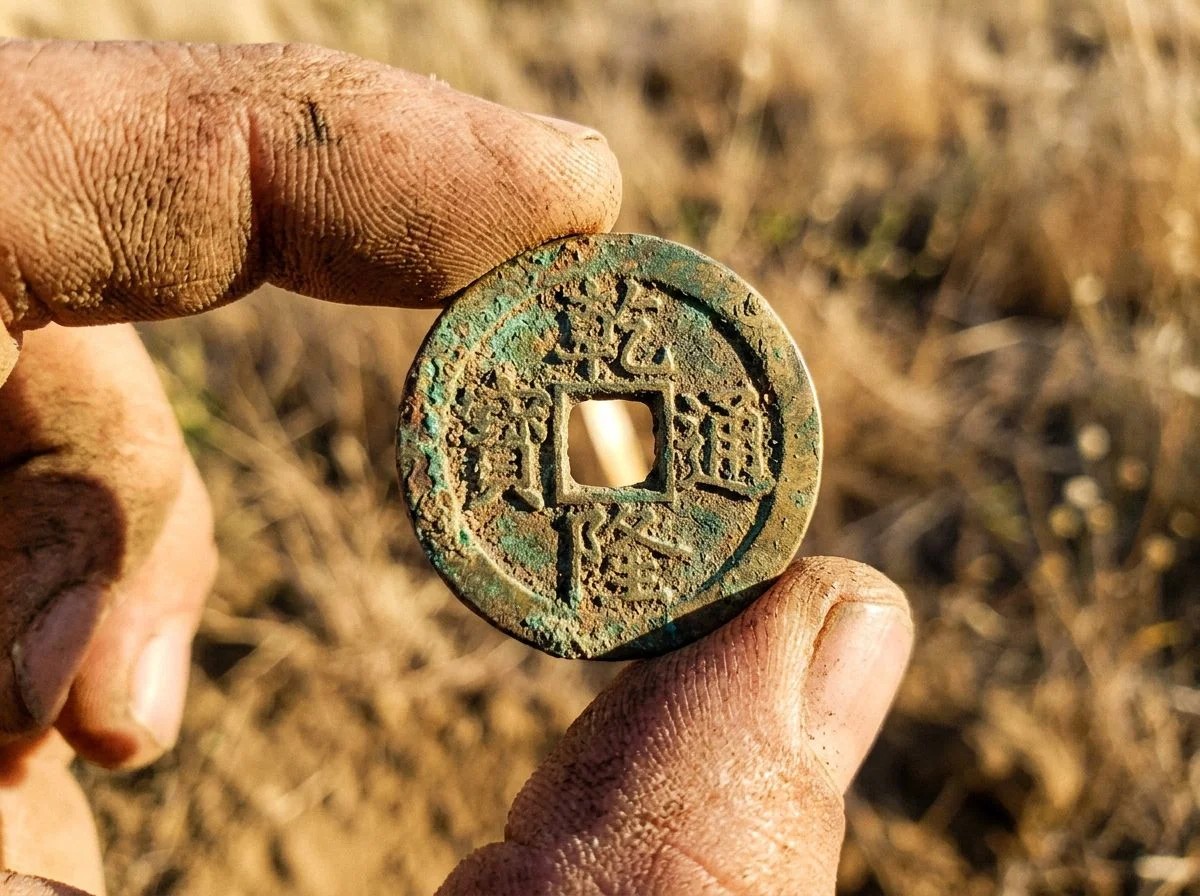
Chinese cash coins metal detecting relies on reading four characters. The obverse is the side with four Chinese characters. They’re read in pairs, not sequentially around the circle like a clock. The right and left characters translate to “current coin” or “current treasure.” That’s essentially boilerplate that appears on nearly every cash coin ever minted (Cal State East Bay). The top and bottom characters are where the real information lives. They indicate the emperor’s reign title.
So if you’re holding a coin and trying to orient it, the reign title runs vertically. The “current coin” phrase runs horizontally. Once you know that, you can stop rotating the thing in your hand like I did for the better part of an afternoon.
The Manchu Mint Marks on the Reverse

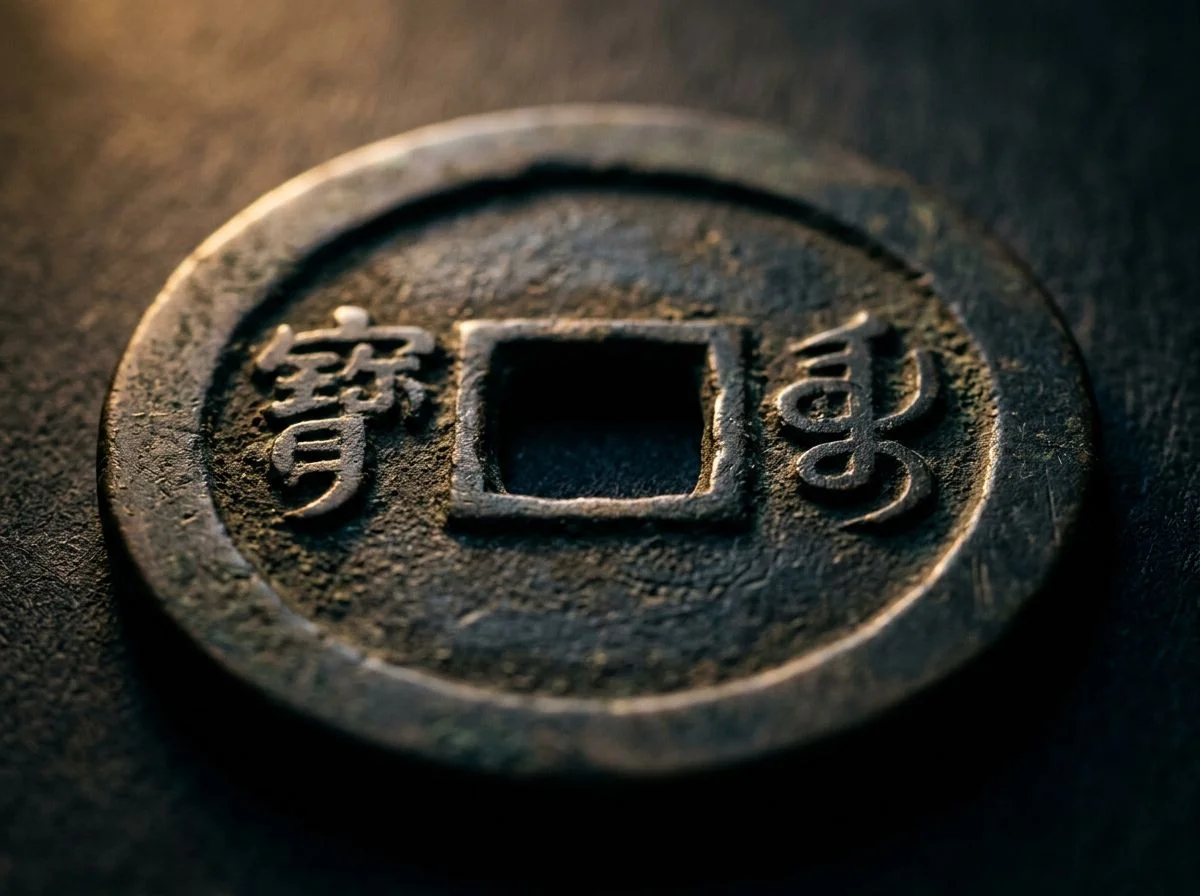
Chinese cash coins metal detecting gets easier once you can read the mint marks. Flip the coin over and you’ll find two Manchu characters. This is where a lot of detectorists stall out, because Manchu script looks nothing like the Chinese characters on the front. The left character translates to “boo,” meaning coin. The right character indicates the specific mint (Cal State East Bay). Peking is a common one, but dozens of provincial mints operated across China during the Qing Dynasty.
The mint mark matters more than you’d think. A coin from a provincial mint like Yunnan or Szechuan tells you something about trade networks. Those southern mints fed the ports where most West Coast immigrants departed from. A Peking mint mark suggests a coin that circulated more broadly before it ever crossed the Pacific.
Why the Square Hole Matters
Chinese cash coins metal detecting hinges on that square hole. That square hole isn’t decorative. It was practical. Coins were cast with the hole so they could be strung together on cords in groups of 100 or 1,000 for easy carrying and counting. A merchant could hoist a string of cash coins over a shoulder and go.
For you, the square hole is also a diagnostic. If you dig a round brass disc with a round hole, it’s probably not a Chinese cash coin. It might be a washer, a button, or some other hardware. The square hole is the first thing I check when I’m not sure what I’ve pulled out of the ground. Square hole plus Chinese characters? Cash coin. Round hole or no hole? Back to the junk pouch.
The hole also explains why these coins survive in the ground as well as they do. Cast brass is durable, and the hole means water drains through rather than pooling against the surface. That’s why a coin minted in 1700 can come out of California dirt looking green but still legible. A modern zinc penny from 1990, meanwhile, dissolves into a white smear after five years.
How to Identify a Dug Chinese Cash Coin
Chinese cash coins metal detecting identification follows a simple workflow. Here’s the workflow I use. Clean it gently. Orient it using the square hole. Photograph both sides. Match the reign title to an emperor chart. Identify the mint mark. Record what you’ve got. Sounds simple. It took me three weeks the first time.
My first cash coin sat on my desk for nearly a month because I couldn’t figure out which way was up. I’d rotate the thing, squint at the characters, flip it over, rotate again. Nothing clicked. The breakthrough came when I realized the square hole isn’t just decorative. It’s the orientation key. The characters are arranged around that hole in a specific relationship to its corners. Once you see it, you can’t unsee it.
Step 1: Clean it — but not too aggressively. These coins are cast brass, and the patina carries a lot of the detail. Dry brushing with a soft toothbrush gets most of the dirt off. If it’s crusted, a soak in distilled water for a few hours loosens things up without eating into the metal. Skip the vinegar. Skip the electrolysis. I ruined a perfectly good 1700s coin once by getting impatient with a wire brush. Learn from my mistake.
Step 2: Orient the coin. Hold it so the square hole is positioned like a diamond rather than a square. Corners pointing up, down, left, right. The obverse has four Chinese characters arranged around that diamond-shaped hole. The two characters on the right and left read “current coin” or “current treasure” — boilerplate that appears on nearly every cash coin ever minted (Cal State East Bay). The top and bottom characters give you the emperor’s reign title. That’s your dating key.
Step 3: Match the reign title. Take a clear photo of the obverse. Compare the top and bottom characters against an emperor reign chart. Common ones you’ll see on West Coast finds include K’ang Hsi (1662–1722), Yung Cheng (1723–1735), and Chia Ch’ing (1796–1820). But here’s the catch. Those early coins stayed in circulation for centuries. A coin dated 1667 might have been dropped in a Seattle neighborhood in 1895 (Grant Keddie). The mint date tells you when it was made, not when it was lost.
Step 4: Flip it and read the mint. The reverse has two Manchu characters. The left one translates to “boo” — coin. The right one identifies the specific mint (Cal State East Bay). Peking is common, but provincial mints pop up too. Those can hint at trade routes. A Yunnan mint mark on a coin found in Oregon suggests a different journey than a Peking coin.
Step 5: Record it. Note the depth, location, and any nearby finds. Context matters more than you’d think. A 2011 Yukon discovery found a Kangxi-era coin minted between 1667 and 1671 alongside stone carving tools in an archaeological setting with no later European materials. That suggests it arrived before the 1898 Klondike Gold Rush, likely
Why the Coin’s Date Isn’t the Site’s Date
Chinese cash coins metal detecting teaches a hard lesson about dates. Here’s the uncomfortable truth about Chinese cash coins. The date stamped on the coin tells you almost nothing about when it went into the ground. These coins circulated for centuries after minting. A coin dated 1667 could easily have been lost in 1890. The date is a starting point, not an answer.
If you dig a Kangxi coin and tell your detecting club you found a 1660s site, you’re probably wrong by two centuries. Here’s the archaeological evidence that proves it.
Grant Keddie’s analysis of a burial at Newcastle Island, B.C. is the case study I keep coming back to. The burial contained seven Chinese coins spanning 1662 to 1820. But the coffin was assembled with square-headed nails. The associated artifacts — late-style bone buttons, a copper thimble, a partial blue bead — all pointed to a late 19th or early 20th century interment (Grant Keddie). Those coins were old when they went into the ground. Really old. Someone carried them around for generations before they ended up in that burial.
The pattern holds across the West Coast. At the Yema-po site in the San Francisco Bay Area, the average date of issue for the Chinese coins recovered preceded the site’s actual occupation by about two centuries (Cal State East Bay). Two centuries. Let that sink in. If you’re using coin dates to date your site, you’re not just off by a few years. You’re off by entire historical eras.
Why did this happen? Qing Dynasty coins from the four oldest reign periods (1644–1795) remained in circulation for centuries (Grant Keddie). They were minted by the billions. They carried almost no monetary value. They got repurposed constantly — as gaming pieces, talismans, medicine tools, you name it. A coin minted in 1670 wasn’t “old” to someone in 1880. It was just a coin. They’d carry it across the Pacific, string it on a cord, use it in a fan-tan game, lose it under the floorboards of a laundry.
So when you dig a cash coin, the date on it is the earliest possible date for your site — not the actual date. To pin down when that coin hit the dirt, you need context. The other artifacts around it. The history of the location. The age of the structures. The coin is one data point in a much bigger picture. Don’t let it fool you.
What Your Cash Coin Was Actually Used For
Chinese cash coins metal detecting reveals surprising uses beyond currency. Your cash coin probably wasn’t money. In the American West, these coins served as gaming pieces, talismans, and trade goods far more often than they ever bought anything. What if that coin you dug wasn’t lost pocket change? What if it was a piece of a fan-tan gambling set, or a talisman strung on red thread to guarantee longevity?
The Jacksonville Chinese Quarter site in Oregon is the clearest picture we have of this. Archaeologists recovered 10 Chinese wen coins, one 1866 Hong Kong mil coin, and 37 cast-zinc Vietnamese dong coins from a burned house (Jacksonville Review). The contexts told two completely different stories. Some coins sat alongside glass gaming pieces used for fan-tan, the betting game that dominated Chinese gambling houses. Others, like a Kangxi reign coin, had been kept as talismans for longevity. Same coin type. Completely different purposes. Sometimes in the same building.
The talisman angle runs deep. Cash coins got strung on red thread, woven into coin swords, and carried for luck and protection (Akin, Bard & Akin). Some were used in traditional medicine. Rubbing the coin against skin was believed to draw out illness. A coin minted in 1700 might have spent its final decades in a leather pouch as a charm, never once used to buy anything.
And here’s the part that surprises most detectorists. These coins circulated well beyond Chinese communities. Wishram and Tlingit women acquired cash coins through trade. They sewed them onto baskets and ceremonial regalia as decoration (Akin, Bard & Akin). So that corroded disc you pulled from a riverbank might have been a gambling token in a Chinese quarter. A charm in someone’s pocket. An ornament on a Tlingit dancer’s regalia. You’ll probably never know which.
That uncertainty is part of what makes these finds so compelling. The coin’s story didn’t end when it left the mint. It was just getting started.
Where Do Chinese Cash Coins Turn Up?

Chinese cash coins metal detecting success depends on site research. The short answer? Research railroad camps, Chinatown sites, and old commercial districts. Then cross-reference historical maps and newspapers to pinpoint structures that no longer exist. The same approach that finds seated dimes finds cash coins. You’re just looking for a different kind of site.
I learned this the hard way near Auburn. An 87-year-old former conductor tipped me off to a forgotten train stop. Three weekends of swinging later, I’d pulled over 30 Indian Head pennies and my first seated Liberty dime. The spot looked like nothing. Just a slight widening in the road near the old rail bed. But the research told me exactly where to stand.
The same logic applies to Chinese cash coins, except the research points you toward different structures. Laundries, boarding houses, and gambling halls in old Chinatowns are the money spots. These were wooden buildings that burned, rotted, or got bulldozed. What’s left underground is a concentrated layer of daily life — including coins that slipped through floorboards.
The Lovelock Chinatown site in Nevada is the gold standard example. The settlement emerged right after Central Pacific Railroad construction kicked off in August 1868. When archaeologists excavated it, they recovered 24 small-denomination coins from the subfloor of a Chinese laundry. They also found a hoard of $1,865 in gold coins buried in a snuff jar beneath an adjacent cottage. That’s the kind of concentration you’re hoping for.
So how do you find these sites? Start with Sanborn fire insurance maps. They show building footprints, construction materials, and sometimes even business types. A Chinese laundry in 1885 is a bullseye. Then cross-reference with old newspapers. Ads, arrest reports, and business directories mention Chinese-owned establishments by name and address. I’ve spent entire evenings in county archives chasing a single line from an 1890s paper. Sometimes it pays off exactly like it did near Auburn.
One more thing. Don’t assume the site is gone just because the building is. The subfloor finds at Lovelock came from a structure that no longer exists. The coins were waiting under the dirt, not under the floorboards.
Cash Coins vs. Other Asian Coins You Might Dig
Chinese cash coins metal detecting requires knowing what isn’t Chinese. The short answer? If it’s cast brass with a square hole, it’s probably Chinese. If it’s cast zinc, you’ve got a Vietnamese dong. If it’s struck bronze with no hole, start thinking Hong Kong mil. The material and manufacturing method are your first clues (Jacksonville Review).
I learned this distinction the hard way. My first “cash coin” turned out to be none of the above. Just a corroded washer that had me convinced for a solid afternoon. But once you know what separates these Asian coins, identification gets a lot less frustrating.
Chinese cash coins are the ones everyone pictures. Cast brass, square hole in the center, four characters on the front. They were minted by the billions and circulated for centuries. That’s why they dominate most West Coast finds (Akin, Bard & Akin). When you dig an Asian coin on this side of the Pacific, odds are it’s one of these.
But not always. At the Jacksonville Chinese Quarter site in Oregon, 37 of the 48 Asian coins recovered were Vietnamese zinc dong coins, not Chinese cash coins (Jacksonville Review). That distinction reveals trade ties to southern Chinese ports between 1880 and 1895. It’s a staggering ratio. It tells you these zinc coins weren’t rare oddities. They were moving through the same channels as the brass cash.
The zinc is the giveaway. Vietnamese dong coins corrode differently than brass. They get that white, chalky crust that crumbles when you try to clean it. If you dig a square-holed coin and it’s falling apart in your hand, you’re probably holding a dong, not a wen.
Hong Kong mil coins are the curveball. These are struck, not cast. Machine-made bronze with crisp edges and no square hole. The 1866 mil from Jacksonville is a perfect example of how one coin can throw off your whole identification system if you’re not expecting it (Jacksonville Review).
So when you pull an Asian coin from the ground, check three things in order. Material: brass, zinc, or bronze. Manufacturing method: cast or struck. The hole: square or absent. That sequence will put you on the right track before you even start squinting at characters.
Digging Chinese Cash Coins Responsibly
Chinese cash coins metal detecting demands ethical care. The short answer? Get permission, follow local laws, and never dig on known archaeological sites. This is especially true for historic Chinese quarters, where context matters more than the coin itself.
These coins are someone’s heritage, not just a cool find. If you dig one from a known archaeological site, you’re not just breaking the law. You’re erasing history that belongs to a community.
I know that sounds heavy, but it’s the truth. Archaeological sites like Yreka Chinatown and the Jacksonville Chinese Quarter have produced cash coins in context with gaming paraphernalia, talismans, and household items. That context is destroyed when hobbyists remove coins (Farris, Historical Archaeology). A coin sitting next to fan-tan glass pieces tells researchers something. A coin in your display case tells them nothing.
So what’s the practical rule? Private property with permission — fine. Public parks where detecting is allowed — fine. But if you’re standing on a documented archaeological site, a designated historic district, or any location on federal land, put the detector down. The fines aren’t worth it. And frankly, neither is the damage to the historical record.
The ethical line isn’t always obvious. That empty lot might have been a Chinese laundry in 1890. Do your research first. If it was, consider leaving it alone or contacting local archaeologists instead. The hobby survives on trust. Digging where we shouldn’t is how we lose it.
Common Chinese Cash Coin Questions Answered
Chinese cash coins metal detecting raises one big question: value. The short answer? No, your Chinese cash coin is probably not worth much money. But the story it tells is worth more than the coin itself. Most dug cash coins are worth a few dollars at best. Yet they’re among the most historically interesting finds you’ll ever pull from West Coast soil.
Is my Chinese cash coin worth anything? Monetarily, probably not. These coins were minted by the billions and carried a value of roughly 1/10 of an American cent. Common Qing Dynasty cash coins in dug condition typically sell for $1–5. Heavily corroded specimens are worth even less. But here’s the thing. The value isn’t in the coin. It’s in what the coin tells you about the ground you’re standing on.
Herbert K. Beals analyzed 101 Chinese cash coin specimens from six Pacific Northwest aboriginal sites. His work showed these coins entered Native American circulation and use prior to 1830 (Beals, Historical Archaeology). That’s decades before large-scale Chinese immigration to the region. These coins traveled through indigenous trade networks as ornaments and status symbols long before they arrived in immigrant pockets. When you dig one, you’re holding evidence of a trade route that predates the Gold Rush.
So no, you’re not retiring on it. But you’re holding a piece of metal that crossed an ocean, passed through multiple cultures, and sat in the ground for a century or more waiting for your coil to find it. That’s worth more than whatever a dealer would offer.
The Coin Is the Beginning, Not the End
Chinese cash coins metal detecting ultimately leads beyond the coin itself. The short answer is this. A Chinese cash coin you pull from West Coast soil is rarely worth more than a few dollars. But it connects you to a story that spans oceans, centuries, and cultures in ways a modern coin never could. The value was never in the metal.
That Mercury dime that hooked me all those years ago wasn’t worth much either. Maybe a few bucks on a good day. But holding something someone lost 80 years earlier — feeling the weight of that moment in my palm — that’s what kept me swinging a coil through Sacramento summers. A Chinese cash coin does the same thing, except the gap is wider. Much wider.
Think about what a single corroded disc can connect. A Sacramento park to a Guangdong village, where someone’s ancestor pressed that coin into a pocket before boarding a ship. A Yukon wilderness site to Russian fur traders and Tlingit ceremonial regalia, the coin traded for sea otter pelts and sewn into a rattle. A Seattle construction site to a Prohibition-era Finntown neighborhood, buried under a bridge where ships once landed.
That’s not a coin. That’s a thread.
So when you dig one, don’t just toss it in the junk pouch. Clean it carefully. Photograph it. Try to read the reign title. Ask where it came from and how it got there. The research is where this hobby actually lives. The coin is just the excuse to start digging.

My name is Paul and I am the founder of Detector For Metal, a dedicated resource for metal detecting enthusiasts seeking to uncover historical treasures and connect with the past using the latest technology. As a stay-at-home dad and family man, I’ve found metal detecting to be the perfect hobby that combines family adventure with historical learnings for the whole family.
As a father, I’m deeply committed to passing on this hobby to the next generation of detectorists, starting with my own children. I share advice on everything from metal detecting with kids to exploring the top 10 metal detecting sites you never thought about. My methodical approach to the hobby goes beyond the thrill of discovery—it’s about creating family traditions while preserving history and sharing the stories of those who came before us.