Table of contents
- Why You Need Open Ears While Detecting
- How Bone Conduction Metal Detecting Works
- Hearing Traffic and Hazards on Solo Hunts
- Can You Detect While Watching Your Kids?
- What Bone Conduction Sounds Like in the Field
- A Real Win for Hearing-Impaired Detectorists
- Picking Bone Conduction Headphones for Detecting
- Should You Switch from Over-Ear Headphones?
- Bone Conduction Metal Detecting Questions Answered
Bone conduction headphones let you hear your detector’s tones and the world around you at the same time. For solo detectorists near traffic and dads keeping an ear on kids at the park, that dual awareness isn’t a luxury. It’s the whole point.
Here’s the thing about traditional detecting headphones: they’re isolation chambers. They’re great for hearing a faint 10-05 signal. They’re terrible for hearing a car, a bike, or a kid who just fell off the swing set. I’ve lost count of how many times I’ve had to yank one ear cup off to check on my youngest. And every time, I missed a target tone in the process.
Bone conduction changes that equation completely. The transducers sit on your cheekbones, not over your ears. Your ear canals stay completely open. An audiologist’s review of the Shokz OpenRun explains that the vibrations travel through the zygomatic bones straight to your inner ear. They bypass the eardrum entirely. You hear the detector’s tones inside your head while ambient sound flows in naturally.
For solo curb-strip hunting, that’s a genuine safety upgrade. Shokz’s own guide points out that open-ear designs let you hear car horns, trains, and warning shouts. That’s the stuff that keeps you from becoming a statistic. And for dad-duty detecting at the playground or beach, you’re not choosing between the hobby and watching your kids. You’re doing both without compromise.
One detectorist on the Friendly Metal Detecting Forum put it perfectly. After nearly two hours with bone conduction headphones on an Equinox 800, he forgot he was wearing them. He could still hear his pinpointer without pulling a single ear cup off. That’s the dream scenario. And it’s exactly why I keep reaching for mine.
Why You Need Open Ears While Detecting

Here’s the short answer: bone conduction headphones leave your ear canals completely open. You can hear your detector’s tones and a car horn at the same time. No muffling, no isolation, no trade-off between safety and signal.
Last Tuesday, I was working a curb strip about six blocks from my house. The kids were home with my wife. I’d squeezed in 45 minutes before dinner. The Equinox was chattering away through my bone conduction headphones. Mostly pull-tabs, if I’m being honest. Then a Subaru came around the corner. I heard the tires on wet pavement before I saw it. Didn’t flinch, didn’t jump. I just stepped back onto the grass and kept swinging.
That’s the moment this technology earns its keep.
Traditional headphones, especially waterproof ones, have a nasty habit. They trap water against your ear and turn every outside sound into a distant mumble. An audiologist’s review of the Shokz OpenRun confirms what I’ve felt in the field. Bone conduction leaves the ear canal 100% unobstructed. Ambient sound flows in naturally while the detector’s tones ride straight through your cheekbones. You’re not choosing between hearing the machine and hearing the world. You get both, cleanly.
For solo detectorists near traffic, that’s not a convenience. It’s the difference between a relaxing hunt and a near-miss. And for dads like me, it means I can keep an ear on the front door, the driveway, or the playground while I’m chasing a faint signal. No more yanking one ear cup off every ninety seconds. No more missing the good target because I was checking on the kids.
How Bone Conduction Metal Detecting Works
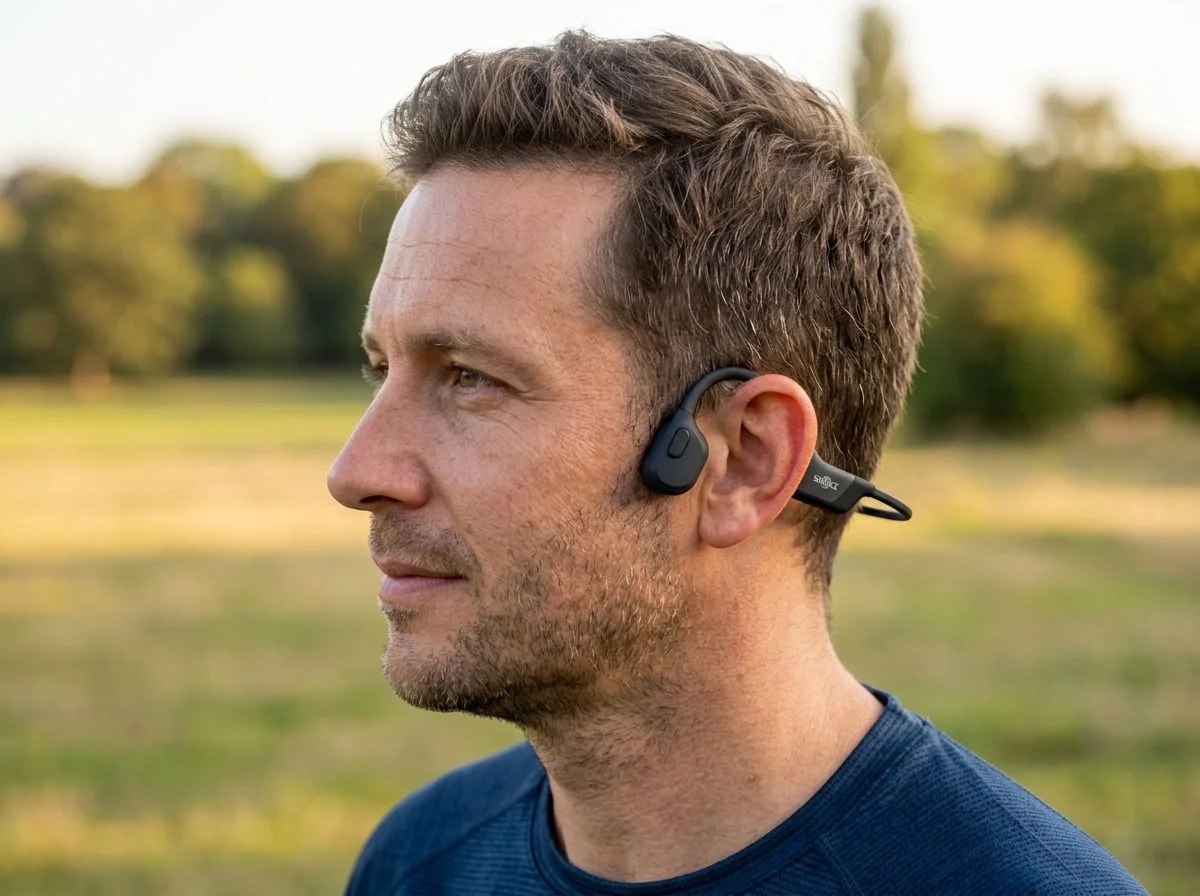
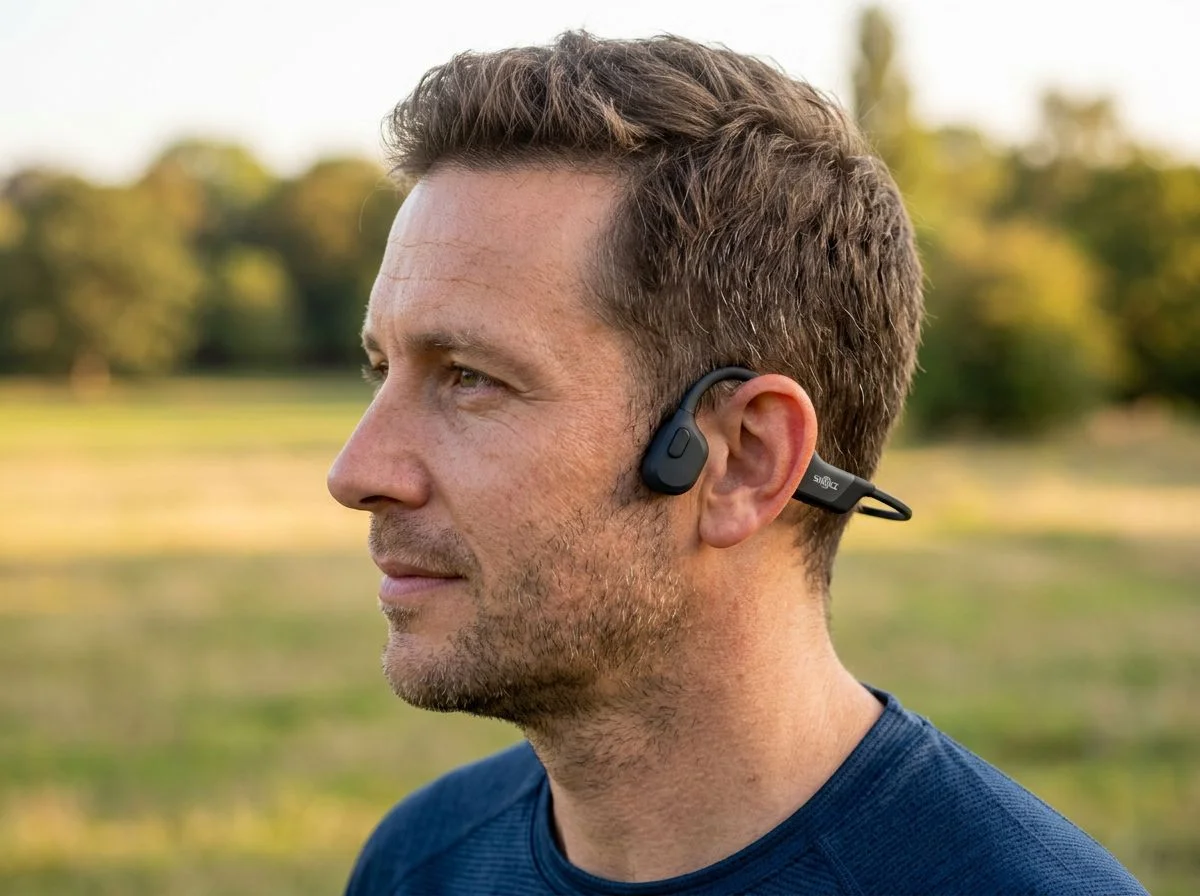
Here’s the short version: bone conduction headphones skip your eardrums entirely. They sit on your cheekbones and send vibrations straight through the bones of your skull to your inner ear. Your ear canals stay completely open to the world.
The first time I put on a pair, I kept touching them to make sure they were actually doing something. They rest on the zygomatic bones. That’s your cheekbones, if you want to skip the anatomy lesson. The vibrations travel directly to the cochlea. No eardrum involvement. No ear canal blockage. Shokz’s guide to the technology explains that this bypass route is exactly why the Audiology Foundation of America notes bone conduction causes less damage to eardrums than traditional headphones. I’ve already logged thousands of hours with earcups clamped on. That’s a comforting thought.
And here’s the part that always gets me: this isn’t new technology. Beethoven was deaf. Completely, functionally deaf. And he still composed. His trick? He clamped a rod to his piano and bit down on it. The vibrations traveled through his jawbone straight to his inner ear, bypassing the ears that no longer worked. That’s bone conduction. Two hundred years before Shokz put it in a sleek little headband.
For detectorists, the practical upshot is simple. Your detector’s tones arrive inside your head while the ambient world flows in naturally. Nothing covers your ears. Nothing muffles a car horn or a kid calling your name.
Hearing Traffic and Hazards on Solo Hunts

Here’s the short answer: open-ear bone conduction design means you hear car horns, trains, and warning shouts while your detector’s tones ride through your cheekbones. No isolation, no trade-off. You get the full sonic picture at once.
That curb strip story I mentioned? The Prius one? It actually happened twice, sort of. The first time, I was wearing traditional over-ear headphones. I was locked onto a deep, repeatable signal near the sidewalk. I never heard the car. It was one of those silent hybrids that creep up like a cat. By the time I registered the shadow, I’d already stumbled backward into the street. The driver waved apologetically. I waved back, heart hammering, and thought about how close that was.
The second time, same curb strip, same kind of Prius. But I had the bone conduction headphones on. I heard the tires on the asphalt a full two seconds before it reached me. I stepped onto the grass, kept swinging, didn’t miss a beat. That’s the whole argument in two moments.
The numbers back it up. Traditional headphones can cut environmental noise by up to 24 dB. That’s great for signal clarity, terrible for situational awareness, according to Treasure Coast Metal Detectors. Meanwhile, Shokz’s breakdown of open-ear benefits lists exactly what you do still hear: car horns, trains, warning shouts. The stuff that keeps you alive when you’re hunting solo near a road.
For me, that’s the difference between a relaxing 45-minute hunt and constantly looking over my shoulder. I’d rather hear the world and the machine together.
Can You Detect While Watching Your Kids?

Here’s the short answer: bone conduction headphones leave both ears completely free. You can track your detector’s tones through your cheekbones while still hearing every “Dad, look at this!” from fifty feet away. No ear cups, no isolation, no choosing between the hunt and the kids.
Last spring, I took both kids out to a spot along the American River. It was an old swimming hole I’d been meaning to work for years. My daughter is seven and currently convinced she’s going to be an archaeologist. She was working the pinpointer and a small hand trowel. My son is five. He had zero interest in digging and was drifting toward the creek with the kind of single-minded focus only a five-year-old can manage.
With traditional headphones on, I’d have missed it. The creek there runs fast in spring. He was maybe forty yards out when I heard his boots crunching on the gravel. Not a yell, not a splash. Just the sound of small feet moving toward water. I called his name. He froze. Crisis averted before it started.
That’s the thing the spec sheets don’t tell you. One user on the Friendly Metal Detecting Forum mentioned the headphones are so lightweight he forgot he was wearing them after two hours. I can confirm. The first time I took the kids out with them, I kept reaching up to adjust earcups that weren’t there. The open-ear design means both ears stay free to monitor the chaos. That’s the entire job description when you’re detecting with children.
My daughter did eventually pull a 1940s wheat penny from about six inches down. She’s still telling people about it. My son found a stick he was very proud of. I heard both of them the whole time.
What Bone Conduction Sounds Like in the Field
Here’s the short answer: tones seem to come from inside your head rather than from external speakers. Faint signals you’d normally miss become highly perceptible. Threshold and low iron tones are felt more than heard. It’s a completely different sensory experience.
MinnesotaMetal over on the Friendly Metal Detecting Forum nailed the description. He paired bone conduction headphones with his Equinox 800. He said the tones seem to come from inside the head rather than from external speakers. That’s exactly what it feels like. The detector’s audio bypasses your ears entirely and just arrives in your skull.
The weird part is how much this changes your perception of faint signals. With traditional headphones, a whisper-deep target at the edge of detection is easy to lose. Wind, traffic, your own breathing — it all competes. With bone conduction, those faint signals are highly perceptible. They register as a distinct vibration against your cheekbone before your brain even processes them as sound.
Threshold and low iron tones are the real surprise. Those barely-audible background hums that tell you the machine is still working? You feel them more than hear them. It’s like the detector is tapping you on the jaw instead of whispering in your ear. I found myself lowering the volume on my Equinox and still catching every nuance. I’d never have attempted that with standard headphones.
It takes about twenty minutes to adjust. Then you forget the headphones are there at all.
A Real Win for Hearing-Impaired Detectorists
Here’s the short answer: bone conduction transmits sound through vibration rather than through the ear canal. Detectorists with hearing loss can often perceive tones they’d miss entirely with traditional headphones. It’s not a cure. But for many, it’s the difference between hunting blind and hunting with confidence.
The XP Deus II’s BH-01 bone conduction headphones are built with this in mind. The signal bypasses the eardrum and travels directly through the cheekbones to the cochlea. Hearing-impaired detectorists benefit from a transmission path that doesn’t depend on the parts of the ear that may be damaged.
A forum user named jimmy clark over at Find’s Treasure Forums explained his situation perfectly. He has ear ringing and hearing loss in his right ear. With traditional headphones, he had to constantly pull one side off to hear his pinpointer. That’s not a minor inconvenience. It’s a workflow that breaks every time you dig a target. He sought out bone conduction specifically because the open-ear design would let him catch the pinpointer’s beep without removing anything.
That’s the thing about accessibility wins like this. They don’t just help people with diagnosed hearing loss. They help anyone whose hearing isn’t what it used to be. Years of loud environments, power tools, or just getting older take their toll. The vibration-based transmission gives your ears a second pathway to the signal. And for some detectorists, that second pathway is the only one that still works reliably.
Picking Bone Conduction Headphones for Detecting
Here’s the short answer: if you own a Nokta Legend 2, the $89.99 Nokta Bone Conduction Headphones are the obvious budget-friendly entry point. But if you’re running a Deus II and plan to dive, the XP BH-01 earns its premium with an IP68 rating good to 65 feet.
Let’s start with the Nokta option. It’s the one I’d actually recommend to most people. At $89.99, it’s priced like an accessory rather than an investment. The headphones are built specifically for the Legend 2. That means no adapter headaches and no compatibility guesswork. They just pair and work. The listing at Metal Detecting Stuff emphasizes the fully waterproof construction and the open-ear design. You can hear surf conditions while still catching subtle tone variations. That’s the sweet spot for water hunters who don’t want to drop Deus II money.
The XP BH-01 is a different beast entirely. It’s rated IP68. That means it’s not just splash-proof. It’s submersible to 65 feet. If you’re diving with your Deus II, that’s not a luxury. It’s the whole point. Standard waterproof headphones trap water in the ear canal and muffle everything. The BH-01 sits on your cheekbones and transmits through vibration. The audio stays clear even when you’re fully submerged. That said, you’re paying a premium for that capability. If you never go deeper than knee-deep surf, the Nokta will do the job just fine.
One warning before you buy anything: watch out for Bluetooth latency. Over on Find’s Treasure Forums, member KindManTall flagged that many generic bone conduction headphones lack AptX Low Latency support. That means your detector’s tone arrives a beat after your coil actually passes over the target. That delay might not sound like much. But when you’re pinpointing a dime at eight inches, it’s the difference between a clean plug and a scratched coin. Stick with manufacturer-specific models. Or verify the latency specs before you commit.
Should You Switch from Over-Ear Headphones?
Switch if you hunt alone near traffic. Switch if you want to hear your pinpointer without pulling a cup off your ear. Switch if you have hearing loss that traditional headphones can’t work around. Stick with over-ears if you hunt in howling wind or crashing surf. In those conditions, that up to 24 dB of environmental noise reduction is the only thing standing between you and a missed silver dime.
I’ll be honest. I still grab my over-ears for beach hunts. When the Pacific is doing its thing and the wind is blowing sand sideways, bone conduction just can’t compete with a sealed cup. The tones get lost in the chaos. But for curb strips, old parks, and anywhere with cars or kids around, bone conduction has become my default.
There’s also the health angle nobody talks about. Bypassing the ear canal reduces ear infection risk and impacted earwax. After years of shoving earbuds into sweaty ears during Sacramento summers, I appreciate that more than I expected to.
So here’s my rule. If your hunts involve headphones coming off and on constantly, or you’ve ever been startled by a car you didn’t hear, make the switch. If you’re a dedicated water hunter, or you hunt in conditions where signal isolation is everything, keep the over-ears. Hell, keep both. That’s what I did.
Bone Conduction Metal Detecting Questions Answered
Here’s the short answer: bone conduction headphones work for detecting. But only if you buy ones with AptX Low Latency. Cheap Bluetooth buds will drive you crazy with delayed tones. Comfort is excellent. One detectorist reported forgetting they were wearing them after two hours.
Let me answer the questions I actually see pop up on forums. They’re more specific than “do they work?”
“Will my detector pair with generic bone conduction headphones?”
Maybe, but you’ll regret it. Over on Find’s Treasure Forums, member KindManTall flagged the exact problem. Most consumer bone conduction headphones lack AptX Low Latency support. That means the tone hits your skull a beat after your coil passes the target. In trashy ground, that delay makes pinpointing nearly impossible. If you’re running a Legend or Equinox, stick with detector-specific models. Or verify the codec before you buy.
“Are they comfortable for long hunts?”
This is where bone conduction shines. A user on the Friendly Metal Detecting Forum reported detecting for nearly two hours with “extreme comfort.” They were so lightweight he forgot he was wearing them. That’s the opposite of my over-ears. Those feel like a head vice by hour three.
“Can I hear my pinpointer?”
Yes, and that’s the whole point. No more sliding one cup off your ear every time you switch to the carrot.

My name is Paul and I am the founder of Detector For Metal, a dedicated resource for metal detecting enthusiasts seeking to uncover historical treasures and connect with the past using the latest technology. As a stay-at-home dad and family man, I’ve found metal detecting to be the perfect hobby that combines family adventure with historical learnings for the whole family.
As a father, I’m deeply committed to passing on this hobby to the next generation of detectorists, starting with my own children. I share advice on everything from metal detecting with kids to exploring the top 10 metal detecting sites you never thought about. My methodical approach to the hobby goes beyond the thrill of discovery—it’s about creating family traditions while preserving history and sharing the stories of those who came before us.