Table of contents
- Why Metal Detecting Around Tree Roots Is Tricky
- How Roots Trap and Hold Targets Underground
- Tools for Metal Detecting Around Tree Roots
- Working With Roots Instead of Fighting Them
- Which Trees Mark Old Home Sites and Relic Spots
- When to Walk Away From a Root-Bound Target
- GPR, Hydro Excavation, and Calling in the Pros
- Common Questions About Metal Detecting Around Tree Roots
Metal detecting around tree roots is one of the most frustrating — and rewarding — parts of this hobby. Here’s the short version: don’t cut structural roots. Work from the sides instead of straight down. Use hand tools with narrow blades to gently pry targets free. If a root is thicker than your wrist, you’re better off leaving the target than risking the tree — or your shovel.
That said, I’ve pulled enough keepers out of root tangles to know the frustration is usually worth it. The key is understanding what you’re actually dealing with. About 90% of a tree’s roots live in the top meter of soil. That means most targets near mature trees are tangled in the feeder root zone. Those are the pencil-thin to one-inch roots that are safe to work around. Thin roots are fair game. A sharp spade handles anything under an inch cleanly. Honestly, cutting a few feeder roots won’t hurt a healthy tree.
The structural roots are a different story. Those thick, load-bearing roots anchor the tree. Cutting major roots on one side can make a tree dangerously unstable in storms. My rule: if the root is thicker than my forearm, I work around it or walk away.
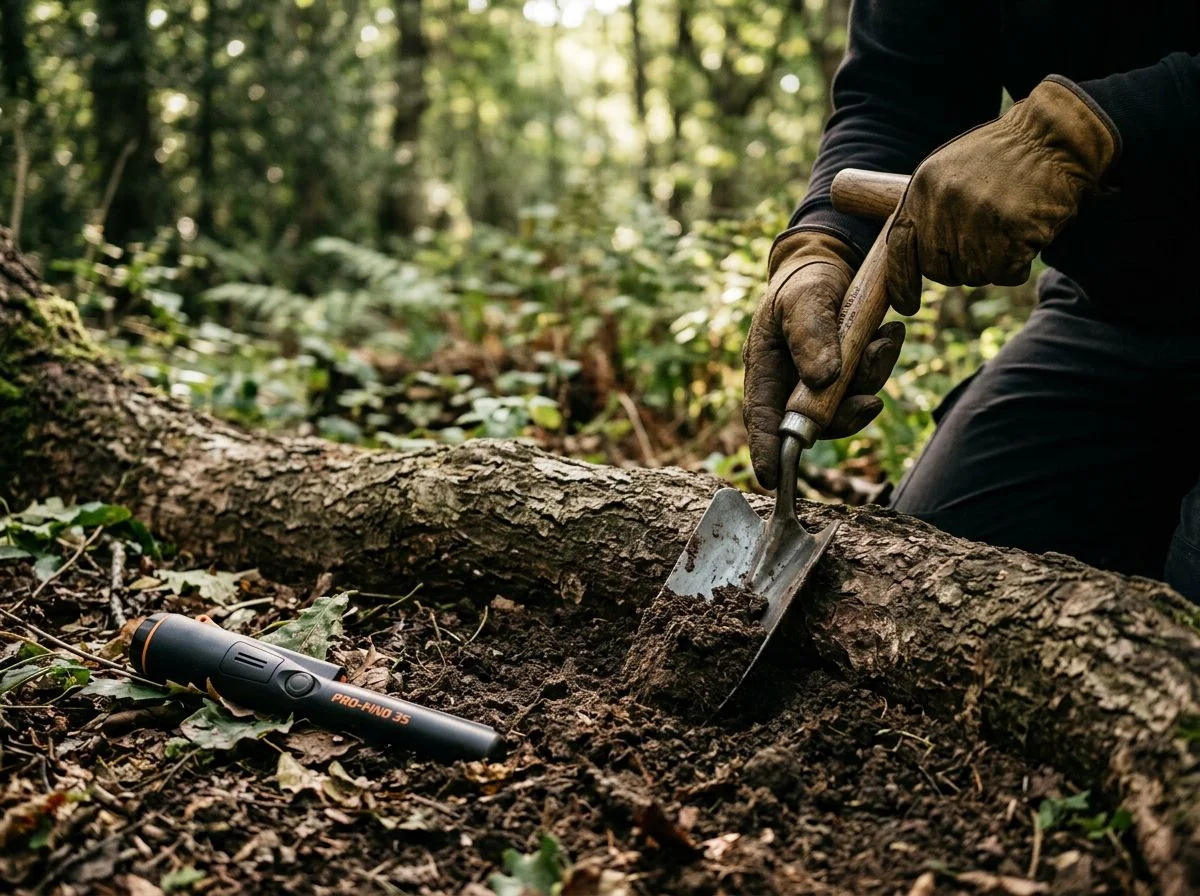
When I do commit, I clear soil from around the root first before attempting any cut. Exposed roots let you see what you’re doing. A clean single-pass cut heals faster than a torn, ragged one. Then I probe gently with my pinpointer. I work the target loose from the side rather than prying upward against the root.
It’s slow work. But some of my best finds came from exactly this kind of patience. That includes a 1907 Barber dime that had been hugged by an oak root for probably a century.
Why Metal Detecting Around Tree Roots Is Tricky
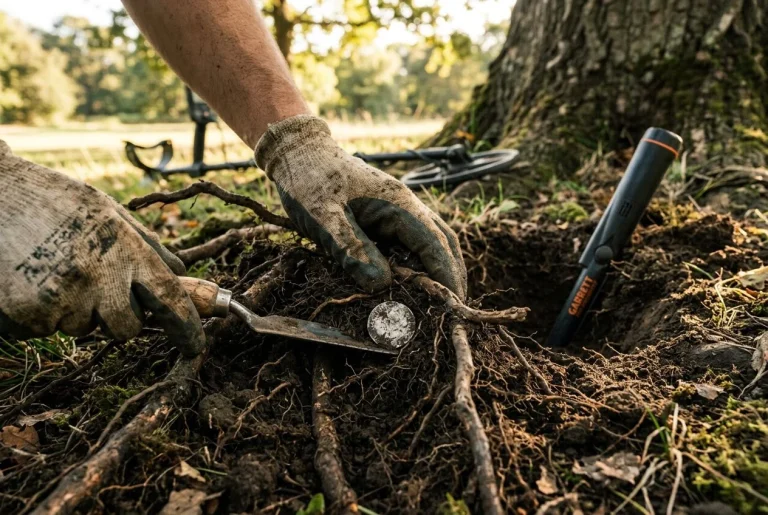
Metal detecting around tree roots is tricky because roots are both your best friend and worst enemy. They trap and preserve relics for decades, but they also make those relics nearly impossible to extract cleanly. The same root system that protected that coin from being lost forever is the thing standing between you and your pinpointer.
I still remember my first root-bound find. I was at an old swimming hole outside Sacramento. Maybe my fourth or fifth time out with a borrowed Garrett ACE 250. I got a screaming signal right at the base of a massive valley oak. I dug down three inches and hit a root the size of my forearm. Forty-five minutes later, sweating and swearing, I worked a 1943 Mercury dime out from where it had been slowly swallowed for decades.
Here’s the thing most detecting guides won’t tell you. Those mature trees that frustrate you at every park and homesite are doing something remarkable underground. About 90% of a tree’s roots live in the top meter of soil. Those roots often extend outward two to three times the width of the canopy. That means every old tree you meet is sitting on top of a sprawling underground net.
So yes, roots will make you want to throw your Lesche into the nearest pond. But they’re also why the target is still there, waiting for you. It wasn’t plowed under, washed away, or scooped up by some landscaper forty years ago. The tree is the reason the relic survived. The tree is also the reason you’re about to spend twenty minutes on your knees muttering things you wouldn’t say in front of your kids.
That’s the trade-off. And once you understand it, you stop seeing roots as obstacles. You start seeing them as archives.
How Roots Trap and Hold Targets Underground
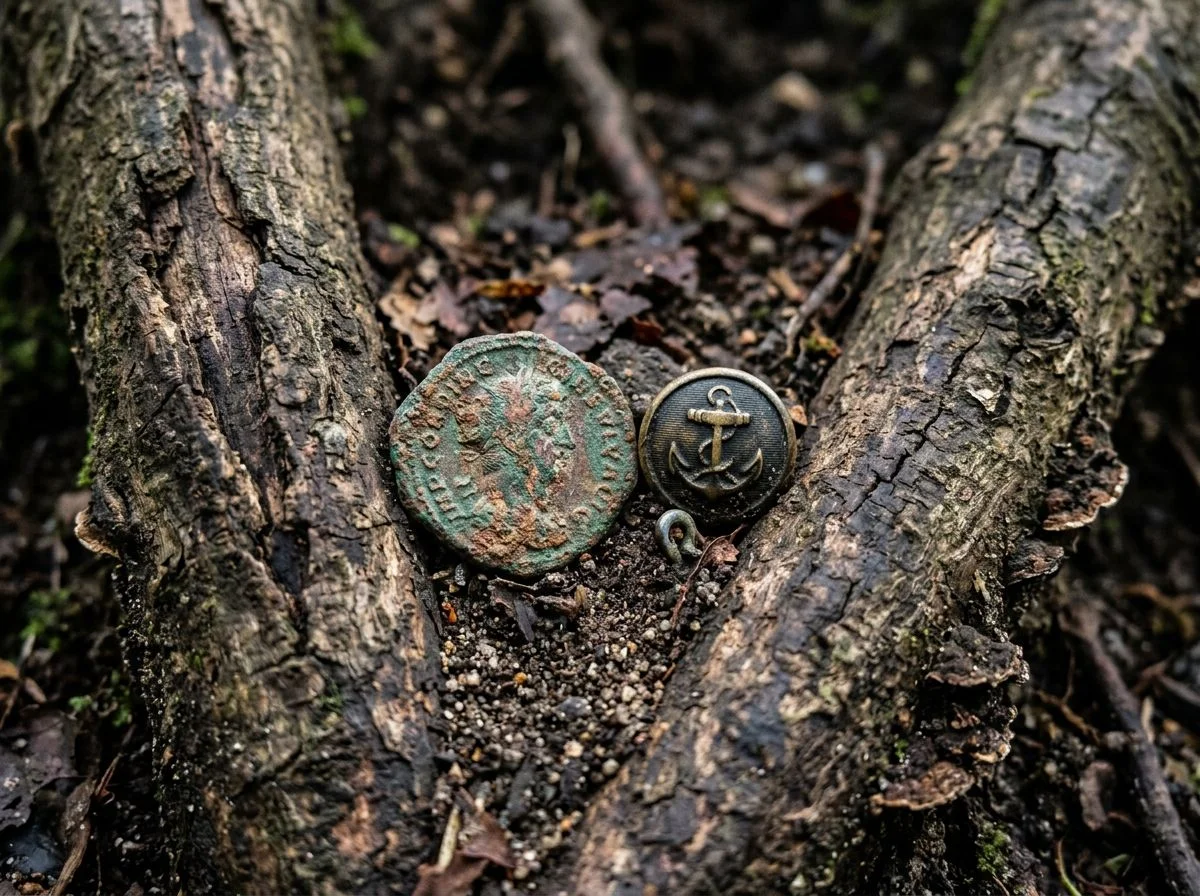
Roots trap targets by growing around them, not through them. They follow paths of least resistance. A solid metal target becomes an obstacle the root simply routes around. Eventually, the target gets encased in a living cage of wood that tightens and holds it for decades.
Roots aren’t blind. They respond to soil density, moisture, and obstacles with surprising precision. When a growing root tip encounters something solid — a stone, a foundation remnant, or your 1943 Mercury dime — it doesn’t push through. It deflects. The Oxford Archaeology report on tree roots and archaeological sites documented this at a Roman-Celtic temple site in Oxfordshire. Roots consistently grew around solid stone walls rather than penetrating them. Over years, that deflection becomes a wrap. The root encircles the object. Then another root crosses it. Then another. Eventually the target is woven into a root ball that holds it like a fist.
And root balls can hold things deep. The most dramatic example I know of came out of Parkin Archeological State Park in Arkansas. A tornado on March 31, 2023, blew over a massive pecan tree. The uprooted root ball left a hole five to six feet deep. It exposed archaeological layers from centuries of occupation. Park staff spent days power washing soil out of that root ball into screens. They recovered pottery sherds, animal bone, stone tools, and historic items from the former Sawdust Hill community. Artifacts that had been sitting at depths no detectorist would ever casually reach, hauled up by a storm.
That’s the underground trap in action. Roots don’t destroy what they capture — they archive it. The same mechanism that makes metal detecting around tree roots miserable is also what kept that target from being plowed away, washed downhill, or buried beyond recovery.
Tools for Metal Detecting Around Tree Roots
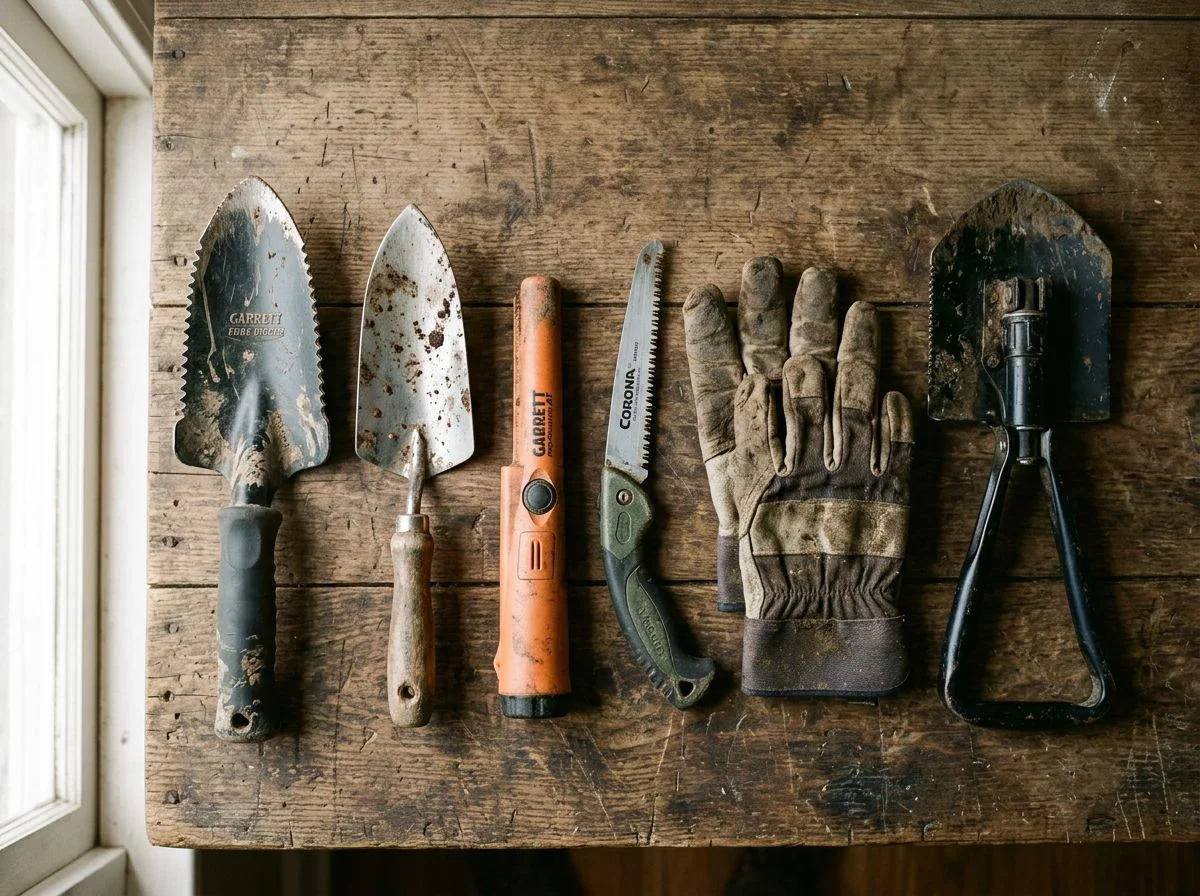
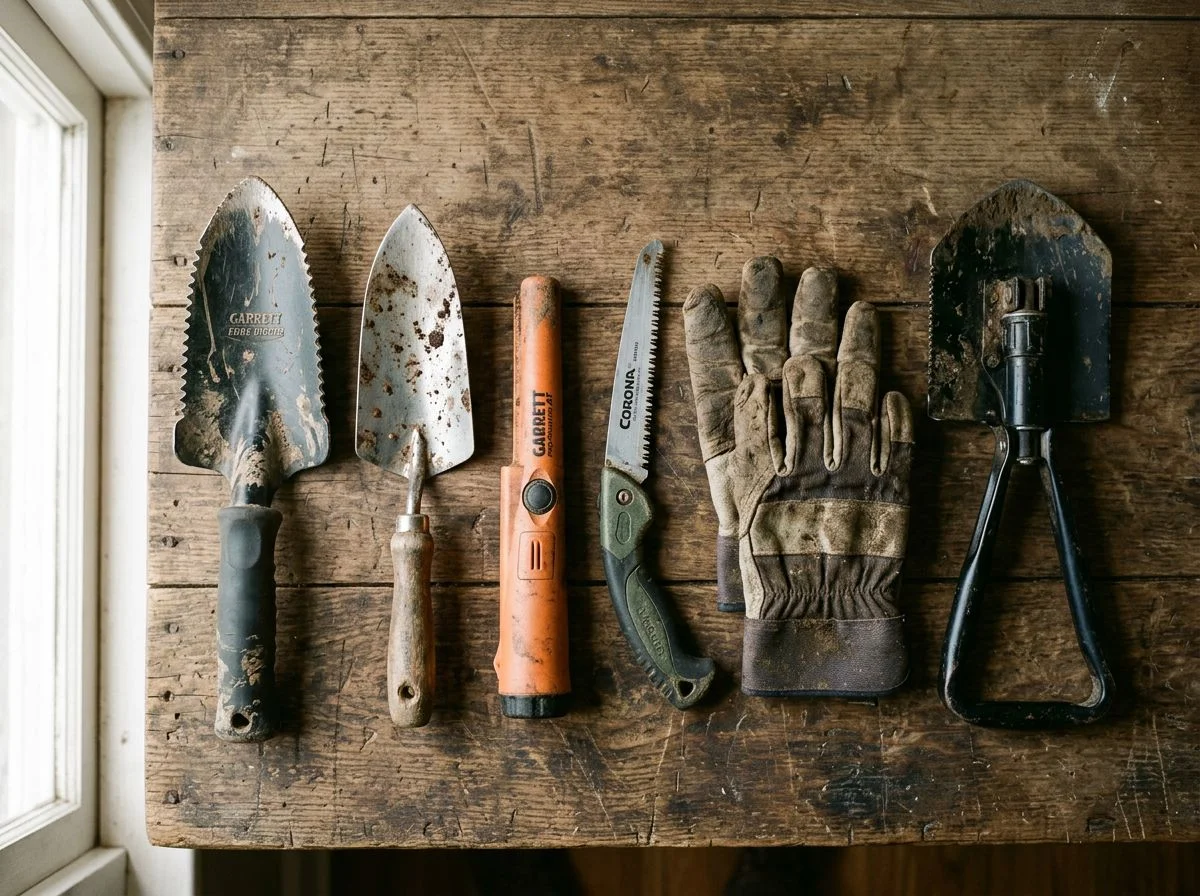
For metal detecting around tree roots, you need three tools. A sharp spade for anything under 1 inch. Loppers or a pruning saw for 1–3 inch roots. A reciprocating saw for anything thicker. Match the tool to the root, not the other way around. You’ll save yourself a lot of frustration.
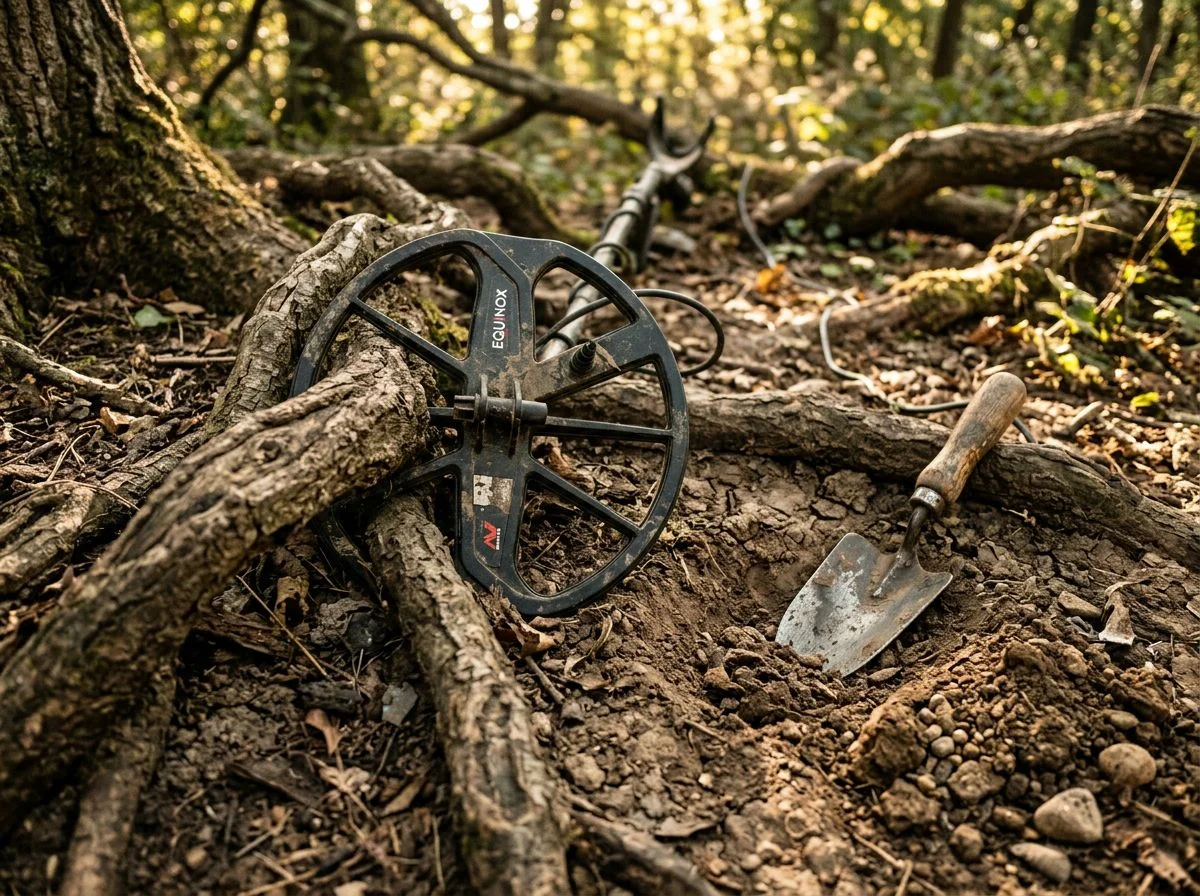
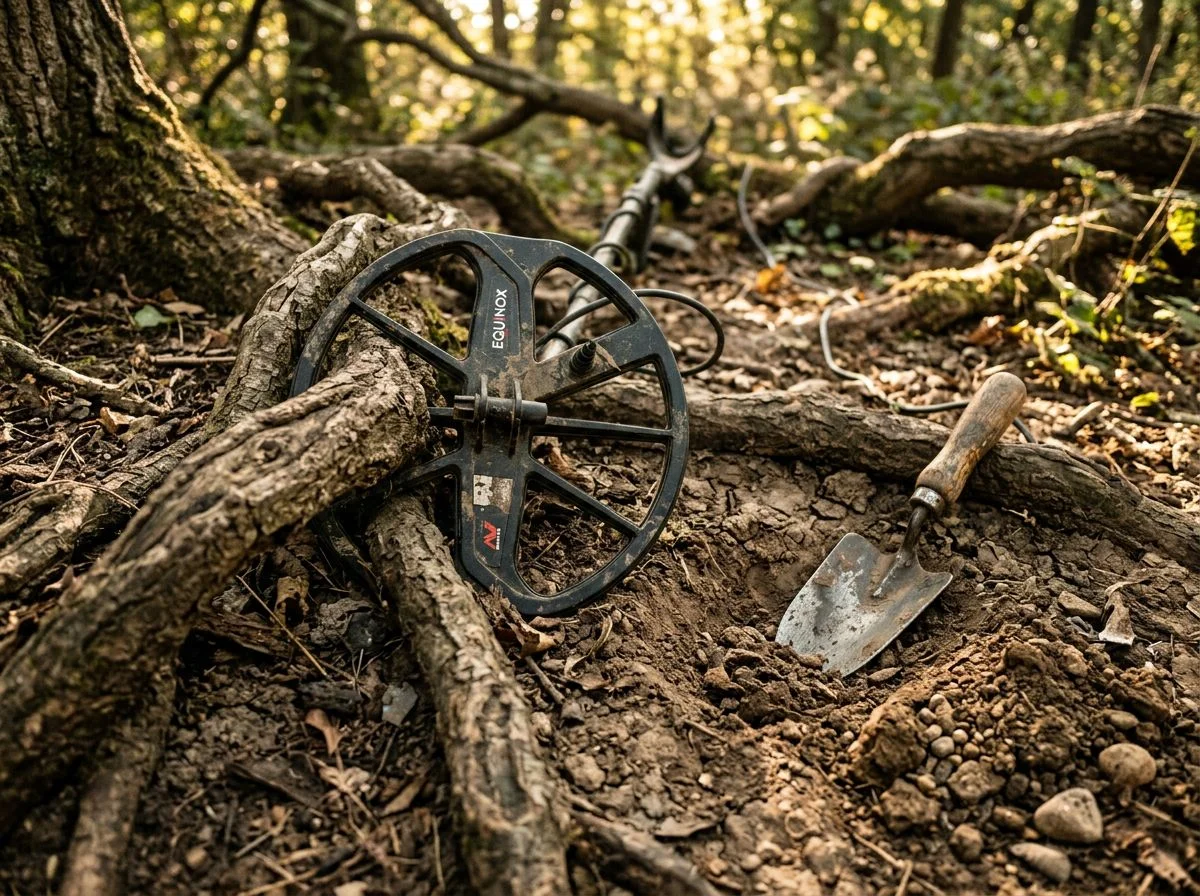
I learned this lesson the hard way at an old homestead site near Folsom. I’d driven out there with my Minelab Equinox 900, a fancy new shovel I’d just bought, and way too much confidence. I got a solid signal under a mature oak. I dug down maybe four inches and hit a root the size of a baseball bat. I hacked at that thing for twenty minutes, dulled the blade, and worked up a sweat that had my shirt soaked through.
My buddy Tom finally walked over. He handed me a $15 hand pick from his pack and said, “Try not to reinvent the wheel, Paul.” Three minutes later, the target was out. A 1919 wheat penny, probably not worth more than a buck. But I’d spent half an hour learning that the right tool matters more than the expensive one.
Here’s the breakdown that actually works in the field. Roots under 1 inch can be cut with a sharp spade. These are the feeder roots — pencil-thin to finger-thick. They’re not load-bearing. Don’t feel bad about cutting them. A clean spade cut through a half-inch root is fine for the tree and fine for your target recovery. Just make sure the spade is actually sharp. A dull spade tears instead of cuts. Torn roots are more susceptible to fungal decay than clean cuts.
For roots in the 1–3 inch range, loppers or a pruning saw are your best friends. These are structural roots, so you want to be more careful. But sometimes you have to cut through one to get to a target. The key is exposing the root fully before you cut. That way you’re not working blind and accidentally tearing something bigger. I keep a folding pruning saw in my detecting pack now. It weighs almost nothing and has saved me more times than I can count.
Anything 3 inches or thicker, and you’re into reciprocating saw territory. I’ll be honest — I’ve only needed this a handful of times. Each time I stopped to ask myself whether the target was worth it. A reciprocating saw with a pruning blade makes quick work of a big root. But cutting a major structural root on one side of a tree can make it unstable and prone to blowing down in storms. That’s a trade-off I don’t take lightly.
Working With Roots Instead of Fighting Them
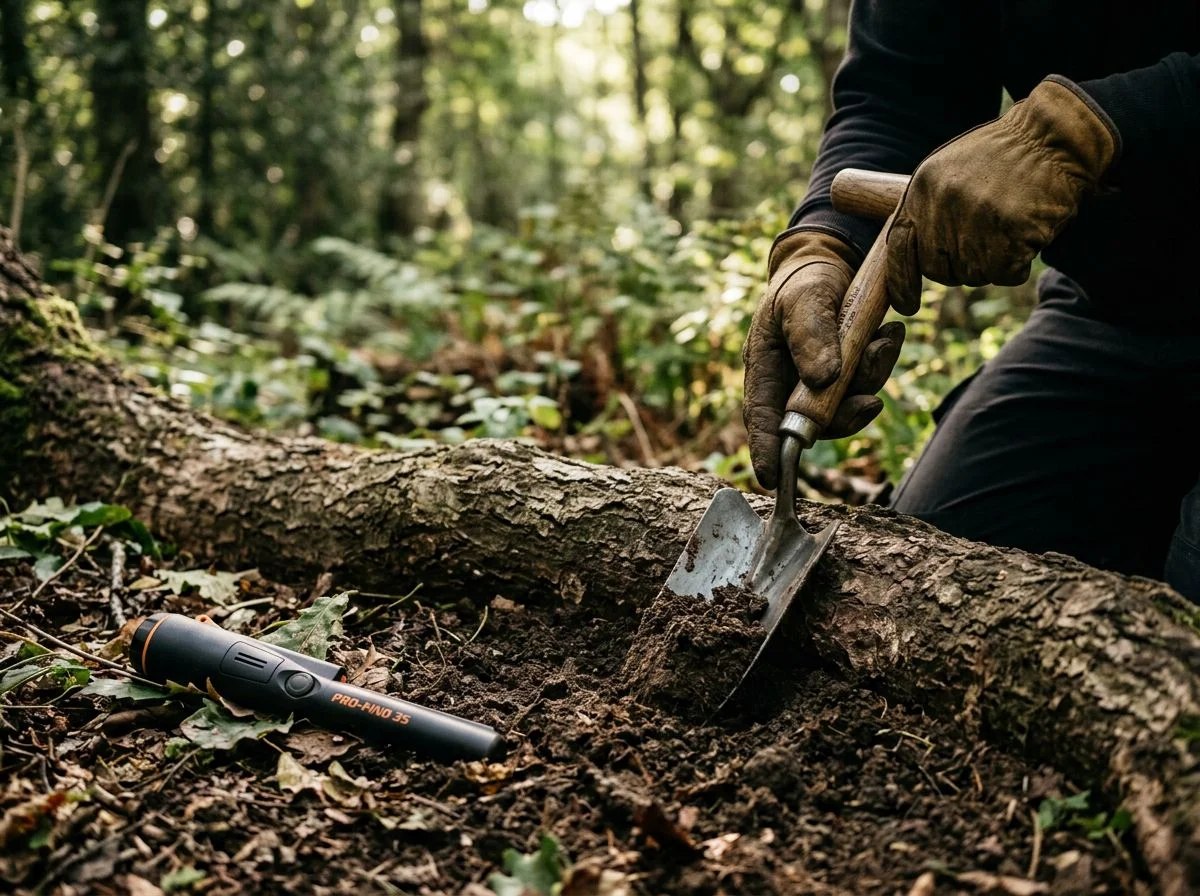
The extraction technique for metal detecting around tree roots comes down to one principle. Expose the root fully before you cut it, and always undercut first. That single habit prevents the tearing that damages both the tree and your target. Here’s how it played out at an old train stop near Auburn last month.
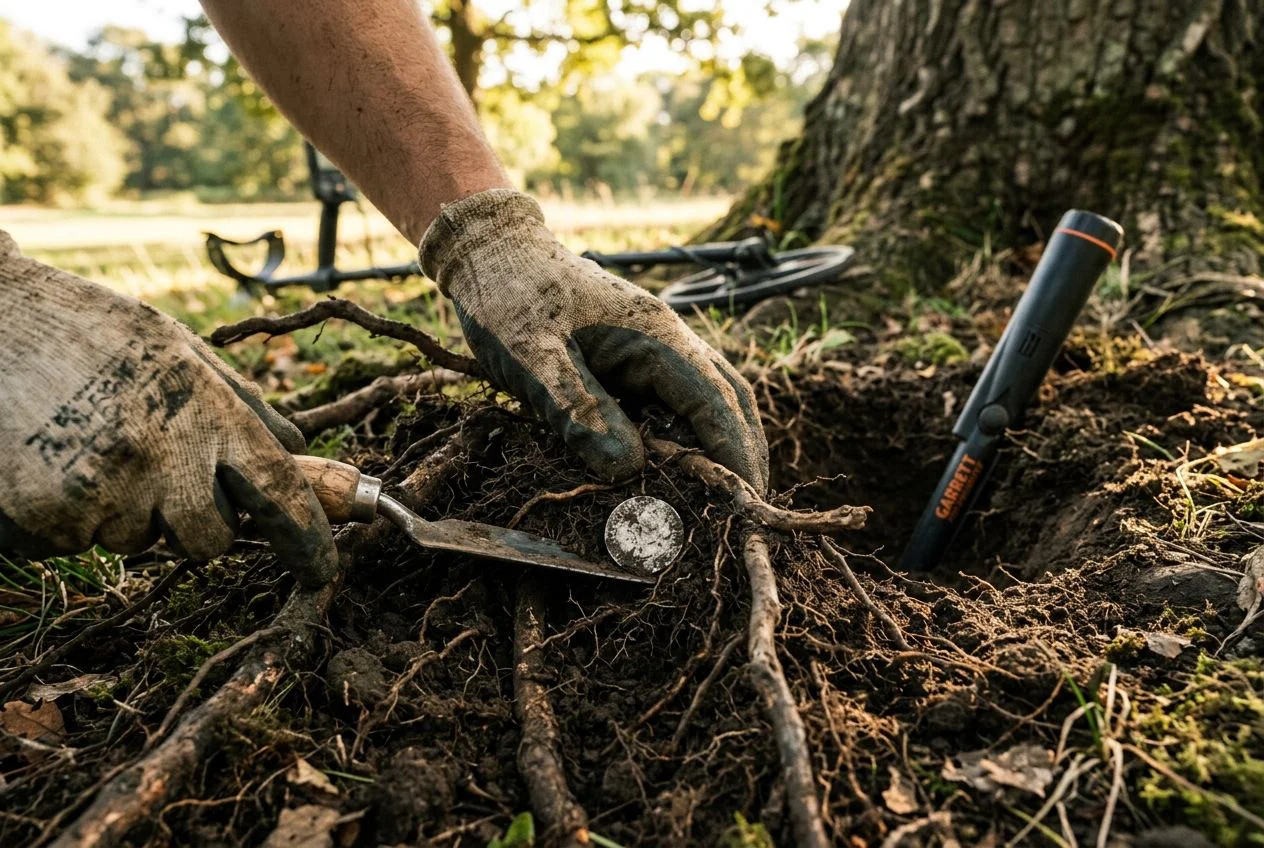
Step one: Clear the soil around the root. I’d gotten a solid 82-84 signal on my Equinox 900, about six inches down. It sat right where a mature oak had sent a lateral root the thickness of a garden hose. My first instinct was to start hacking. Don’t. I used my hand trowel to clear soil from both sides of the root. I kept going until I could see a good four inches of clean wood. Exposing the root fully before cutting gives you a clear view of what you’re dealing with. It’s the difference between a surgical cut and a jagged tear.
Step two: Undercut first. This is the trick most detectorists skip. I slid my pruning saw under the root and made an upward cut from the bottom. Then I finished from the top. Undercutting the root first ensures a clean, single-pass cut that prevents tearing. Think of it like cutting a branch off a tree. If you only saw from the top, the weight of the root pulls it down and rips the bark. Clean cuts heal faster and reduce the risk of fungal decay getting into the tree.
Step three: Recheck the signal. After the root was out of the way, I ran my coil over the hole again. The signal was still there, but now it was sharper, more defined. That root had been masking the target’s true depth. Turned out the dime was only four inches down. The root had been sitting on top of it the whole time, not wrapping around it.
Step four: Recover and repair. I pulled a 1912 Barber dime, my first from that site. Then I spent two minutes putting the soil back and pressing the root ends together. The tree will be fine. The dime is in a flip case.
The whole process took maybe ten minutes. The key wasn’t strength or special equipment — it was patience. Clear the soil, expose the root, undercut, and let the tool do the work. My buddy Mike used to just yank roots out with a shovel. He’s killed more targets than he’s recovered. Don’t be Mike.
Which Trees Mark Old Home Sites and Relic Spots
Old trees aren’t just obstacles for metal detecting around tree roots — they’re historical markers. The “pillow and cradle” formations left by uprooted trees trap relics in root balls. They also expose them in depressions. That means the tree itself can tell you where to swing before you ever break ground.
Here’s the thing most detectorists miss. When a mature tree topples, it doesn’t just fall over. The root ball rips upward. It tears soil from depths of 5 to 6 feet and flips it onto its side. That churned earth is a time capsule. At the Parkin Archeological State Park in Arkansas, a tornado uprooted a massive pecan tree in March 2023. Archaeologists spent days power washing the root ball to recover pottery sherds, stone tools, and historic items from the Sawdust Hill community. Same principle applies to us — just with less power washing and more patience.
The formation itself is what you’re looking for. When a tree goes down, it leaves a depression where the roots once sat. That’s the “cradle.” The “pillow” is the mound of soil and roots now standing vertical. Both spots are prime detecting ground. The uprooting process concentrates artifacts in the root ball. At the same time, it exposes deeper layers in the hole left behind.
I’ve seen this play out at old field-clearing sites. Back when farmers cleared land with horses and oxen, they’d dig around stumps, cut the lateral roots, and haul the whole mess out. That process left behind concentrated pockets of whatever was in the soil — coins, buttons, tools. A detecting buddy of mine pulled Civil War relics straight from a root ball at one of these sites. Minieballs, a couple of buckles, and a Hotchkiss shell that made my heart skip when he showed me.
So before you dig around a mature tree, read it. Look for the pillow and cradle signature. Check the depression for signals. Scan the exposed root ball itself. Targets get trapped in the root structure at shallow depths, often just inches from the surface. The tree’s been doing the excavating for you. All you have to do is listen.
When to Walk Away From a Root-Bound Target
The short answer: walk away when the signal sits under a major structural root. Walk away when you’re on property where the owner values the tree more than the find. Walk away when the extraction would leave visible damage. A dime isn’t worth killing a 200-year-old oak. And it’s definitely not worth losing permission to hunt there again.
The Tree Protection Zone isn’t a suggestion. Arborists calculate it by measuring the trunk diameter at chest height and multiplying by 12 to get the radius in centimeters. In feet, that’s diameter times 5. So a tree with a 2-foot-thick trunk needs a 10-foot buffer in every direction. That’s the zone where you shouldn’t be cutting roots at all. I’ve walked away from solid signals inside that radius more times than I can count.
Then there’s the permission angle. I was hunting a farmhouse site near Placerville last spring. I got a screaming signal right at the base of a massive valley oak. The owner came out to see what I’d found. He saw me eyeing the root system and said, “That tree’s been here since my great-grandfather’s time.” That was my cue. I filled the hole, thanked him, and moved on. He’s let me back three times since.
Some targets just aren’t worth it. I’ve left signals in the ground that still haunt me. One sounded like a large cent, right under a root the size of my thigh. But the math doesn’t change. Clean cuts heal, torn roots invite decay. A detectorist who leaves a scarred tree behind doesn’t get invited back. Your reputation in this hobby travels faster than your finds ever will.
GPR, Hydro Excavation, and Calling in the Pros
For 99% of root-bound targets, hand tools and patience are all you need for metal detecting around tree roots. But sometimes you’re dealing with a historically significant tree, a protected landscape, or a target swallowed by a root system the size of a Volkswagen. That’s when it’s time to call in the professionals. And they’ve got some seriously cool tech.
Ground-penetrating radar (GPR) is the big one. A portable system running at 450 MHz can identify roots larger than 2 cm in diameter down to 2.5 meters deep. It does this with about 5 cm of precision on both horizontal and vertical measurements. That means an arborist can map exactly where the major structural roots are before anyone puts a shovel in the ground. I’ve never hired a GPR survey for a detecting site. The cost would eat up any potential find value. But if you’re hunting a property with historic trees and the owner wants documentation, it’s worth knowing this exists.
Hydro excavation is the other tool that’s changed the game. Instead of digging, crews use pressurized water to blast soil away from roots without damaging the bark. UC Davis used exactly this technique during campus utility trenching. They did exploratory hydro excavation to expose root systems before any cutting happened. Once roots were exposed, they wrapped them in burlap and kept them moist to prevent sunburn and dehydration. That’s the level of care a 150-year-old oak deserves.
When should you actually call a pro? If the target sits under a root thicker than 3 inches and the tree has historical or sentimental value, stop digging. An arborist can assess whether the root is load-bearing. They can also tell you whether extraction is even feasible without killing the tree. Some finds aren’t worth the tree they’re trapped under. I’ve made peace with a few signals in my day. Honestly, the mystery is sometimes more fun than the dime.
Common Questions About Metal Detecting Around Tree Roots
The short answer: yes, you can usually extract root-bound targets safely when metal detecting around tree roots. Work slowly, use the right tools, and respect the tree’s structural roots. But the questions I see on forums suggest a lot of detectorists are making this harder than it needs to be.
“How do I know if a root is safe to cut?”
This question comes up constantly on r/metaldetecting. The answer is simpler than most people expect. Feeder roots — those pencil-thin to 1-inch diameter roots that spread everywhere — are generally safe to cut. They regenerate. But anything thicker than 1 inch needs a hard look before you put a blade to it. That’s structural territory. You’re gambling with the tree’s stability.
“What’s the best tool for cutting roots?”
I’ve seen everything recommended, from hatchets to reciprocating saws. For roots under an inch, a sharp spade does the job. Between 1 and 3 inches, loppers or a pruning saw. Beyond that, you should probably be walking away anyway. But if you must cut, use a clean single-pass undercut.
“Will cutting a root kill the tree?”
One clean cut on a feeder root? No. Torn cuts on a structural root? That’s where decay gets in. Clean cuts heal faster and resist decay better than torn cuts. That’s why arborists use sharp tools instead of just ripping roots apart. If you’re going to cut, make it count.

My name is Paul and I am the founder of Detector For Metal, a dedicated resource for metal detecting enthusiasts seeking to uncover historical treasures and connect with the past using the latest technology. As a stay-at-home dad and family man, I’ve found metal detecting to be the perfect hobby that combines family adventure with historical learnings for the whole family.
As a father, I’m deeply committed to passing on this hobby to the next generation of detectorists, starting with my own children. I share advice on everything from metal detecting with kids to exploring the top 10 metal detecting sites you never thought about. My methodical approach to the hobby goes beyond the thrill of discovery—it’s about creating family traditions while preserving history and sharing the stories of those who came before us.