Table of contents
- Why Your Detector Setup Causes Repetitive Strain
- Why Detecting Hurts After a Few Hours
- Set Up Your Detector to Fit Your Body
- Digging and Bending Without Wrecking Your Back
- Harnesses and Support Gear
- Why Detectorists Should Train Like Athletes
- An All-Day Hunt Ergonomic Checklist
- Common Questions About Detectorist Ergonomics
The fix isn’t one magic piece of gear — it’s a system. Counterbalance your detector properly, shorten your shaft, use your arm strap religiously, and switch arms every 20 minutes. Do those four things and your back and shoulder will thank you by hour five.
I learned this the hard way, like I learn most things. My first “serious” hunt — six hours at an old swimming hole outside Sacramento — ended with me lying flat on the living room floor while my wife asked if I needed to see a doctor. The dime I’d found wasn’t worth three days of ibuprofen.
Here’s what actually works.
Counterbalance the shaft. A global moderator on the Friendly Metal Detecting Forum named “grinsebring” put it perfectly: your detector should balance like a scale. You should be able to place two fingers under the shaft at the hand grip and have it sit level. If it flops toward the coil, that misbalance is what’s wrecking your lower back. Overbalance it, and the pain migrates to your shoulder. I’ve adjusted my Equinox 900 three times in a single hunt before finding the sweet spot. It matters that much.
Shorten your shaft. Sounds obvious, but most detectorists run their shaft too long because it feels like better coverage. An Australian detectorist reported that shortening the shaft brought the coil closer to his feet and straightened his arm angle, which eliminated his shoulder pain entirely. I tried it after reading that and felt stupid for not doing it years earlier.
Use the arm strap. Every single time. It’s not decorative. The strap prevents elbow pain by transferring some of the swing load off your forearm. I used to skip it because it felt restrictive. Now I won’t hunt without it.
Switch arms. The standard sweeping motion works your pectorals, rotator cuff, and trapezius — all on one side of your body. That’s a recipe for imbalance and strain. I switch arms every 20 minutes or so
Why Your Detector Setup Causes Repetitive Strain
Here’s the truth: your detector didn’t get heavier at hour three. You got tired. The pain you feel after an all-day hunt isn’t caused by the machine. It’s caused by doing the same motion thousands of times until your muscles give out.
The math is sobering. Recovering 60 targets on a beach hunt means bending over 120 times — and that’s assuming you nail every single recovery on the first try. Miss the target once, and you’re digging three or four holes per signal. Before you know it, you’ve bent over 200 times in a single afternoon.
I didn’t think about any of this until my own back started staging a protest. The first hour of a hunt feels easy — you’re a kid again, every signal a buried treasure. But hour three is where shoulders, wrists, and lower backs start screaming. That’s not a coincidence. A 2001 study in the British Journal of Sports Medicine found that roughly 26% of muscular strain injuries occur after fatigue has already set in. The injury doesn’t happen when you’re fresh. It happens when you’re tired and your form collapses.
That’s the part nobody talks about. Fatigue comes from constant repetition — swinging, carrying, kneeling, bending — not from a single heavy lift. Which means the pain isn’t inevitable. It’s predictable. And predictable means preventable.
Why Detecting Hurts After a Few Hours
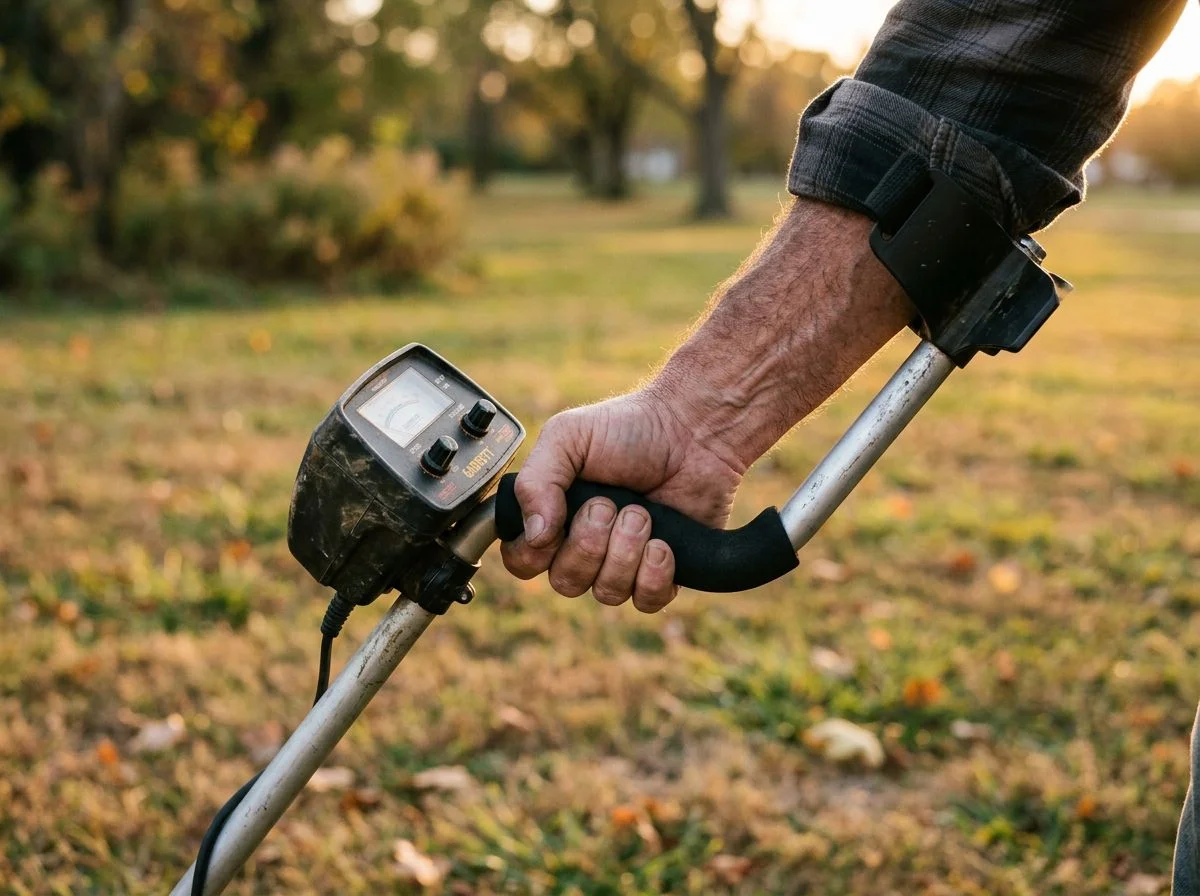
Here’s the short version: detecting hurts because you’re doing one-sided, repetitive work for hours — swinging with the same arm, bending at the same angle, digging with the same motion — until your muscles fatigue and your form collapses. It’s not the weight. It’s the repetition.
My first all-day hunt taught me this the hard way. Six hours at an old swimming hole outside Sacramento, digging 40 pull-tabs and exactly one Mercury dime. I woke up the next morning feeling like I’d been in a car wreck. My right shoulder wouldn’t lift past my ear. My lower back screamed every time I stood up. The dime wasn’t worth three days of ibuprofen.
The biomechanics are pretty straightforward once you think about them. That slow, rhythmic sweep works your pectoral muscles, rotator cuff, and trapezius — all on one side of your body. Left side gets nothing. Right side gets everything. Do that for three hours and you’ve essentially done a one-armed workout with no rest and terrible form.
Then there’s the digging. Recovering 60 targets means bending over 120 times — and that’s if you nail every recovery on the first try. Miss the target once and you’re bending three or four times per signal. Before you know it, you’ve bent over 200 times in an afternoon. Your lower back wasn’t designed for that.
And here’s the thing most people miss: your detector’s balance matters more than its weight. A global moderator on the Friendly Metal Detecting Forum named “grinsebring” explained it perfectly — if your detector flops toward the coil, that misbalance is wrecking your lower back. Overbalance it the other way, and the pain migrates straight to your shoulder. The pain isn’t random. It’s a direct result of how your machine sits in your hand.
The good news? Once you understand why it hurts, you can fix it.
Set Up Your Detector to Fit Your Body
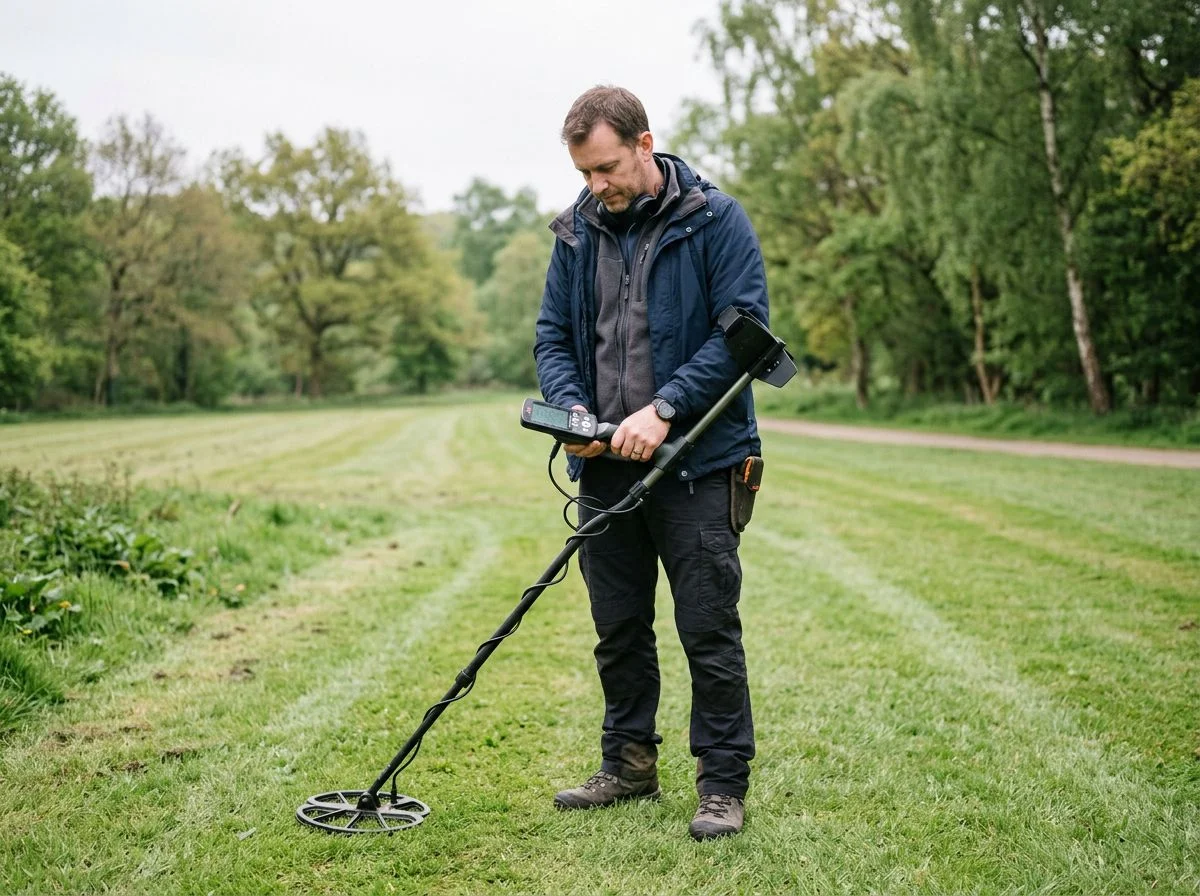
Here’s the short version: your detector’s shaft length and balance point determine whether you’re swinging comfortably or fighting the machine for hours. Most people set up their detector once and never touch it again — and that’s exactly why they hurt. The fix takes 30 seconds.
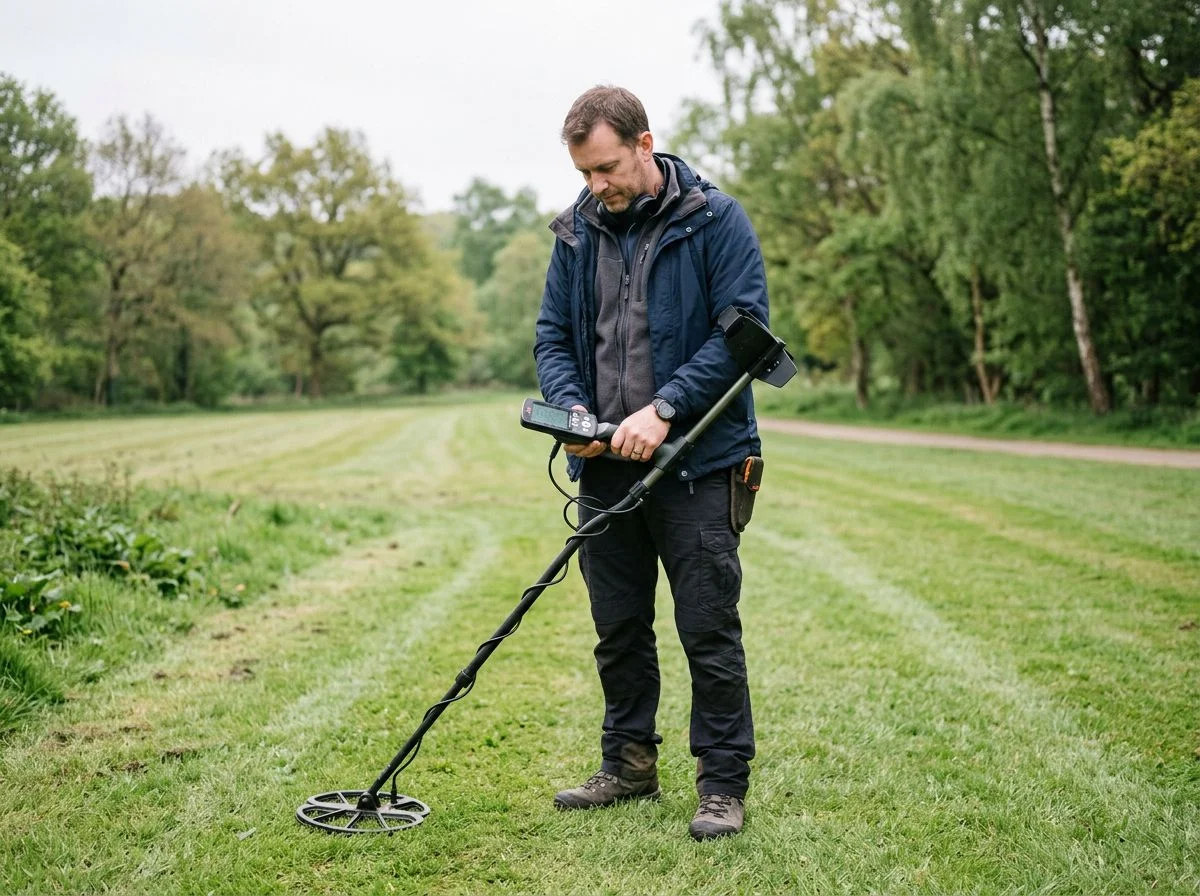
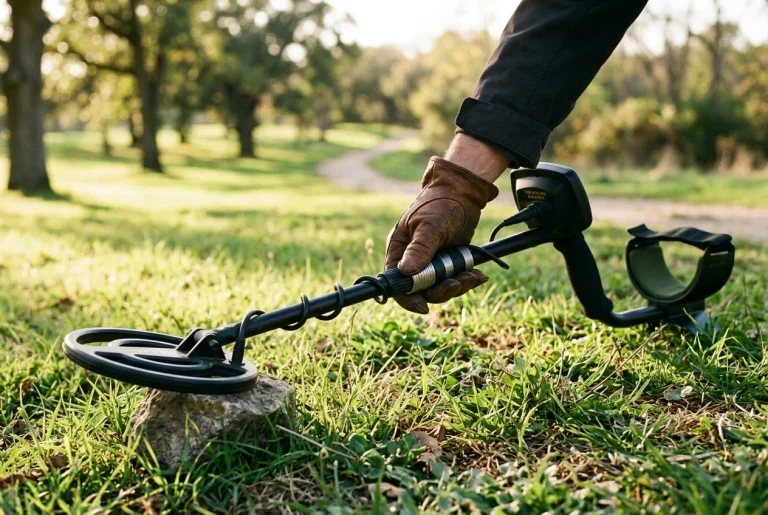
Let me give you the test first, because it’s the single most useful thing I’ve learned about detecting ergonomics. Stand with your detector in your normal grip, arm relaxed at your side. Now slip two fingers under the shaft at the hand grip. If the detector balances like a scale — coil hovering just above the ground, no flopping forward or tipping back — you’re set. If the coil drops toward the dirt, your lower back is doing all the work. If it flies up, your shoulder’s taking the hit.
A global moderator on the Friendly Metal Detecting Forum named “grinsebring” explained this better than any physical therapist I’ve met: misbalance toward the coil causes lower back pain, while overbalancing migrates the pain straight to your shoulder. I tested this myself with my Equinox 900 after a particularly brutal hunt near Folsom. The coil was flopping forward on every swing, and my lower back felt it for three days.
The fix is embarrassingly simple. Shorten the shaft. That’s it. Shortening the shaft brings the coil closer to your feet and straightens your arm angle — one detectorist reports this single change eliminated their shoulder pain entirely. No new gear, no physical therapy, no harness. Just a shorter shaft.
I’ll admit I resisted this for years. I’d been told the coil should swing a certain distance from my feet, so I left the shaft long and just dealt with the fatigue. Turns out I was setting up my detector for a textbook illustration, not for my actual body. Once I shortened it by about two inches, the balance point shifted and the detector stopped fighting me.
Here’s the thing: there’s no “correct” shaft length printed in any manual. The right length is whatever makes the two-finger test pass. If that means the coil swings closer to your feet than the YouTube videos show, fine. Your shoulder doesn’t care about YouTube.
Take the 30 seconds before your next hunt. Adjust the shaft, run the two-finger check, and tweak until it balances. Your back will thank you around hour four.
Digging and Bending Without Wrecking Your Back
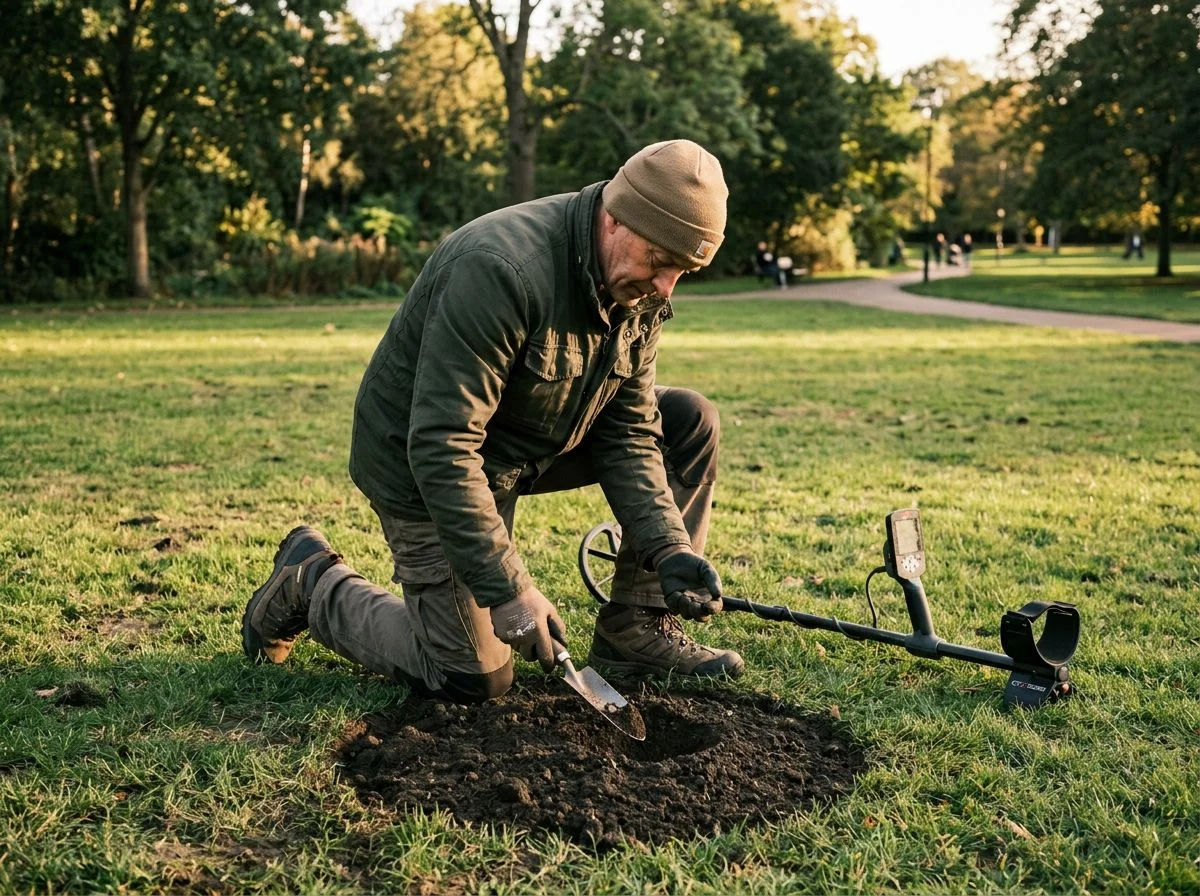
Here’s the short version: your recovery technique — how you bend, kneel, and dig — matters more than your detector’s weight. Bend at the knees, not the waist. Use a long-handled scoop on the beach. And kneel whenever the ground allows it. Your back will thank you by hour four.
Quick question: how many times did you bend over on your last hunt? Most detectorists can’t answer. That’s the problem.
I couldn’t answer it either until I started counting. Sixty targets, two bends per target, plus the misses — I was looking at 150-plus bends in a single afternoon. No wonder my lower back felt like it’d been through a folding chair.
The fix starts with how you bend. Bending at the knees instead of the waist reduces lower back strain significantly. It sounds obvious, but watch yourself next hunt. I’d bet good money you’re folding at the waist like a rusty hinge, especially when you’re tired. I catch myself doing it constantly — the first hour I’m squatting properly, and by hour three I’m doing some kind of awkward forward fold that would make a yoga instructor wince.
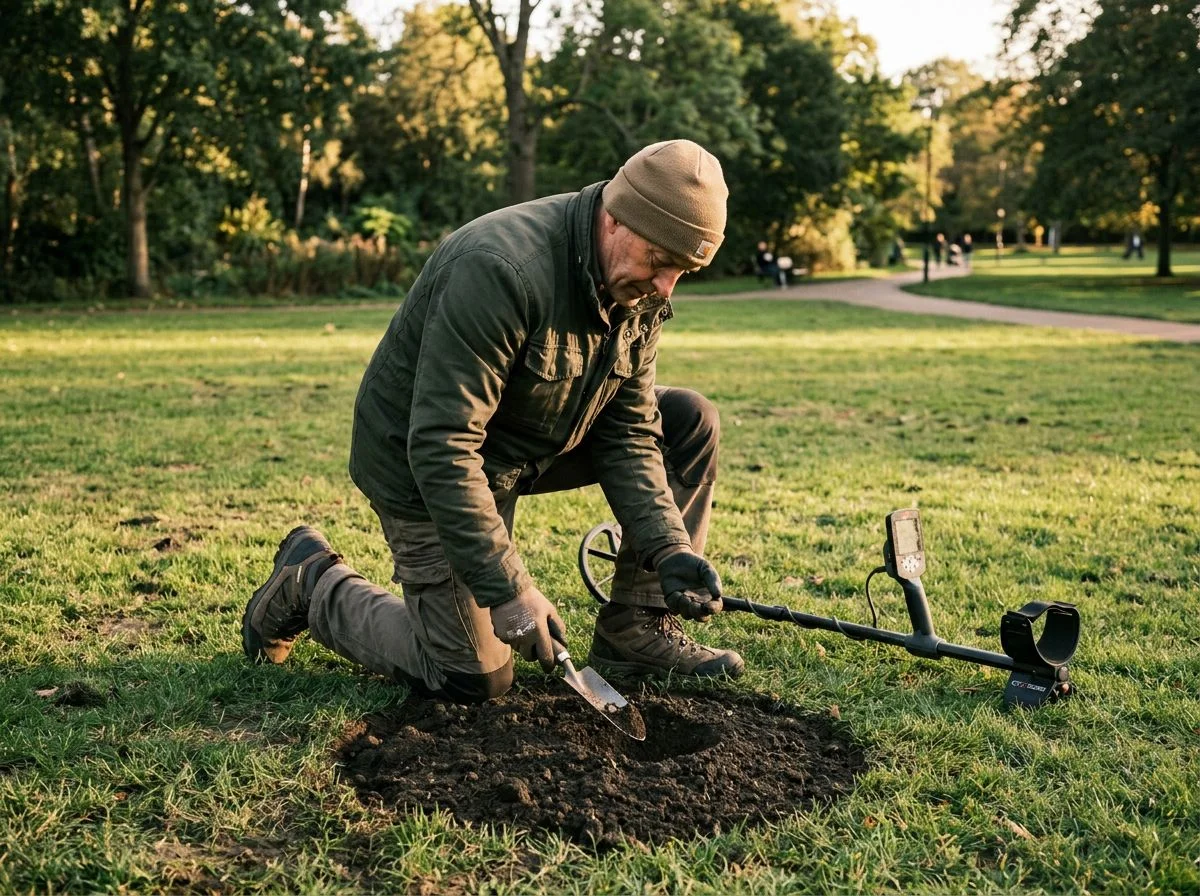
Here’s what actually works for me: when I get a signal, I drop to one knee. Not a full squat — that wears out your quads and knees fast. A single knee down, target-side, with my digging tool in the opposite hand. It keeps my spine neutral, gets my face closer to the hole for accurate target recovery, and spreads the work across different muscle groups instead of hammering my lower back with 150 deadlifts.
For beach hunting, the solution is even simpler. A long-handled scoop keeps your posture straight and eliminates bending entirely. One forum member with a herniated L5 disc swears by it — he manages four-hour beach hunts by scooping standing up, never bending at all. I tested this last summer at Ocean Beach in San Francisco. Different world. No kneeling, no bending, just a scoop, a shake, and a scan. My back felt so good afterward I almost forgot I’d been detecting for five hours.
The other half of recovery ergonomics is what you’re kneeling on. Get knee pads. Not the cheap gardening ones — proper gel-filled pads that strap on. I use a pair meant for construction work, and they’ve saved my knees on rocky Sierra sites more times than I can count. (Side note: they also make you look like you’re about to install drywall, which my wife finds endlessly amusing.)
One more thing: switch your digging hand. I’m right-handed, so I naturally dig with my right. But that means my right side does everything — swing, dig, kneel, recover. When I remember to dig left-handed on every third or fourth target, the difference in next-day soreness is noticeable. It feels awkward for about ten minutes. Then your body figures it out.
The bottom line: count your bends. Then cut that number in half with a knee drop, a long scoop, and a pair of decent pads. Your spine isn’t a folding chair.
Harnesses and Support Gear
Here’s the short version: a harness is the single best upgrade for long hunts, but only if your detector weighs enough to justify it. For lightweight machines, a $32 bungee setup does the same job. For heavier rigs, the Pro-Swing 45 is worth every penny.
My buddy Tom swore he’d never use a harness. “That’s for old guys,” he told me, right up until I handed him my Pro-Swing 45 on a six-hour relic hunt near Placerville. He bought his own the next week. Didn’t say a word about it — just texted me a photo of the box.
Here’s what a harness actually does. It transfers the detector’s weight from your shoulders to your hips, which prevents the flexion and extension muscle strain that builds up when your arm and shoulder hold the machine for hours. Your hips are built for load-bearing. Your shoulder isn’t. Simple biomechanics, but most detectorists ignore it.
The Minelab PRO-SWING 45 is the gold standard here. It uses what Minelab calls a W8 distribution system to create “weightless” detecting — the bungee takes the load, and you just guide the coil. I was skeptical until I used one. The detector genuinely floats. You still control the swing, but the weight disappears.
Now, do you need the $150 harness? Not always. Tom runs a Garrett AT Max — heavy enough to justify it. But if you’re swinging a Simplex Ultra or an ACE 300, a “Swingy Thingy” runs about $31.95 and does the same basic job. It’s a bungee that clips to your belt or shoulder. Less support, sure, but your detector weighs three pounds. You don’t need a full rig for that.
The honest takeaway? Match the gear to the machine. Heavy detector, long hunts — get the harness. Light detector, occasional fatigue — the cheap bungee works fine. Tom learned that the hard way, and so did I.
Why Detectorists Should Train Like Athletes
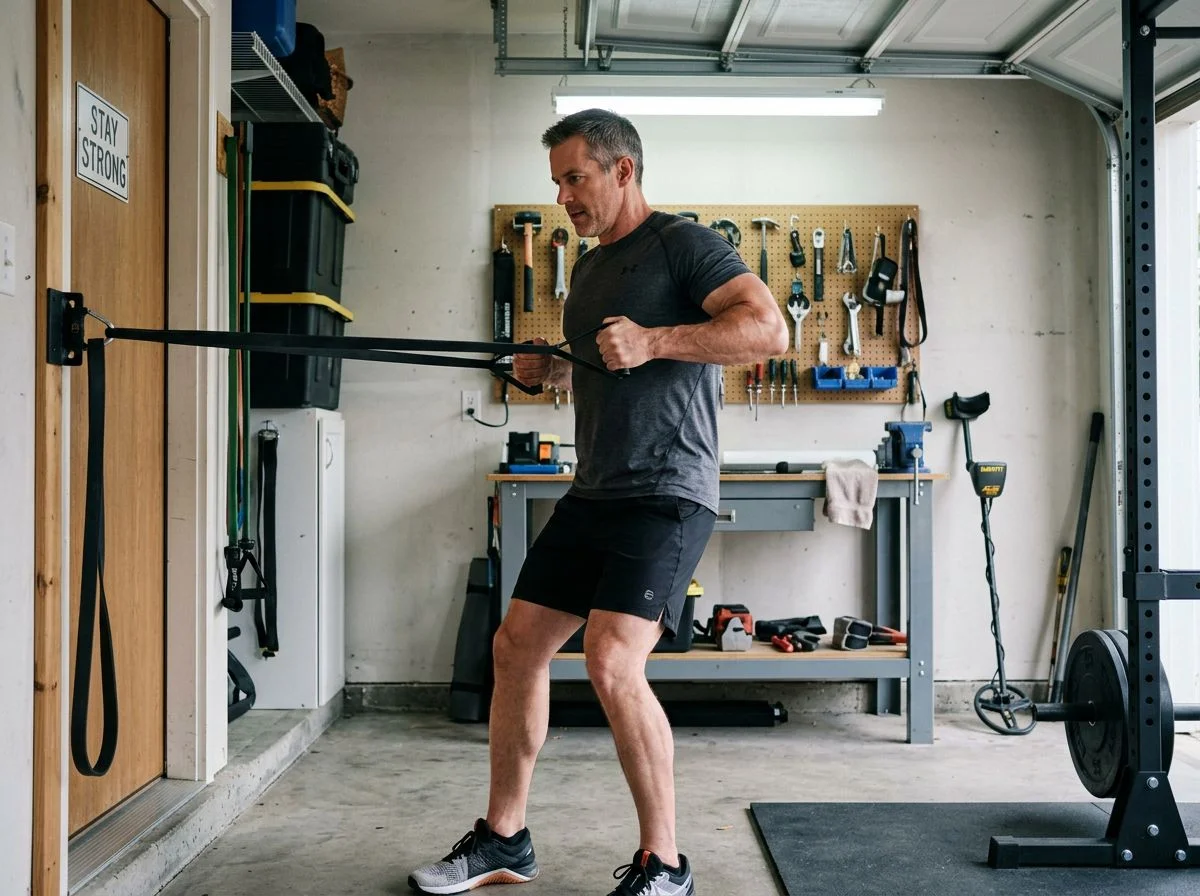
Here’s the short version: metal detecting is a sport. Treat it like one, or it’ll treat you like a spectator. Your core, shoulders, and grip need conditioning before you swing for six hours — not after your back gives out.
I’ll be honest: the first time someone suggested I warm up before a hunt, I laughed. Push-ups before metal detecting? Come on. That’s for people who run marathons, not guys wandering a beach with a stick. Then I hit 45, and my body started filing formal complaints.
Here’s what actually happens during a hunt. That sweeping motion looks gentle, but it works your pectoral muscles, rotator cuff, and trapezius — all on one side. Meanwhile, your core is fighting to keep your trunk from twisting with every swing. Strong oblique muscles are what stabilize you and prevent that rotation. If they’re weak, your lower back picks up the slack. And your lower back is not built for that job.
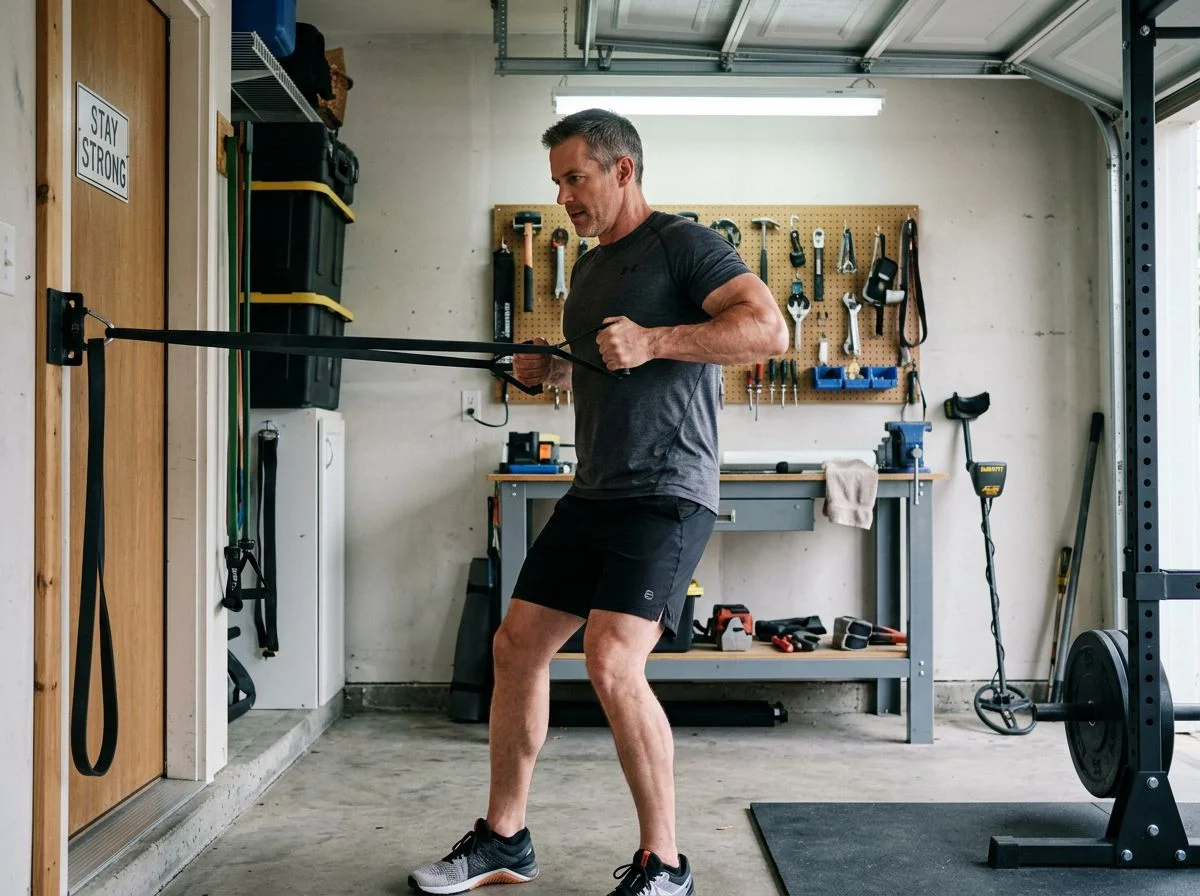
The fix isn’t a gym membership. It’s five minutes before you turn the detector on. Warm-up exercises like push-ups or jumping jacks get blood flowing to the muscles you’re about to abuse for hours. I do a quick set of push-ups against my tailgate, some arm circles, and a few torso twists. Takes less time than setting up my pinpointer. My wife thinks I look ridiculous. She’s not wrong. But she also doesn’t hear me complaining about my shoulder at dinner anymore.
The other half is switching arms. I know, it feels wrong. Your non-dominant arm swings like a drunk toddler for the first ten minutes. But alternating sides balances the workload and prevents that one-sided muscle fatigue that turns into real injury by hour four. I forced myself to learn this after a tendonitis scare in my right elbow a few years back. Now I switch every 20 minutes or so. My left arm still isn’t as smooth, but it gets the job done — and both shoulders make it through the day.
The takeaway is simple: your detector is a tool. Your body is the machine. Condition it like one.
An All-Day Hunt Ergonomic Checklist
The short version: treat a six-hour hunt like a work shift, not a marathon. Scheduled breaks, capped sessions, and a pre-planned recovery rhythm are what separate a great day of finds from three days of ibuprofen.
Last spring I hit an old Sacramento-area train stop for six hours. Forty-five targets recovered — mostly railroad spikes and a few wheat pennies — and I woke up the next morning feeling completely fine. Not lucky. Planned. Here’s exactly what I did, and what you should steal from it.
Hour one: Full warm-up at the truck. Push-ups against the tailgate, arm circles, torso twists. Five minutes, done.
Hours two through four: Hunt in 90-minute blocks with a mandatory 10-minute sit-down between each. I keep a folding stool in my pack now — standing around leaning on my shovel doesn’t count as rest. Taking regular breaks and listening to your body’s signals is the difference between finishing strong and limping back to the car.
Beach hunts get a hard cap. Limit beach sessions to 2 hours — the constant kneeling and hole-filling wrecks your knees faster than any inland hunt. I learned that one the hard way at Ocean Beach. Twice.
Hour five: Switch arms for at least 20 minutes. Your swing will look drunk. Doesn’t matter. The one-sided fatigue is the enemy.
Hour six: Cool-down stretch before I even start the truck. Hamstrings, lower back, shoulders. Takes three minutes and my wife has stopped making fun of me for it. Mostly.
The checklist isn’t sexy, but neither is waking up unable to turn your head to check your blind spot.
Common Questions About Detectorist Ergonomics
Here’s the short version: yes, you can absolutely keep detecting with a bad back, a cranky shoulder, or a herniated disc — but you’ll need to adapt your gear, your technique, and your expectations. The detectorists who’ve done it aren’t superhuman. They just got stubborn and smart.
“Can I detect with a herniated disc?” This is the question I get most, and the answer is yes — with specific adaptations. One detectorist on the Friendly Metal Detecting Forum with a herniated L5 disc manages 4-hour hunts by taking Naproxen, using an inversion table twice daily, and wearing a back brace. He also swears by a long-handled scoop so he never has to bend at the waist. His advice: avoid sloped beaches entirely. The uneven ground is murder on a compromised lower back.
“What if I have spondylolisthesis?” A prospector on Prospecting Australia has lived with spondylolisthesis at L5 on S1 for over 30 years. His cracked vertebra doesn’t cause immediate pain, but it triggers severe back fatigue by the end of a hunt. His solution was counterintuitive: he ditched his heavy Minelab GPZ 7000 and switched to the lighter GPX series. The weight difference — roughly a pound and a half — was the difference between quitting at hour two and hunting all afternoon.
“Do harnesses actually help?” Yes, but they’re not magic. A proper harness transfers the detector’s weight from your shoulder to your hips, which is exactly what you want if flexion and extension strain is your problem. The key is balance: if your detector flops toward the coil, your lower back pays. If it overbalances backward, your shoulder takes the hit. Get the counterbalance right and a harness makes the machine feel nearly weightless.
“Is it worth switching arms?” Only if you enjoy feeling incompetent for ten minutes. Seriously though — it’s the single cheapest ergonomic fix out there. Your non-dominant arm will swing like a drunk toddler, but alternating sides prevents the one-sided fatigue that turns into real injury by hour four. I forced myself to do this last season and my wife stopped

My name is Paul and I am the founder of Detector For Metal, a dedicated resource for metal detecting enthusiasts seeking to uncover historical treasures and connect with the past using the latest technology. As a stay-at-home dad and family man, I’ve found metal detecting to be the perfect hobby that combines family adventure with historical learnings for the whole family.
As a father, I’m deeply committed to passing on this hobby to the next generation of detectorists, starting with my own children. I share advice on everything from metal detecting with kids to exploring the top 10 metal detecting sites you never thought about. My methodical approach to the hobby goes beyond the thrill of discovery—it’s about creating family traditions while preserving history and sharing the stories of those who came before us.