Table of contents
- Why Cold Weather Metal Detecting Works
- Does Frost Heave Push Targets to the Surface?
- What Happens Under Your Coil in Frozen Ground
- Cold Weather Metal Detector Settings That Matter
- What to Wear for Cold Weather Metal Detecting
- Cold Weather Metal Detecting Locations Most People Miss
- Cold Weather Metal Detecting Safety Rules
- Cold Weather Metal Detecting Gear Worth Buying
- Cold Weather Metal Detecting Questions Answered
Winter works because the ground itself becomes your research partner. Freeze-thaw cycles push buried targets closer to the surface. Competition disappears from public parks. And the 10 AM to 2 PM window gives you a reliable daily hunting schedule. Here’s the complete playbook for cold weather metal detecting.
The first thing to understand is timing. Ground temperature dynamics dictate that the prime hunting window occurs between 10 AM and 2 PM, when surface frost thaws enough to make digging feasible. I schedule my winter hunts in 90-minute blocks within that window. Anything longer and my fingers stop cooperating, no matter how many hand warmers I’ve stuffed in my gloves.
Gear adjustments matter more than you’d think. Switching to lithium batteries prevents power drop-offs in low temperatures. I also lower my sensitivity 15-20% to compensate for the signal distortion that ice pockets create in frozen soil. And I run a manual ground balance every 10-15 minutes to keep false readings in check.
Location-wise, south-facing slopes and ground near buildings display 30% to 40% shallower frost lines due to solar absorption. That’s where I start every winter hunt. The digging is actually feasible there. And the frost heave effect is most active on those thawing slopes.
One more thing: light snow cover under 2 inches provides a clean slate for identifying ground disturbances. Footprints, recent digs, animal activity — it all shows up. I’ve found more than one productive spot just by following the story the snow was telling.
Why Cold Weather Metal Detecting Works
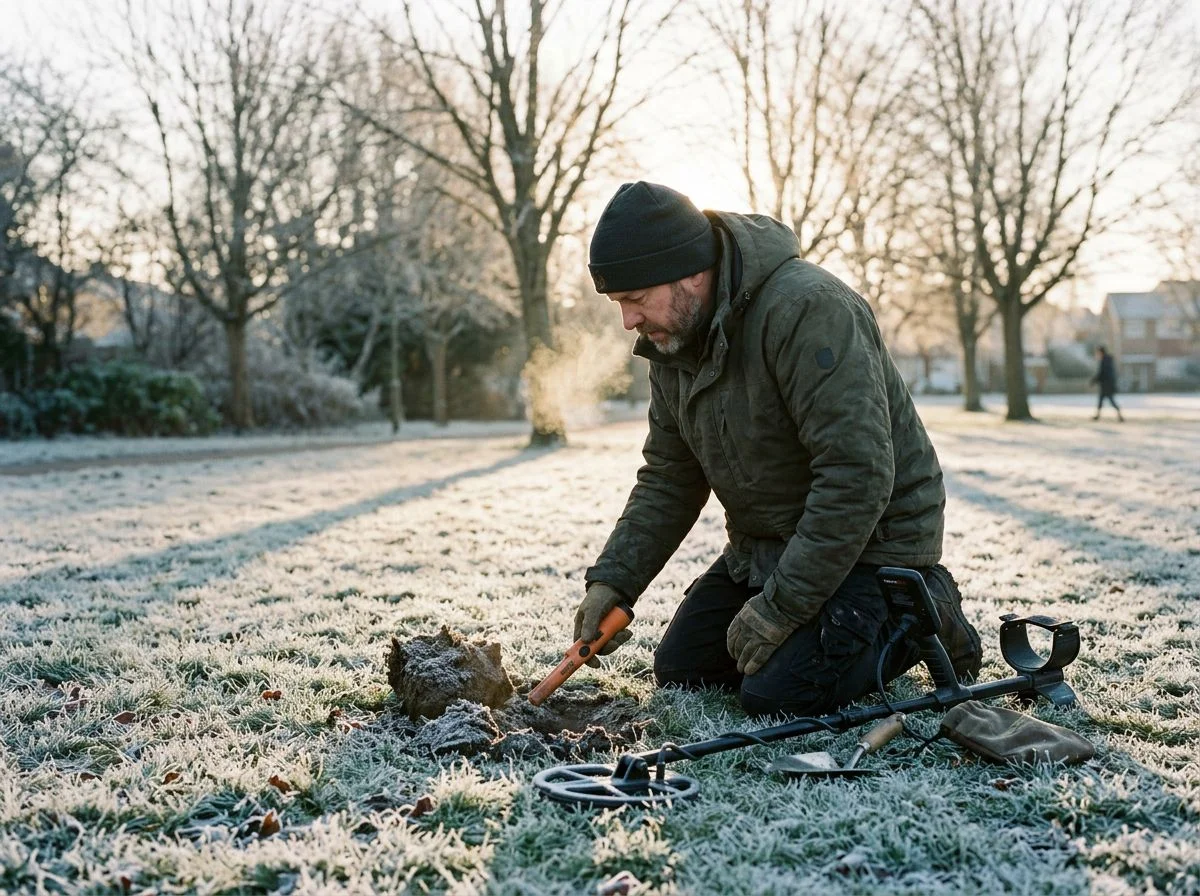
Winter isn’t the off-season for cold weather metal detecting. It’s actually the best time of year to find old coins. The same freeze-thaw cycles that crack roads and heave fence posts are quietly pushing deeply buried targets 1-2 inches closer to the surface. With empty parks and zero competition, you’ve got conditions July can’t touch.
Most detectorists pack up their machines in November and don’t touch them again until April. I used to be one of them. Then I noticed something weird during a January hunt at a Sacramento swimming hole I’d pounded all summer without much luck. Suddenly, deep silver signals were popping up everywhere. That’s when I started paying attention to what the ground itself was doing.
Here’s the thing: when water in the soil freezes, it expands by about 9%. That expansion pushes soil particles — and whatever’s buried in them — upward. When things thaw, the soil settles back down. But the metal object doesn’t quite return to its original depth. Repeat that cycle dozens of times over a winter, and coins that were 8-10 inches deep in October are sitting at 5-6 inches by February. That’s the difference between a whisper and a scream on your detector.
And here’s what makes it even better: south-facing slopes experience 30-40% less frost depth than other terrain. That means the frost heave effect is most active exactly where the digging is actually feasible. I start every winter hunt on those slopes, and they rarely disappoint.
My buddy Mike still thinks I’m crazy for cold weather metal detecting in January. But he’s the one complaining about pull-tabs at the same overhunted park every spring. Meanwhile, I’m pulling seated dimes from ground that spent all winter doing my excavation work for me.
Does Frost Heave Push Targets to the Surface?
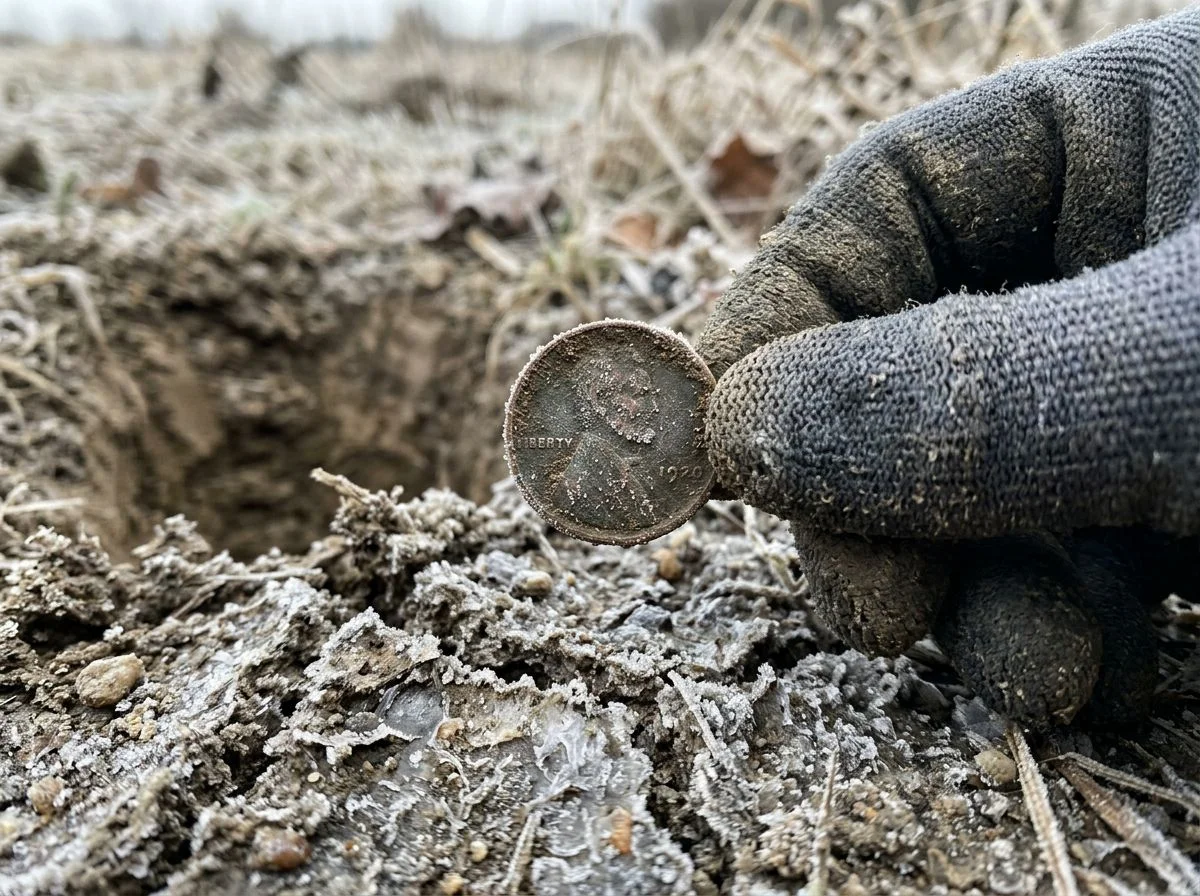
Frost heave is your winter excavation crew. When water in the soil freezes, it expands by roughly 9%, pushing buried targets upward. When the ground thaws, those targets don’t settle back to their original depth. Repeat that freeze-thaw cycle dozens of times over a winter, and coins that were 8-10 inches deep in October are sitting at 5-6 inches by February.
The first time I saw this in action, I wasn’t even looking for it. I’d been hunting a swimming hole outside Sacramento all summer. The kind of spot that’s been drawing families since the 1940s. My haul was decent but shallow: modern clad, a few wheat pennies, nothing older than about 4 inches down. I figured the deep stuff was either gone or out of reach.
Then January rolled around. We’d had a solid week of overnight freezes followed by daytime thaws. I decided to give the old spot one more shot. My Equinox started hitting silver signals in areas I’d walked over a hundred times. First target: a Mercury dime at 6 inches. Second: a Buffalo nickel at 7. By the end of that afternoon, I’d pulled more old coins from that swimming hole than I had in three months of summer hunting.
Here’s what was happening underground. Frozen ground forms tiny pockets of ice and trapped air. Each freeze cycle nudges solid objects — coins, buttons, relics — slightly higher. The soil around them compresses and settles, but the metal doesn’t. It’s slow, patient work that the ground does for free while you’re sitting inside drinking coffee.
The best part? You can predict where it’s working hardest. South-facing slopes and ground near buildings display 30% to 40% shallower frost lines due to solar absorption. Those are the spots where freeze-thaw cycles happen most frequently. And where the heave effect is most active. I start every winter hunt on those slopes, and they rarely disappoint.
What Happens Under Your Coil in Frozen Ground
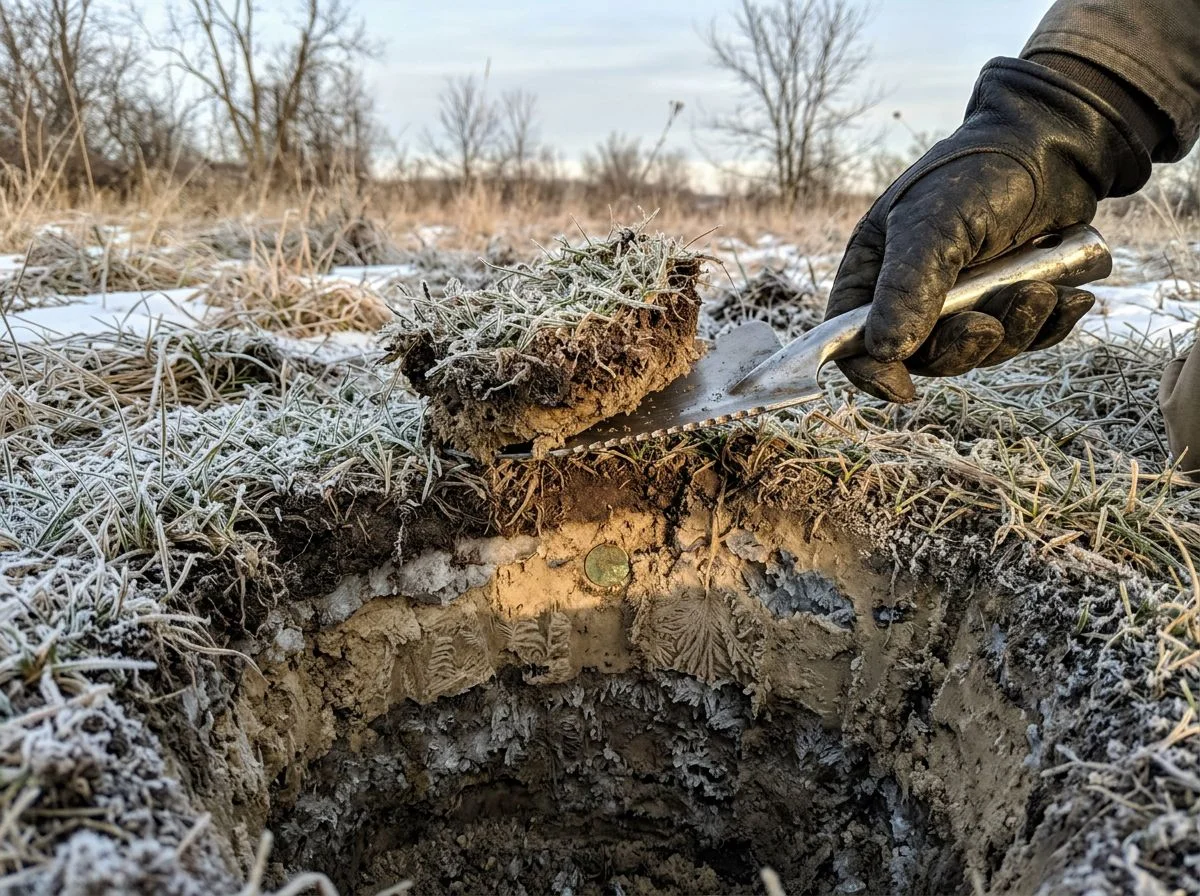
Frozen ground isn’t just harder to dig. It’s actively messing with your detector’s brain. Ice pockets and trapped air alter how signals travel through soil. That means your machine’s ground balance from October is now reading a completely different underground landscape.
Why does your detector suddenly false in January when it was stable in October? Because frozen ground forms tiny pockets of ice and trapped air that scatter and distort the signal your coil sends down. The mineralization your machine learned to ignore three months ago has physically changed. Those ice pockets create inconsistent density zones. Some spots conduct better, some worse. Your detector interprets that chaos as targets.
I learned this the hard way during a February hunt near Folsom Lake. My Equinox 900 started chirping at phantom signals every few feet. I dug three empty holes before I realized the machine wasn’t broken. The ground had changed underneath me overnight.
The fix isn’t complicated, but it does require discipline. You need to run a manual ground balance every 10 to 15 minutes as you move across frozen terrain. In summer, I ground balance once at the start of a hunt and maybe again if I change locations. In winter, the freeze-thaw cycle is actively shifting soil moisture and ice content hour by hour. Especially between 10 AM and 2 PM when surface frost starts melting.
I also drop my sensitivity 15% to 20% below my normal settings. It feels counterintuitive. Shouldn’t you crank it up to reach deeper targets? But higher sensitivity in unstable ground just amplifies the false signals. Lower sensitivity gives you a quieter machine that still hits solid targets. Just without the constant chatter.
The tradeoff is real: you’ll lose a little depth. But you’ll gain sanity, and you’ll actually trust the signals you do get. That’s worth more than an extra inch of theoretical reach.
Cold Weather Metal Detector Settings That Matter
Drop your sensitivity 15-20%. Re-ground-balance every 10-15 minutes. Swap in lithium batteries. And plan your hunt for the 10 AM to 2 PM window. That’s the whole cold weather metal detecting formula. Everything else is just staying warm while you swing.
I learned the sensitivity lesson the embarrassing way. January hunt near Folsom Lake, my AT Pro started chattering at phantom signals every few feet. The kind of noise that sounds almost like a deep target if you squint your ears. I dug six empty holes before I admitted the machine wasn’t finding treasure. It was hallucinating. The frozen ground had shifted its mineralization profile overnight. My summer sensitivity setting was amplifying every ice pocket and trapped air gap into a false signal. The fix? I backed the sensitivity down 15% to 20% and the machine went quiet. Not dead quiet, but the kind of quiet where a real target still punches through. You lose a little raw depth, sure. But you gain the ability to trust what you’re hearing.
Ground balance is the other discipline that winter demands. In July, I balance once and forget it. In January, I’m re-balancing every 10 to 15 minutes because the ground literally changes under my feet as the sun thaws surface frost. That 10 AM to 2 PM window is when the thaw is most active. And when your machine is most likely to drift out of calibration. If you’re hunting a south-facing slope, expect even more fluctuation.
One more thing: lithium batteries are non-negotiable in freezing temps. Alkalines drop voltage fast when they get cold. Your detector will start acting drunk — weak signals, sluggish response, random shutdowns. Lithium cells hold steady. I keep spares in an inside coat pocket, not my gear bag. Warm batteries are happy batteries.
And honestly? Keep your sessions to about 90 minutes. Not because the detecting gets worse. Because your focus does. My best winter finds have come in short, sharp hunts between 10 and 2. Not marathon sessions where I’m too cold to care about subtle tones.
What to Wear for Cold Weather Metal Detecting
The answer is simple: a moisture-wicking base layer, an insulating mid-layer, and a waterproof shell. That three-layer system keeps you dry, warm, and flexible enough to dig through frozen ground for hours. Skip any layer and you’ll feel it within 30 minutes.
The base layer is the one beginners always get wrong. Cotton t-shirts are the enemy in January. They trap sweat against your skin. Once you stop moving, that damp fabric turns into a personal refrigeration unit. You want something synthetic or merino wool that pulls moisture away from your body. I learned this lesson the hard way during a December hunt near Folsom Lake. I thought a flannel shirt would be “good enough.” It wasn’t.
The mid-layer is where the actual warmth comes from. Fleece, wool, or a lightweight puffy jacket — anything that traps air. This is the layer you’ll unzip and zip constantly as your activity level changes. Digging a plug in frozen soil works up a sweat fast. You need to vent that heat before it soaks your base layer.
The outer shell is non-negotiable. It doesn’t need to be heavy. Just waterproof and windproof. Wet cold is what ends hunts early, not dry cold. A decent rain shell over your insulation keeps snow from melting into your layers. And it blocks the wind that’ll cut through everything else.
One piece of gear that pulls double duty: full-size headphones. I switched to fully enclosed earcups last winter and was genuinely surprised by how much warmer my whole head felt. They trap heat around your ears and block the wind that makes your eyes water. The audio isolation is a bonus. You hear subtle target tones better without ambient noise competing.
And about those frozen fingers: last January, I pulled off my glove to retrieve a target with my pinpointer. I fumbled the thing straight into the hole I’d just dug. My fingers were so numb I couldn’t feel the buttons. Now I keep disposable hand warmers in my coat pockets and slip them inside my gloves between targets. It’s a small thing that saves you from watching your $130 pinpointer disappear into a snowbank.
Cold Weather Metal Detecting Locations Most People Miss
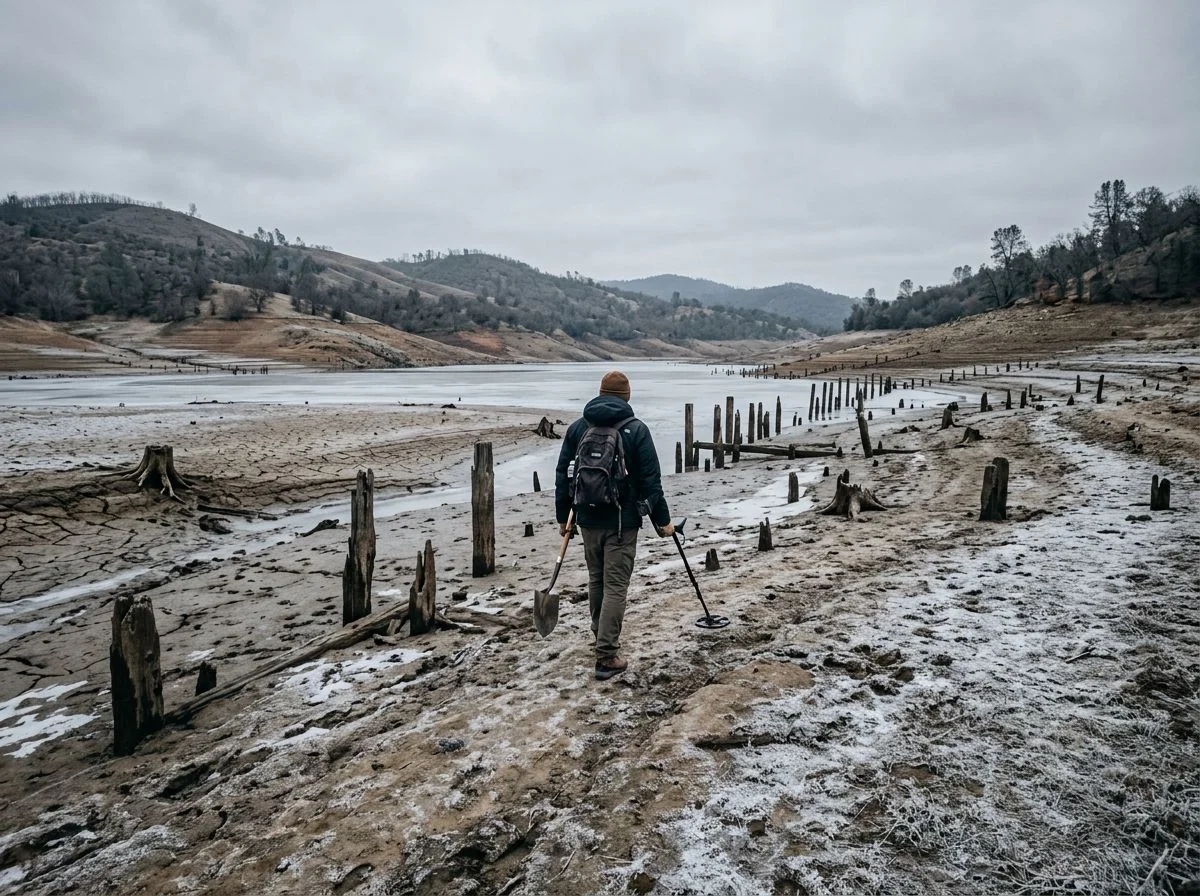
Sledding hills, skating pond shorelines, and cross-country ski paths are where winter losses concentrate. Most detectorists drive right past them. These spots see heavy glove-and-mitten traffic all season. That means dropped jewelry, coins, and gear. The best part? Fresh snowbanks let you recover items without ever breaking frozen ground.
My favorite winter discovery came from a sledding hill behind an elementary school in Folsom. I’d driven past that hill a hundred times in summer without a second thought. But one January afternoon, with kids screaming down the slope and parents stamping their feet at the bottom, I realized something. Every mittened hand digging into snow pockets. Every wipeout at the bottom of the run. Every pocket unzipped for a phone. That’s a potential drop zone. I waited until the hill emptied out around 4 PM. Then I worked the base where sleds naturally slow down and kids tumble off.
About twenty minutes in, my Equinox 900 hit a solid 22 — silver range. Two inches down in the churned snow and mud, I pulled a small sterling ring with a heart-shaped setting. Looked like something a teenager lost while pulling off wet gloves. Probably worth $15, maybe less. But the thrill wasn’t the value. It was realizing this entire hill had been invisible to me for years because I only thought of it as a summer landmark.
Sledding hills are productive precisely because winter recreation concentrates losses in predictable zones. The bottom of the run is the jackpot. That’s where momentum stops, bodies roll, and pockets empty. The launch point at the top is second-best. That’s where kids sit and adjust gear before pushing off.
Skating pond shorelines work the same way. People sit on benches or logs to lace up skates. Gloves come off. Keys and phones get set down in the snow and forgotten. And here’s the beautiful part: items dropped into fresh snowbanks can often be recovered easily before they sink into the soil. No heavy digging required. You’re essentially surface hunting with a detector.
Ski paths and snowshoe trails round out the list. Cross-country skiers shed gear constantly. Zipper pulls, pins, pocket change, the occasional ring when gloves come off to adjust bindings. The trails themselves concentrate the losses into narrow corridors. That makes covering ground efficient. I’ll take a groomed ski path over a random frozen field any day of the week.
The common thread? Winter activities force people to handle their belongings with cold, clumsy fingers. In places they’d never visit during warmer months. That’s your opening.
Cold Weather Metal Detecting Safety Rules
Hunt with a partner. Carry a fully charged phone with battery backup. Pack emergency blankets and hand warmers. And have a clear warm-up plan before you leave the house. These aren’t suggestions. They’re the difference between a bad afternoon and a genuinely dangerous situation.
The most dangerous thing about cold weather metal detecting isn’t the cold. It’s the isolation.
Think about it. In summer, you’re at a park with joggers, dog walkers, families. Someone’s always within shouting distance. In January? That same park is empty. You’re alone, maybe a half-mile from your car. If you slip on ice or twist an ankle in frozen ruts, nobody’s coming to check on you.
That’s why hunting with a partner is the single most important winter safety rule. My buddy Tom and I have a standing agreement from December through February: we don’t hunt solo, period. It slows us down sometimes. Coordinating schedules, splitting finds. But I’d rather dig half as many targets than lie in a drainage ditch waiting for a phone that’s dead from the cold.
Which brings me to the phone. Cold kills batteries fast. A phone that reads 80% at your kitchen table can drop to nothing in 45 minutes of January air. Keep a portable battery backup in an inside pocket, close to your body heat. Keep the phone itself in a chest pocket, not a thigh pocket where it’s exposed.
Emergency blankets and hand warmers live in my detecting bag all winter. They weigh almost nothing and take up no space. The blanket is for the worst-case scenario. Someone wet, injured, or stuck waiting for help. The hand warmers are for the more common problem: fingers too numb to operate your detector controls or dig safely.
Finally, have a warm-up plan. That means knowing exactly where you’ll go if you get too cold. A running car, a nearby coffee shop, whatever’s within 20 minutes. The prime hunting window is 10 AM to 2 PM. When that window closes, so should your hunt. There’s no find worth frostbite.
Cold Weather Metal Detecting Gear Worth Buying
The short answer: a rain cover, a heavy-duty digging tool, and full-size headphones. Everything else is optional. Do you really need a $1,500 waterproof detector for winter, or will a rain cover do? Unless you’re planning to submerge your machine in a frozen pond, a rain cover handles snow moisture just fine.
Here’s what I’ve learned after a decade of January hunts: the gear that fails first in cold weather metal detecting is rarely the detector itself. It’s the accessories. A rain cover protecting your control box from snow and cold moisture is essential. Not because your machine is fragile. Because snow melts. It seeps into button gaps and screen edges, then refreezes. I’ve had my AT Pro’s buttons stick solid after a wet snow hunt because I skipped the cover. Lesson learned.
The digging tool is where most people cheap out. Winter punishes that immediately. Frozen topsoil requires heavy-duty digging tools. Your standard garden trowel will bend or snap on the first hard frost. I carry a Lesche-style digger with a serrated edge. It cuts through frozen crust without destroying targets underneath. My buddy Mike once tried a plastic-handled trowel in January. The handle shattered on the third plug. He dug the rest of the afternoon with a screwdriver from his truck.
Now, about waterproof detectors. Machines rated to 10 feet underwater handle snow without any issue. The waterproofing is overkill for snow, but it means zero concern about moisture. My Equinox 900 is fully waterproof. I’ve never once worried about snow on the control box. But that’s convenience, not necessity. A $30 rain cover on a non-waterproof machine accomplishes the same thing for winter hunting.
One more thing: full-size headphones beat backphones in cold weather. They keep your ears warm and block wind noise. So you actually hear those faint deep signals. That’s a real winter advantage, not just comfort.
Cold Weather Metal Detecting Questions Answered
The short answer: yes, with caveats. Frozen ground is hard to dig but not impossible to detect through. Smart detectorists learn which conditions are worth braving. And which are better left for a thaw.
Can I metal detect when the ground is frozen solid?
You can detect, but digging is another story. Your machine will still pick up signals through frozen soil. The real problem is recovery. A heavy-duty digger with a serrated edge can chip through a few inches of frost. But once the ground freezes more than 3–4 inches deep, you’re essentially trying to excavate concrete. I’ve spent twenty minutes on a single plug that would’ve taken ninety seconds in spring. Not worth it.
The workaround is targeting the thaw window. Ground temperatures rise just enough between 10 AM and 2 PM to soften the top layer on sunny days. And south-facing slopes thaw 30–40% faster than anywhere else. That’s where I head when the ground is mostly frozen. Those slopes give me diggable soil hours before anything else.
What about snow? Light cover under two inches actually helps. It shows you where people have been walking. But deeper snow adds distance between your coil and the target. That means you’ll need a larger coil to maintain depth. And if the snow itself is frozen hard, here’s a trick: sprinkle a little salt on the spot to accelerate thawing. It works on ice, and it works on frozen snowpack too. Just don’t go crazy with it. You’re detecting, not de-icing a highway.

My name is Paul and I am the founder of Detector For Metal, a dedicated resource for metal detecting enthusiasts seeking to uncover historical treasures and connect with the past using the latest technology. As a stay-at-home dad and family man, I’ve found metal detecting to be the perfect hobby that combines family adventure with historical learnings for the whole family.
As a father, I’m deeply committed to passing on this hobby to the next generation of detectorists, starting with my own children. I share advice on everything from metal detecting with kids to exploring the top 10 metal detecting sites you never thought about. My methodical approach to the hobby goes beyond the thrill of discovery—it’s about creating family traditions while preserving history and sharing the stories of those who came before us.