Table of contents
- VLF Gold Prospecting in Bedrock Cracks
- Why VLF Beats Pulse Induction on Shallow Bedrock
- Best VLF Detectors for Gold Prospecting
- Why Smaller Coils Work Better on Bedrock
- Manual Ground Balance for Gold and Hot Rocks
- Reading Bedrock to Find Gold in Cracks
- The Recovery Toolkit for Bedrock Hunting
- Common Bedrock Hunting Mistakes
- VLF Gold Prospecting Questions Answered
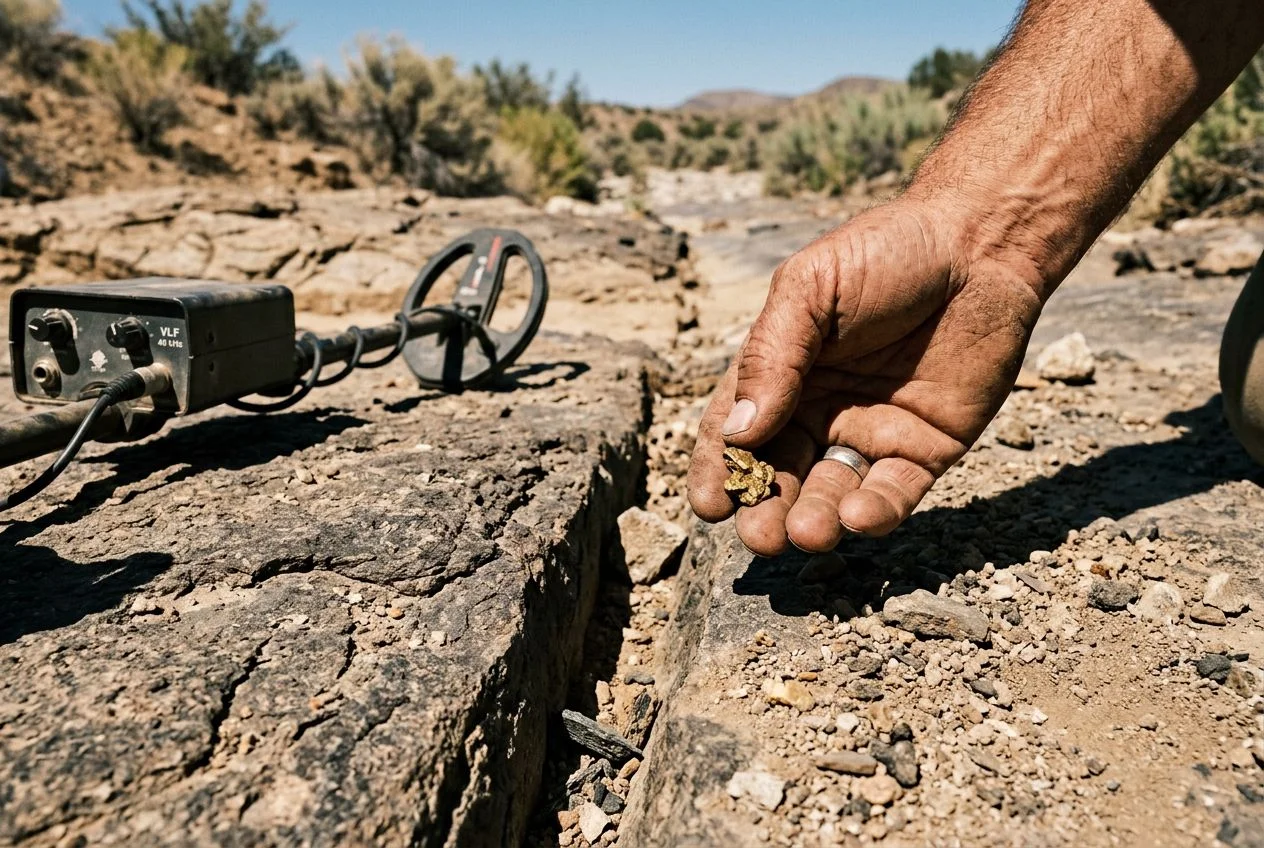
Small nuggets hide in bedrock cracks. Gold is roughly six times heavier than surrounding sand and gravel. It drives itself into every fracture until something stops it. A high-frequency VLF detector with a small coil — swept slowly across exposed bedrock — will find what deeper-seeking pulse induction machines walk right over.
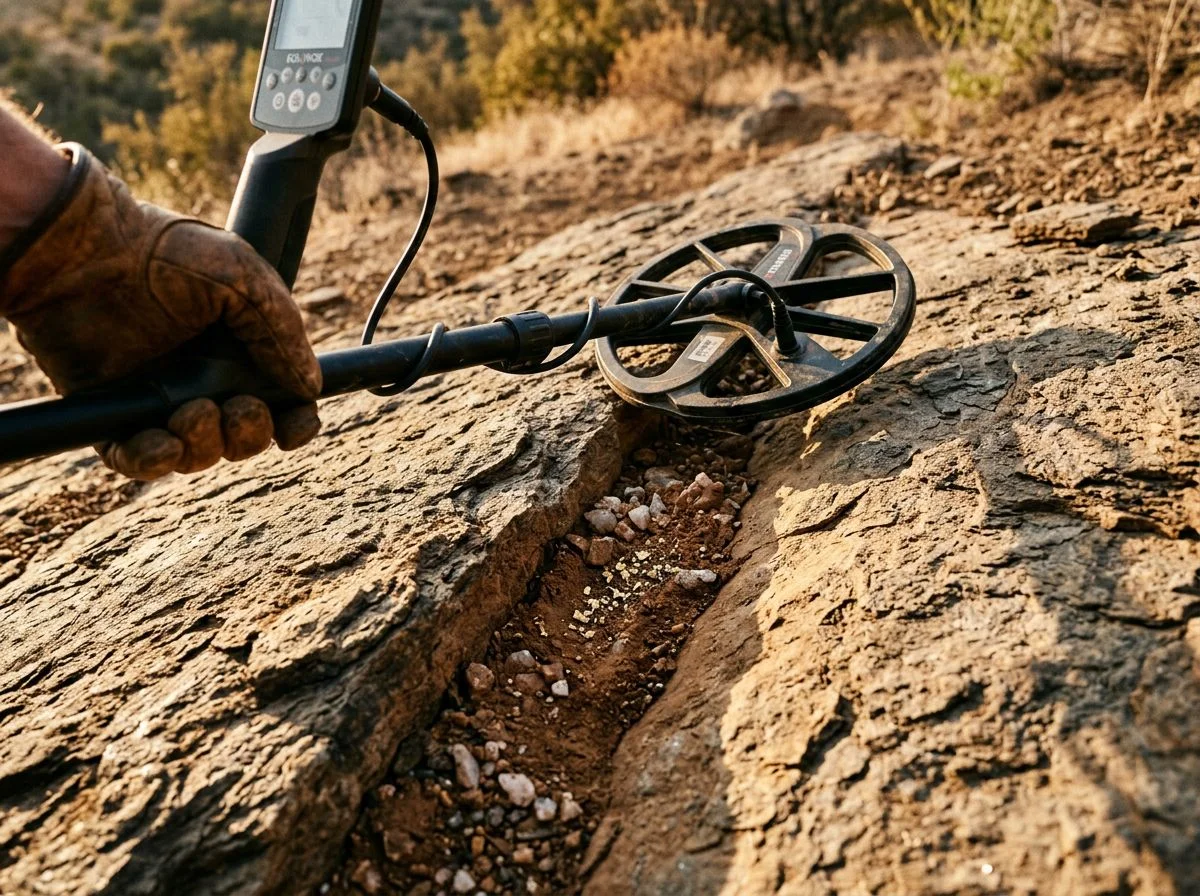
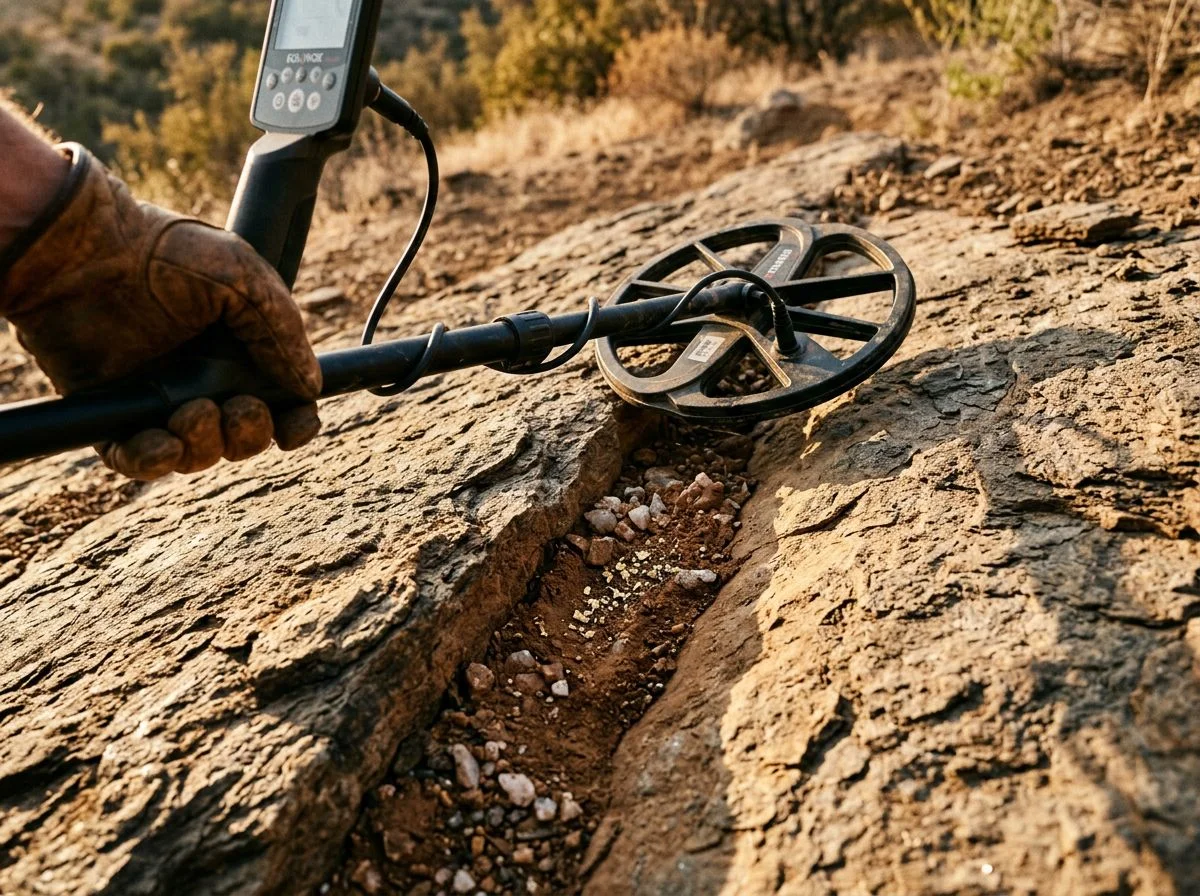
The technique starts with coil selection. Swap to a 5-inch or 6.5-inch elliptical “sniper” coil before you even think about hunting cracks. These small coils fit into tight openings. They also give you the target separation you need when gold sits inches from hot rocks. In a field test, a Fisher Gold Bug 2 with a 6.5-inch coil recovered three pickers at one to two inches deep on heavily hunted bedrock. A companion running a pulse induction machine got no signal over the same spots.
Speed matters more than most prospectors realize. Slow your swing to a crawl. The Gold Monster 1000 field test emphasized maintaining a very slow sweep speed to hear faint targets in bedrock. Those whisper signals are often small gold. A fast swing will miss them entirely.
Ground balance manually if your machine allows it. Bedrock is typically less mineralized than surrounding soil, which works in your favor. But cracks can concentrate black sand and hot rocks. The XP ORX Fine Gold program handles heavy mineralization with fast recovery speeds. Manual balancing still gives you the cleanest threshold.
Once you get a signal, work it with hand tools. Use a cold chisel to open tight fractures and a snuffer bottle for recovery. The detector finds it. The tools finish the job.
You’ll know it worked when your first bedrock crack produces a picker that a bigger machine missed.
VLF Gold Prospecting in Bedrock Cracks
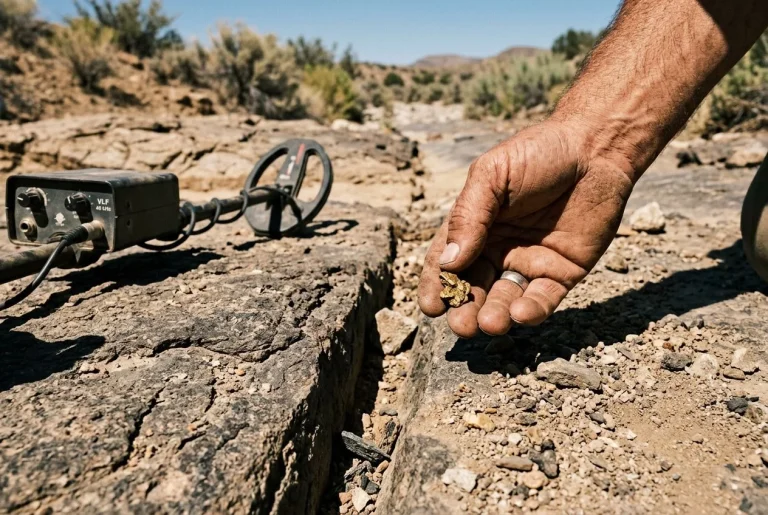
Bedrock cracks are the most overlooked gold trap. Gold is roughly six times heavier than surrounding sand and gravel. It drives itself into every fracture, ledge, and pothole until something stops it. Most prospectors walk right over those shallow cracks chasing deeper ground instead.
Here’s the thing that took me years to fully appreciate: gold doesn’t just sink. It drives. That weight differential — six times heavier than the material around it — means gold behaves less like a passive particle and more like a tiny, determined missile. Every flood event, every seasonal runoff, every time water moves across exposed bedrock, gold gets shoved downward into whatever crack, crevice, or pothole will accept it. Once it’s in there, it doesn’t come back out on its own.
The frustrating part is that these traps don’t look like much. A hairline fracture in a slab of bedrock. A small depression behind a ledge where water velocity drops. A pothole the size of a coffee mug. Nothing about them screams “dig here” — unless you understand the physics at work. The New 49ers documented a bedrock deposit so concentrated it averaged over $300 an hour for half a day of hand scraping. Not dredging. Not heavy equipment. Just working cracks with hand tools.
And the numbers get almost absurd when you zoom in. One prospector recovered $280 in gold from a single small crevice after low water exposed the bedrock. One crack. Not a claim, not a paystreak — a single fracture in the rock that everyone else had been walking past.
That’s the part that still gets me excited after all these years. The gold isn’t hiding somewhere exotic. It’s sitting in the most obvious geological feature on the creek — the bedrock itself. It’s waiting for someone to slow down and actually look at the cracks instead of swinging wide and moving on.
Why VLF Beats Pulse Induction on Shallow Bedrock
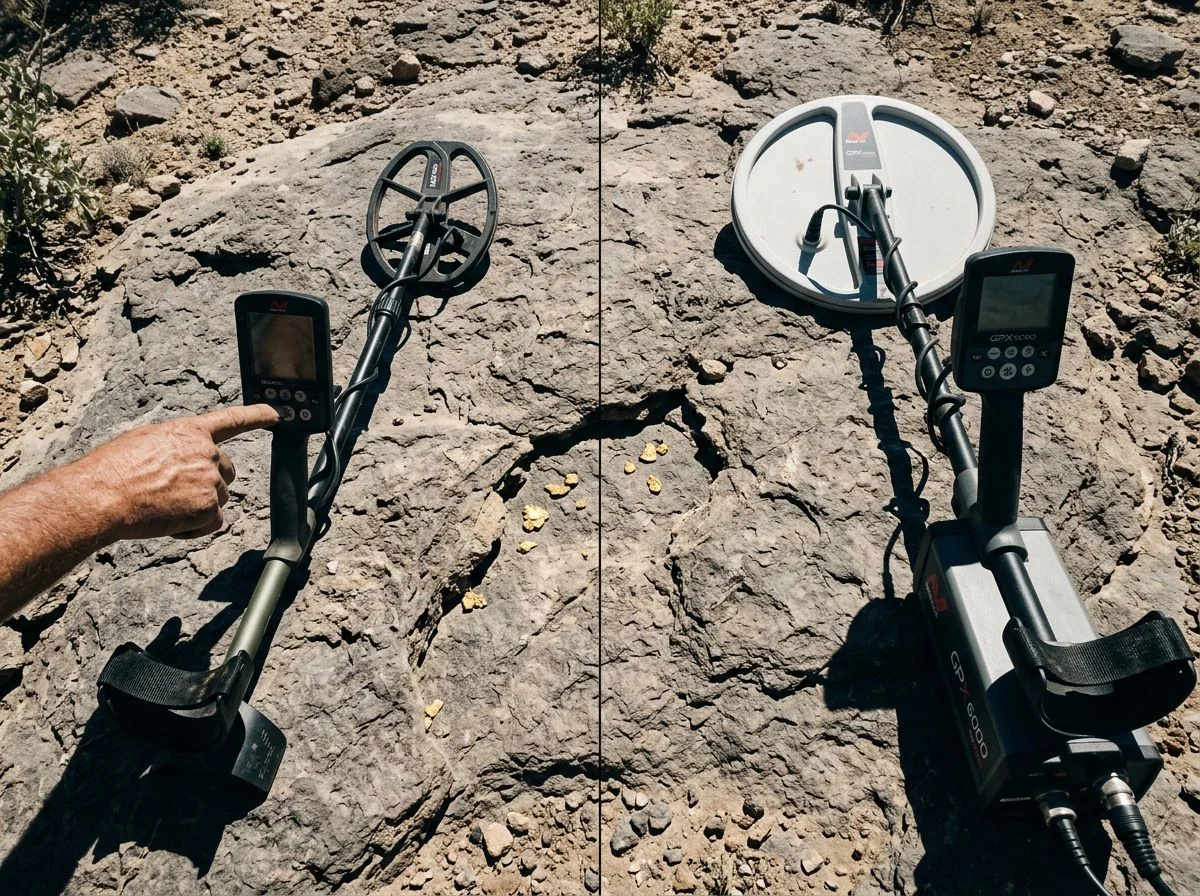
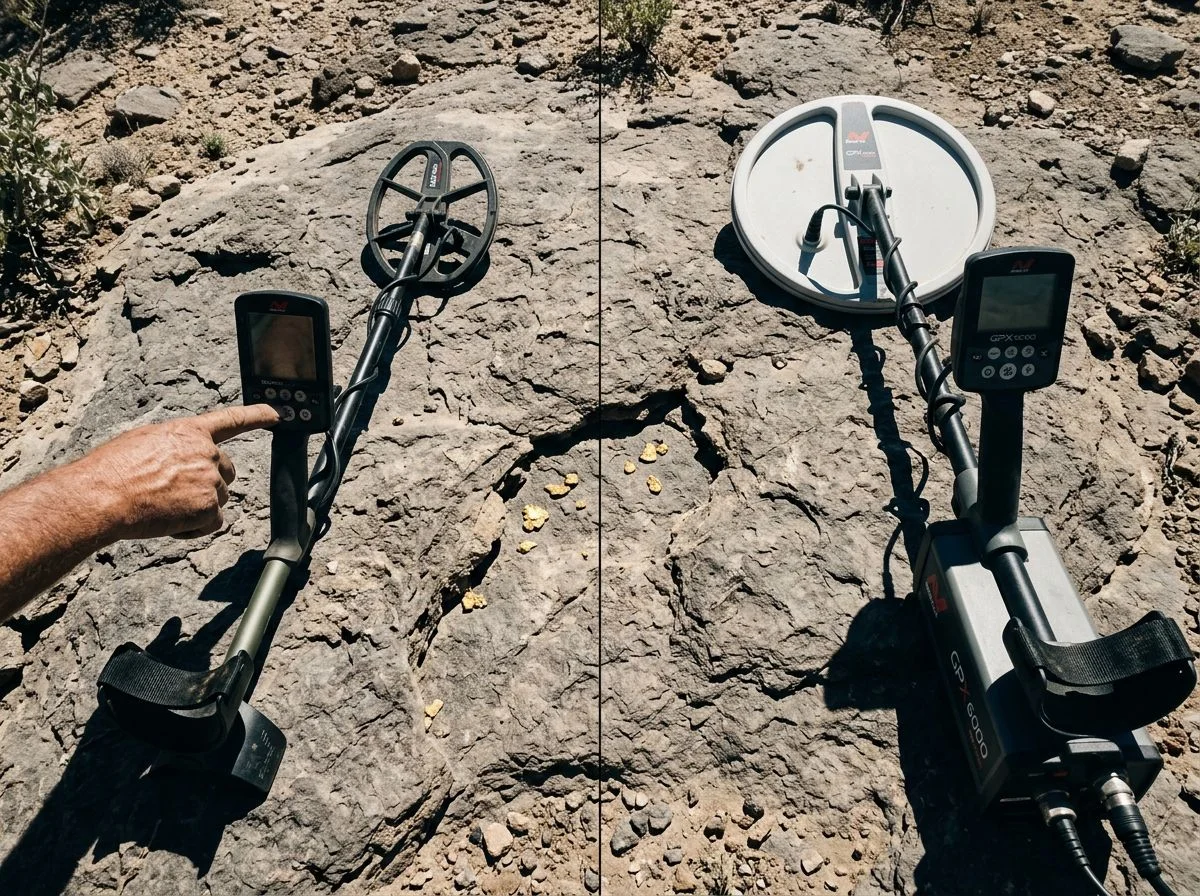
On exposed bedrock, a $700 VLF machine will often out-hunt a $7,000 pulse induction detector. Bedrock gold sits only a few inches down. PI machines are built to punch 500mm deep, not to hear tiny targets at two inches. The physics flips the conventional wisdom.
Here’s the thing most prospecting forums get wrong: PI machines are depth monsters. That’s exactly the problem on bedrock. A Minelab GPZ 7000 will dig targets down to 500mm — just over 19 inches — through mineralized soil and clay. But that depth comes with a cost. The large 14-inch coil struggles to pinpoint small targets. The recovery speed is tuned for deep ground, not shallow crevices.
Bedrock is different. It’s typically less mineralized than surrounding soil. The gold you’re chasing sits in cracks only a few inches deep. A VLF’s expected depth on bedrock is a few inches — and that’s all you need. The high frequency (45–48 kHz) of machines like the Gold Monster 1000 or Gold Bug 2 makes them hyper-sensitive to small gold. Their small coils fit into tight crevices where big PI coils physically can’t go.
I watched this play out on a heavily hunted patch of exposed bedrock last season. A buddy running a Fisher Gold Bug 2 with the 6.5-inch elliptical sniper coil recovered three pickers buried one to two inches deep. His companion, swinging a more expensive pulse induction machine, walked over those same spots and got no signal at all. Not a whisper. The PI machine was built to find deep gold — and it did that job perfectly. It just couldn’t hear the shallow stuff sitting right under the coil.
That’s not a knock on PI machines. They’re the right tool for deep clay and heavy mineralization. But on exposed bedrock, the VLF is the right tool for the job — and the cheaper one, at that.
Best VLF Detectors for Gold Prospecting
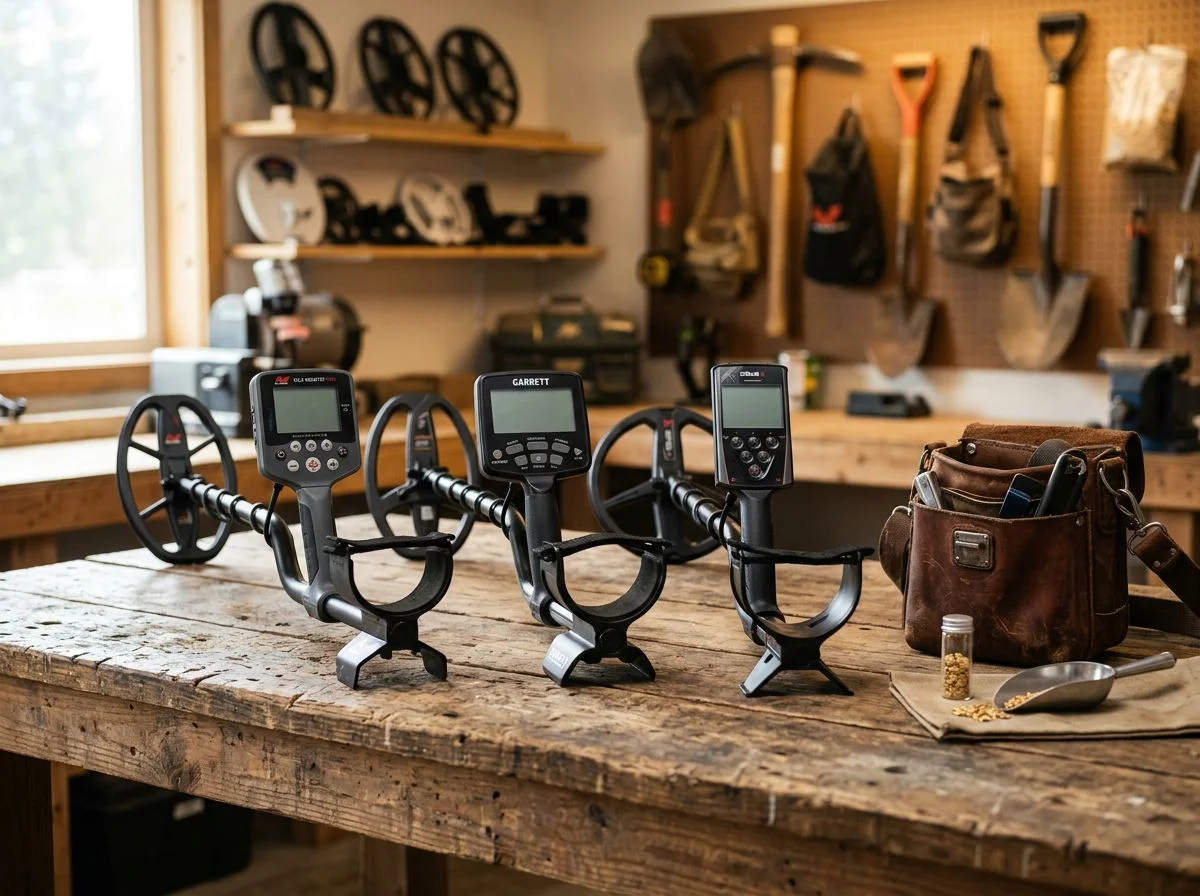
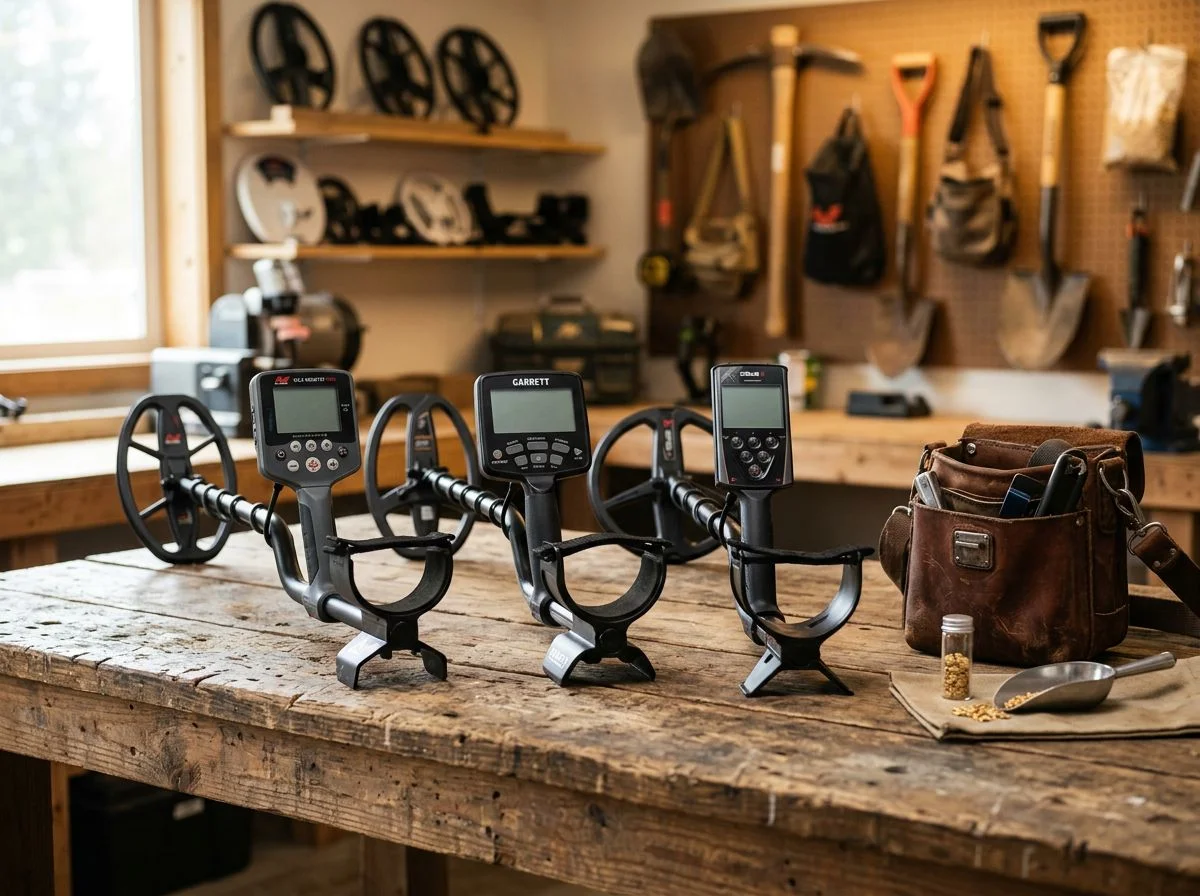
If you’re hunting shallow bedrock cracks, you want a high-frequency VLF machine — somewhere in the 45–48 kHz range. That’s where small gold becomes audible. Three detectors dominate this niche: the Garrett Goldmaster 24k, the Minelab Gold Monster 1000, and the XP ORX.
The Garrett Goldmaster 24k runs at 48 kHz. That’s specifically tuned for fine flakes and tiny pickers that lower-frequency machines walk right over. It comes with XGB auto-tracking ground balance, so you’re not constantly re-balancing as you work across variable bedrock. The 6″x10″ DD waterproof coil means you can sweep directly through shallow water and wet gravels without flinching. That waterproofing matters more than you’d think — some of my best bedrock cracks have been half-submerged.
The Minelab Gold Monster 1000 operates at 45 kHz with 24-bit signal processing. It pulls faint target signals out of background noise without making your headphones sound like a Geiger counter. It weighs under three pounds. I’ll be honest — after a six-hour day hunched over bedrock, that lightness stops being a spec-sheet detail and becomes the reason your arm still works. The 5-inch coil option is the real star here for tight crevices.
The XP ORX takes a different approach with its Fine Gold program. It’s built specifically for heavy mineralization like ironstone and decomposed granite. It gives you five levels of Iron Audio Reject. That’s invaluable when you’re working bedrock littered with hot rocks that want to mimic gold signals. Pair it with the 5.5-inch round coil and you can physically get into cracks that larger coils can’t touch.
Frequency is the whole game here. Higher kHz means better sensitivity to small, shallow gold — exactly what bedrock cracks hold.
Why Smaller Coils Work Better on Bedrock
On exposed bedrock, a small coil isn’t a compromise — it’s the advantage. You’re hunting shallow cracks and tight crevices, not deep ground. A 5- to 6.5-inch coil gives you better target separation, easier pinpointing, and physical access that a 10-inch or 14-inch coil simply can’t match.
Here’s the question that settles it: When was the last time you needed 12 inches of depth on exposed bedrock? Never. The gold you’re chasing sits in cracks only a few inches down. A big coil’s depth capability is wasted. Worse, it becomes a liability. Large coils struggle to separate targets in trashy or mineralized bedrock. They physically can’t fit into the narrow fractures where small nuggets accumulate.
The Fisher Gold Bug 2 with the 6.5-inch elliptical “sniper” coil is the classic setup for this exact scenario. That elliptical shape lets you work the coil into narrow cracks while maintaining superior target separation in trashy bedrock. During a four-hour test on heavily hunted bedrock, that combination recovered three pickers at one to two inches deep. A companion’s PI machine walked right over those targets.
The Gold Monster 1000 takes the same approach with its 5-inch coil option. Swap to that small coil and slow your swing speed. You’ll see a dramatic improvement in feedback on faint targets in exposed bedrock. The machine’s 24-bit signal processing does the heavy lifting. The small coil is what lets you isolate individual cracks instead of averaging everything beneath a wide footprint.
If you’re running an XP ORX, the 5.5-inch round coil is the crevice specialist. It pairs with the Fine Gold program’s fast recovery speed and Iron Audio Reject to separate tiny gold from hot rocks and ferrous trash in tight pockets. And for a PI machine you might carry as backup, a 6″x8″ mono coil lets you maneuver into openings between rocks where the stock coil can’t physically go.
The tradeoff is coverage — small coils mean slower ground coverage. That’s fine. On bedrock, you’re not sweeping acreage. You’re working specific cracks methodically. Precision beats speed every time.
Manual Ground Balance for Gold and Hot Rocks
Manual ground balance is the single most important skill you can learn for bedrock detecting. It’s what lets you tune out the hot rocks that scream “gold” and hear the faint, real signals hiding in the cracks. Auto-tracking systems are convenient. But they can’t always keep up with the rapid mineralization swings you hit when working exposed bedrock. Here’s how to do it right.
The Fisher Gold Bug 2 is the machine I learned this on. Its manual ground balance is still the gold standard for a reason. You pump the coil up and down over a clean patch of ground — no targets — while adjusting the ground balance knob until the threshold hum stays steady on both the downstroke and the upstroke. That’s it. That steady hum means the machine is ignoring the mineralization and listening for actual metal. Once you’ve got it dialed in, flip on the Audio Boost mode. It amplifies those faint whispers from tiny targets hiding deep in crevices. I remember working a crack system in the Sierras where a 0.3-gram picker sounded like a coin at the surface — that’s Audio Boost doing its job. Without it, I’d have walked right past.
The Garrett Goldmaster 24k takes a different approach with its XGB auto-tracking ground balance. It continuously adjusts as you sweep across variable bedrock — wet gravel, dry schist, ironstone seams, all in the same ten-foot stretch. It’s genuinely helpful when you’re covering ground fast and don’t want to stop and re-balance every few minutes. But here’s the thing I’ve learned the hard way: auto-tracking can mask a target if you linger over it too long. The machine starts treating the gold as ground noise. So even with auto-tracking, I’ll periodically switch to manual, find a clean spot, and lock it in.
Then there’s the XP ORX, which handles the hot rock problem differently — with five levels of Iron Audio Reject (IAR). Instead of balancing out the mineralization, you’re telling the machine to reject ferrous signals outright. On bedrock littered with magnetite and hematite, I’ll start at IAR level 2 or 3. That kills most of the hot rock chatter while still letting small gold through. Crank it to 5 and you’ll have blissful silence. But you’ll also miss tiny pickers that read close to iron.
The real skill isn’t just setting the balance once and swinging. It’s knowing when to re-check it. Bedrock conditions change fast — a wet crack, a dry ledge, a pocket of black sand. Every time the threshold starts drifting or chattering, stop, find clean ground, and re-balance. It takes thirty seconds. Those thirty seconds are the difference between digging hot rocks all afternoon and walking out with gold.
Reading Bedrock to Find Gold in Cracks
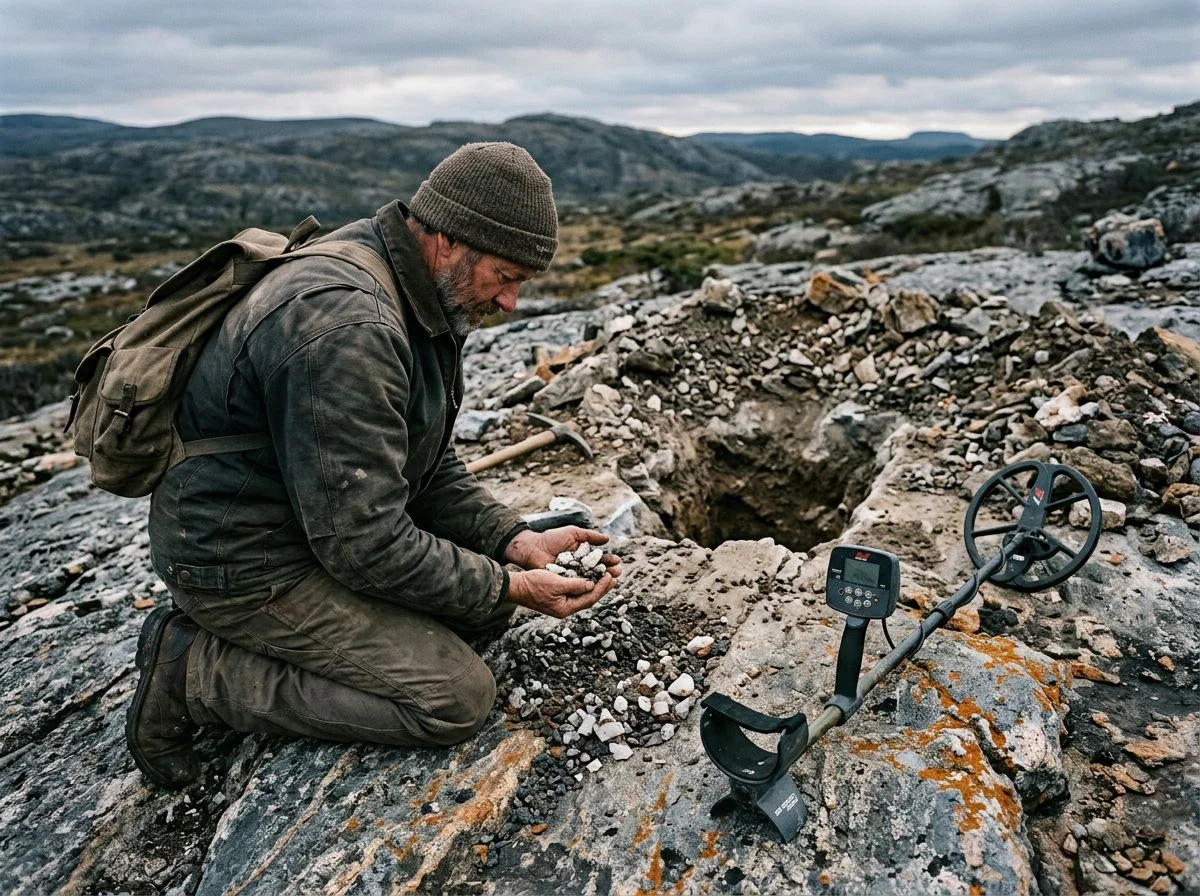
Gold hides where water slows down — in deep narrow cracks, behind rock ledges, and inside natural potholes. The heaviest material settles to the absolute bottom and stays put. Your job is to read those features and hunt the traps, not the open rock.
The physics is simple. Gold is roughly six times heavier than the sand and gravel around it. It doesn’t drift along with the current. It sinks. Fast. Every time water moves across bedrock, the gold drops into the lowest available point and stays there until something physically scrapes it out. That means the deep, narrow cracks are your primary targets — not the wide, shallow fractures where a good rain can flush everything downstream.
Areas behind rock ledges work the same way. Water velocity drops sharply on the downstream side of an obstruction. Gold drops with it. I’ve found more pickers tucked behind fist-sized cobbles than in open stretches of bedrock. The ledge created a dead zone where heavy material could settle.
Natural potholes are the third trap. These are the round depressions worn into bedrock by swirling water and gravel over centuries. They act like miniature sluice boxes. Water spins in, loses energy, and drops its heaviest load. When you find a pothole, clean it out completely. Don’t just scrape the surface.
Here’s the indicator I trust most: black sand. When you see concentrated black sand in a crack or pothole, you’re looking at a natural concentration zone. Black sand is heavy — magnetite and hematite — and it settles in exactly the same places gold does. If the black sand is there, the gold had every reason to be there too. I’ve dug black sand pockets that held nothing but frustration. But I’ve never found gold in bedrock without at least some black sand nearby. The science of bedrock gold backs this up. Heavy materials concentrate together. Black sand is the visible evidence that the trap works.
So when you’re scanning bedrock, stop looking at the stone and start looking for the traps. Deep cracks. Ledge shadows. Potholes. And wherever you see black sand, slow down and work that spot hard.
The Recovery Toolkit for Bedrock Hunting
Your detector finds the gold. Your hand tools recover it. A 20-ounce claw hammer, a 10-inch cold chisel, a snuffer bottle, and a water sucker are the four essentials. Everything else is optional weight. Without them, you’ll locate targets you can’t extract. That’s more frustrating than finding nothing at all.
The hammer is your primary tool. A 20-ounce claw hammer gives you enough weight to break loose cemented gravel in cracks without exhausting your arm. The claw end works surprisingly well for prying up flakes of decomposing bedrock. I lost a proper rock hammer years ago and replaced it with a framing hammer from the garage. Honestly, I haven’t missed the rock hammer.
For tight fractures that refuse to open, a sharp 10-inch cold chisel does what no detector can. You wedge the tip into the crack and tap it with the hammer. The bedrock splits along its natural seam. Go slow. You’re not mining — you’re persuading the rock to give up what it’s been holding.
Once the target is loose, a snuffer bottle collects the small stuff. It’s just a squeeze bottle with a tube. Squeeze, place the tube next to the gold, release, and the vacuum pulls it in. No chasing pickers with wet fingers.
The best tool in my kit is a homemade water sucker built from 1.25-inch clear plastic tubing and a squeeze bulb, with an adjustable 10-inch copper tube on the business end. It works like a turkey baster on steroids. Squeeze the bulb to expel air. Insert the copper tube into a water-filled crack. Release, and it sucks up water, gravel, and gold together. The clear tubing lets you see exactly what you’re pulling out. When you spot a glint of yellow, you know you’re in the right crack. I built mine for under $15. It’s recovered more small nuggets than any store-bought tool I own.
Common Bedrock Hunting Mistakes
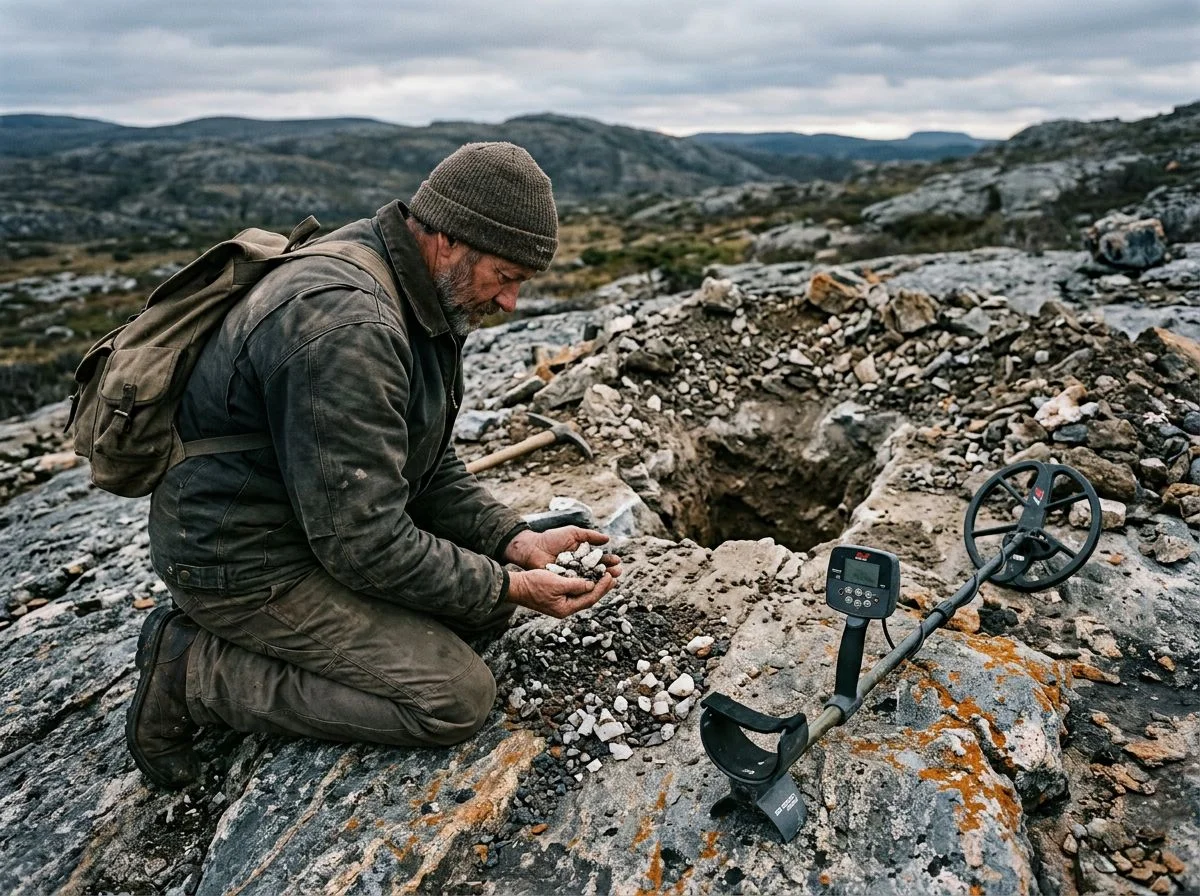
Most bedrock hunters fail not because they’re in the wrong spot. They fail because they’re moving too fast, running too much sensitivity, and treating every crack the same way. The fix is usually slower swings, manual settings, and matching your program to the rock. How many good signals have you walked away from because you were swinging too fast?
Swing speed is the silent killer. Small gold targets on bedrock are shallow — often just an inch or two down. But they’re tiny, and your detector needs time to process them. The GPAA field test of the Gold Monster 1000 specifically calls this out. The tester manually adjusted sensitivity and maintained a very slow swing speed to successfully hunt exposed bedrock. I’m talking half your normal pace, maybe slower. You’re not covering ground. You’re interrogating it.
Running sensitivity too hot is the second mistake. Cranked sensitivity on mineralized bedrock just fills your headphones with chatter. You’ll mentally tune out the faint whispers that matter. On the Gold Monster 1000, manual sensitivity adjustment — not auto — let the tester hear clear feedback on tiny targets. Back it down until the noise settles, then hunt.
Using the wrong program for the rock is the third. Ironstone and decomposed granite are brutal on VLF machines. If your detector has specialized programs — like the XP ORX’s Fine Gold program, built specifically for heavy mineralization like ironstone and decomposed granite — use it. The generic Gold program won’t cut it in that ground. Match the program to the rock type under your coil, not the rock type you wish you were hunting.
VLF Gold Prospecting Questions Answered
Here are the questions I get asked most often about using a VLF detector on exposed bedrock — answered straight, with the numbers I actually trust.
How deep will a VLF detector find gold in bedrock?
Only a few inches — and that’s fine. Bedrock gold sits near the surface, trapped in cracks and crevices, not buried deep. The GPAA Knowledge Base puts expected VLF depth on bedrock at just a few inches. If you’re chasing depth, you want a pulse induction machine. If you’re chasing shallow pickers, VLF is the right tool.
What frequency should I look for?
High frequency — 45 kHz or above. The Minelab Gold Monster 1000 runs at 45 kHz. The Garrett Goldmaster 24k hits 48 kHz. That high frequency is what makes tiny flakes and pickers light up. Low-frequency machines will walk right over them.
Should I use a small coil?
Yes, if you’re working tight crevices. A 5-inch or 6-inch coil gets into spots a big coil physically can’t. The Fisher Gold Bug 2 field test recommends the 6.5-inch elliptical for exactly this reason — superior target separation in trashy, fractured rock.
Do I need manual ground balance?
On bedrock, absolutely. Bedrock is typically less mineralized than surrounding soil, but hot rocks still exist. Manual ground balance lets you tune out the noise and hear the faint signals. The GPAA field test of the Gold Monster 1000 specifically noted that manually adjusted sensitivity — not auto — was what made tiny targets audible.
Can I use a VLF as my only gold detector?
For bedrock work, yes. For deep ground

My name is Paul and I am the founder of Detector For Metal, a dedicated resource for metal detecting enthusiasts seeking to uncover historical treasures and connect with the past using the latest technology. As a stay-at-home dad and family man, I’ve found metal detecting to be the perfect hobby that combines family adventure with historical learnings for the whole family.
As a father, I’m deeply committed to passing on this hobby to the next generation of detectorists, starting with my own children. I share advice on everything from metal detecting with kids to exploring the top 10 metal detecting sites you never thought about. My methodical approach to the hobby goes beyond the thrill of discovery—it’s about creating family traditions while preserving history and sharing the stories of those who came before us.