Table of contents
Identifying vintage horse tack comes down to three things: the metal it’s made from, how it was manufactured, and where it attached to the animal. Learn those tells, and a rusty buckle stops being junk. It becomes a date stamp for your site.
Start with the material. Solid brass and iron dominate pre-1900 tack. Zinc die-cast hardware is a modern red flag for vintage horse tack identification. It’s brittle and snaps under load, so you’ll rarely find it on working harnesses from the 1800s. If it’s brass and heavy, you’re probably looking at something with real age. If it feels light and crumbles, it’s likely a modern reproduction.
Manufacturing method is your next clue. Early horse brasses were sand-cast. That left a slightly rough, grainy back surface. Around 1880, a stamping method using a fly press was introduced. It produced cleaner, more uniform pieces. A stamped brass rosette with crisp edges is almost certainly post-1880. A sand-cast one with an uneven back could date to the 1700s.
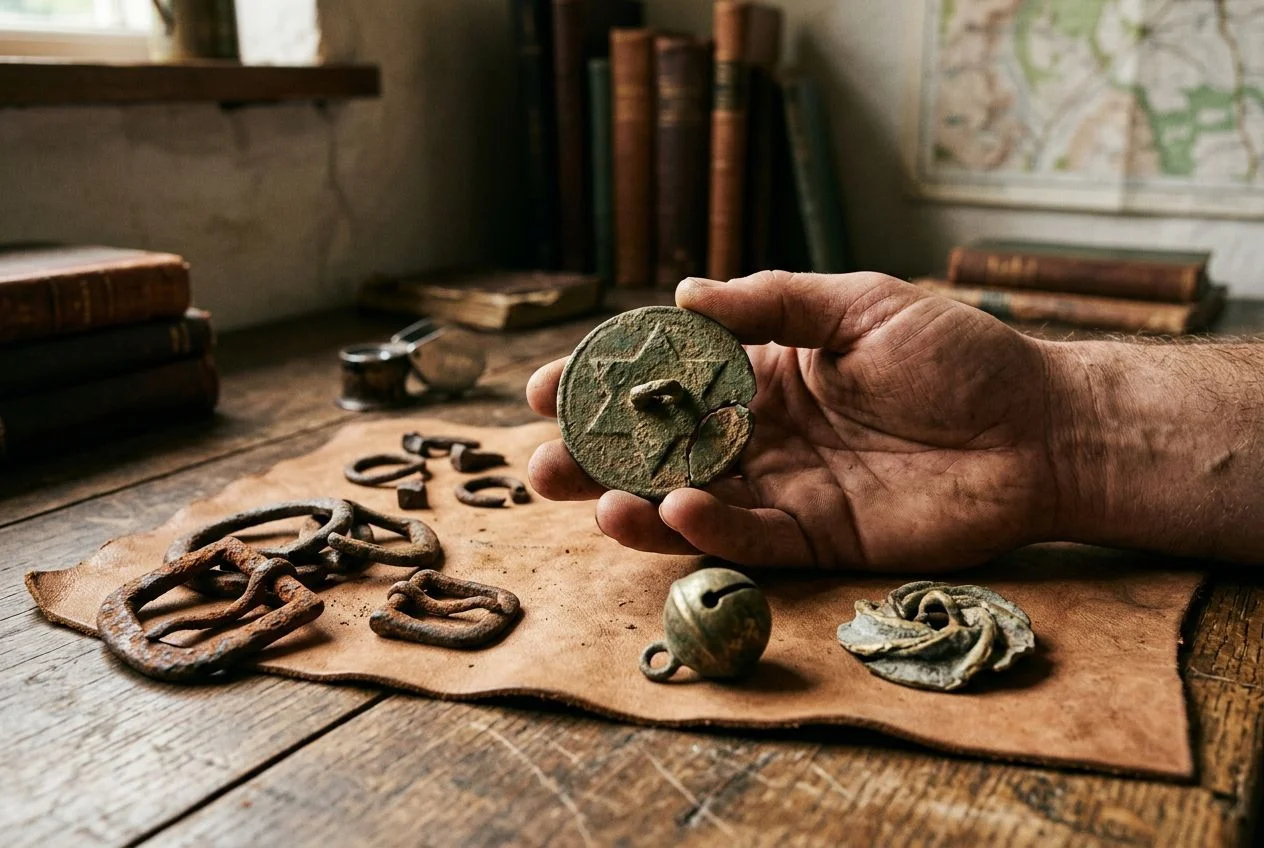
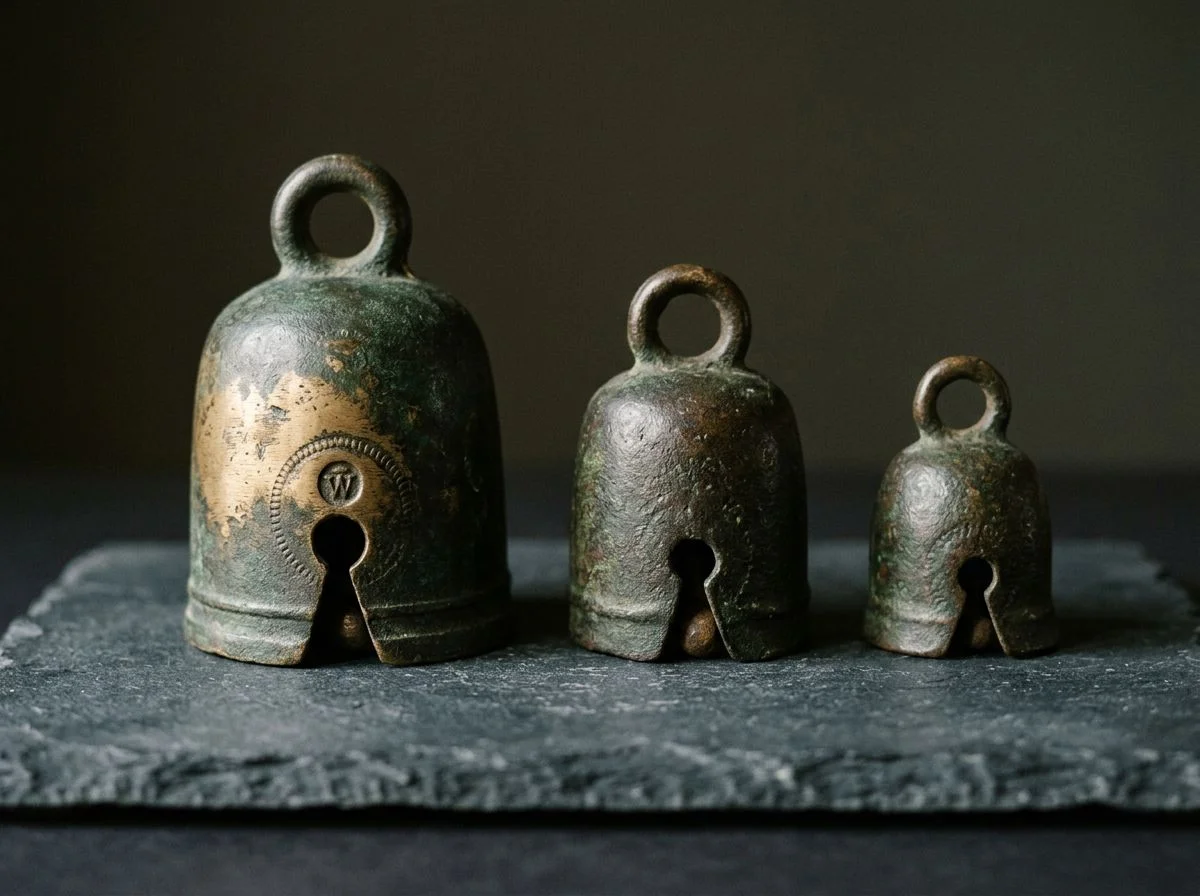
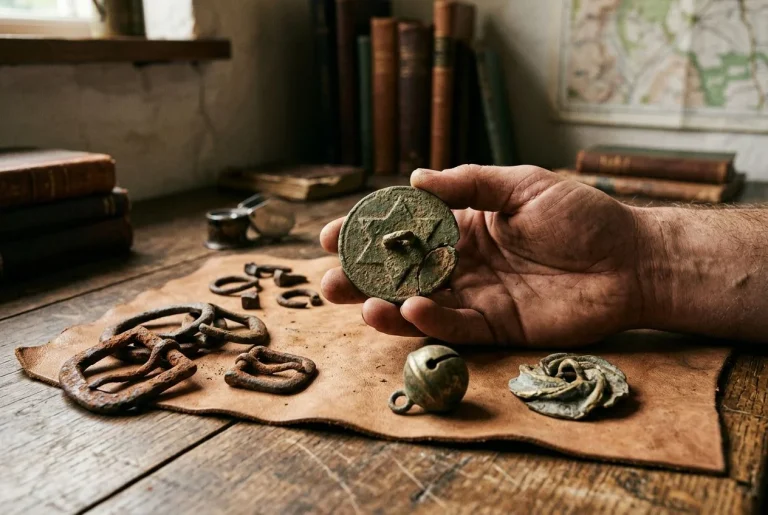
Then consider function. Bridle rosettes sat where the crown piece and brow band meet. They often had a domed glass cover protecting a decorative design underneath. Archaeologists recovered exactly this type at Fort McCoy with a faded star heirloom pattern. Buckles tell their own story. Horse harnesses used simpler brass or iron single and double-frame buckles, not the ornate gilded buckles people wore on clothing. Crotal bells, those round rattling bells, add another layer to vintage horse tack identification. One-piece cast examples with drilled suspension loops date from the 16th to mid-17th century. Later production eliminated that drilled loop entirely.
When in doubt, check the back. Lead backing on a rosette, like the half-intact example dug at a Civil War camp in Mississippi, points to 19th-century military use.
Why Horse Tack Hardware Ends Up in the Ground
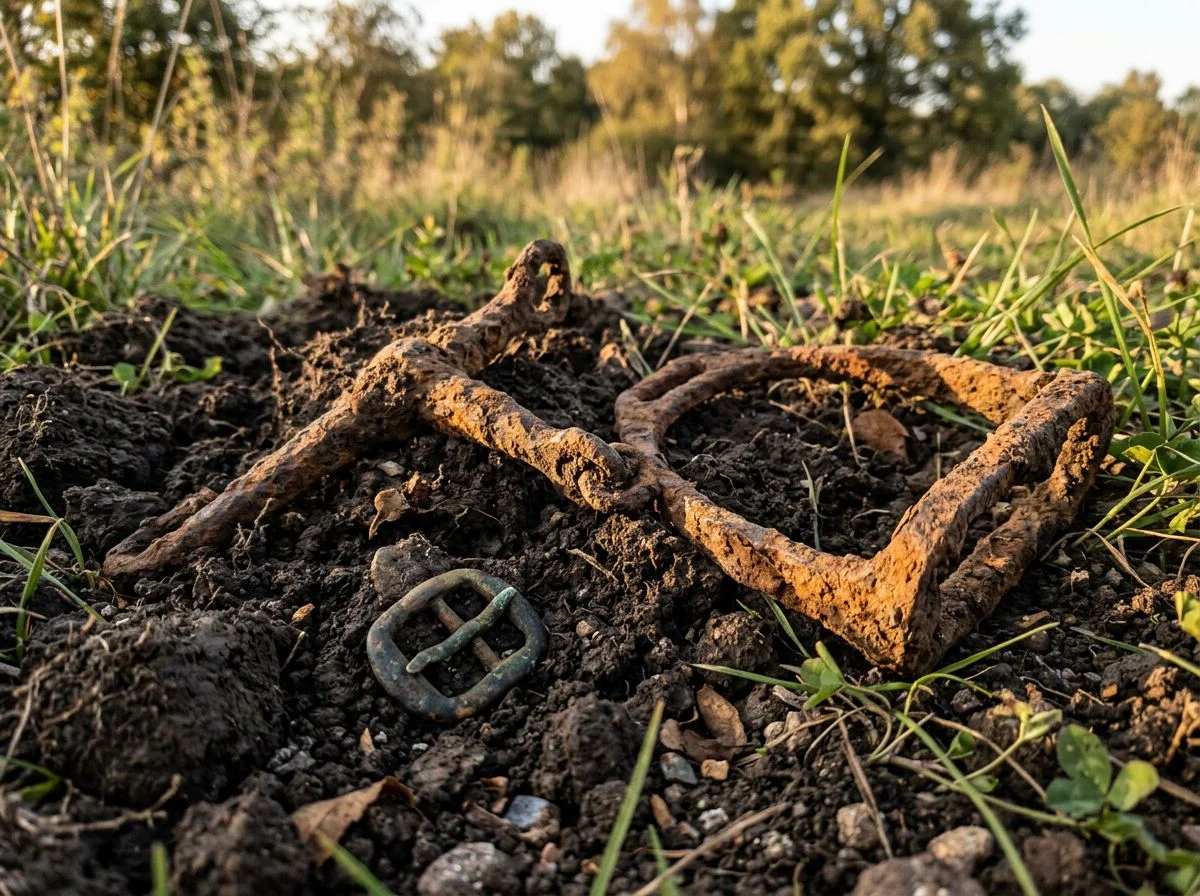
Horse tack hardware is one of the most common finds on old farm sites. The leather rots away, leaving behind the brass, iron, and copper fittings that once held saddles, bridles, and harnesses together. Those scattered buckles, rosettes, and rings are date stamps for your site — if you know how to read them for vintage horse tack identification.
I learned this the hard way at an old farmstead outside Placerville. I’d been working the site for weeks, pulling wheat pennies and a few Indian Heads that suggested late-1800s activity. Then I dug a brass rosette. It was flat, circular, with a worn star pattern and a broken loop on the back. The coins had given me a rough window. That rosette narrowed it. The stamping was crisp, not sand-cast. That put it after 1880. The farm had been active earlier than the coins suggested, and the rosette proved it.
Here’s what most relic hunters miss: horse tack isn’t just “horse stuff.” It’s a timeline. Horse brasses date back to the pre-Roman period, when early amulets were cast in bronze, silver, or gold. But actual brass — the copper-zinc alloy we dig today — wasn’t manufactured in England until Elizabeth I’s reign, between 1559 and 1603. Before 1830, most “brass” horse fittings were actually latten, a brass-like alloy. After 1830, the town of Walsall became the manufacturing hub for vintage horse tack identification. It eventually produced over 2,000 distinct horse brass designs.
So that rosette in your pouch isn’t a consolation prize. It’s often more precise than the coins. Coins circulate for decades. Hardware gets replaced when it breaks. When you find tack at a site, you’re finding the moment someone’s harness failed. And that moment has a date range you can work with.
Buckles, Rings, and Parts That Survive
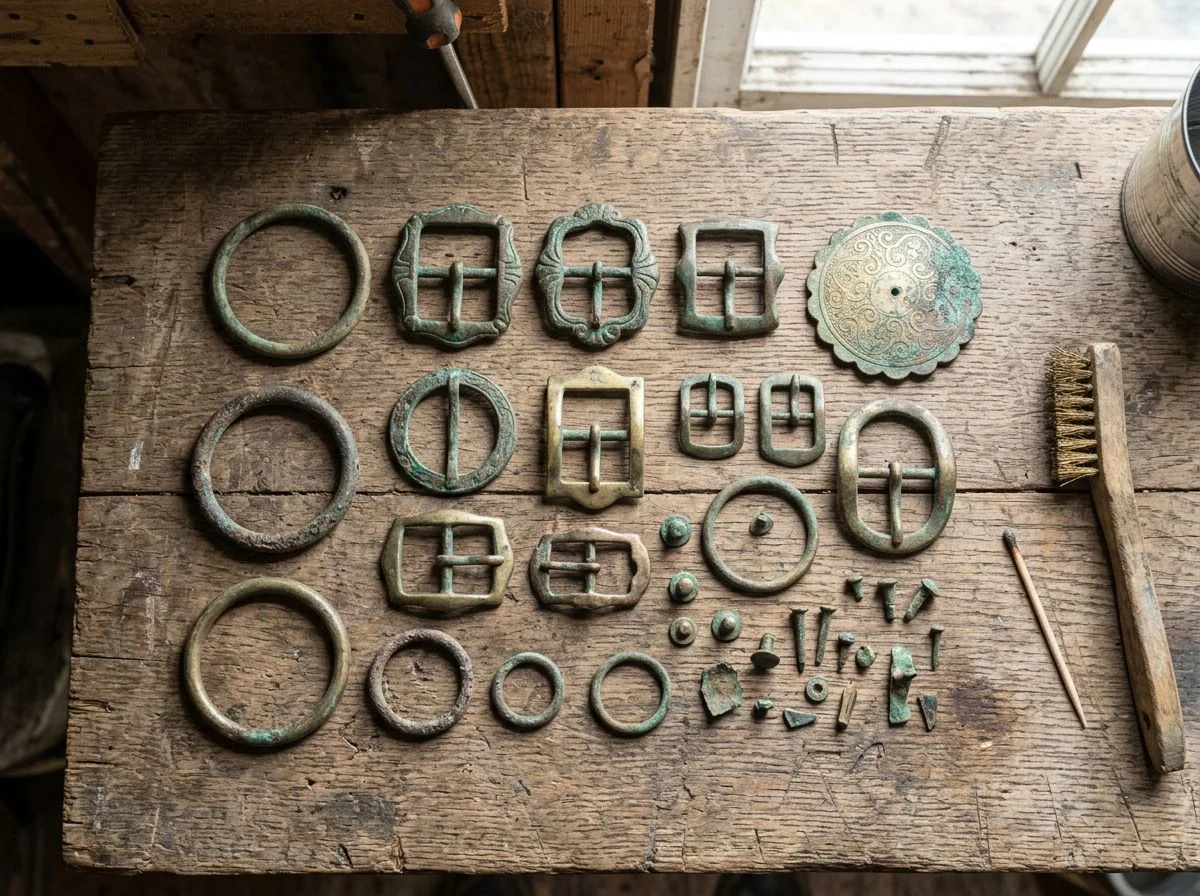
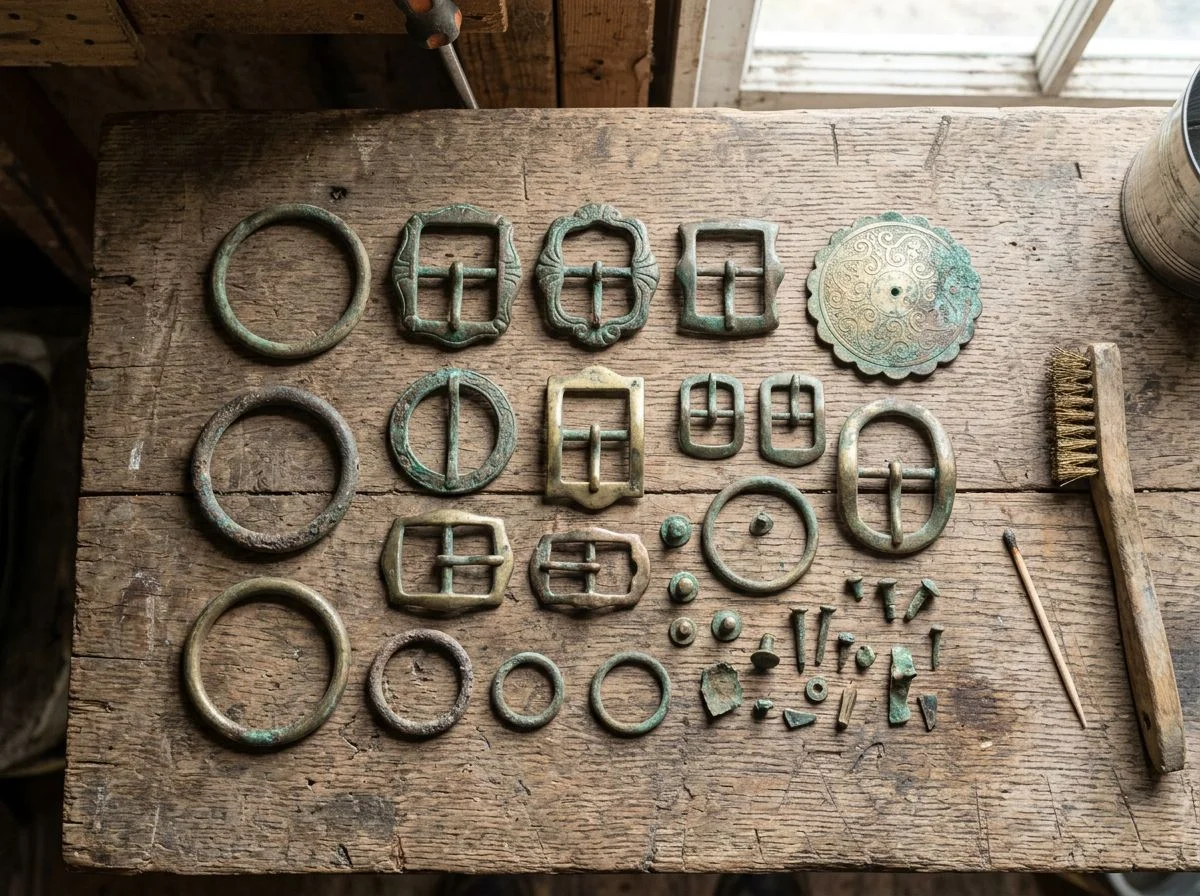
A buckle isn’t just a buckle. Learn the five parts — frame, chape, pin, roll, and tongue — and you can tell a harness buckle from a shoe buckle at arm’s length. Even when it’s half-corroded and caked in dirt.
The frame is the outer ring you see first. The chape is the inner plate that holds everything together. It’s composed of the pin (the pointed bit that goes through the leather hole), the roll (the cylinder the chape pivots on), and the tongue (the bar that rests across the frame). That’s the full anatomy. Once you know it, you stop saying “some kind of buckle thing” and start reading the piece like a maker’s mark.
Here’s the tell that matters most in the field: horse harnesses used simpler brass or iron single and double-frame buckles, not the ornate gilded buckles people wore on clothing. Clothing buckles — especially the fancy girdle and stock buckles popular in the 1700s — got decorative treatment. Harness buckles didn’t. They were load-bearing. They were built to hold a 600kg horse’s pulling force, not to accessorize a waistcoat.
I dug a double-frame buckle at a cellar hole outside Folsom last spring that drove this home. It was brass, heavy for its size, with two rectangular frames sharing a single chape. No decoration, no gilding. Just solid construction. At first I figured it was from a belt or strap. But the double-frame design is the giveaway. That configuration spreads tension across two points. That’s exactly what you need when a horse spooks and suddenly tests every fitting on the harness. A clothing buckle wouldn’t bother with that kind of reinforcement.
The material tells you the rest. If a buckle feels light and brittle, it’s probably zinc die-cast. That’s a modern manufacturing shortcut that fails under load. Solid brass and iron were the working metals. If it’s heavy, it’s old. If it crumbles, it’s junk.
Why Bridle Rosettes Get Misidentified
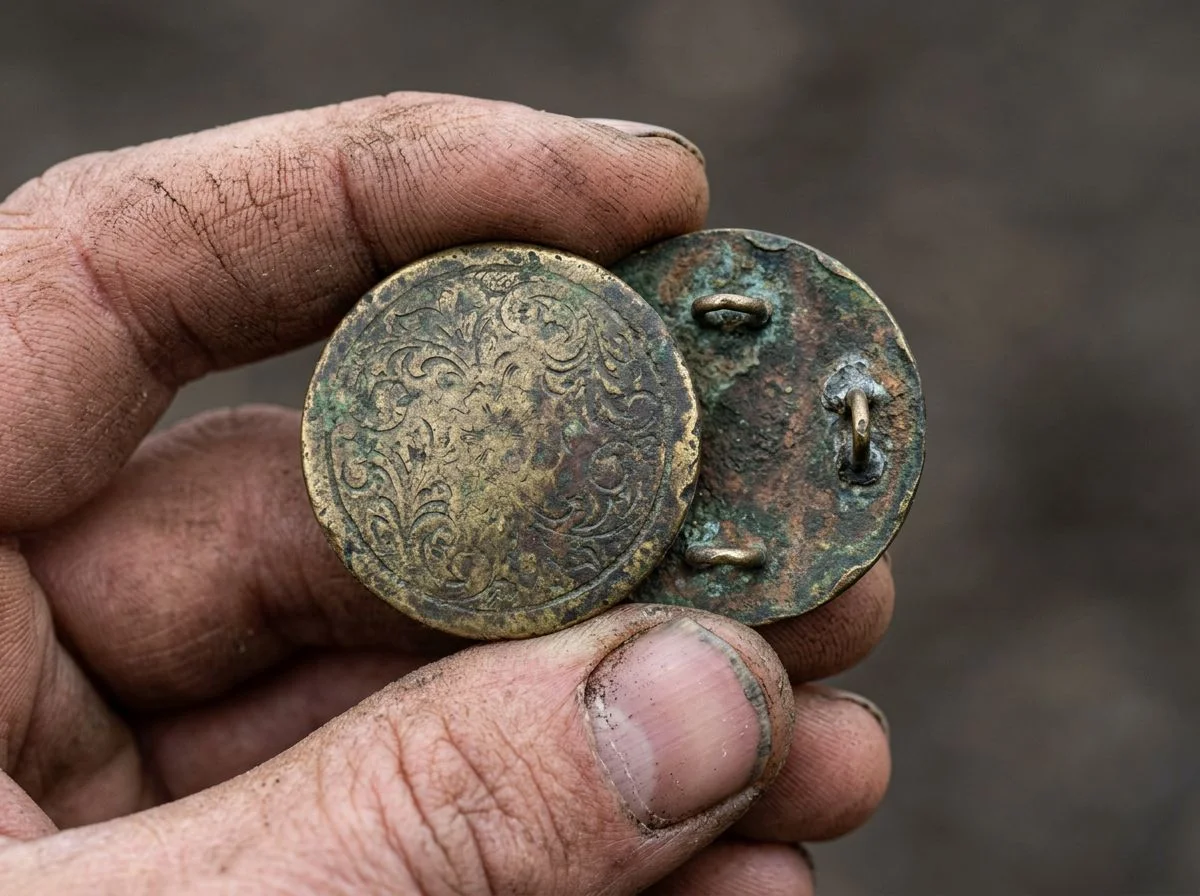
Bridle rosettes are the round, decorative fittings that secured the headstall, crown piece, and brow band together at the sides of a horse’s face. They’re also the tack find most likely to get tossed in the junk pouch by someone who doesn’t know better. Don’t be that someone.
Here’s the thing about rosettes: they were both functional and decorative. That means they got more attention from manufacturers than almost any other piece of tack hardware. A plain buckle could be plain. A rosette was supposed to catch the eye. That’s why you’ll dig rosettes with stamped stars, floral patterns, geometric designs, and occasionally something far more interesting.
In 2015, archaeologists from Colorado State University’s Center for Environmental Management of Military Lands were working a dig at Fort McCoy when they recovered a rosette that stopped the crew. It featured a faded star heirloom design protected beneath a domed glass cover. That’s the kind of piece that tells you someone cared about that horse. They probably showed it off at parades or public events.
The rosette was still recognizable for what it was: a fitting designed to secure the bridle headstall, holding the crown piece and brow band together. Alongside it, the team pulled a portion of leather harness with a brass rivet, a metal harness piece, and a ring from a horse bit. That’s what a complete tack assembly looks like after a century underground. Scattered, but traceable if you know the parts.
Military rosettes are their own category in vintage horse tack identification. They’re where the real collector money sits. A Civil War “USA” intertwined rosette dug at Wyatt’s Crossing, Mississippi — a Union camp active during the 1862 skirmishes — still retained about half its original lead backing. That lead was poured into the back to secure the attachment loop. When you find one with the lead intact, you’ve got a piece that survived exactly as it was mounted. Howard Crouch’s Civil War Artifacts notes this style may have seen artillery usage. That only adds to the story. These aren’t farm tack. They’re battlefield relics.
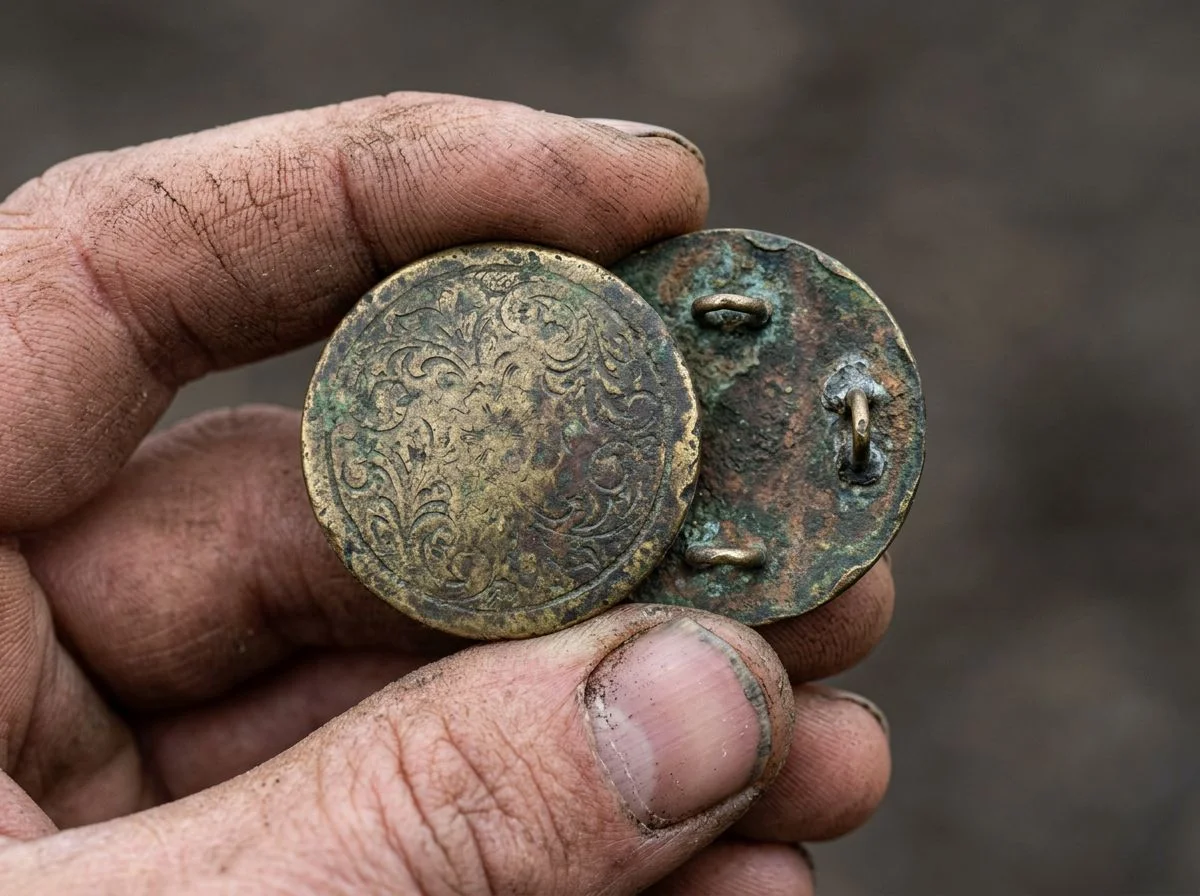
The misidentification problem comes from the back. Most rosettes you’ll dig have a broken loop or a blob of lead where the loop used to be. Without the front design intact, they look like random brass discs. Flip them over. Look for the attachment point. If it’s centered and reinforced, you’re holding a rosette, not a piece of scrap. And if it’s got a star under glass, call your detecting buddies before you call the scrap bucket.
Crotal Bells and Horse-Drawn History
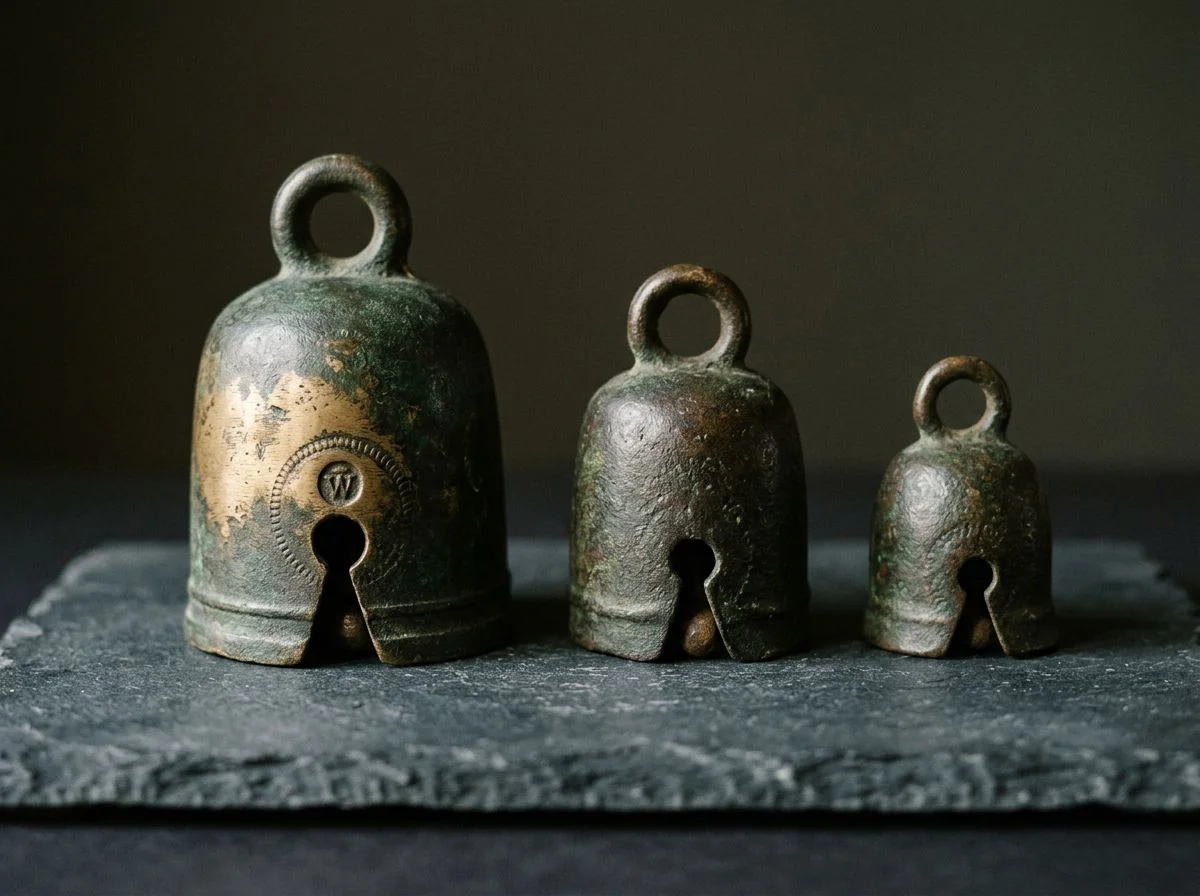
Crotal bells are the round, rattling bells you’ll dig on old farm and road sites. They’re hollow brass spheres with a loose metal “pea” inside that jingles when shaken. They hung from horse harnesses, wagons, and sleighs. They announced a horse’s approach long before it came into view. And unlike a regular bell with an external clapper, a crotal bell’s clapper is sealed inside the chamber. That’s exactly why they still rattle after 200 years in the ground.
Here’s the question that trips up most relic hunters: what makes a crotal bell different from a regular bell? A church bell or school bell has a clapper hanging outside the body. It swings to strike the rim. A crotal bell flips that design. The clapper is a loose metal pellet trapped inside a perforated chamber. The slits cut into the bell’s lower hemisphere let the sound escape while keeping the pellet contained. That’s why you’ll shake a dug crotal bell and hear that distinctive “pea” rattle, even when the bell itself is half-corroded. If you find a bell with no rattle and no visible clapper attachment, you’re almost certainly holding a crotal bell with the pea rusted away or fused to the interior.
The history runs deeper than most people expect. Bells have been in continuous production for over 4,000 years. The earliest examples were cast in China before 2000 BC. But the crotal bell as we know it — a spherical, pea-filled rumbler — shows up much later. The earliest dateable examples come from 9th-century female graves in Gotland, Sweden. They were worn as personal adornments, not yet hung from horse harnesses. By the medieval period, crotal bells had migrated onto animal collars and tack. They stayed there for centuries.
The manufacturing tells are what make crotal bells datable in the field. One-piece cast bells from the 16th through mid-17th century feature drilled suspension loops. The hole at the top was literally bored through the solid cast metal. A 17th-century innovation eliminated that step. Later bells show integrally cast loops with the hole formed during the pour. If you dig a crotal bell with a drilled loop, you’re holding something that predates the English Civil War. The Whitechapel Bell Foundry, established in 1570, was casting bells during this exact transition. It’s still Britain’s oldest manufacturing company. It made Big Ben and the Liberty Bell along the way.
So when you pull a crotal bell from a farm field, don’t just toss it in the finds pouch. Turn it over. Look at the suspension loop. Shake it. That little brass sphere just told you whether a horse was pulling a cart down that road in 1650 or 1850.
What Horse Brasses Tell You
Horse brasses are the decorative plaques that hung from draft and cart horse harnesses. They’re among the most collectible tack finds you’ll pull from the ground. Pre-Roman examples were bronze, not brass. True brass casting for these pieces only took off in England during Elizabeth I’s reign (1559–1603). Latten — a brass-like copper-zinc alloy — was used before 1830. After that, Walsall became the manufacturing hub. It eventually produced over 2,000 distinct designs.
Here’s the comparison that matters when you’re holding a dug example. A collector-grade horse brass that spent its life on a pub wall or in a display case retains crisp detail, even patina, and a readable back stamp. A ground-dug brass tells a different story. Soil chemistry attacks the zinc in the alloy. The surface gets pitted. The once-sharp design softens into something that looks almost melted. The loop on the back — where the leather strap passed through — is often the first part to corrode away entirely.
I’ve dug brasses that were identifiable only by their outline and a ghost of the central motif. A star, maybe. A horse’s head, if I squinted. That’s the reality of collecting horse brasses from farm fields: the ground takes its cut.
Value drops accordingly. A clean Victorian brass with a documented design might bring £10–£30 at auction. The same brass pulled from three inches of acidic soil? Maybe a few dollars to a collector who wants a “dug example” for a relic display. The Christie’s London sale in January 2009 moved a collection of Victorian and later brasses for £625. That included an 1882 ploughing prize brass and an 1887 jubilee brass. It represented the top end of the market. Those pieces had survived with their detail intact. That’s exactly what the ground rarely allows.
That said, dug horse brasses still have value as site markers. A latten brass with a pre-1830 manufacturing tell dates your field more precisely than most coins will. The story is in the corrosion.
Identifying Wrought Iron Bits and Stirrups
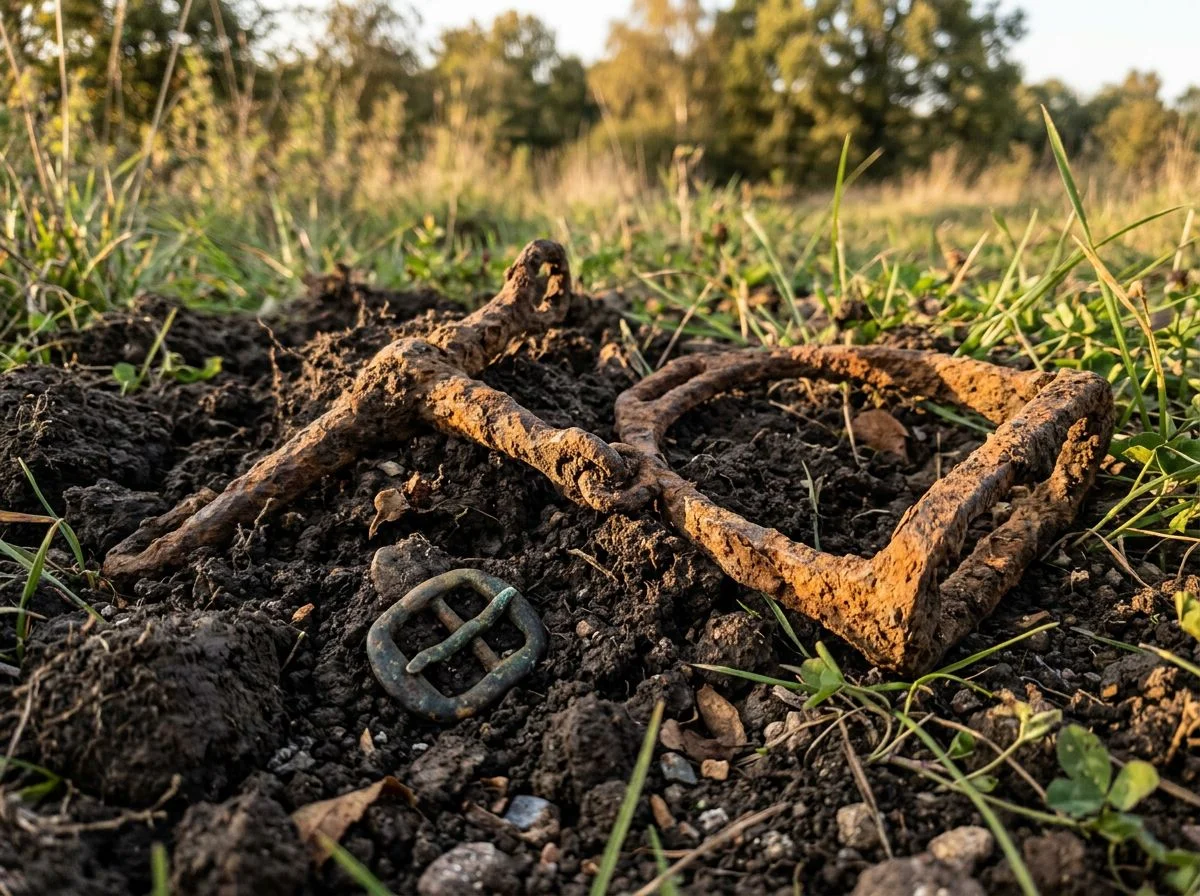
Iron horse tack is a different identification challenge entirely. The metal corrodes, fragments, and loses its shape in ways brass never does. The Historic Jamestowne collection shows exactly what you’re up against. Alongside an early 17th-century iron curb bit, archaeologists recovered 12 stirrups including matched pairs. They also found two saddle parts known as iron gullets. But those are the success stories. The same site yielded thousands of iron straps so fragmented, bent, or broken that researchers couldn’t say with certainty whether they came from horse tack, wagon fittings, or building hardware.
That’s the core problem with iron. A brass rosette keeps its shape. An iron strap doesn’t. After 400 years in poor soil conditions, what you dig is often a curved sliver of rust. It might be a stirrup fragment. It might be a barrel band from a 17th-century well. The Jamestowne archaeologists are honest about this. Iron strapping had many different uses in the period. Without surviving leather or wood attached, the metal alone often can’t tell you what it originally did.
So when you pull a heavily corroded iron piece from an old site, here’s my advice. First, look for any surviving functional feature. A stirrup’s tread plate, a bit’s cheek ring, the distinctive curve of a gullet plate. Those shapes are diagnostic even when the metal is rough. Second, note the context. Iron fragments scattered around a barn foundation or along an old road bed are more likely tack-related than the same fragments found near a domestic hearth. Third, don’t force an identification. Some iron is just iron. If you can’t match it to a known form, label it “wrought iron fragment, possible tack” and move on. Better to leave a mystery open than to call a barrel hoop a stirrup and build a false history on top of it.
Dating Vintage Horse Tack Identification Finds
Dating horse tack hardware comes down to reading manufacturing shifts. The small changes in alloy, casting method, and construction detail pin a piece to a specific era. Get those tells down and you’ll date most finds within a generation or two.
Alloy is your first clue. Before 1830, British makers used latten — a brass-like copper-zinc alloy that behaves differently in the ground than true brass. Latten corrodes with a distinctive gray-green crust. It tends to be softer and more porous. True brass, which took over after 1830, holds its shape better. It develops that familiar golden-brown patina. If you’re holding a harness boss or rosette with a silvery-gray surface, you’re likely looking at pre-1830 latten. If it’s yellow brass with crisp edges, it’s almost certainly later.
Manufacturing method narrows it further. Horse brasses were traditionally sand-cast. That leaves a slightly rough, granular texture on the back and soft interior corners. Around 1880, the fly press stamping method arrived. It’s a dead giveaway when you see it. Stamped pieces have sharp, uniform edges, a smooth back, and often a slightly domed face where the metal was pressed into a die. Sand-cast pieces feel heavier and thicker. Stamped pieces are lighter, more uniform, and show no casting porosity. I’ve pulled two nearly identical star-pattern brasses from the same farm field. One was sand-cast, one was stamped. The stamped one dated the site’s later occupation phase without me digging a single coin.
Construction details can be even more precise. Take crotal bells, those round harness bells with the slit in the bottom. One-piece cast bells from the 16th to mid-17th century feature a drilled suspension loop. You can see the circular drill mark passing through the top. The 17th-century innovation eliminated that step by casting the loop integrally. No drill marks appear. That single detail separates a 1600s bell from a 1700s one at a glance.
And here’s the humbling part: sometimes you get too much context. The 2021 investigation at the Sylta burial ground in Sweden recovered over 500 iron objects. Decorated fittings, spurs, bits, harness components. They came from graves where horses had been cremated with their harnesses still attached. A thousand years in the ground, and the stylistic cohesion of those pieces told archaeologists they were looking at a localized “horse costume,” not random equipment. When you’re dating your own finds, that’s the principle. One piece gives you a date range. A cluster of pieces from the same site gives you a story.

My name is Paul and I am the founder of Detector For Metal, a dedicated resource for metal detecting enthusiasts seeking to uncover historical treasures and connect with the past using the latest technology. As a stay-at-home dad and family man, I’ve found metal detecting to be the perfect hobby that combines family adventure with historical learnings for the whole family.
As a father, I’m deeply committed to passing on this hobby to the next generation of detectorists, starting with my own children. I share advice on everything from metal detecting with kids to exploring the top 10 metal detecting sites you never thought about. My methodical approach to the hobby goes beyond the thrill of discovery—it’s about creating family traditions while preserving history and sharing the stories of those who came before us.