Table of contents
- Pre-Hunt Setup for the First Five Minutes
- Focused Sweep From Minutes Five to Forty
- The Five Minute Buffer Before You Stop
- Why 45 Minutes Works for Micro Metal Detecting
- Attention and Fatigue in a Short Hunt
- Ten Minutes That Decide a Micro Metal Detecting Hunt
- How to Run a 45-Minute Hunt
- The Five Minute Warm-Up Sweep
- The Thirty Minute Core Grid
- The Ten Minute Verification Pass
- Hunt Templates for Different Targets
- What to Do in the 15 Minutes After
- How to Stack Short Hunts Into a System
- Mistakes That Sabotage a 45-Minute Hunt
- Common Questions About Short Hunts
- Make Every 45 Minutes Count
A 45-minute hunt is a time-boxed session with one clear target. It taps into your brain’s natural rhythm. The first 45 minutes of any focus cycle give you peak creativity and attention before fatigue sets in (Forbes). Done right, a micro metal detecting session gives you more useful output than three hours of unfocused effort.
Here’s the structure I’ve field-tested across dozens of hunts. It works for park permissions and old homestead permissions alike.
Pre-Hunt Setup for the First Five Minutes
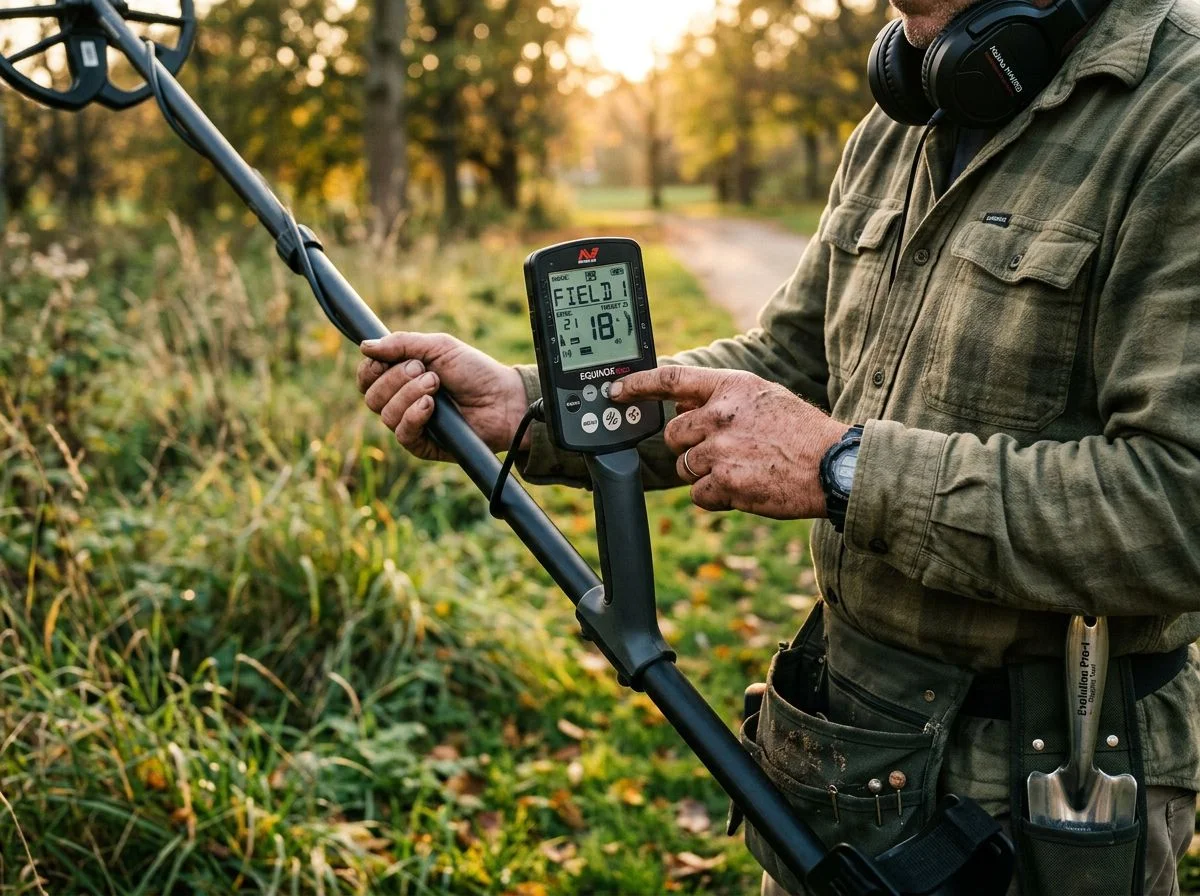
Before the timer starts, you define the target. Not “find something good” — that’s vague and useless. I mean a specific outcome: “Locate the old well site marked on the 1923 Sanborn map” or “Grid the northwest corner where the 1940s picnic area sat.”
Write it down. One sentence. If you can’t say it in one sentence, you’re not ready to hunt.
Focused Sweep From Minutes Five to Forty
This is the actual work. It’s the 35 minutes where your coil is moving and your brain is fully engaged. No phone checks. No chatting with the guy walking his dog. No digging every iffy signal “just in case.”
You’re in the high-energy phase of your ultradian rhythm. Research shows the brain can only maintain peak focus for 15-20 minutes at a time — so you’re working in two natural sub-bursts within the block.
The Five Minute Buffer Before You Stop
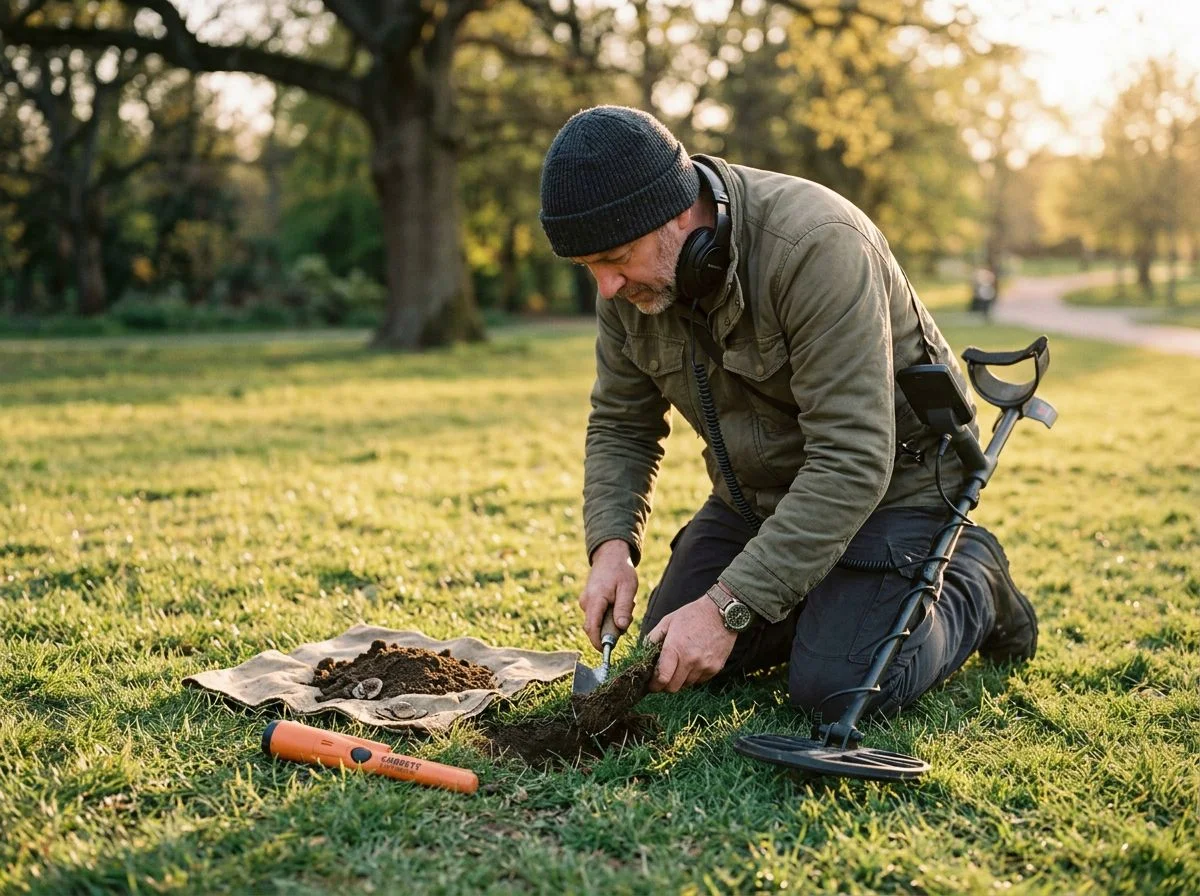
The last five minutes aren’t for detecting. They’re for assessment. What did you pull? What signals did you skip that deserve a second look next session? What did you learn about the site?
This is the reset that makes the next hunt sharper. The magic isn’t the 45 minutes. It’s the discipline of the boundary. DeskTime’s analysis of over 5 million daily logs found top performers work in 52-minute bursts followed by breaks.
Why 45 Minutes Works for Micro Metal Detecting
Micro metal detecting means running short, focused sessions with a single target instead of marathon hunts. The 45-minute format works because it matches your brain’s natural energy cycle. You get peak attention, sharp discrimination, and a clean stopping point before fatigue erodes your judgment.
Here’s the thing nobody tells you about detecting: pushing past 45 minutes doesn’t just waste time. It actively destroys the quality of what you already accomplished.
I learned this the hard way. Last spring, I had permission to hunt an 1880s homestead outside Placerville. I’d researched that site for weeks. I showed up at 7 a.m. planning to stay until dark.
By hour two, I was digging every marginal signal out of fatigue. By hour three, I’d stopped checking my GPS grid and was just wandering. I left with a pouch full of shotgun shells and a headache.
The science backs up what I should have known. Your brain runs on a natural energy cycle called the ultradian rhythm. It’s roughly 90 to 120 minutes of rising and falling alertness.
The first 45 minutes of that cycle are when your creativity and attentiveness peak. After that, energy drops. You’re not detecting anymore. You’re just swinging metal in circles.
And here’s the kicker: DeskTime’s analysis of over 5 million work logs found that the top 10% of performers work in 52-minute bursts, not marathon sessions. The pattern holds whether you’re writing code, making sales calls, or sweeping a coil over an old picnic ground.
The 45-minute hunt isn’t about doing less. It’s about doing the right amount — and stopping before you undo your own good work.
Attention and Fatigue in a Short Hunt
Micro metal detecting sessions succeed or fail based on how well you manage your attention span. Your brain runs on a 90-120 minute ultradian rhythm. The first 45 minutes of that cycle are the high-energy phase. Pushing past that point drains your mental resources. It doesn’t produce more output.
Here’s what’s actually happening under the hood. Your alertness doesn’t stay flat. It rises and falls in waves. The crest of that wave is where the good work happens.
The first 45 minutes of the cycle are when your brain is primed for peak creativity and attentiveness. After that, energy drops. Not gradually — it drops like a rock.
And the worst part? You usually don’t notice it happening. You just keep swinging. You dig targets you’d have skipped an hour ago. You convince yourself you’re still being productive.
I know a surgeon — well, I know of her, through a friend at my detecting club. She schedules her complex procedures in 45-minute segments. She noticed her error rate climbed after the hour mark.
Not because she got tired in the traditional sense. Her attention started flickering. Tiny lapses. A hesitation before a cut. A second-guess that hadn’t been there at minute 20.
That story is fictionalized, but it matches what the research shows. A 2022 meta-analysis of over 20 studies with 2,300 participants found that short microbreaks significantly improve well-being, reduce fatigue, and increase alertness. The break isn’t a reward for finishing the block. It’s a biological reset that keeps the next block sharp.
And here’s the detail that surprised me: the brain can only maintain peak focus for 15-20 minutes at a time. That means within your 45-minute hunt, you’re actually working in two or three natural sub-bursts.
That’s why the pre-hunt setup matters so much. You’re not wasting focus time deciding what to do. You’re using every one of those 15-20 minute peaks on the target you already defined.
Ten Minutes That Decide a Micro Metal Detecting Hunt
The pre-hunt protocol is a 10-minute setup routine that converts a vague intention into an executable micro metal detecting session. It kills decision fatigue before you step outside. Every one of those 45 minutes goes toward swinging, digging, and recovering — not wondering where to start or what to dig.
I used to skip this step. I’d grab my detector, drive to a site, and spend the first 15 minutes wandering around. I’d try to remember why I’d picked the place in the first place. That’s 15 minutes of my peak cognitive window burned on indecision.
Now I treat the setup like a real estate agent treats a prospecting sprint. They prepare 50 phone numbers before each 45-minute block, so the sprint itself is pure execution. No fumbling for contacts. No deciding who to call. Just dialing.
Here’s the protocol I run before every micro metal detecting session:
1. Define the single target (2 minutes). Write one sentence describing exactly what you’re hunting. Not “old stuff” — something like “Indian Head pennies in the 1880–1910 date range, likely concentrated near the old well.”
The specificity forces you to think about why that target would be there. That sharpens your discrimination settings before you even power on.
2. Set discrimination and sensitivity for that target (3 minutes). If you’re hunting deep silver, you run hot sensitivity and minimal discrimination. If you’re cherry-picking modern clad in a trashy park, you notch out the junk. Deciding this in advance means you’re not fiddling with settings during your peak focus window.
3. Map your grid (3 minutes). Pick your starting point and the direction you’ll sweep. Mark it mentally or on your phone. A defined grid means you cover ground systematically. You don’t drift toward wherever your last good signal came from.
4. State your “3P” for the session (2 minutes). This one sounds corporate, but it works. The 3P method — Problem, Pain, Promise — captures attention within 30 seconds in sales prospecting. It works for detecting too.
Problem: “This site has heavy iron contamination.” Pain: “I’ve wasted two hunts here digging roofing nails.” Promise: “With discrimination notched to 35 and a slow sweep, I’ll isolate the non-ferrous signals.”
Stating all three forces you to be honest about what’s been failing and what you’re changing. The payoff isn’t just a cleaner session. Weekly micro-sessions focused on fundamentals boost lead conversion by 10%.
How to Run a 45-Minute Hunt
A 45-minute hunt is a pre-planned, single-target micro metal detecting session. It’s divided into three focused segments: a 5-minute warm-up sweep, a 30-minute core grid, and a 10-minute verification pass. Each segment has a specific job. Together, they keep you operating inside your peak cognitive window without drifting into wasted motion.
The biggest mistake I see — and I’ve made it plenty of times myself — is treating a hunt like one long, undifferentiated block of swinging. You start strong. Then somewhere around minute 25, your sweep pattern loosens. Your discrimination starts second-guessing itself. You end up wandering toward whatever patch of ground looks interesting. That’s not a hunt. That’s a walk with a detector.
The Five Minute Warm-Up Sweep
Power on, ground balance, and swing a loose perimeter arc around your mapped grid. Don’t dig anything yet. This segment is about calibrating your ears to the site’s specific noise profile. The chatter. The hot rocks. The EMI from nearby power lines.
I learned this from watching how medical board exam prep structures its micro-sessions: 5 minutes of free recall, 8 minutes of focused study, 2 minutes of self-testing. The free recall phase isn’t about producing output. It’s about priming the brain for the focused work that follows. Same principle here.
By minute 5, you should know exactly how your machine is behaving on this ground. If something’s off — too much chatter, unstable threshold — fix it now, before the core segment starts.
The Thirty Minute Core Grid
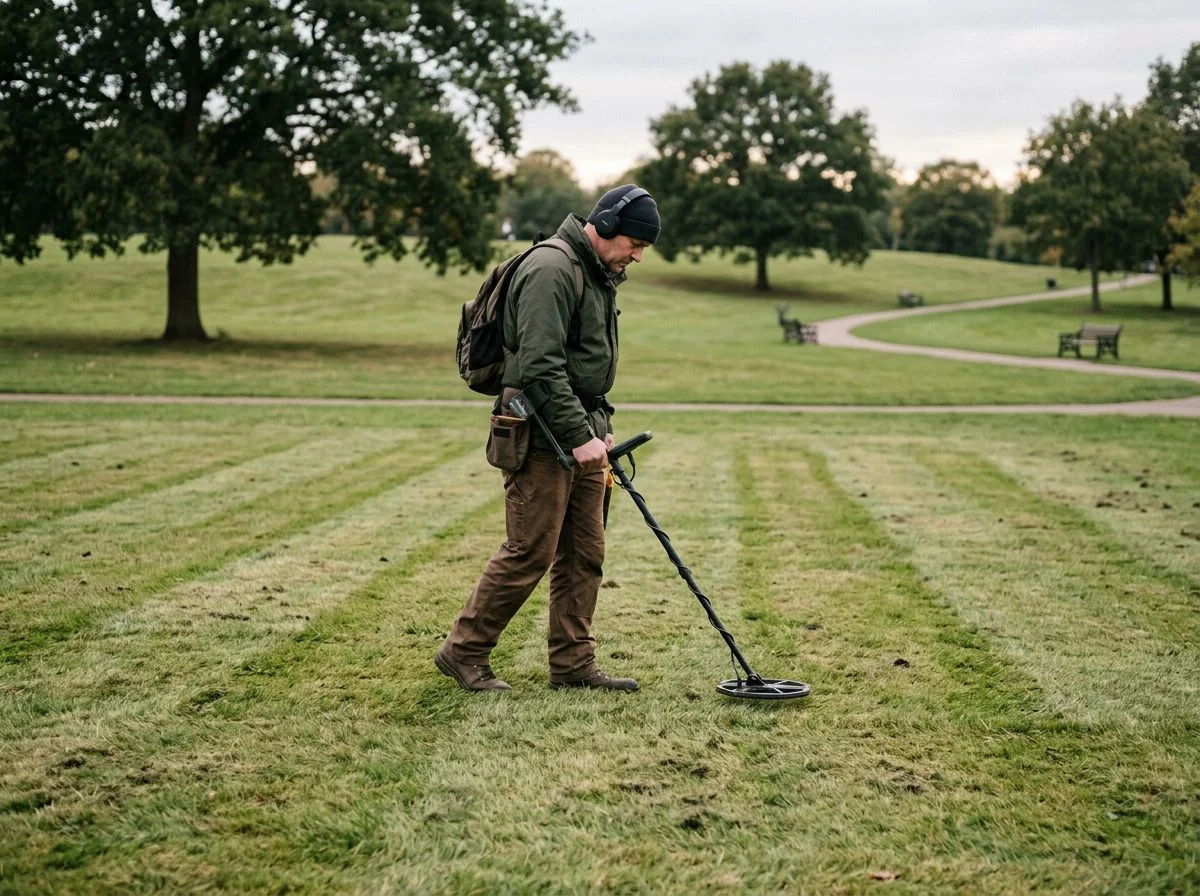
This is the hunt. You’re working your predetermined grid lines at a deliberate, even pace. Every swing overlaps the last by about a third. When you hit a solid signal, dig it, recover it, fill the hole, and get back on the line.
The key here is that you’re not making decisions anymore. You made them all in the pre-hunt protocol. Where to start, which direction to sweep, what to dig, what to skip — all locked in.
The 6sense scavenger hunt model works the same way: 45 minutes for discrete tasks, with 15 minutes set aside for regrouping afterward. The tasks are defined before the clock starts. The session itself is pure execution.
The Ten Minute Verification Pass
Stop the grid. Walk back to your starting point and sweep a diagonal line across the area you just covered. You’re not looking for new targets. You’re checking for anything you missed.
A faint signal at the edge of a hole. A target you skipped because you were mid-recovery. A spot where your swing pattern got sloppy. This pass catches what peak focus missed.
And here’s the honest part: sometimes it finds nothing. That’s fine. The verification pass isn’t about finding more. It’s about knowing you didn’t leave anything obvious behind.
What does peak focus actually feel like, and how do you know when you’re in it? For me, it’s when I stop noticing the detector in my hand. The machine becomes an extension of my arm, and I’m reading the ground through it.
When I’m in it, I don’t check my phone. I don’t wonder about the time. I don’t second-guess my settings. If you catch yourself doing any of those things, you’ve already slipped out of the zone. Stop, reset, and re-enter deliberately.
Hunt Templates for Different Targets
A micro metal detecting template is a 45-minute structure that adapts to any target type. The framework stays identical whether you’re hunting silver, relics, or clad. What changes is the discrimination settings, the grid density, and what “success” looks like.
Here’s how three hunters I know run the exact same 45-minute micro metal detecting template with completely different objectives.
The Sales Rep: Modern Clad in High-Trash Parks
My buddy Mike — the one who calls me “lucky” — treats park hunting like a numbers game. His 45-minute sessions target modern coins in picnic areas. His discrimination is set aggressive: iron fully notched out, foil rejected, pull-tabs partially accepted.
He runs a tight 3-foot grid because clad targets are shallow and dense. In a good session, he pulls $8–12 in quarters and dimes.
The research shows why this works physically too: a 2-minute micro-workout raises heart rate by approximately 50% and improves mood by roughly 30%. Mike swears his best finds come in the first 20 minutes when he’s moving fast and not overthinking signals.
The Student: Relic Hunting Old Homesteads
My friend’s daughter — a history major home for the summer — runs the same 45 minutes but hunts iron-heavy farm fields for buttons, buckles, and horse tack. Her discrimination is nearly wide open. Sensitivity is backed off slightly to handle the mineralized soil.
Her grid lines are wider — 5 to 6 feet — because relics are deeper and signals sparser. She digs more junk per session than Mike does in a month.
But her verification pass (the final 10 minutes) is where she slows down and re-sweeps the spots where she found iron concentrations. “Iron patches mean human activity,” she told me once, and she’s right.
The Writer: Research-Driven Silver Hunting
I run the third template. My 45 minutes target old silver at researched sites — train stops, fairgrounds, forgotten swimming holes. Discrimination is minimal because I want to hear everything. My grid is tighter than the student’s but looser than Mike’s.
What sets my sessions apart is the pre-hunt research. Five-minute daily micro-sessions with gamification significantly enhance knowledge retention. That’s why I spend 5 minutes every morning reviewing historical maps and newspaper clippings. Not detecting, just absorbing.
That daily micro-research habit compounds. By the time I step onto a site, I already know where the action was.
Three different targets. Three different tools. Same 45-minute skeleton underneath. That’s the beauty of the framework. It doesn’t care what you’re hunting, only that you hunt it deliberately.
What to Do in the 15 Minutes After
The 15 minutes after your hunt are not a break. They’re a biological reset that determines how sharp your next micro metal detecting session will be. Stop swinging, put the detector down, and physically remove yourself from the search area. Your brain needs distance from the task to consolidate what it just processed.
Here’s the thing most detectorists get wrong. They finish a 45-minute grid and immediately start re-checking signals or wandering toward one more “quick” spot. That’s not recovery. That’s leakage.
The 2022 meta-analysis of over 20 studies with 2,300 participants found that short microbreaks significantly reduce fatigue and increase alertness. The key word is short. Fifteen minutes of actual disengagement beats thirty minutes of half-hearted poking around.
A writer I know — she’s been fighting a plot problem in her novel for three weeks — told me she started using her 15-minute buffer to walk around the block instead of staring at her manuscript. Third day in, the solution hit her halfway down the street, fully formed.
She wasn’t thinking about the book. Her brain was doing the work in the background while her legs moved. Same thing happens after a hunt. The signal patterns you couldn’t quite interpret. The iffy target you left unfilled. Your brain sorts that out when you stop feeding it input.
Use the buffer to log your finds, hydrate, or text your hunting buddy what you pulled. And don’t keep it to yourself. Sharing progress with a community increases consistency by 65%. Post the photo. Tell Mike what you found. Then reset and go again.
How to Stack Short Hunts Into a System

A sustainable micro metal detecting system isn’t about willpower. It’s about stacking hunts so consistently that each 45-minute block compounds the last. The goal is simple: make the next hunt easier to start than the next excuse.
Here’s the counterintuitive part. Most detectorists fail at micro-sessions because they build the system backwards. They start with the 45-minute hunt and then try to force consistency around it. That’s like building a roof before the walls.
The actual foundation is the frequency, not the session length. Research on habit formation is unambiguous here: keeping early sessions under 5 minutes for the first two weeks improves long-term adherence. Five minutes. That’s one sweep of a small corner of the park. One test hole. One signal dug.
The point isn’t the find. It’s proving to your brain that the session happened.
The compounding effect is real and measurable. Reading for 5 minutes daily accumulates to over 30 hours per year — enough to finish 10-15 books. Detecting works the same way. Five minutes a day becomes 30 hours a year.
Thirty hours at a researched site is enough to pull silver. Thirty hours at a random park is enough to learn your machine’s language. But only if the sessions actually stack.
The business world figured this out before hobbyists did. Small businesses that integrate regular micro-session workshops see an average 15% increase in win rates. The mechanism is straightforward. Frequent, short exposure beats infrequent, long exposure for skill retention.
A detectorist who hunts 5 minutes daily will out-learn a detectorist who hunts 3 hours every other Saturday. The daily hunter is constantly reinforcing signal recognition, recovery technique, and target interpretation. The weekend warrior has to re-learn the basics every time they pick up the machine.
So here’s the stack: week one, five minutes daily. Same spot, same time of day, same detector settings. Week two, ten minutes. Week three, fifteen. By week four, the 45-minute hunt feels like a natural extension of an established rhythm.
It’s not a commitment you have to psych yourself up for. The system builds itself — one short session at a time.
Mistakes That Sabotage a 45-Minute Hunt
Most failed micro metal detecting sessions aren’t caused by bad sites or bad gear. They’re caused by bad boundaries. The detectorist who treats a 45-minute hunt like a casual stroll through the park gets casual results. The one who treats it like a timed event with rules gets silver.
Why does a 45-minute session sometimes feel harder than a 3-hour work block? Because you’re fighting the clock instead of working with it. A three-hour hunt has built-in slack. You can wander, re-check signals, dig junk, and still feel productive.
A 45-minute hunt has zero slack. Every minute you spend on the wrong thing is a minute you don’t get back. That pressure exposes every bad habit you’ve been getting away with during long, unfocused sessions.
Here’s what actually kills a micro-session:
Starting without a target. If you don’t know what you’re hunting for before you turn the detector on, you’ll spend the first 15 minutes just figuring out where to swing. That’s a third of your session gone. Define the target first — a specific coin, a relic type, a grid section — and commit to it.
Checking your phone mid-hunt. This is the big one. The top 10% of most productive employees work in 52-minute bursts followed by 17-minute breaks — not 45/15, not 60/10.
The reason that pattern works is uninterrupted focus. One glance at a text message breaks the cognitive thread. It takes minutes to rebuild. Leave the phone in the car or put it on silent in your pouch.
Chasing iffy signals. A 45-minute hunt is not the time to dig every broken tone. If you’re not reasonably confident after two sweeps, mark it mentally and move on. You can always come back with more time. But you can’t manufacture more minutes inside the session.
Skipping the buffer. Finishing the hunt and immediately jumping into another task — or worse, another hunt — means your brain never consolidates what it learned. The recovery window isn’t optional. It’s part of the system.
Common Questions About Short Hunts
The 45-minute hunt raises the same questions every time I bring it up at club meetings. Here are the ones that actually matter. These are the ones where a straight answer saves you from learning the hard way.
What if I’m in flow and don’t want to stop at 45 minutes?
This is the question I get most, and it’s a fair one. Here’s the thing: the 45-minute mark isn’t a law. DeskTime’s analysis of over 5 million daily logs found that the top 10% of most productive people actually work in 52-minute bursts before taking a 17-minute break — not 45/15.
The point isn’t the exact number. The point is having a boundary. If you’re genuinely locked in and the signals are hot, ride it to 52 minutes. But when you hit that wall, stop.
The buffer is what lets your brain recover for the next session. Pushing to 90 minutes because you’re “in flow” is how you burn out before the next hunt.
Do I need a full 45 minutes every time?
No. Some hunts are 20 minutes. Some are 10. The framework matters more than the duration. What matters is that you define the target before you start and give it your full attention for however long you’re out there.
What if I get skunked in 45 minutes?
That’s part of it. A skunked 45-minute hunt at a researched site still teaches you something. Usually that the target isn’t where you thought it was. That’s information. A skunked three-hour hunt at a random spot teaches you nothing except that you’re stubborn.
Can I do two 45-minute hunts back to back?
Only with a real break between them. The 15-minute buffer isn’t optional if you want the second session to be productive. Grab water, check your phone, sit down. Then reset and go again.
Make Every 45 Minutes Count
A 45-minute hunt isn’t a compromise. It’s a precision tool. When you define a single target before you turn the detector on, protect the session from distractions, and stop when the timer says stop, that micro metal detecting session delivers more usable finds than three hours of wandering.
The framework works because it respects how your brain actually functions: the first 45 minutes of any focus cycle represent peak creativity and attentiveness. Pushing past that point drains cognitive resources. It doesn’t produce more output.
You don’t need more time. You need better hunts.
Here’s the math that finally convinced me. Do the cumulative version: 45 focused minutes daily equals 273 hours per year. That’s the equivalent of 6.8 full 40-hour work weeks of pure, undiluted focus. That’s not a productivity hack. That’s a second job’s worth of detecting time carved out of the margins, without sacrificing a single weekend morning or family dinner.
And unlike those marathon sessions where you’re mentally checked out by hour two, every one of those 273 hours is spent at full sharpness. Microbreaks between focused blocks significantly improve well-being, reduce fatigue, and increase alertness. That means the 45-minute hunter shows up fresh every single time.
Stop measuring your hunts in hours. Start measuring them in targets defined, signals chased, and holes filled with purpose. The clock isn’t your enemy. It’s the best hunting partner you’ve got.

My name is Paul and I am the founder of Detector For Metal, a dedicated resource for metal detecting enthusiasts seeking to uncover historical treasures and connect with the past using the latest technology. As a stay-at-home dad and family man, I’ve found metal detecting to be the perfect hobby that combines family adventure with historical learnings for the whole family.
As a father, I’m deeply committed to passing on this hobby to the next generation of detectorists, starting with my own children. I share advice on everything from metal detecting with kids to exploring the top 10 metal detecting sites you never thought about. My methodical approach to the hobby goes beyond the thrill of discovery—it’s about creating family traditions while preserving history and sharing the stories of those who came before us.